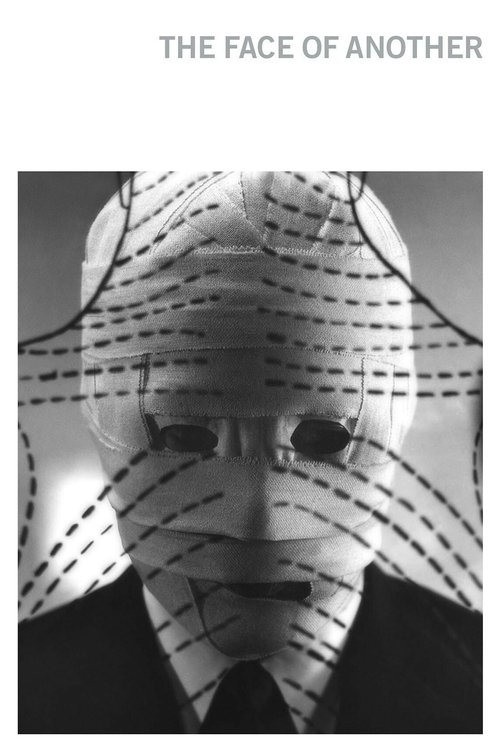
The Face of Another
1966 · Hiroshi Teshigahara
When you want a film to chew on for days — an eerie, brainy midnight movie for a night when you're up for a challenge rather than comfort.
What it's about
An engineer whose face was destroyed in an industrial accident commissions a perfect lifelike mask from a psychiatrist who is far more interested in the experiment than the cure. As the businessman tests his new face on the world — and on his own wife — the mask begins to rewrite the man wearing it, and a parallel story follows a young woman whose scarred face carries the memory of the atomic bomb.
The experience
Cold, hypnotic, and deeply unsettling — less a thriller than a philosophical experiment you watch with mounting unease. It's slow-burning and cerebral, the kind of film that gets under your skin precisely because it never raises its voice.
Performances
Tatsuya Nakadai plays a man estranged from his own reflection with chilling precision, letting the mask liberate something in the character that bandages had hidden.
The craft
The psychiatrist's clinic — glass walls etched with anatomical diagrams, disembodied ears floating in space, designed with avant-garde architect Arata Isozaki — remains one of the great film sets of the 1960s, and the stark black-and-white photography turns every close-up into an interrogation. Teru Takemitsu's spectral score deepens the chill; it's a film whose images reward the biggest, sharpest screen you can find.
Why it matters
The centerpiece of Teshigahara's celebrated collaborations with novelist Kōbō Abe, it stands as a high-water mark of Japanese art cinema in the 1960s and a forerunner of every film about faces, surgery, and stolen identity since.
The third of Hiroshi Teshigahara's four collaborations with novelist Kōbō Abe — between Woman in the Dunes and The Man Without a Map — is the coldest and most cerebral: a science-fiction chamber piece about an engineer, played by Tatsuya Nakadai, whose face has been ruined in an industrial accident and who commissions a lifelike mask from a psychiatrist rather more interested in the experiment than the cure. Abe's question is whether a face is a possession or a self, and Teshigahara answers in images: the doctor's clinic, its glass walls etched with anatomical diagrams, disembodied ears floating in space, was conceived with avant-garde architect Arata Isozaki and remains one of the great sets of the 1960s. A parallel story follows a young woman whose face bears a keloid scar from the atomic bomb, quietly grounding the identity games in Japan's postwar disfigurement. Tōru Takemitsu supplies a Viennese waltz that lilts, recurs, and slowly curdles as the mask takes hold.
Reception
Long overshadowed by Woman in the Dunes — the middle sibling of the Teshigahara–Abe collaborations got a cooler reception at home and abroad — it's been steadily reappraised since Criterion's 2007 'Three Films by Hiroshi Teshigahara' box, and plenty of cinephiles now argue it's the trilogy's peak.
How The Face of Another was received, from release to now →
Influences: the films it descends from and the films it influenced
- Pitfall (1962) — The founding Teshigahara–Abe–Takemitsu collaboration that fused Abe's parable of dislocated identity with documentary-textured surrealism, establishing the chamber-allegory grammar The Face of Another later formalizes.
- Eyes Without a Face (1960) — Direct ancestor for the surgical-face conceit: the clinical grafting of a new face onto a patient, filmed with cold documentary poise that lets surreal horror bleed through antiseptic mise-en-scène — Teshigahara inverts it by giving the patient volition over his new mask.
- Woman in the Dunes (1964) — Immediate predecessor from the same authorship cycle: tactile extreme close-ups of skin and matter, an entrapment fable scored by Takemitsu's dissonant sound-design, and Abe's existential-experiment structure carried straight into the clinic.
- The Blood of a Poet (1930) — Ancestor for the surreal iconography of masks, mirrors, and faces detached from selfhood — the poetic-cinema tradition of treating the human face as a plastic, removable object that Teshigahara's mask sequences echo.
- The Cabinet of Dr. Caligari (1920) — Expressionist template for the mad-clinician-in-a-distorted-space: architecture as psychological derangement, the debt Isozaki's disorienting glass-and-anatomy clinic set pays forward into modernist design.
- Vertigo (1958) — Ancestor of the obsessive remaking of a person's face/identity, bound to a circling, waltz-like Herrmann motif — a structural rhyme with Takemitsu's recurring waltz threading Nakadai's reconstruction of self.
- Harakiri (1962) — Sibling via shared craftsmen: Tatsuya Nakadai's controlled interior performance and a Takemitsu score of biwa-scraped austerity, wedded to rigid geometric framing — the same collaborators' formalism in a different key.
- Kwaidan (1964) — Sibling in staging and sound: Takemitsu's musique-concrète scoring over openly artificial, painted studio environments — the anti-realist set-as-dreamspace strategy Isozaki's clinic shares.
- Onibaba (1964) — Japanese New Wave sibling on the mask-fused-to-face motif: the hannya mask that adheres to and disfigures its wearer, dramatizing the same terror of a disguise that consumes identity.
- Seconds (1966) — Same-year sibling: surgical rebirth into a wholly new face and life as an existential experiment, shot in James Wong Howe's warping wide-angle distortions that estrange the reconstructed self — a Western mirror of Nakadai's plot.
- Persona (1966) — Same-year sibling in the chamber-piece dissolution of identity: two faces superimposed and merged, the film's surface fracturing to expose the instability of the mask/self boundary.
- The Ruined Map (1968) — Descendant closing the Teshigahara–Abe cycle: a detective's identity dissolving into his quarry's, extending the seed's theme of a self unmoored by a borrowed face into noir architecture.
- 3 Women (1977) — Descendant of the identity-transfer chamber film: personalities bleeding and swapping between characters, carrying the Persona/Teshigahara inquiry into whether the self survives the loss of its face.
Similar films
- Woman in the Dunes (1964) — influence & lineage · same viewing thread
- Pitfall (1962) — influence & lineage · same viewing thread
- Eyes Without a Face (1960) — influence & lineage
- Persona (1966) — influence & lineage
- Harakiri (1962) — influence & lineage
- Seconds (1966) — influence & lineage
- Onibaba (1964) — influence & lineage
- Mishima: A Life in Four Chapters (1985) — influence & lineage
All the films related to The Face of Another →
Watch it with: curated runs of related films
- The Vanishing Self — A run of 1960s–70s modernist art cinema where identity comes undone — people simply vanish, faces are remade, memory bleeds into hostile landscape — that rewards being watched in a stretch, each film deepening the last's dread.