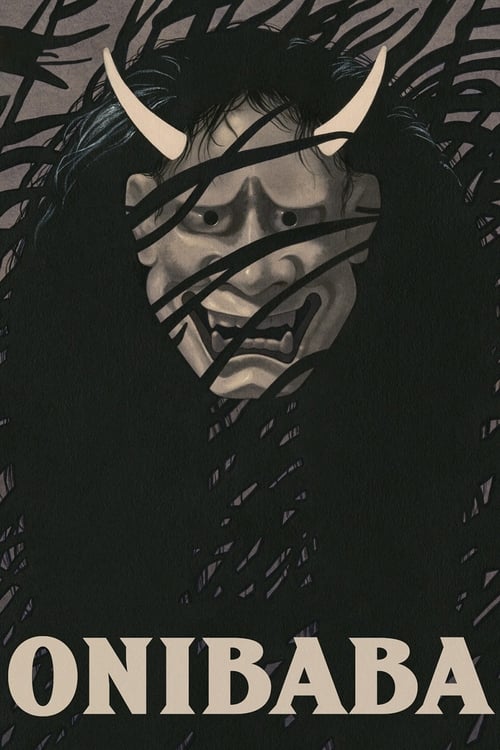
Onibaba
1964 · Kaneto Shindō
When you're craving a real scare with atmosphere instead of jump-scares — an intense, adults-only midnight watch for when you want horror that feels ancient.
What it's about
In war-torn medieval Japan, a mother and her daughter-in-law survive alone in an endless sea of tall grass by ambushing stray samurai, dumping the bodies in a deep black pit, and selling the armor. When a neighbor returns from the war with news of the son's death — and starts an affair with the young widow — the older woman's jealousy drives her to weaponize the one thing more frightening than hunger: a demon mask taken from a dead warrior.
The experience
Primal and hypnotic — wind hissing through the grass, pounding drums, sweat and moonlight, and a mounting dread that's as much about desire as demons. It's sensual and scary in equal measure, and the images stick with you long after.
Performances
Nobuko Otowa is ferocious as the older woman, playing hunger, lust, and terror with an animal directness that carries the whole film.
The craft
Shot in stark widescreen black-and-white, the film turns a single location — swaying susuki grass, a hut, a pit — into a complete world; the percussion-driven score is practically a second heartbeat. The night photography is astonishing, and it genuinely rewards the biggest, darkest screen and good speakers you can give it.
Why it matters
A landmark of Japanese horror whose demon-mask imagery echoed through the genre for decades, it remains one of the most striking proofs that terror can be built from landscape, sound, and two desperate people.
Snapshot
Onibaba ("Demon Hag") is Kaneto Shindō's elemental folk-horror, set among an endless sea of windblown susuki grass during the civil wars of fourteenth-century Japan. Two women — an unnamed older woman and her daughter-in-law — survive the chaos by ambushing stray, wounded soldiers, dumping the corpses into a deep black pit, and bartering the armor and swords for millet. When a neighbor, Hachi, returns from the war and begins an affair with the younger woman, the older woman's jealousy curdles into something darker; she terrifies her rival into submission with a demon mask stripped from a dead samurai, only for the mask to fuse to her own ruined face. Shot in stark Tohoscope black-and-white, scored with pounding percussion, and frankly, insistently carnal, the film fuses Buddhist parable, anti-heroic period drama, and primal horror. It is, with its companion piece Kuroneko (1968), the work that secured Shindō's international reputation and one of the foundational texts of modern Japanese horror.
Industry & production
Onibaba was produced by Kindai Eiga Kyōkai (the Modern Film Association), the independent production company Shindō had co-founded in 1950 with director Kōzaburō Yoshimura and the actor Taiji Tonoyama after leaving the studio system. The company operated on the margins of an industry dominated by the major studios, chronically undercapitalized and dependent on the success of individual pictures. Onibaba was distributed by Toho, which gave Shindō's small operation access to a national release and to the widescreen Tohoscope process. The film is widely credited with being a substantial commercial success — important enough to stabilize a company that had repeatedly flirted with collapse — though precise box-office figures should be treated with caution and are not reproduced here.
Production lore around Onibaba is unusually vivid and consistently reported: the cast and crew decamped to a remote marsh and lived communally in basic huts near the location for the duration of the shoot, contending with heat, insects, and the physical demands of working waist-deep in grass and water. The grass itself had to be cultivated and managed as a set. The austerity of the production — a tiny principal cast, a single landscape, minimal sets — was both an aesthetic choice and an economic necessity, and the finished film turns that poverty of means into expressive density.
Technology
The film was shot on black-and-white 35mm in the anamorphic Tohoscope format, yielding a roughly 2.35:1 widescreen frame. This format choice is central rather than incidental: the extreme horizontal canvas lets the susuki grass fill the screen edge to edge, dwarfing the human figures and converting landscape into an active, almost meteorological presence. The monochrome stock, exploited for deep, light-swallowing blacks and silvered highlights on the grass, gives the marsh its nocturnal menace and renders the central pit as an absolute void. Standard mid-1960s production technology is used throughout, but with a deliberate primitivism — wind, water, fire, and grass are the dominant "effects," generated practically on location.
Technique
Cinematography
The photography by Kiyomi Kuroda — a key long-term Shindō collaborator who would also shoot Kuroneko — is the film's signature achievement. Kuroda treats the susuki field as the principal character: low angles place the camera beneath the grass so the reeds rake across the frame; long lenses compress and flatten the stalks into a churning wall; and night sequences exploit high-contrast lighting so figures emerge from and dissolve into blackness. The wind, constantly agitating the grass, supplies perpetual motion even in static compositions. Kuroda repeatedly frames the human body against this organic chaos — running, copulating, fleeing — so that desire and violence feel continuous with the natural world rather than set apart from it. The recurring overhead and edge-on framings of the pit make a bottomless hole into one of the most legible visual motifs in Japanese horror.
Editing
The cutting is rhythmic and percussive, frequently synchronized to the score's drumming, and it accelerates sharply in the film's chase and terror sequences — the mask-clad woman crashing through the grass is built from short, disorienting fragments. Elsewhere Shindō holds shots long enough for the wind and sound to accumulate dread. The editing's chief structural device is the alternation between the claustrophobic interiors of the women's hut and the boundless exterior of the field, and between labor (the grim routine of killing and trading) and eruption (sex, jealousy, the supernatural). I will not attribute the cut to a named editor with confidence, as the editing credit is not something I can verify here; the technique, however, is clearly of a piece with Shindō's controlling design.
Mise-en-scène / staging
Shindō stages the drama with near-theatrical economy: essentially one landscape, two huts, a pit, and a handful of bodies. Props carry enormous weight — the mask, the swords and armor, the millet, a single peach as an object of barter and temptation. The grass functions as a labyrinth in which characters appear and vanish, eavesdrop, and pursue. Bodies are central to the staging: sweat, exertion, and nudity are presented matter-of-factly as facts of survival and appetite. The pit anchors the geography morally as well as spatially — everything the women do orbits that hole, and the film's logic of consequence draws the older woman back toward it.
Sound
The sound design is among the film's most influential elements. Hikaru Hayashi's score is built on aggressive, modernist percussion — taiko-like pounding, atonal stabs, and jazz-inflected dissonance — that reads as both heartbeat and threat. Against this, Shindō layers a dense bed of natural sound: the ceaseless hiss and rush of wind through the grass, water, breathing, and cries. Silence and sudden percussive shock are deployed for terror in a manner that prefigures decades of horror sound practice. The interplay of relentless ambient wind and abrupt rhythmic violence gives the film a trance-like, ritualistic pulse.
Performance
Nobuko Otowa, Shindō's most important actor and longtime collaborator (the two would later marry), gives a ferocious, physical performance as the older woman, charting a path from pragmatic brutality through sexual humiliation to desperation and, finally, abjection beneath the mask. Jitsuko Yoshimura plays the daughter-in-law with a raw, animal directness, her desire unsentimental and unapologetic. Kei Satō's Hachi is coarse, opportunistic, and vital — the catalyst whose return detonates the women's grim equilibrium. Taiji Tonoyama appears as the merchant Ushi. The performances are pitched toward the elemental rather than the psychological, bodies driven by hunger, lust, fear, and survival.
Narrative & dramatic mode
The narrative is a tightly closed chamber drama in an open landscape: a love triangle of survival economics that escalates into supernatural retribution. Its dramatic mode is parable. Shindō has long stated that the film derives from a Buddhist fable — associated with the Shin (Jōdo Shinshū) tradition — in which a mother dons a demon mask to frighten her daughter-in-law away from devotion, only to find the mask welded to her flesh, a punishment for the cruelty of the deceit. Shindō secularizes and eroticizes the tale: religion recedes, and what remains is appetite, jealousy, and the literalization of "the demon within." The structure is ruthlessly causal — every act of predation and betrayal returns as consequence — and the famous final image leaves moral and ontological questions deliberately unresolved.
Genre & cycle
Onibaba sits at the intersection of jidaigeki (period film) and kaidan (the Japanese ghost-story tradition), but it strips the period film of heroism and the ghost story of decorum. Its release coincided with a notable mid-1960s revival of literary, art-cinema kaidan — most prominently Masaki Kobayashi's lavish, anthology-form Kwaidan, released the same year. Where Kobayashi is painterly and stylized, Shindō is earthen, sweaty, and carnal. Onibaba also anticipates and overlaps the emergent "pink film" wave in its frank treatment of sexuality, and it belongs to a small, potent strand of folk-horror grounded in landscape and superstition. Together with Kuroneko, it forms Shindō's two-film contribution to the supernatural genre.
Authorship & method
Shindō was a prolific writer-director — by trade originally a screenwriter, and one of postwar Japan's most productive — whose authorship is defined by independence, social engagement, and an attraction to the lives of the poor and laboring. His earlier The Naked Island (1960), a near-wordless study of a family farming a barren islet, shares Onibaba's fascination with bodies at labor in an unforgiving landscape and its willingness to let environment carry meaning. His method on Onibaba — communal location living, a stripped cast, a single dominant setting — reflects both a leftist, collective ethos and a pragmatic response to scarce resources.
The key collaborators recur across his filmography. Cinematographer Kiyomi Kuroda translated Shindō's conception of the grass-as-character into images and would reunite with him on Kuroneko. Composer Hikaru Hayashi, also a frequent collaborator, supplied the percussive, modernist score that is inseparable from the film's terror. Actor Nobuko Otowa was Shindō's creative partner across decades and the expressive center of much of his work. The screenplay is Shindō's own, adapting the Buddhist mask parable into his materialist, body-centered idiom.
Movement / national cinema
The film belongs to the era of Japanese independent cinema that grew up alongside, but distinct from, the studio-driven mainstream and the more urban, politically self-conscious Japanese New Wave (Nūberu bāgu) of Ōshima, Imamura, and others. Shindō's Kindai Eiga Kyōkai was a model of postwar independent production, and Onibaba benefited from the international appetite for Japanese cinema that had been opened by Rashomon's success in the early 1950s. Its frank eroticism and visual ferocity traveled well on the international art-house and festival circuit, where it became one of the more notorious and admired Japanese imports of the decade.
Era / period
Released in 1964 — the year of the Tokyo Olympics and the high tide of Japan's postwar economic miracle — Onibaba pointedly turns away from modern prosperity toward a medieval world of famine, war, and predation. Its diegetic setting is the fourteenth-century conflict between the Northern and Southern Courts (the Nanboku-chō era), with dialogue invoking the warring camps; the great lords fight while the peasantry starves and scavenges. Read against its moment of production, the film's vision of survival amid civilizational collapse carries a charge specific to a director from Hiroshima working two decades after the war. The disfiguring mask has frequently been interpreted in light of the keloid scarring of atomic-bomb survivors — a reading the film's imagery strongly supports even where it does not state it — connecting Onibaba to Shindō's explicit Hiroshima films, Children of Hiroshima (1952) and Lucky Dragon No. 5 (1959).
Themes
The film's governing themes are survival and the collapse of moral order under extremity: war reduces human beings to scavengers, and the women's murders are framed less as evil than as economics. Sexuality is its second great subject — desire as an irrepressible, leveling, dangerous force that overrides loyalty, age, and decorum. Jealousy and the fear of abandonment drive the older woman's cruelty. Above all the film dramatizes the demon within: the mask externalizes the monstrousness that scarcity and resentment have already produced, and its fusion to the flesh insists that the demon was never separable from the self. Class is a persistent undertone — the contempt for fallen samurai, the indifference of the great wars to those who feed on their refuse — as is a stripped, post-religious moral universe in which Buddhist parable survives only as the mechanics of consequence.
Reception, canon & influence
Onibaba was received internationally as a striking, transgressive work, admired for the visual power of its grass-and-darkness cinematography and noted (and in some quarters censured) for its sexual frankness. Western critics and historians of Japanese film, among them Donald Richie, helped establish it as a key Shindō work, and it has since been canonized through restoration and home-video release, including by the Criterion Collection. It remains the film most associated with Shindō outside Japan and a fixture of the international horror canon.
Looking backward, the film draws on the Shin Buddhist mask parable Shindō credited as its source, on the kaidan tradition of vengeful and supernatural transformation, and on Shindō's own materialist landscape filmmaking exemplified by The Naked Island. Looking forward, its influence is broad. William Friedkin has spoken of Onibaba — and specifically its demonic, disfigured face — as an influence on The Exorcist (1973), one of the most frequently cited cross-cultural lineages in horror history. More diffusely, the film's grammar of the disfiguring mask, the hair-and-face revelation of monstrousness, and the woman transformed into demon prefigures the visual vocabulary of later Japanese horror, including the J-horror wave of the 1990s–2000s. Within Shindō's own work it set the template he would refine in Kuroneko. Its image of two figures running through an infinite field of grass, pursued and pursuing, has become one of the indelible compositions of postwar Japanese cinema.
A Deleuzian reading
Start with the grass.
The full Deleuzian reading of Onibaba →
Reception
A hit in Japan but sniffed at by some Western critics as lurid erotica when it traveled, Onibaba has since been fully canonized — Criterion treatment, endless 'greatest horror' lists — as art-house horror's great grass-field fever dream.
How Onibaba was received, from release to now →
Influences: the films it descends from and the films it influenced
- The Naked Island (1960) — Shindō and cinematographer Kiyomi Kuroda's earlier near-wordless study of bodies laboring against a barren landscape established the materialist method — environment as protagonist, ScopeRatio wide shots of figures dwarfed by terrain — that Onibaba transplants into the grass.
- Ugetsu (1953) — Mizoguchi's kaidan grammar of the seductive woman who is revealed as a vengeful spirit supplies the supernatural-transformation template Shindō adapts into the mask-as-demon revelation.
- Rashomon (1950) — Kazuo Miyagawa's technique of pointing the lens up through foliage toward the sun, and dappled light raking faces in a wild natural setting, is the direct precedent for Kuroda's low-angle grass and sun-pierced canopy.
- Throne of Blood (1957) — The Noh-derived yamamba/demon mask and the haggard female face as locus of supernatural dread, set in fog-shrouded wilderness, prefigure Onibaba's hannya mask and its hair-and-face disclosure of monstrousness.
- Ivan the Terrible, Part II (1958) — Eisenstein's expressionist chiaroscuro — faces carved out of crushing blacks, mask-like grimaces lit for theatrical menace — anticipates Onibaba's high-contrast blacks and the disfigured visage emerging from darkness.
- Kuroneko (1968) — Shindō refines the same machine — Kuroda's grass-and-darkness photography, Hayashi's percussion, Nobuko Otowa as transforming spirit — into a more overtly supernatural kaidan, the direct sequel-in-method to Onibaba.
- The Exorcist (1973) — Friedkin has explicitly named Onibaba's demonic, disfigured face as the source for his conception of the possessed visage — the cross-cultural transfer of the mask-revealed demon into Western horror.
- Ringu (1998) — The J-horror grammar of monstrousness disclosed through hair falling away from a ruined face — the female demon's terror located in the revelation beneath the hair — descends directly from Onibaba's mask-removal scene.
- Ju-on: The Grudge (2002) — Extends the same vocabulary of the woman-turned-vengeful-demon and percussive, rattling sound design used as a pure shock device, the J-horror inheritance of Shindō's kaidan terror.
- The Witch (2015) — Folk-horror staging of the woman-as-demon emerging from a menacing wilderness, with terror generated by elemental landscape and a dissonant, percussive-vocal score rather than narrative monster.
- Antichrist (2009) — Reprises the 'demon within' the woman set loose in a hostile natural setting, fusing eroticism, grief, and the landscape's malevolence in the lineage of Onibaba's survival-amid-collapse parable.
- Kill List (2011) — Carries forward the masked-cult demon and the slow dread built from landscape and abrupt percussive sound cuts, an heir to Onibaba's interior-exterior alternation and mask iconography.
- The Sword of Doom (1966) — Shindo and cinematographer Kiyomi Kuroda develop a system of high-contrast monochrome photography in which shadow volume and light geometry encode moral condition directly — darkness as ethical atmosphere rather than atmospheric decoration — establishing the monochrome-shadow-expressionism technique that Okamoto's cinematography inherits for Ryunosuke's world, where visual texture and moral texture are made identical.
- The Wailing (2016) — Japanese folk horror using wide-frame landscape cinematography where terrain itself carries spiritual threat, and a ritual mask that becomes an agent of possession and disfigurement — a direct visual and thematic precedent for the Stranger's mountain isolation and its contaminating proximity.
- Demons (1971) — Inky high-contrast night photography where black voids and reeds swallow the frame, staging dehumanization through figures dissolving into surrounding darkness—Shura's chiaroscuro-void aesthetic.
- Legend of the Mountain (1979) — Turned windswept landscape into an active, menacing force and bound the demonic-feminine to erotic threat, the nature-as-antagonist and seductive-danger pairing Legend restages on its Korean plateaus.
- Ballad of Tara (1979) — A woman who survives by stripping armor and weapons from dead warriors, filmed with the terrain itself (the grass) as the hostile agent that swallows and returns bodies — the closest prior formulation of Tara's found sword and her labor amid a landscape that will not release its history.
- Woman in the Dunes (1964) — Released the same year, it shares the exact craft cluster — two figures trapped in a single elemental landscape (the sand pit answering Onibaba's grass and hole), abstracted erotic survival, and Tōru Takemitsu's modernist percussion mirroring Hayashi's score.
- Kwaidan (1964) — A contemporaneous flowering of the kaidan-as-art-cinema, foregrounding stylized supernatural transformation and a dissonant, sparse modernist soundtrack as the engine of terror rather than narrative shock.
- Harakiri (1962) — Shares the anamorphic-jidaigeki idiom — austere widescreen compositions, deep high-contrast blacks, and percussive editing rhythms deployed against period settings to convey existential dread over spectacle.
- Days of Heaven (1978) — Néstor Almendros's photography of wind moving through endless fields of grain, with the landscape elevated to a character and human drama subordinated to elemental nature, parallels Kuroda's grass-as-protagonist.
- The Face of Another (1966) — Japanese New Wave sibling on the mask-fused-to-face motif: the hannya mask that adheres to and disfigures its wearer, dramatizing the same terror of a disguise that consumes identity.
- Fires on the Plain (1959) — High-contrast black-and-white of figures dwarfed by a barren plain (susuki grass echoing Ichikawa's field), survival stripped to animal need and taboo.
- Pitfall (1962) — Turns a windblown grass wasteland into a high-contrast black-and-white psychosexual landscape haunted by folk-supernatural dread, the same repurposing of ghost-story machinery for the poverty and violence of the rural underclass.
Similar films
- Ugetsu (1953) — influence & lineage · often watched together
- Kuroneko (1968) — influence & lineage
- Harakiri (1962) — influence & lineage
- Throne of Blood (1957) — influence & lineage
- Woman in the Dunes (1964) — influence & lineage
- In the Realm of the Senses (1976) — often watched together
- Kwaidan (1965) — shared sensibility
- Demons (1971) — shared sensibility
All the films related to Onibaba →