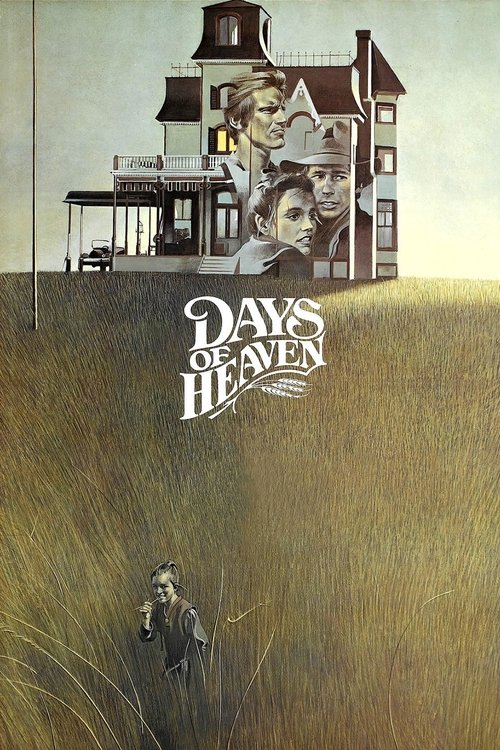
Days of Heaven
1978 · Terrence Malick
When you want to watch something purely beautiful and let it wash over you — a contemplative evening, not a gripping one. Choose it for awe; it's closer to poetry than page-turner.
What it's about
In 1916, a Chicago steelworker flees an act of violence with his girlfriend and his little sister, riding the rails to the Texas panhandle to harvest wheat on a rich, ailing farmer's land. When the farmer falls for the girlfriend, the lovers see a way out of poverty — and a love triangle takes root in the fields, narrated in the sister's flat, wised-up child's voice.
The experience
Hypnotic and hushed — the story is simple melodrama, but it plays like a remembered dream, told in images of light, wheat, and sky. It's slow by design, and quietly devastating rather than loud.
Performances
Richard Gere, young and coiled, and Sam Shepard, all stillness and sorrow as the farmer, work in a minimal register; Linda Manz's unpolished voiceover as the kid sister gives the film its strange, unforgettable tone.
The craft
Shot largely in the few minutes of natural light around sunset by Néstor Almendros (with Haskell Wexler), it contains some of the most beautiful photography ever put on film — locusts, fire, and wheat fields like paintings in motion. Ennio Morricone's score and the whispering sound design make it a film that demands the biggest, best screen you have.
Why it matters
It set the standard for natural-light cinematography, won the Oscar for it, and defined Terrence Malick's legend — he wouldn't make another film for twenty years, and generations of visual filmmakers have chased this one since.
Snapshot
Terrence Malick's second feature is one of cinema's supreme acts of visual poetry: a triangular melodrama of love, class, and catastrophe set among itinerant wheat-harvesters on the Texas panhandle during the summer of 1916, told in a hushed, associative register that privileges sensation over event. Shot almost entirely in the brief natural light of dusk—the "magic hour"—by Néstor Almendros and Haskell Wexler, Days of Heaven achieved an unprecedented fusion of landscape painting and narrative cinema. It announced that the New Hollywood's hunger for psychological realism could coexist with, or even yield to, a lyric formalism rooted in silence, wonder, and impermanence.
Industry & production
After the critical success of Badlands (1973), Malick spent several years developing the screenplay that would become Days of Heaven, a period that coincided with his growing isolation from the Hollywood mainstream. Paramount Pictures agreed to finance the project on a constrained budget that demanded creative resourcefulness rather than spectacle. Principal photography took place largely in southern Alberta, Canada—primarily around Lethbridge and the irrigated wheat country of the Milk River Ridge—chosen for its resemblance to the flat grandeur of the historic Texas panhandle and for practical access to authentic harvesting operations. The production engaged local farmers and their equipment, integrating period-appropriate threshing machinery with a degree of documentary fidelity.
The shoot was organized around Almendros's unusual time-management demands: because so much footage was to be captured at magic hour, the company often filmed only brief windows per day, requiring meticulous pre-visualization and near-military precision in setup. When Almendros's contractual commitments to a prior European production required him to depart before photography was complete, Haskell Wexler was brought in to finish the remaining sequences. Wexler's participation was extensive enough to merit an additional-photography credit, and he later expressed frustration that his contribution was not more prominently recognized; Almendros, for his part, had established the visual grammar of the film, and Wexler honored it with considerable fidelity. The Academy Award for Best Cinematography went to Almendros alone.
Post-production was protracted. Malick engaged with the edit through an unusually extended revision process, and the narration by Linda Manz—added late in post, partly as a structural solution to what remained of an elliptical cut—became one of the film's most distinctive and celebrated elements.
Technology
The film's central technological achievement is its exploitation of the "magic hour" (or "golden hour"): the roughly twenty to thirty minutes following sunset or preceding sunrise when the sun is below the horizon but the sky remains luminous, casting diffused, directionless light of extraordinary color temperature. Almendros, drawing partly on experience with constrained natural-light shooting on Éric Rohmer's Claire's Knee (1970) and other contes moraux, deployed ultra-fast Zeiss Super-Speed prime lenses capable of exposure at very low light levels alongside Panavision anamorphic cameras to capture the wide-format compositions that define the film's look. The combination allowed photography in conditions that earlier technologies would have required supplemental lighting to overcome, preserving the organic quality of the light itself.
The anamorphic widescreen format (approximately 2.39:1) was essential to Malick's compositional strategy: the extreme horizontal frame accommodated both the vastness of the prairie horizon and the visual rhyme between human figures and landscape. Production designer Jack Fisk—who had collaborated with Malick on Badlands and would become a long-term creative partner—constructed and sourced period-accurate props, structures, and grain-harvesting equipment with material rigor, giving the film its tactile weight and historical texture.
Technique
Cinematography
The cinematography of Days of Heaven constitutes one of the most influential bodies of work in the medium's history. Almendros's visual strategy was to subordinate the camera to the light rather than impose a photographic scheme upon it: shots are organized around what the light is doing, not around what dialogue or action demands. The golden-hour sequences—amber skies dissolving from burnt orange to deep blue, wheat fields lit from below as if from within—have an almost geological patience. Frames are often held long after the narrative function is served, as if the camera is reluctant to leave.
Almendros used relatively long lenses to compress foreground and background, flattening figures against the sky and giving the landscape a painted quality that critics consistently associated with Andrew Wyeth's egg-tempera paintings of the American pastoral and the agrarian panoramas of Thomas Hart Benton. The association is not merely impressionistic: Malick was deeply literate in American visual art, and the compositional rhymes between Days of Heaven and Wyeth in particular have been remarked upon since the film's first screenings.
Wexler's completion photography is largely seamless, a tribute both to his skill and to the clarity of the visual system Almendros established. The locust-plague sequence—a set piece of near-apocalyptic intensity in which the wheat fields are consumed by fire and swarming insects—is among the most visually spectacular passages in American cinema of its decade.
Editing
Billy Weber edited Days of Heaven under Malick's close supervision. The editing proceeds not by causal logic or conventional scene structure but by emotional and perceptual association: cuts follow rhythm and rhyme—visual or sonic—rather than narrative necessity. Action is often elided entirely; we are shown aftermath or preparation, and the film trusts the spectator's imagination to complete transactions the screenplay might have staged. The result is a temporal structure that feels less like story time than like memory—fragmentary, luminous, partial.
The integration of Linda Manz's voiceover is particularly sophisticated. Her narration, spoken in a Chicago street-kid's idiom, often addresses events obliquely or not at all, sometimes contradicting or misunderstanding what the images show. This deliberate disjunction between image and word creates ironic distance without cynicism: the narrator is not deceptive but perceptually limited in a childlike way, seeing surfaces with great acuity and interior states barely at all.
Mise-en-scène / staging
Malick's staging approach is phenomenological rather than theatrical: actors are placed in authentic environments and given behavioral latitude while the camera observes rather than directs. The human drama is consistently framed within, and often overwhelmed by, the surrounding landscape. Characters appear small against the sky, partially occluded by crops or machinery, glimpsed at oblique angles. This is not misanthropy but a philosophical proposition: humanity exists within nature, subject to the same rhythms and indifference, and the film refuses the conventional cinematic hierarchy that places the human face above the world it inhabits.
Sam Shepard's farmer is a study in stillness—his theatrically austere stage presence matching the spare staging Malick preferred. Richard Gere, before his mainstream stardom crystallized, plays Bill with a coiled physical energy that the film frames as fundamentally out of place in the pastoral order: a man of the industrial city inserted into an agrarian world he cannot fully inhabit.
Sound
Ambient sound—wind across wheat, the clank and hiss of steam-powered threshers, birdsong at dusk—is treated with the same compositional care given the images. Ennio Morricone's score, pastoral and elegiac, weaves folk-derived melodic lines into orchestral textures that amplify without overpowering the natural soundscape. Equally famous is Malick's use of Camille Saint-Saëns's "Aquarium" movement from The Carnival of the Animals (composed 1886), whose shimmering, liquid quality—gliding strings over plinking piano—becomes the film's unofficial musical signature. The juxtaposition of a nineteenth-century French salon piece with early twentieth-century American agricultural labor is quietly dissonant, underscoring the persistent sense that the characters inhabit a world apart, a pocket of grace that cannot last.
Performance
Malick's approach to performance is anti-theatrical: emotional legibility is suppressed, and performances communicate primarily through behavior, posture, and presence rather than delivered dialogue. Linda Manz's narration was substantially improvised; Malick encouraged her to talk around her character's experience rather than explain it, yielding a voice that sounds genuinely unguarded. Brooke Adams brings a self-contained, slightly mournful quality to Abby that the film never overexplains. The instability of the love triangle—is Abby's affection for the Farmer genuine? is Bill capable of love or only possession?—is rendered through accumulating behavioral detail rather than psychological exposition.
Narrative & dramatic mode
Days of Heaven belongs to what might be called the lyric mode of cinema: a tradition that prioritizes texture, mood, and sensory immersion over causal plot. Its narrative—Bill kills his foreman in a Chicago mill, flees south with Abby and younger sister Linda, the three find work harvesting wheat, Abby marries the wealthy Farmer (believed to be dying) as a scheme to inherit his land, the Farmer unexpectedly recovers and discovers the deception, jealousy and violence follow—is the skeleton of a conventional melodrama, even of a rural noir. But Malick largely withholds the interiority that would make this a psychological study: we are given the conditions of feeling without their explanation, the surfaces of desire without their depths.
The film's true narrative engine is seasonal. It observes a single agricultural cycle—arrival, harvest, winter, return—and the characters' drama unfolds within that structure as if itself subject to natural law. The locust plague that destroys the harvest is a catastrophe not merely economic but mythological: the blighted crop as conditional grace revealed, the paradise of the wheat fields exposed as always borrowed time. The biblical resonance—Deuteronomy's promise of "days of heaven upon the earth" for those who keep the covenant—shadows the film without being made explicit, one layer of a palimpsest of American mythologies.
Genre & cycle
Days of Heaven inhabits several generic territories simultaneously without fully committing to any. It is, formally, a period drama with melodramatic content; it has the triangle structure of the rural noir; it has the landscape scale and temporal patience of the Western without the Western's moralized violence. It belongs most completely to the tradition of the American pastoral film—a tradition thin enough to make the film, in some respects, its own category.
The film arrived in 1978 near the crest and beginning decline of New Hollywood's creative autonomy. Its commercial modesty made it less a cultural phenomenon than an art-cinema touchstone, quietly influential rather than broadly consumed. Alongside Apocalypse Now (1979) and The Deer Hunter (1978), it represents a late-period crystallization of the decade's ambition to reconcile Hollywood genre filmmaking with European formalism.
Authorship & method
Terrence Malick is among American cinema's most categorically singular auteurs. Trained in philosophy as an undergraduate at Harvard and subsequently as a Rhodes Scholar at Oxford, Malick completed a translation of Martin Heidegger's The Essence of Reasons (published 1969 by Northwestern University Press) before turning to filmmaking. He brings to cinema a phenomenological orientation in the strict sense: his films are less concerned with what characters want than with how beings experience the world's presence, the texture of time and sensation. Days of Heaven is the purest early expression of this method—less encumbered than Badlands by genre convention and less diffuse than his later work.
Néstor Almendros (1930–1992), the Barcelona-born cinematographer, was among the most accomplished and philosophically engaged directors of photography in world cinema, a regular collaborator of Rohmer and François Truffaut who brought European art-cinema sensibility to the project. His memoir A Man with a Camera (published in French in 1980, in English translation 1984) contains his account of the magic-hour methodology and remains an essential document of the film's making. Ennio Morricone (1928–2020) brought to the score a pastoral lyricism calibrated precisely to Malick's images: unhurried, open-ended, tonally ambiguous. Jack Fisk, production designer and Malick's long-term collaborator, provided the film's material world with authentic density; his eye for period texture and spatial atmosphere has defined Malick's visual grammar across multiple films.
Movement / national cinema
Days of Heaven is American cinema's most thoroughgoing attempt, within the New Hollywood era, to synthesize commercial filmmaking with the contemplative formalism of European art cinema. Malick's influences ran through philosophy and literature as much as through film history, and his second feature situates itself closer to Dreyer or early Tarkovsky than to the Hollywood tradition it technically inhabits.
The film belongs to the broader 1970s cycle of revisionist Americana—films interrogating the mythologies of frontier, land, and class—but does so through aesthetic rather than political means. It does not argue about American inequality; it shows it, holds it in the light, and allows the observation to stand.
Era / period
The film is set in the summer of 1916, a moment deliberately chosen: the last years before American industrial modernity fully colonized the landscape, when itinerant agricultural labor remained the economic reality for millions of working-class Americans. The setting places the story just before the United States' entry into the First World War, a historical threshold that would transform the country's self-image irreversibly. The characters' brief "days of heaven" are partitioned, historically, from catastrophe to come.
Malick does not engage this historical framing analytically. The period is evoked through surfaces—clothing, tools, transport—rather than contextualized through event. What registers is not history but its texture: the weight of the machinery, the exhaustion of bodies doing agricultural work in a pre-mechanized economy, the social distance between the landowner and the workers who move through his fields.
Themes
The film's central thematic concern is paradise and its loss—not in a naively Edenic sense but in the Heideggerian register Malick clearly favors: the world discloses itself as beautiful and sufficient, briefly; then the conditions of that disclosure change, and the beauty is gone. The wheat fields in summer are a genuine pastoral paradise—nourishing, abundant, visually overwhelming—and the characters' residence within them carries the quality of grace. That grace is, from the beginning, contingent: the land is owned, the harvest is subject to plague, and the love at the story's center is founded on deception.
Class is a structuring condition rather than an explicit theme. Bill and Abby are workers; the Farmer is a landowner; the plan—marrying into wealth to inherit—represents the American Dream in its most cynical form, and the film quietly observes its inevitable failure without moralizing the observation.
Nature in Days of Heaven is not symbolic but literal: the film restores to cinema the physical fact of the natural world, its indifference to human drama, its beauty entirely independent of what humans project onto it. The locust plague is not a moral judgment but a meteorological event; the fire that destroys the fields is not punishment but chemistry. That these events also function symbolically is a consequence of the film's density, not of didactic intent.
Reception, canon & influence
On its initial release, Days of Heaven was widely praised by critics attentive to its visual achievement but performed modestly at the box office—a pattern consistent with Malick's career and with the structural difficulty of marketing formally ambitious American cinema to mainstream audiences. Almendros's Academy Award for Best Cinematography validated the film's technical distinction, and Malick received the Best Director prize at the Cannes Film Festival in 1979, consolidating his standing as a figure of international art-cinema significance.
Backward influences. The film's most traceable formal ancestor is F.W. Murnau's Sunrise: A Song of Two Humans (1927), whose triangular structure—itinerant worker, his woman, a wealthier rival—lyric landscape photography, and substitution of visual rhythm for conventional scene construction anticipate Days of Heaven in striking ways. Jean Renoir's pastoral films, and the silent cinema tradition's capacity to render the natural world as participant rather than backdrop, inform Malick's approach. Philosophically, American Transcendentalism—Emerson's and Thoreau's conviction that nature discloses moral and metaphysical truth—runs through the film's thematics, even as Malick's phenomenological training complicates any simple Transcendentalist reading. The Depression-era documentary photography of Dorothea Lange and Walker Evans, though chronologically posterior to the film's 1916 setting, provided aesthetic templates for the iconography of agricultural labor and of landscape-as-social-fact that Malick and Almendros drew upon.
Forward influence. Days of Heaven fundamentally changed the vocabulary of American cinematography. The magic-hour aesthetic it codified—shooting exclusively or primarily in available natural light at the extremes of the day—has become a baseline option for cinematographers of every generation since. Almendros's account of the methodology, disseminated through A Man with a Camera and extensive interviews, made the approach teachable and reproducible; cinematographers including Roger Deakins and Emmanuel Lubezki have cited the film as a touchstone.
Malick's own subsequent career—the twenty-year silence after Days of Heaven, then The Thin Red Line (1998), The New World (2005), The Tree of Life (2011), and the increasingly associative films of the 2010s—progressively elaborated the lyric method first fully realized here. The Tree of Life in particular is unthinkable without the formal and thematic groundwork laid by Days of Heaven.
More broadly, the film's model of a narrative cinema that trusts landscape, light, and durational observation over plot and psychology has informed the international "slow cinema" tradition and the American art-cinema wave of the 1990s and 2000s. Gus Van Sant's informal "death trilogy"—Gerry (2002), Elephant (2003), Last Days (2005)—owes a specific formal debt to Malick's patient camera and his willingness to let figures move through landscapes without narrative consequence. The film's influence is, at this point, both canonical and diffuse: so thoroughly absorbed into cinematographic practice that its specific innovations are difficult to isolate from what has simply become the language of serious visual filmmaking.
A Deleuzian reading
Begin with light.
The full Deleuzian reading of Days of Heaven →
Reception
Met with mixed, even chilly reviews in 1978 — critics called it gorgeous but emotionally remote — though Malick won Best Director at Cannes; it's since been fully canonized as one of the most beautiful films ever made.
How Days of Heaven was received, from release to now →
Influences: the films it descends from and the films it influenced
- Sunrise: A Song of Two Humans (1927) — Murnau's triangular rural narrative — itinerant laborer, his woman, a wealthier rival — combined with location landscape photography that substitutes exterior geography for psychological exposition furnishes Days of Heaven's entire plot architecture and its model of treating the natural world as an active dramatic participant rather than a backdrop.
- Toni (1935) — Renoir's location-shot treatment of migrant agricultural labor in Provence — available natural light, non-professional performers, the land itself as social determinant — directly anticipates the visual and class texture of Malick's Texas Panhandle harvest sequences, where itinerant field workers are observed with the same documentary-inflected naturalism.
- Au hasard Balthazar (1966) — Bresson's systematic suppression of actorly expression through his 'model' methodology — non-professionals trained to withhold interiority, faces observed rather than performed — provides the theoretical foundation for Days of Heaven's anti-theatrical performance register, which Linda Manz and Richard Gere inhabit as behavioral surfaces rather than psychological interiors.
- Elvira Madigan (1967) — Jörgen Persson's Scandinavian pastoral cinematography — available natural light, shallow-focus optics, temporally dilated exterior compositions that impose lyric register onto tragic melodrama — establishes the visual template that Almendros codifies as methodology in Days of Heaven's magic-hour shooting: luminous environment as the film's true protagonist.
- McCabe & Mrs. Miller (1971) — Vilmos Zsigmond's pre-fogged, diffused anamorphic widescreen cinematography — shooting in practical and natural light sources to produce a de-saturated, period-accurate color palette — established the organic naturalism that Zsigmond carried directly into his early principal photography on Days of Heaven before Almendros assumed the magic-hour sequences.
- Badlands (1973) — Tak Fujimoto's natural-light location work and Sissy Spacek's dissociated first-person narration — speaking lyric non-sequiturs and moral observations that refuse to illustrate the images beneath them — directly prototype the voiceover-image disjunction that Linda Manz's narration perfects in Days of Heaven, where the narrator's tone and the drama's content operate on entirely separate frequencies.
- L'Avventura (1960) — Aldo Scavarda's long-lens compression of figures against volcanic Sicilian seascape, and Antonioni's elliptical editing that withholds psychological motivation while insisting on landscape as a pressurizing presence, furnish the European formalist precedent — explicitly absorbed in Days of Heaven's 'european-formalism-synthesis' — for treating exterior geography as the film's dominant dramatic register.
- Rashomon (1950) — Nestor Almendros's magic-hour cinematography — shooting directly into the light source at its most technically inadvisable, producing a blinding luminosity that makes the visual field unstable — extends Miyagawa's direct-sun technique from Rashomon's black-and-white forest into color, treating the encounter with direct light as an ethical register for the unreliability of what is seen.
- The Magnificent Ambersons (1942) — Malick's retrospective elegiac voiceover — narrating events already irrevocably past from a position of helpless loss, with visual time rendered as duration rather than information — extends Welles's specific use of the narrator as a mourner who cannot intervene in what he describes, transposing the posture from midwestern aristocracy to American pastoral.
- Jules and Jim (1962) — Malick's romantic triangle narrated retrospectively by a detached voice (Linda Manz), combined with Néstor Almendros's natural-light location cinematography that turns landscape into elegiac register, extends Jules and Jim's structural and visual model into the American prairie — the chronicle of doomed love observed at a temporal remove through a narrator's retrospective consciousness.
- Shane (1953) — Malick carried Stevens's landscape-as-meaning principle into an extreme formal statement: Nestor Almendros's golden-hour Texas Panhandle photography uses changing light conditions as moral and temporal register, directly extending Stevens's systematic use of Wyoming light to encode the provisionality of human settlement.
- Amarcord (1973) — Néstor Almendros's magic-hour warm amber diffusion cinematography — underlit, gauze-filtered, enveloping — extends the visual grammar Rotunno developed for Amarcord, combining it with seasonal agricultural rhythm as the primary narrative structure in place of dramatic arc.
- The Thin Red Line (1998) — Emmanuel Lubezki's magic-hour and ambient-light cinematography extends Days of Heaven's golden-hour methodology into combat, while the associative voiceover — multiple soldiers meditating on nature and mortality over images that refuse psychological illustration — directly scales up the voiceover-image disjunction first achieved here, proving the lyric mode can accommodate mass violence without abandoning its formal logic.
- The Tree of Life (2011) — Lubezki's handheld available-light cinematography, the film's seasonal-to-cosmological structure scaling Days of Heaven's harvest cycle outward to the birth of the universe, and the mother's whispered voiceover running disjunct from image sequences in exactly the mode of Linda Manz's narration extend Days of Heaven's lyric grammar to biographical and metaphysical scale — the film is formally unthinkable without it.
- Gerry (2002) — Harris Savides's long-lens compression of two figures traversing desert landscape — takes held far past narrative utility, the camera observing ambulatory bodies without psychological commentary — directly cites the compositional patience of Days of Heaven's wheat-field walking sequences, where duration and landscape displace incident as the unit of meaning.
- Last Days (2005) — Harris Savides's natural-light handheld cinematography of a figure drifting through a forested estate, with extended real-time takes and ambient environmental sound replacing conventional dramatic construction, applies the Days of Heaven model of non-theatrical ambulatory observation — figures moving through landscape without narrative consequence — to rock-music biography.
- Beasts of the Southern Wild (2012) — Ben Richardson's handheld magic-hour and available-light cinematography of Louisiana bayou, combined with Hushpuppy's dissociated lyric voiceover running disjunct from image logic and the film's seasonal-elemental structure, extends Days of Heaven's child-narrator-in-pastoral template: a non-adult consciousness delivering impressionistic moral observation over images that cannot confirm or illustrate her conclusions.
- Meek's Cutoff (2010) — Chris Blauvelt's natural-light 1.33:1 cinematography of Oregon high desert, the film's elliptical compression of frontier migration labor into durational landscape observation, and its systematic refusal of conventional dramatic resolution extend Days of Heaven's model of American pastoral indifference — the land neither rewards nor punishes, it simply continues.
- Upstream Color (2013) — Carruth's self-shot available-light naturalism, associative editing that privileges sensory and temporal rhythm over narrative causation, and ambient sound design substituting for explanatory dialogue inherit the Days of Heaven model of lyric-mode cinema as organisational principle — the film's images accumulate meaning through juxtaposition and duration rather than plot logic.
- Once Upon a Time in Anatolia (2011) — Gökhan Tiryaki's night-to-dawn anamorphic cinematography of Anatolian steppe — takes held in durational rural observation, the camera patient well beyond narrative necessity, landscape registered as an indifferent force that outlasts the human drama conducted across it — extends the international slow-cinema lineage that Days of Heaven's formal innovations helped inaugurate into Turkish art cinema.
- Hamnet (2025) — The founding model of magic-hour available light and elemental landscape (wind, fire, harvest) treated as the drama's emotional register rather than backdrop.
- Train Dreams (2025) — Establishes the image/voiceover interplay Train Dreams runs on: magic-hour landscape photography paired with a narrating voice that drifts free of the plot rather than explaining it.
- The Piano (1993) — Néstor Almendros's desaturated naturalistic palette, Linda Manz's first-person retrospective female voiceover narration, and the elliptical causal structure between landscape spectacle and human action are direct precursors to Dryburgh and Campion's method of oscillating between environmental grandeur and interior state.
- Y Tu Mamá También (2001) — Nestor Almendros's proof that 35mm narrative filmmaking could be lit exclusively by available and golden-hour light without sacrificing compositional control is the direct precedent Lubezki extended on Y Tu Mamá También, choosing augmented natural sources over studio fill for both exteriors and the car interiors.
- Aguirre, the Wrath of God (1972) — Thomas Mauch's handheld location cinematography renders the Amazon as an overwhelming, indifferent natural force — not background but antagonist — and Herzog's non-synchronised ambient sound design arrives at the same position as Days of Heaven's nature-indifference thesis through documentary urgency where Malick uses lyric stillness; both films reconceive landscape as the true subject of the drama.
- The Deer Hunter (1978) — Vilmos Zsigmond's anamorphic widescreen photography of rural Pennsylvania and the film's seasonal-ritual structure — wedding, deer hunt, war, aftermath — runs parallel to Days of Heaven's harvest-cycle architecture; both films deploy ambient environmental sound as an emotional register and treat working-class American pastoral as the moral ground from which characters are violently expelled.
- Kagemusha (1980) — Nestor Almendros establishes a rhythm of extreme stillness interrupted by elemental violence, with silence treated as structural duration rather than neutral absence; this oppositional grammar runs parallel to Kagemusha's stillness-montage contrast and its strategy of using quiet to give specific sound events catastrophic weight.
- Gallipoli (1981) — Parallel use of magic-hour, naturalistic widescreen pastoral in which characters are dwarfed by an indifferent vast landscape — the same landscape-vastness sensibility Boyd pursued.
- Doctor Zhivago (1965) — Extends Freddie Young's telephoto long-lens compression and magic-hour landscape isolation, reducing human figures to small forms within overwhelming natural scale.
- Walkabout (1971) — Inherits the natural/magic-hour light, telephoto figures-in-landscape, and elliptical associative montage with ironic voiceover counterpoint that Walkabout pioneered.
- Capote (2005) — Néstor Almendros's magic-hour, available-light naturalism on the open plains is the source of Capote's desaturated, light-led exterior grammar that refuses studio polish.
- Onibaba (1964) — Néstor Almendros's photography of wind moving through endless fields of grain, with the landscape elevated to a character and human drama subordinated to elemental nature, parallels Kuroda's grass-as-protagonist.
- Kramer vs. Kramer (1979) — Almendros's natural-light cinematography immediately prior — window light, no fill, time-of-day realism — is the same photographic naturalism he carries straight into Kramer the following year.
- The Outsiders (1983) — Almendros's magic-hour photography — figures backlit against amber skies — is the golden-hour idiom Stephen Burum reaches for in the sunset and church-fire imagery.
- Pride & Prejudice (2005) — Canonized magic-hour/dawn shooting where low golden and blue light replaces studio glamour — the direct ancestor of Osin's misty sunrise on the moor where Darcy first proposes reconciliation.
- Little Women (2019) — Néstor Almendros's magic-hour natural light, where color temperature itself carries emotion, is the ancestor of Le Saux's golden, backlit girlhood scenes at Orchard House.
Similar films
- The Tree of Life (2011) — influence & lineage · same viewing thread
- Sunrise: A Song of Two Humans (1927) — influence & lineage
- The Thin Red Line (1998) — influence & lineage
- Au Hasard Balthazar (1966) — influence & lineage
- Badlands (1974) — shared sensibility
- City Girl (1930) — shared sensibility
- Silent Light (2007) — shared sensibility
- A Hidden Life (2019) — shared sensibility
All the films related to Days of Heaven →
Watch it with: curated runs of related films
- The Frontier's Long Shadow — A run of American myths going to seed — outlaws, oilmen, and foreclosed ranchers set against big country that outlasts them all; watch them close together and the classic Western slowly dissolves into its elegiac modern kin.
Film essays and courses that include it
- The Unreliable Eye: Cinema's First Person
- What the Ear Sees: A Century of Cinematic Sound
- American Cinema Breaks Open: New Hollywood 1967–1980
- Scope and Shadow: The Anamorphic Vision
- The Ache of Distance: Cinema's Language of Longing
- The Wound of Time: Cinema's Elegiac Masters
- The Vow and Its Violation: A Century of Marriage on Screen
- The Land Speaks: Rural Landscape as Moral Force
- What Light Remains: The Impressionist Memory Film
- The Immense Frame: Cinema's 70mm Obsession from VistaVision to IMAX
- Light Made Visible: Cinema's Great Image
- The Whispered Prayer
- The Voice in the Score
- The Camera That Sees With and Beyond