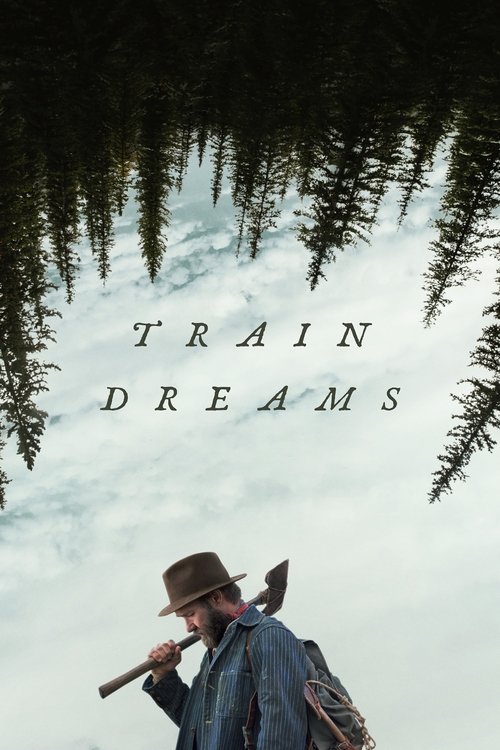
Train Dreams
2025 · Clint Bentley
For a reflective night when you want to feel the size of a life — grief, wonder, and all — and you're patient enough to let a film move at the speed of seasons. A meditative sit, and a likely cry.
What it's about
Robert Grainier is a logger, bridge-builder, and railroad laborer in the forests of the Pacific Northwest, and the film follows his whole quiet life — the wife and child he loves, the work that scars him, the losses that come — as early twentieth-century America transforms around him. Adapted from Denis Johnson's Pulitzer-finalist novella, it treats one unremarkable man's years as something worth the full weight of attention.
The experience
Slow, hushed, and quietly overwhelming — less a plot than a current that carries you through decades. It builds a lump in your throat you don't notice until it's already there.
Performances
Joel Edgerton plays Grainier with almost no showmanship — a weathered, watchful stillness that makes an ordinary man's endurance feel monumental.
The craft
Director Clint Bentley and co-writer Greg Kwedar compress Johnson's lyric prose into images: towering forests, rail trestles, firelight, the small human figure against enormous country. It's genuinely poetic filmmaking rather than filmmaking that announces itself as poetic, and the landscapes ask for the biggest screen you can find.
Why it matters
It brought one of the most beloved American novellas of the century to the screen and confirmed Bentley as a filmmaker of unusual patience and feeling.
Snapshot
Train Dreams is an adaptation of Denis Johnson's celebrated novella of the same name — first published in The Paris Review in 2002 and issued as a standalone book in 2011, where it became a finalist for the Pulitzer Prize for Fiction — directed by Clint Bentley from a screenplay he co-wrote with his longtime creative partner Greg Kwedar. It is a film of deliberate quietness and lyric compression, tracing the life of Robert Grainier, an itinerant laborer in the forests and railway camps of the American Pacific Northwest across the first half of the twentieth century. Played by Joel Edgerton, Grainier is an ordinary man — a logger, a bridge-builder, a hauler of freight — whose biography would never warrant a chronicle were it not for the way the film, like Johnson's prose, treats an unremarkable life as a vessel for the largest themes: love and its loss, the violence of progress, the indifference and grandeur of the natural world, and the bafflement of a single consciousness pressed against historical change it cannot comprehend. The narrative is elliptical and impressionistic, organized less by plot than by the accretion of remembered episodes, and carried in large part by voiceover narration that lifts Johnson's language directly into the soundtrack. Premiering in the U.S. Dramatic Competition at the 2025 Sundance Film Festival and subsequently acquired by Netflix, the film arrived as a prestige literary adaptation and a continuation of the unshowy, deeply humane filmmaking that Bentley and Kwedar had established with Jockey (2021) and Sing Sing (2023).
Industry & production
Train Dreams is the product of the American independent sector and of one of its more distinctive collaborative partnerships. Clint Bentley and Greg Kwedar have worked in tandem for over a decade, alternating directing and writing duties: Kwedar directed Transpecos (2016) and Sing Sing (2023), while Bentley directed Jockey (2021), with each man co-writing the other's films. Train Dreams, directed by Bentley and co-written with Kwedar, extends that method and the pair's recurring interest in marginal, working men whose interior lives the mainstream rarely pauses to consider.
The film was produced as an independent feature and brought to the 2025 Sundance Film Festival, where it screened in the U.S. Dramatic Competition — the same launchpad that has historically served as the principal marketplace and proving ground for American independent cinema. There it was acquired by Netflix, which positioned it within the streamer's strategy of absorbing festival-acclaimed prestige titles. Precise figures for the acquisition have circulated in the trade press, but as the public record on the exact terms is not something I can verify with confidence, I decline to cite a number rather than risk error.
The casting reflects the production's prestige ambitions while remaining consonant with Bentley and Kwedar's preference for performance over spectacle. Joel Edgerton, an Australian actor with a substantial body of character work, takes the central role of Robert Grainier; Felicity Jones plays his wife, Gladys. The supporting ensemble draws on respected character players — including William H. Macy and Kerry Condon — and the veteran actor Will Patton supplies the film's pervasive narration, a casting choice of real consequence given how much of the novella's effect lives in its narrating voice. Beyond these broad strokes, granular production detail — shooting schedule, exact locations, budget — is not something I can responsibly specify without documentation, and I note the thinness of the record rather than invent particulars.
Technology
Train Dreams is, by every available indication, a film whose technology serves an aesthetic of restraint and naturalism rather than spectacle. Its visual program depends on landscape — the old-growth forests, rivers, and mountain light of the Northwest — and on the photographic rendering of weather, season, and the rough textures of timber and labor. This is a tradition of location-based, naturalistically lit cinematography rather than one of optical or digital innovation. Where the film does engage the technological is at the level of its subject: the era it depicts is precisely the period in which industrial technology — the railroad, mechanized logging, the dynamiting of forests for rights-of-way — was remaking the American wilderness, and the film's imagery is necessarily concerned with the machinery of that transformation. On the question of capture format and any specialized apparatus, I do not have verified information, and it would be invention to assert a particular gauge or process; what can be said is that the film's technical means are demonstrably subordinated to mood, performance, and the depiction of an environment in the throes of change.
Technique
Cinematography
The cinematography is credited to Adolpho Veloso, and the film's visual identity rests on the depiction of the Northwestern landscape as both setting and protagonist. The forests, rivers, and skies are rendered with an attentiveness that makes the natural world a continuous presence rather than mere backdrop, and the photography is keyed to the rhythms of light, season, and weather that structure a laborer's outdoor life. The visual mode is observational and contemplative, favoring compositions that situate the small human figure within an immense environment — a strategy that visually enacts the film's central theme of an ordinary man dwarfed by nature and history alike. The handling of fire — a destructive wildfire is a pivotal event in Johnson's source — and of the changing forest across decades gives the cinematography its dramatic arc, moving from the density of old growth toward landscapes scarred and altered by both catastrophe and industry.
Editing
The film's editing is governed by the elliptical, associative structure of Johnson's novella, which proceeds not as continuous narrative but as a mosaic of episodes drawn from across Grainier's lifetime. The cutting must therefore manage large temporal leaps, threading a life together from fragments and memories rather than a linear chain of cause and effect. This lends the film a meditative, almost musical rhythm, in which scenes are juxtaposed for resonance and accumulation rather than plot momentum. The interplay of image and voiceover is central to the editorial scheme: narration carries the connective tissue of time and reflection while the images supply discrete, sensuous moments. I do not have a verified credit for the editor and so refrain from naming one; the editorial sensibility, however, is plainly that of a film built to honor the source's impressionistic compression.
Mise-en-scène / staging
The staging is rooted in period authenticity and in the physical reality of manual labor. The world of the railway camps, the logging operations, the modest homestead Grainier builds, and the forests in which he works are realized as lived, worked-in spaces, and the drama is staged through the rhythms of physical work — felling, hauling, building — as much as through dialogue. Bentley and Kwedar's prior films share this attention to the dignity and texture of labor, and Train Dreams extends it to the early-twentieth-century frontier. The domestic scenes between Grainier and Gladys provide the film's emotional center and are staged with intimacy and quiet, set against the vast impersonality of the surrounding wilderness. The film's recurring motifs — the forest, the railroad, fire, the solitary cabin — function within the mise-en-scène as both literal environment and thematic emblem.
Sound
Sound is among the film's most consequential dimensions, and on two fronts. First, the voiceover narration delivered by Will Patton is structurally essential: it transposes Johnson's distinctive prose voice into the film, supplying the reflective, retrospective register that frames Grainier's life as a told story. This reliance on narration is a defining formal choice, binding the film to its literary source in a way that is unusual and deliberate. Second, the score is composed by Bryce Dessner, the guitarist of the band The National who has built a substantial parallel career in film composition. Dessner's music tends toward the spare and the elegiac, an idiom well suited to the film's tone of quiet grace and loss. The naturalistic sound of the environment — the forest, the river, the labor of axes and machinery, the passing trains — completes a soundscape that grounds the film's lyricism in the sensory reality of its world.
Performance
Performance in Train Dreams is necessarily a study in interiority and restraint, since the protagonist is a taciturn man whose drama is largely internal and whose story is substantially mediated by narration. Joel Edgerton's Robert Grainier must convey a life of feeling through reticence — the weathering of grief, the endurance of solitude, the small graces of love and work — and the role exemplifies the kind of understated, deeply felt character acting that Bentley and Kwedar's cinema has consistently sought. Felicity Jones's Gladys anchors the film's central relationship and its great loss, and the supporting players, including William H. Macy and Kerry Condon, populate Grainier's intermittent encounters with the wider human world. The overall performance register is muted and naturalistic, in keeping with a film that finds its power in accumulation and absence rather than declamation.
Narrative & dramatic mode
The film's dramatic mode is elegiac and contemplative rather than conventionally dramatic. There is no governing plot in the ordinary sense; instead, the film offers the shape of an entire life, assembled from episodes and refracted through memory and narration. Its engine is not conflict-and-resolution but the passage of time and the sedimentation of experience — love found and lost, work undertaken and finished, a world transformed across decades. This is the mode of the literary tone-poem brought to film: a biography of an ordinary man treated with the seriousness usually reserved for the extraordinary. The central emotional turn is one of loss — the catastrophe that severs Grainier from the family and home he has made — after which the film becomes a study in solitude, endurance, and the slow reckoning of a man left alone with the wilderness and his memories. The retrospective narration frames the whole as something already past, lending every episode the coloring of elegy. It is melodrama in the most serious sense — a drama of feeling and recognition — but stripped of incident, its affect generated by ellipsis, juxtaposition, and the sheer weight of a life observed.
Genre & cycle
Train Dreams sits at the intersection of several traditions. It is a period drama and, in its setting and concerns, a kind of frontier or Western-adjacent film — though one that pointedly inverts the genre's mythology, replacing the gunslinger and the empire-builder with the anonymous laborer whose sweat actually built the infrastructure of the West. It belongs more precisely to the cycle of contemplative, literary American independent cinema concerned with landscape, labor, and the lives of marginal men: a lineage that includes the elegiac frontier films of recent decades and the broader strain of "slow," observational art cinema. As a literary adaptation faithful to an impressionistic, much-admired source, it participates in the tradition of films that attempt to translate a distinctive prose voice into image and sound rather than merely dramatizing a plot. Within the work of its makers, it extends a small but coherent cycle — Jockey, Sing Sing, and now Train Dreams — of films about working men in confined or demanding worlds, rendered with documentary attention and humane regard.
Authorship & method
Train Dreams is most legible as the product of the Bentley–Kwedar partnership, and it crystallizes the values that define their collaboration: an attention to overlooked, working lives; a preference for restraint, naturalism, and performance over spectacle; and a humane, almost reverent regard for ordinary human dignity. Clint Bentley directs and, with Greg Kwedar, adapts Denis Johnson's novella — and the central authorial challenge of the film is precisely one of adaptation: how to honor a source whose power lies in its language and its compression. The decision to retain Johnson's voice through sustained narration is the defining authorial move, a wager that fidelity to the prose is the truest fidelity to the book.
Among the key collaborators, cinematographer Adolpho Veloso supplies the landscape-centered visual program that makes nature a presence rather than a setting; composer Bryce Dessner provides the spare, elegiac score that matches the film's tone of grace and loss; and narrator Will Patton functions almost as a second author, carrying Johnson's prose into the film's texture. Joel Edgerton's restrained central performance is the human anchor around which the film's lyricism organizes itself. The editorial sensibility — whose specific credit I leave unattributed for lack of verified information — is essential to the film's mosaic structure. Above all, the film is a meeting of literary source and a directorial method committed to quietness, and its authorship is best understood as the disciplined service of Johnson's vision by filmmakers temperamentally suited to it.
Movement / national cinema
The film is a work of contemporary American independent cinema, and specifically of the festival-driven, prestige-adjacent strand that launches at Sundance and finds distribution through streaming platforms and specialty distributors. It belongs to a national-cinematic conversation about the American past — and particularly about the human cost and the laboring substrate of westward expansion and industrialization — conducted in a register of revisionist seriousness rather than mythic celebration. In its contemplative pace and its subordination of plot to mood and landscape, it also participates in the international current of "slow cinema" and observational art film, even as its subject and idiom are distinctly American. As an entry in the careers of Bentley and Kwedar, it marks the maturation of two filmmakers working at the artisanal end of the American independent sector, where modest means and a consistent moral sensibility produce films of unusual coherence.
Era / period
Train Dreams is set across the early decades of the twentieth century — the era, in the film's own framing, of monumental change in America — and its period is integral to its meaning. This was the age in which the railroad and mechanized logging penetrated and transformed the forests of the Pacific Northwest, in which old-growth wilderness was felled and dynamited to lay track and extract timber, and in which an entire pre-industrial way of life gave way to the machinery of modern capitalism. Grainier's biography is deliberately coextensive with this transformation: he is one of the anonymous workers whose labor built the infrastructure of the modern nation, and his life registers the cost of that progress at the most intimate human scale. The film's portrait of the period is unsentimental about the violence of development — to the land, to indigenous and immigrant labor, to the displaced — even as it finds grace in the lives lived within it. The historical moment is thus not mere backdrop but the film's true antagonist: the indifferent engine of change against which a single life is measured.
Themes
The film's governing theme is the dignity and significance of an ordinary, unremarkable life — the insistence that a man who leaves no mark on history is nonetheless a fit subject for the deepest contemplation. Around this orbit several interlocking concerns. There is the theme of love and loss, the emotional core of the film, in which the happiness Grainier builds is taken from him and he is left to endure. There is the theme of nature and its relation to humanity — the wilderness as both sustenance and overwhelming, indifferent power, beautiful and destructive by turns, embodied above all in fire. There is the theme of progress and its costs, the monumental change of the era figured as both achievement and devastation, with Grainier as both its instrument and its casualty. There is the theme of solitude and endurance — the long aftermath of loss, lived alone against the immensity of the natural world. And running beneath all of it is a meditation on memory and mortality, the film's retrospective narration framing a whole life as something to be recalled, weighed, and finally let go. The cumulative vision is elegiac: tender toward its subject, clear-eyed about the world's indifference, and quietly insistent that even the smallest life contains the universal.
Reception, canon & influence
Train Dreams premiered at the 2025 Sundance Film Festival to a strong critical reception, with praise concentrated on its lyricism, its faithful translation of Denis Johnson's prose, the restraint of Joel Edgerton's performance, and the beauty of its landscape cinematography. Its acquisition by Netflix signaled industry confidence in its prestige standing. As the film is recent, any judgment about its long-term canonical position would be premature, and I note that the fuller record of its awards trajectory and critical consolidation was still forming at the time of writing; I therefore decline to assert specific honors I cannot verify.
Influences on the film run, most directly, to its literary source — Denis Johnson's novella, whose impressionistic structure, elegiac tone, and distinctive voice the film strives to preserve. Beyond Johnson, the film draws on the tradition of contemplative, landscape-centered American cinema concerned with the frontier and its human cost, and on the broader heritage of literary adaptation that privileges fidelity to voice over fidelity to incident. Within its makers' own work, it builds on the method established in Jockey and Sing Sing — the patient, humane study of working men.
Its influence forward cannot yet be assessed with any confidence given its recency, but its significance is most plausibly located in two areas: as a further consolidation of the Bentley–Kwedar partnership as a distinctive voice in American independent cinema, and as a notable instance of a streaming platform backing a deliberately uncommercial, contemplative literary adaptation — a model whose viability shapes what kinds of serious film get made and seen. Should the film endure, it will likely do so as an exemplar of how an "unfilmable" prose work of interiority and compression can be rendered on screen through the disciplined marriage of image, landscape, score, and narrating voice.
A Deleuzian reading
Picture Robert Grainier at the foot of a tree older than the country he lives in, axe in hand, about to bring down something that took centuries to grow.
The full Deleuzian reading of Train Dreams →
Reception
It walked out of Sundance 2025 as the festival's quiet consensus masterpiece, got scooped up by Netflix, and by year's end had climbed from 'gorgeous little indie' to four Oscar nominations including Best Picture — the rare streaming-era film whose stature only grew after it hit the platform.
How Train Dreams was received, from release to now →
How to watch Train Dreams: what to notice on a first viewing
- Listen for a narrator's voice, not Grainier's own. Will Patton narrates Robert Grainier's life in the third person, lifting Denis Johnson's prose directly onto the soundtrack instead of giving Grainier his own spoken voice. Someone else is telling this story, because the man living it never would.
- Notice how small Grainier looks against the forest. Compositions repeatedly situate the small human figure within an immense environment, forests, rivers, sky, so the landscape reads as a continuous presence rather than backdrop. The scale of the frame is already telling you who has the real power here.
- Watch the rhythm of his physical work, not his words. The drama is staged through felling, hauling, and building as much as through dialogue, a taciturn man's whole interior life expressed in the motion of his hands. You learn who Grainier is by watching what his body does, not by what he says.
- Notice years passing between scenes without warning. The film accretes remembered episodes from across Grainier's lifetime rather than following one continuous chain of cause and effect, jumping across years in a single cut. A whole life is assembled here from fragments, the way memory actually works.
- Listen for axes, machinery, and trains under the score. Bryce Dessner's spare music sits alongside the actual sound of labor and forest, axes, engines, running water, grounding the film's lyricism in physical, sensory reality. The world sounds worked-in, not just beautifully composed.
The whole guide to watching Train Dreams, with the keys for a rewatch →
Influences: the films it descends from and the films it influenced
- Days of Heaven (1978) — Establishes the image/voiceover interplay Train Dreams runs on: magic-hour landscape photography paired with a narrating voice that drifts free of the plot rather than explaining it.
- The Tree of Life (2011) — Fragments a single life into an elliptical, non-chronological mosaic held together by whispered interior voiceover instead of causal scene-to-scene plotting.
- The Thin Red Line (1998) — Converts a novel's interior prose into layered, free-floating voiceover set against an indifferent natural world, the same wager on voice-as-fidelity Train Dreams makes.
- A River Runs Through It (1992) — Preserves Norman Maclean's first-person prose through sustained narration over Montana landscape, privileging fidelity to literary voice over fidelity to incident.
- Barry Lyndon (1975) — An omniscient literary narrator carries the source's voice while human figures are dwarfed inside painterly wide compositions, landscape as framing presence.
- The Assassination of Jesse James by the Coward Robert Ford (2007) — Anti-mythic western fusing Deakins' elemental landscape photography with a third-person literary narrator's elegiac prose, the closest formal cousin to Train Dreams' narrated tone-poem.
- McCabe & Mrs. Miller (1971) — Builds the frontier from naturalistic period-labor texture, weather, and mournful folk scoring rather than genre heroics, the anti-mythic western template.
- Heaven's Gate (1980) — Renders immigrant frontier labor and the violence of capital's 'progress' through dust-and-smoke period authenticity staged at epic landscape scale.
- The Emigrants (1971) — Patient frontier chronicle whose period-accurate manual labor and figures dwarfed by wilderness model the elliptical, life-span sweep of working lives.
- Sing Sing (2023) — The Bentley–Kwedar partnership's humane, naturalistic attention to overlooked men and non-professional texture, the shared authorial signature.
- Jockey (2021) — Bentley's own restrained study of a working man's aging body and mortality establishes the quiet, performance-over-spectacle method Train Dreams refines.
- First Cow (2019) — Anti-mythic Pacific-Northwest frontier built from quiet labor, small gestures, and boxed-in naturalism that refuses western spectacle.
- Meek's Cutoff (2010) — Pioneers dwarfed within an unforgiving frontier landscape, with narrative information withheld and time rendered elliptically.
- The Power of the Dog (2021) — Anti-mythic western of restrained interiority in which the landscape itself operates as a psychological presence rather than backdrop.
- Nomadland (2020) — Elegiac American-West landscape cinematography married to near-documentary, restrained performance tracing solitude and loss across a life.
- The Revenant (2015) — Shares Bryce Dessner's spare co-composed score and natural-light landscape photography that dwarfs the human figure amid the violence of frontier 'progress.'
Similar films
- The Revenant (2015) — influence & lineage
- The Emigrants (1971) — influence & lineage · same viewing thread
- Godland (2022) — same viewing thread
- The Station Agent (2003) — same viewing thread
- The Tree of Life (2011) — influence & lineage · often watched together
- Heaven's Gate (1980) — influence & lineage · often watched together
- Hamnet (2025) — often watched together
- The Brutalist (2024) — shared sensibility
All the films related to Train Dreams →
Watch it with: curated runs of related films
- Quiet Lives at the World's Edge — Watch these when you want a life pared down to essentials — someone walking out of society to start from zero, or simply living out their days at the margins.