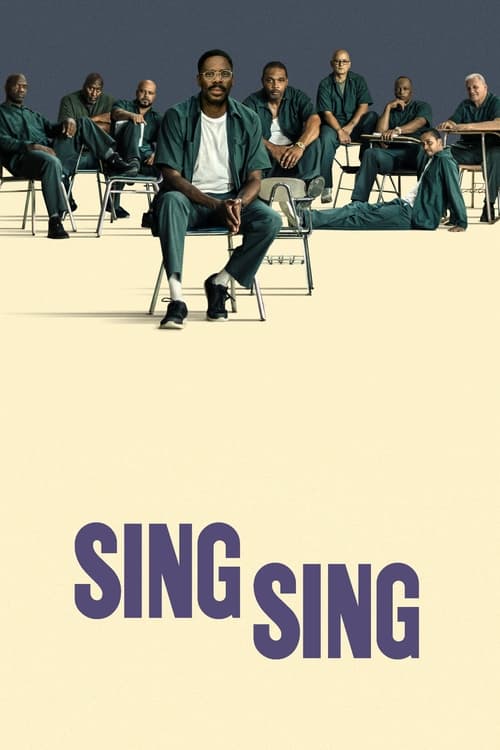
Sing Sing
2024 · Greg Kwedar
When you want to be moved and restored — proof-of-human-decency viewing for a night you need to believe people can change. Emotionally open but never a hard watch.
What it's about
John "Divine G" Whitfield is serving time at Sing Sing for a crime he says he didn't commit, and he has built a life inside around a theater program where incarcerated men write, rehearse, and stage plays. When a guarded yard tough named Divine Eye joins the group, the film follows the friction and friendship between them as the ensemble puts together its most ambitious production yet — men learning to be vulnerable in a place built to punish vulnerability.
The experience
Tender and direct, with almost no prison-movie brutality — the intensity is all in faces, rehearsals, and the risk of letting your guard down. It's the kind of film that makes you cry without ever begging for it, and you leave feeling larger, not wrung out.
Performances
Colman Domingo is extraordinary — warm, wounded, carrying decades of contained hope in his posture — and Clarence Maclin, a real alumnus of the program essentially playing himself, matches him scene for scene with a rawness no trained actor could fake.
The craft
Much of the cast are formerly incarcerated men who lived this story, and the film's whole method — casting, intimacy, patience — argues that they're the ones best equipped to tell it. Shot with a grainy, sunlit warmth that makes the prison feel like a place where people live rather than a set, it trusts long rehearsal scenes to do the dramatic work.
Why it matters
One of the most acclaimed American films of 2024 and a career-peak showcase for Domingo, it became the flagship case for casting people to play their own lived experience — and for what prison arts programs actually do.
Snapshot
Sing Sing is a chamber drama about men in a maximum-security prison putting on a play, and it is also an argument — advanced through casting, financing, and form rather than through speeches — that the people who lived a story are the people best equipped to perform it. Colman Domingo plays John "Divine G" Whitfield, a writer and jailhouse lawyer serving time at Sing Sing Correctional Facility for a crime he maintains he did not commit, who has built a life inside around the Rehabilitation Through the Arts (RTA) theater program. Around Domingo, director Greg Kwedar assembled a cast composed substantially of RTA alumni playing versions of themselves, chief among them Clarence "Divine Eye" Maclin, a formerly incarcerated man whose transition from yard enforcer to actor supplies the film's second and arguably primary arc.
The film is adapted, per its credits, from John H. Richardson's Esquire reporting on the RTA program and from Brent Buell's genuinely deranged time-travel comedy Breakin' the Mummy's Code, which the men rehearse and stage within the film. Its screenplay is credited to Clint Bentley and Kwedar, with story credit shared by Maclin and Whitfield — a credit allocation that is itself part of the film's ethics. A24 opened it in the summer of 2024, withdrew it, and re-released it in early 2025 around its awards campaign, an unusual two-stage theatrical strategy for a film of its scale. It received three Academy Award nominations at the 97th ceremony: Best Actor for Domingo, Best Adapted Screenplay, and Best Original Song for "Like a Bird," by Abraham Alexander and Adrian Quesada.
Industry & production
Sing Sing is a low-budget American independent film that behaved, industrially, like a manifesto. Its most-discussed production fact is its compensation structure: cast and crew, from Domingo down, worked for the same day rate — union scale — and shared equally in the film's backend equity. In an industry organized around above-the-line differentials, this was not a symbolic gesture but a structural one, since a meaningful share of the ownership went to men who had recently been incarcerated and who had no prior screen credits or representation. The arrangement was widely reported and has since circulated in independent-film financing conversations as a reference model.
Production ran on a compressed schedule — reportedly around three weeks — and shot largely at Downstate Correctional Facility in Fishkill, New York, a state prison decommissioned shortly before filming. This is a materially important choice. Rather than building sets or negotiating access to an operating facility (which would have constrained shooting hours, movement, and the presence of formerly incarcerated cast members), the production took possession of a real, emptied carceral machine: real tiers, real corridor lengths, real acoustic properties, real institutional paint. The film's spaces are not designed to look like a prison; they are a prison, filmed after its population was moved elsewhere.
Kwedar and Bentley have worked as a unit for over a decade, alternating director and co-writer roles across Transpecos (2016) and Jockey (2021) under their Marfa Peach Company banner. Domingo produced as well as starred, bringing a name that could unlock financing without imposing a star vehicle's shape on the material. The film premiered at the Toronto International Film Festival in 2023 and carried a long runway of festival and community screenings — including screenings for incarcerated audiences — into its release. Its theatrical gross was modest relative to its critical standing; precise figures vary by source and are not restated here.
Technology
The film was shot on 16mm. That choice does several kinds of work at once. Grain is legible in nearly every frame, and it functions less as nostalgia than as texture — a surface that reads as documentary-adjacent, closer to the 16mm stock of institutional documentary and 1970s American location shooting than to the clean digital surface of contemporary prestige drama. Practically, a 16mm package is small, and smallness mattered: the crew had to move through corridors and cells built to restrict movement, with a cast that included many first-time screen performers for whom a large apparatus would have been an obstacle rather than a support.
The film's other relevant technologies are the ones it declines to fetishize. Contemporary carceral cinema often organizes itself around surveillance imagery — camera feeds, monitors, checkpoints, biometric scanning. Sing Sing registers the institutional machinery (doors, keys, counts, the public-address system, the metal detector) mainly through sound and through the rhythm it imposes on scenes, and keeps its visual attention on faces. Against that, it foregrounds a much older technology: amateur stagecraft. Painted flats, thrift-store costumes, hand-lettered scripts, a gymnasium converted into a house. The film is interested in what a mummy costume and a folding chair can do, and treats that as a genuine technical subject rather than as pathos.
Technique
Cinematography
Pat Scola — whose work on Pig (2021) showed a similar willingness to hold on a face until it becomes a landscape — shoots in a register of held, shallow-focus proximity. The dominant unit is the close-up, often handheld but rarely agitated, with the operator breathing rather than jittering. Scola tends to let backgrounds fall away entirely, so that a man in a corridor is isolated from the corridor even while standing in it; the effect is to grant interiority in a place designed to deny it.
Light is divided along the film's central axis. Institutional spaces are cool, top-lit, and even — the flat, sourceless illumination of a room where nothing is meant to be hidden. The rehearsal space is warm, side-lit, full of dust and window light, and shot with more air around the actors. The film's compositional habit is to frame men through apertures — doorways, bars, the proscenium — and then, in the theater scenes, to abandon that habit, so that the visual grammar itself relaxes when the men do.
Editing
Parker Laramie's cutting is elliptical and unusually patient with silence. Scenes frequently begin after their inciting beat and end before their resolution, which keeps the film from resolving into a series of dramatic units. There is rehearsal-montage material, but it is deployed sparingly and never as an engine of triumph; time passes according to the play's progress rather than by calendar markers. The most conspicuous editorial choice is what the film refuses to cut to: the parole hearing sequences are held in long, unrelieved takes on faces receiving bureaucratic language, and the film declines the reaction-shot rhythm that would let the audience discharge its discomfort.
Mise-en-scène / staging
The film's staging depends on the contrast between two systems of dress and space. State-issue uniforms flatten the men into a single visual mass; the play's costumes — pirates, gladiators, an Egyptian mummy, a Freddy Krueger figure, Hamlet — are anachronistic, cheap, and gloriously incoherent. Breakin' the Mummy's Code is a bad play in the conventional sense and the film knows it, which is precisely the point: the men are not redeemed by encountering great art but by making something together, badly and seriously.
The rehearsal room operates as a genuine heterotopia — a space inside the institution where the institution's rules of address are suspended. Kwedar stages group scenes in circles and semicircles, with bodies oriented toward each other rather than toward authority, and stages institutional scenes in lines, files, and frontal confrontations. The camera in the theater often sits at the level of the seated group, inside the circle rather than observing it.
Sound
The sound design is one of the film's least-discussed strengths. Corridors carry a long, metallic reverb; the rehearsal room is comparatively dead and close. The film uses this acoustic difference as a structural signal, so that a cut between spaces registers in the ear before the eye. Ambient carceral sound — keys, gates, distant voices, the PA — is present but mixed low and rarely dramatized.
Bryce Dessner's score is restrained and mostly string- and piano-based, arriving late in scenes and often withdrawing before their end. Large stretches of the film carry no music at all. "Like a Bird," the Alexander and Quesada song that closes the film, is placed where a score cue would normally seal an emotional argument, and it functions instead as a release valve after the film has already declined to provide one.
Performance
The central methodological gamble is the pairing of a virtuoso trained actor with nonprofessionals playing themselves. Domingo's Divine G is a performance of enormous technical control that spends most of its running time suppressing that control — a man whose composure is a survival strategy, and whose collapse, when it arrives, is not cathartic but frightening. Maclin, by contrast, plays with almost no technique in the received sense, and the film organizes itself around his register rather than Domingo's. Their scenes work because Domingo modulates down to meet him; the acting-lesson scenes between them are also, transparently, the film's account of its own production.
The RTA alumni in the cast are not deployed as texture. They carry scenes, initiate conflict, and hold close-ups. John Whitfield himself appears in the film. The result is a performance ecology in which the distinction between representing an experience and having had it is deliberately unstable.
Narrative & dramatic mode
Structurally, Sing Sing is a backstage film — the "let's put on a show" template, which in American cinema is almost always a comedy of collective effort. Kwedar keeps the template's forward motion (auditions, rehearsals, crises, opening night) and empties it of its usual payoff. The film's emotional climax is not the performance. It arrives earlier, in private, and the performance itself is handled with something close to modesty.
Two arcs run counter to each other. Divine G's is a descent: a man who has organized his identity around innocence, articulacy, and institutional hope is systematically deprived of each, most brutally by a parole process that treats his self-possession as evidence against him. Divine Eye's is an opening: a man who has organized his identity around impermeability discovers that performance requires him to be legible. The film's dramatic logic is that these arcs must cross — that G's collapse is the precondition for Divine Eye's emergence, and that the friendship survives the exchange.
The film also pointedly refuses the genre's standard plot engines. There is no escape, no riot, no corrupt-warden antagonist, no violence staged for spectacle. Grief enters not through the machinery of the prison but through mortality, in the death of a member of the group, and the film's handling of that loss — collective, undramatized, absorbed into the work — is its most distinctive dramatic move.
Genre & cycle
The prison film is one of American cinema's most rigidly codified genres, running from The Big House (1930) and Brute Force (1947) through Cool Hand Luke (1967) to The Shawshank Redemption (1994), and it is overwhelmingly a genre of resistance, escape, and martyrdom. Sing Sing belongs instead to a smaller counter-tradition of the carceral procedural, interested in duration, institution, and the maintenance of self.
More specifically, it sits inside a distinct 2010s–2020s cycle of American films about incarceration and reentry made under the influence of the abolitionist and criminal-justice-reform turn in public discourse: Chinonye Chukwu's Clemency (2019), Laure de Clermont-Tonnerre's The Mustang (2019) — another prison-rehabilitation-program film built on a nonhuman collaborator — and Garrett Bradley's documentary Time (2020), which shares Sing Sing's conviction that the real subject is the texture of waiting. The cycle's common formal signature is a refusal of the spectacle of prison violence.
Authorship & method
Kwedar and Bentley's authorship is best understood as a shared practice rather than an individual signature: they co-write everything and trade the director's chair, and their films consistently locate drama inside enclosed vocational worlds — border patrol in Transpecos, the backstretch in Jockey — using nonprofessional or semi-professional performers embedded in those worlds. Sing Sing is the fullest realization of that method, because here the participants are not merely consultants on authenticity but co-owners of the story and, via the equity structure, of the film.
Scola's contribution is the film's grammar of proximity; Laramie's is its resistance to closure; Dessner's is a score that declines to instruct. Buell's play is the found object at the center, and Paul Raci — himself an actor whose most celebrated work, in Sound of Metal (2019), came out of a lived relationship to the community he portrayed — plays Buell as a facilitator rather than a savior, which is the single most important calibration in the script. The white outsider who runs the program is not the film's protagonist, does not deliver its thesis, and is not shown transforming anyone.
Movement / national cinema
Sing Sing is a product of the American independent sector in its A24-era configuration: festival premiere, star-anchored financing, modest budget, prestige distribution, awards campaign. But its deeper affiliations are with a long international tradition of casting nonprofessionals to play their own lives — Italian neorealism's use of the street, Kiarostami's Close-Up (1990) with its participants re-enacting themselves, the Dardennes' vocational realism, and in the United States the work of Charles Burnett and, more recently, RaMell Ross. It also belongs to a strand of contemporary Black American filmmaking concerned with interiority, tenderness, and men's permission to be soft — a lineage in which Barry Jenkins' Moonlight (2016) is the proximate landmark, and to which Domingo's own body of work is central.
Era / period
The film arrives at a moment of acute strain for the theatrical independent: a post-pandemic exhibition landscape, a streaming-dominated financing environment, and the aftermath of the 2023 labor actions, which made questions of compensation, residuals, and who owns the upside of a film unusually live. Sing Sing's equity model reads differently in that context than it would have a decade earlier — not as boutique idealism but as a direct proposal about ownership.
It also arrives after a decade in which mass incarceration moved from specialist concern to mainstream subject in American media, and after the reform energy of 2020 had substantially receded politically. The film's implicit position is that the argument now has to be made at the level of personhood rather than policy.
Reception, canon & influence
Critical reception was strongly positive and unusually focused on the film's method. Reviewers widely singled out Domingo's restraint and Maclin's presence, and the discovery framing around Maclin — a nonprofessional holding the screen against one of the best actors of his generation — became the dominant press narrative. The film converted that into a substantial awards-season run, culminating in three Oscar nominations. A dissenting line of criticism, present from the festival circuit onward, held that the film's humanism is also a softening: that by locating its drama almost entirely inside the sanctuary of the theater program, it leaves the conditions of confinement — violence, medical neglect, solitary, the economics of the system — largely off-screen, and risks offering art-as-redemption as an answer to a structural problem. That reading is not unfair, and the film does not fully answer it; what it offers instead is the refusal to make its subjects' worth contingent on innocence.
Backward. The most direct antecedent is Paolo and Vittorio Taviani's Caesar Must Die (2012), which filmed inmates at Rome's Rebibbia prison rehearsing and performing Julius Caesar and deliberately blurred documentary and fiction. Nearer to home is Robert M. Young's Short Eyes (1977), adapted from Miguel Piñero's play, shot in a real New York City facility with a cast drawn partly from people with carceral experience — an almost exact structural precursor that has never received comparable attention. Documentary precedents include Hank Rogerson's Shakespeare Behind Bars (2005) and, more distantly and more antagonistically, Frederick Wiseman's Titicut Follies (1967), whose title's echo of institutional theater hangs over the whole subgenre. Jean Genet's Un Chant d'Amour (1950), Robert Bresson's A Man Escaped (1956), Steve McQueen's Hunger (2008), and Jacques Audiard's A Prophet (2009) form the art-cinema wall against which Sing Sing's gentleness defines itself.
Forward. The film is too recent for a settled legacy, and any claim otherwise would be premature. What is already visible is influence of two kinds. The first is industrial: the equal-pay-and-equal-equity structure has entered independent-film discourse as a concrete, cited precedent rather than an abstraction, and has been raised repeatedly in conversations about how films made with non-professional or subject-community participants should distribute their upside. The second is institutional: the film substantially raised the public profile of Rehabilitation Through the Arts and of prison arts programming generally, and Maclin's move into a professional acting career is itself the argument made flesh. Kwedar and Bentley continued their partnership on Train Dreams (2025), directed by Bentley from their co-written adaptation of Denis Johnson's novella — a continuation of the same interest in inarticulate men and the shape of a working life, made at a different scale.
Whether Sing Sing enters the durable canon of the prison film will depend on something the film cannot control: whether its central formal claim — that the distinction between the actor and the person is a distinction worth dissolving — is taken up by other filmmakers or remains a singular case. On the evidence of the film itself, the claim is sound.
A Deleuzian reading
A man sits in a folding chair while a parole board reads his life back to him in the language of forms.
The full Deleuzian reading of Sing Sing →
Reception
A TIFF 2023 sensation that critics adored but almost nobody saw in its quiet summer 2024 rollout — then A24's awards-season re-release turned it into the 'why did no one watch this' cause célèbre of the year, complete with screenings inside prisons.
How Sing Sing was received, from release to now →
How to watch Sing Sing: what to notice on a first viewing
- Watch faces held close until the background disappears. Pat Scola shoots in shallow-focus proximity, letting corridors and rooms fall out of focus behind the men so a face becomes its own landscape. Deleuze calls a feeling held on a face before it turns into action the affection-image, and that is the film's basic unit.
- Notice the institutional rooms lit flat and cool, the rehearsal room warm and dusty. Cool, even, top-lit illumination marks the prison's official spaces, while the theater room is warm, side-lit, and full of window light and dust. The two lighting registers tell you which spaces let the men be themselves before any scene does.
- Watch the men framed through doorways and bars. The film repeatedly shoots men through apertures, doorways, bars, the proscenium, and then drops that habit once rehearsal scenes begin. The visual grammar itself relaxes exactly when the men do, without a line of dialogue announcing it.
- Compare the state uniforms to the play's costumes. Identical prison uniforms flatten the men into one visual mass, while the rehearsal costumes, pirates, a mummy, Hamlet, are cheap, mismatched, and gloriously incoherent. The contrast shows the men are not redeemed by great art, only by making something together, badly and seriously.
- Listen for how differently a corridor and the rehearsal room sound. Corridors carry a long, metallic reverb, while the rehearsal room is close and dead, so a cut between the two spaces registers in your ear before you see it. The acoustic contrast tells you where you are before your eyes catch up.
The whole guide to watching Sing Sing, with the keys for a rewatch →
Influences: the films it descends from and the films it influenced
- Caesar Must Die (2012) — Opens with an audition in which each incarcerated man states his name, birthplace, and sentence before reading, then shoots rehearsal inside the cell blocks so the dramatic text and the institutional architecture occupy one frame — the rehearsal-in-situ grammar Sing Sing adopts wholesale, down to Divine Eye's audition as character-establishing scene.
- Short Eyes (1977) — Shot inside the actual Manhattan House of Detention with a cast drawn from Miguel Piñero's Family theater company and men with carceral experience playing near-versions of themselves — the exact structural template of casting the milieu rather than reconstructing it on a set.
- Shakespeare Behind Bars (2005) — Establishes the rehearsal-room documentary unit in which a man's line reading doubles as disclosure of his crime, the camera holding on the face after the text ends; Sing Sing converts that documentary equation into scripted scenes without changing its shot logic.
- Titicut Follies (1967) — Frames an institution through its own amateur variety show and records in direct sound, letting offscreen keys, corridor echo, and PA announcements carry the custodial apparatus while the camera stays on inmates' faces — the source of Sing Sing's offscreen institutional ambience as a structuring track rather than atmosphere.
- A Man Escaped (1956) — Casts nonprofessional 'models' reduced to hands and gesture in tight close-up, and assigns narrative work to offscreen sound — footsteps, cell doors, a passing tram — that the camera deliberately declines to show; Sing Sing's shallow-focus hands and its sound-designed prison beyond the frame are Bressonian bookkeeping.
- Un Chant d'Amour (1950) — Establishes the prison film's fundamental optical figure — bodies composed through apertures: peepholes, door slots, the gap in a wall — which Sing Sing restates as its framing-through-apertures motif of door windows, gate mesh, and bar intervals.
- Marat/Sade (1967) — Films institutionalized people staging a play under staff supervision with handheld cameras placed inside the performing circle rather than out in the house, so the audience's sightline is a participant's — the direct precedent for Sing Sing's circles-versus-lines staging of workshop versus yard.
- Vanya on 42nd Street (1994) — Performs a full play in street clothes in a decaying theater with no costume, lighting, or sound cue to mark the crossing from person into role, so the transition happens only in the actor's voice — Sing Sing's central formal claim, that the actor/person distinction is worth dissolving, is this film's method applied to a prison.
- Opening Night (1977) — Covers rehearsal and backstage with searching handheld shallow-focus that treats an actor's private crisis and the play's text as one continuous material, cutting between them without transition — the shooting grammar behind Sing Sing's Divine G scenes.
- Hunger (2008) — Builds an elliptical, largely wordless prison film around one sustained, near-static two-hander that becomes the structural axis of the whole — the same load-bearing use of the long take that Sing Sing gives its parole hearings against otherwise heavily elliptical cutting.
- A Prophet (2009) — Locks a handheld, shallow-focus camera to an unknown lead's sightline so the viewer learns the institution's unwritten procedure at exactly his speed; Sing Sing borrows the apprenticeship-of-perception structure but swaps the criminal economy for the theater program's rules.
- Jockey (2021) — The partnership's prior proof of method: real backstretch riders cast as themselves, magic-hour available light with a small package, and the vocational ritual (the weigh-in, the medical) used as the basic scene unit — the parole hearing in Sing Sing is the same device relocated.
- Train Dreams (2025) — Direct continuation of the Kwedar–Bentley shared-credit practice — co-written adaptation, chairs traded — carrying forward the same close-up-on-an-inarticulate-man construction and elliptical treatment of a working life at larger scale.
- The Florida Project (2017) — Places a single trained professional inside a nonprofessional ensemble and directs him to lower his register until he matches theirs, rather than raising the amateurs to his — the precise casting calibration between Colman Domingo and Clarence Maclin.
- Sound of Metal (2019) — Casts from the actual community it depicts and organizes its structure as an alternation between two incompatible acoustic registers, the cut between them carrying the dramatic turn; Sing Sing uses acoustic contrast — workshop warmth against corridor reverb — the same structurally.
- Nickel Boys (2024) — Renders a carceral institution almost entirely through aperture-bound, body-adjacent framing and refuses conventional coverage of its violence, arriving from the opposite formal extreme at Sing Sing's decision to keep the system's brutality offscreen.
- C'mon C'mon (2021) — Shares Bryce Dessner's scoring idiom — piano and string figures that enter underneath speech and resolve after the cut rather than over it — and intercuts nonprofessional, quasi-documentary testimony with scripted scenes without changing camera language between them.
Similar films
- Nickel Boys (2024) — influence & lineage
- The Shawshank Redemption (1994) — same viewing thread
- 12 Years a Slave (2013) — same viewing thread
- The Green Mile (1999) — same viewing thread
- Just Mercy (2019) — same viewing thread
- Ghostlight (2024) — shared sensibility
- Corpus Christi (2019) — shared sensibility
- One Night in Miami... (2020) — shared sensibility
All the films related to Sing Sing →
Watch it with: curated runs of related films
- Judgment and Mercy — Watch these together for the way each puts a life on the scales — a jury room, a death-row block, a slave plantation, a gunfighter's conscience — and asks what mercy costs the people handing down the verdict.