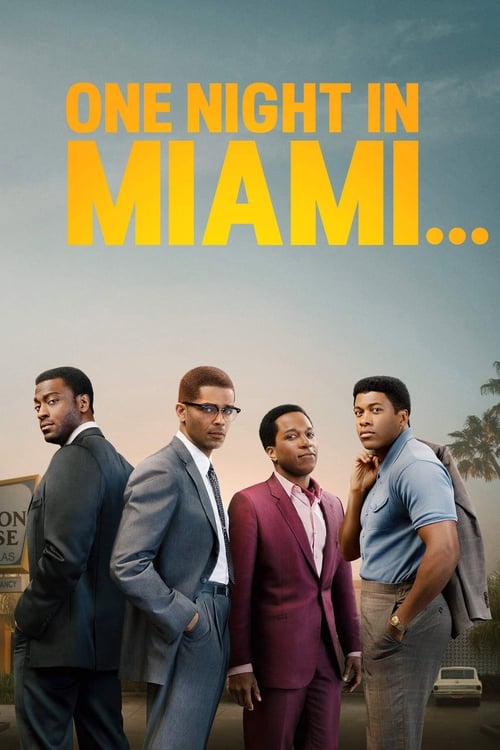
One Night in Miami...
2020 · Regina King
For a night when you want a film to chew on — conversation as combat, history made intimate. More stimulating than soothing, but never a slog.
What it's about
February 1964: hours after Cassius Clay's upset win over Sonny Liston, four friends at the peak of Black American fame — Clay, Malcolm X, Sam Cooke, and Jim Brown — gather in a Miami motel room. What history didn't record, the film imagines: a long night of celebration, needling, and argument about what each man owes the movement, with Malcolm pressing hardest and Cooke pushing back.
The experience
Talky in the best way — a slow-burn chamber piece where the tension comes from ideas and friendship under pressure, punctuated by warmth, jokes, and songs. It sends you out arguing with yourself.
Performances
Kingsley Ben-Adir plays Malcolm X as anxious and burdened rather than iconic, and Leslie Odom Jr.'s Sam Cooke matches him argument for argument — then sings, and the film's whole debate lands in a single performance. Eli Goree's Clay and Aldis Hodge's Jim Brown round out an ensemble with no weak corner.
The craft
Regina King, directing her first feature after three decades of acting, opens up Kemp Powers's stage play just enough to breathe without diluting its pressure-cooker intimacy. The craft is in the staging: four men, one room, and a camera that always knows whose reaction matters.
Why it matters
A landmark actor-turned-director debut that arrived amid a national reckoning on race and felt written for the moment, earning Odom an Oscar nomination and confirming King as a filmmaker.
Snapshot
Four men, one motel room, one night in February 1964. Regina King's feature directorial debut takes a documented but almost entirely unrecorded gathering — Cassius Clay, Malcolm X, Sam Cooke and Jim Brown convening at Miami's Hampton House after Clay's upset defeat of Sonny Liston — and fills its silence with argument. Adapted by Kemp Powers from his own 2013 stage play, the film is a chamber piece disguised as an event movie: no fight choreography of consequence, no assassination, no crescendo of historical incident, just four Black men at the apex of American fame negotiating what that fame obliges them to do. The ellipsis in the title is doing real work. This is a conversation the film declines to close.
Made by a first-time feature director who had spent three decades in front of the camera and several years behind it in television, released by Amazon Studios into the strange pandemic distribution landscape of late 2020, it became one of the defining prestige objects of an awards season unusually crowded with Black historical drama. It is also, in the plainest sense, a film about the impossibility of separating art from politics, made in a year when that separation had collapsed in public.
Industry & production
Powers wrote One Night in Miami... for the stage; it premiered at Los Angeles's Rogue Machine Theatre in 2013 and was subsequently produced at London's Donmar Warehouse in 2016 under Kwame Kwei-Armah's direction. The screen rights moved through independent hands rather than a studio pipeline, and King attached as director after building a television directing résumé across series including Scandal, Being Mary Jane, This Is Us and Insecure — a now-familiar route by which established actors, particularly Black women, have entered feature direction through episodic television rather than through the indie festival circuit.
Two production facts shape the film materially. First, ABKCO — the company that controls Sam Cooke's recorded catalog — was involved on the production side, which gave the film access to Cooke's music that a comparable project might have spent its entire budget chasing. A Cooke film without Cooke recordings would be a different and much weaker object. Second, the film was shot largely in Louisiana rather than Miami, with New Orleans and its surroundings standing in for the segregated Florida of 1964 — a routine tax-incentive decision that nonetheless suits a story in which the specific room matters more than the specific city.
Principal photography took place in early 2020, immediately before the COVID-19 shutdown, and the film's release was entirely shaped by the pandemic. It premiered at the 77th Venice International Film Festival in September 2020 — reported at the time as the first feature directed by an African American woman selected for that festival's official selection — then played Toronto and AFI Fest before a limited theatrical release at Christmas 2020 and a Prime Video premiere in January 2021. That hybrid pattern, a token theatrical window servicing awards eligibility followed by streaming, was the standard prestige release of the 2020–21 season, and it meant the film reached most of its audience as a domestic object viewed at home — an odd but not unflattering fit for a movie set almost entirely in one rented room.
Technology
The film's technological interest is less in capture than in preservation and access. Its climax depends on a televised musical performance from an era of American broadcast television that was very poorly archived; a great deal of early-1960s network programming was wiped or never kept, and the visual record of Black performers on those stages is correspondingly thin. The film effectively reconstructs a moment whose original documentation is fragmentary — a reconstruction of a broadcast rather than a quotation of one. That gap is the same gap the whole film addresses: the historical record confirms the men were together, and preserves nearly nothing of what passed between them.
On the production side, the technology is the enabling condition rather than the subject. Contemporary low-light digital sensors are what allow an interior of practical lamps, a single window and a bare bulb to be photographed at a naturalistic exposure without the fill-heavy flattening that a slower stock would have required; the motel room can look like a motel room. Music technology also enters the narrative as theme: Cooke's argument for ownership of masters and publishing, his running of his own label and production company, is an argument about controlling the means of reproduction, and the film treats the record business as infrastructure, not backdrop.
Technique
Cinematography
Tami Reiker, ASC — a cinematographer with deep experience in intimate American independents (High Art, Love & Basketball, Pieces of April) — faces the single-set problem directly: how to keep a box legible and varied for ninety minutes without resorting to restless coverage that signals panic. The solution is architectural. The room is established early as a set of zones — two beds, a small table, a bathroom, a window, a door to the balcony, and stairs to the roof — and the staging keeps redistributing the four men across them so that each new configuration reads as a new alignment. Doorframes, the bathroom mirror and the sightlines between beds do the work that cutting would otherwise have to do.
Light is source-motivated and warm, dominated by tungsten practicals; the room feels enclosed and slightly stale, and the roof functions as the film's only exhalation. The prologue sequences — Clay's near-disaster at Wembley, Cooke's cold reception at a white supper club, Brown's afternoon on a Georgia porch — are differentiated in palette and camera behavior, so that the film establishes four visual worlds before compressing them into one. It is a deliberately unshowy scheme; the camera is generally at eye level and generally patient, and the most aggressive choices are reserved for moments when the argument turns personal.
Editing
Tariq Anwar, whose credits include American Beauty, Revolutionary Road and The King's Speech, brings a sensibility trained on dialogue scenes carried by faces. The film's editorial rhythm alternates between long, loose, ensemble-scaled takes that let the room breathe and rapid shot/reverse exchanges when two men square off, so that cutting rate itself becomes a measure of dramatic temperature. Anwar resists the temptation to over-cut for pace; the film's stillnesses are where its pressure accumulates.
The most conspicuous editorial gesture is the ending, which cross-cuts a televised performance against private acts of watching, allowing the film to answer its central argument musically rather than verbally. The film also takes evident chronological liberties in compressing the events around that performance into the aftermath of the Miami night; this is dramatic construction, not documentation, and the film does not pretend otherwise.
Mise-en-scène / staging
The production design commits to the specific historical fact of the Hampton House: not a glamorous suite but a room in a Black-owned motel in Brownsville, one of the "Green Book" establishments where the most famous Black men in America had to stay because Miami Beach would not house them. The modesty of the room is the political argument made physical, and the film never lets you forget the discrepancy between the men's stature and their accommodation. Ice cream instead of champagne; two beds for four kings.
Objects carry weight. Malcolm's camera — he was in life a serious amateur photographer — recurs as an emblem of a man who watches and records, and who is himself under surveillance. A record player becomes a weapon when Malcolm uses a white folk singer's protest song to needle Cooke about what he is not writing. The two Nation of Islam brothers stationed outside the door make the room simultaneously a sanctuary and a form of custody.
Sound
Terence Blanchard's score is notably reticent. Rather than underline the debate, Blanchard largely withdraws during the long argument passages and lets the room's acoustics and the actors' voices carry the scene, reserving his trumpet-led material for transitions and the coda. The film's musical energy is instead diegetic: Cooke's own recordings, a nightclub set, a rooftop a cappella moment, and the closing performance. Leslie Odom Jr. sings his own vocals throughout — a Tony-winning stage singer impersonating one of the great American voices, a task he approaches as interpretation rather than mimicry. The end-credits song "Speak Now," co-written by Odom with Sam Ashworth, extends the film's argument into the present tense.
Performance
The ensemble is the film. Kingsley Ben-Adir plays Malcolm X against the grain of the definitive prior screen version: where Denzel Washington's 1992 Malcolm was oratorical and magnetic, Ben-Adir's is brittle, sleepless and frightened, a man in the middle of his break with the Nation of Islam who has already sensed how it will end. Eli Goree's Clay is all forward motion and self-invention, a public performance running continuously because stopping is not safe. Aldis Hodge gives Jim Brown a watchful economy — the least verbal of the four, and the one most clearly calculating an exit. Odom's Cooke deploys charm as armor and lets fury leak through it. King, an actor of long standing, directs for the reaction shot as much as the speech; the film is frequently most alive on the face of whoever is not talking.
Narrative & dramatic mode
The film observes something close to classical unity: one night, effectively one place, continuous time. It is a debate play, structured as a sequence of shifting two-against-two alliances rather than a single sustained opposition, and its dramatic engine is not plot but conversion — who will be moved, and how far. Each man arrives with a thesis about how a Black public figure should act in 1964: Malcolm's disciplined radicalism, Cooke's economic self-determination through ownership, Brown's pragmatic calculation of a body's market value and its expiry date, Clay's belief that self-declaration is itself a political act. The film gives each position its strongest form, then lets the others attack it, and declines to award victory.
Structurally it is an anti-biopic. Where the biopic form marches a life from origin to apotheosis, this compresses four lives into a single evening and lets the audience's knowledge of what came next — Cooke dead within the year, Malcolm within twelve months, Clay transformed into Muhammad Ali within a day — supply the dramatic irony the scene itself cannot. That knowledge is the film's fifth character.
Genre & cycle
It sits at the intersection of three forms: the stage-to-screen chamber drama, the historical counterfactual, and the American civil-rights picture. Its immediate industrial cycle is the post-2013 wave of Black historical cinema — 12 Years a Slave, Selma, Fences, Detroit, Da 5 Bloods — and, more precisely, the extraordinary 2020–21 awards season in which it appeared alongside Ma Rainey's Black Bottom, Judas and the Black Messiah, The United States vs. Billie Holiday, Soul and Sylvie's Love. Two of those, like this one, were adaptations of Black playwrights' chamber work; the cluster is real and was widely noted at the time. Its clearest structural cousin outside that cycle is the jury-room ensemble tradition running from 12 Angry Men, and its closest tonal relatives are the "long conversation" films in which talk is the action.
Authorship & method
King's authorship here is that of an actor's director working in a genuinely collaborative register. Her stated interest is in the men behind the icons, and the direction consistently sacrifices grandeur for proximity: fewer wide establishing gestures than the material invites, more sustained attention to hesitation, deflection and hurt. Her prior work as a performer in Barry Jenkins's If Beale Street Could Talk, for which she won an Academy Award, is legible in the film's confidence that a held close-up is an event.
Kemp Powers, adapting his own play, was simultaneously co-writing and co-directing Pixar's Soul, released the same season — an unusual double that made him one of the season's most visible screenwriters. His adaptation opens the play out with the four prologues and a small number of exterior excursions but refuses the standard flattening move of inventing incident; the film remains a talk piece by design.
Reiker, Anwar and Blanchard each bring a distinct prior tradition — American independent intimacy, British literary-adaptation editing, and the New Orleans jazz lineage Blanchard has carried through decades of scoring for Spike Lee. That last connection matters: Blanchard's presence links this film directly to the Malcolm X of 1992 and to the entire post-1986 Spike Lee project of Black American historical filmmaking.
Movement / national cinema
The film belongs to contemporary American independent cinema as reconstituted by streaming capital. Its lineage runs from the LA Rebellion's insistence on Black interiority, through Lee's 1980s–90s reinvention of the Black American feature, to the post-Moonlight generation in which Black directors were finally granted the prestige-drama infrastructure long reserved for others. It also belongs to a specific cohort of Black women directing features in the late 2010s and early 2020s — DuVernay, Prince-Bythewood, Rees, Chukwu, DaCosta, Blank — whose collective arrival was substantially an industrial story about access, not an aesthetic movement.
There is a transatlantic dimension worth noting: Malcolm X is played by a British actor and Cassius Clay by a Canadian one, continuing a pattern of non-American Black actors cast as American icons that has recurred since Selma.
Era / period
Two eras press on the film. The depicted one is February 1964: the Nation of Islam schism opening under Malcolm's feet after his suspension, Clay one day from announcing his membership and his new name, Cooke poised between the crossover market and the movement, Brown near the end of a football career he would leave for Hollywood, and the Civil Rights Act still months from passage. The Beatles had just arrived in the United States and had posed with Clay in Miami; the pop landscape the film's characters argue about was reorganizing itself in real time.
The era of production is 2020: a film shot immediately before the pandemic and released in the year of the George Floyd protests, when the question of whether Black athletes and entertainers owe their platforms to political struggle was being asked of them directly and publicly. The film does not gesture at this. It does not need to; the argument is identical, and the audience of 2021 supplied the connection unprompted.
Reception, canon & influence
Critical reception was strong and largely admiring, with consistent praise for the ensemble, for Ben-Adir's revisionist Malcolm and Odom's Cooke, and for King's restraint. The recurring reservation, also consistent, concerned staginess: whether the film had adequately transformed its theatrical source or had merely photographed it well. The film received three Academy Award nominations — Best Supporting Actor for Odom, Best Adapted Screenplay for Powers, and Best Original Song for "Speak Now" — and King's absence from the Best Director category became one of the season's most discussed omissions, particularly in a year when the directing field was already the subject of intense scrutiny over gender and race.
Looking backward, the film's influences are visible and acknowledged. Lee's Malcolm X (1992) is the inescapable precedent, and Ben-Adir's performance is legible as a deliberate counter-reading of it. Michael Mann's Ali (2001) is the prior screen Clay. The single-room ensemble tradition of 12 Angry Men and Who's Afraid of Virginia Woolf? supplies the form; August Wilson's chamber dramas, and their recent screen adaptations, supply the model for talk as historical argument. Jenkins's intimate two-shot grammar in If Beale Street Could Talk is a proximate stylistic influence by way of King's own experience inside it.
Looking forward, the honest assessment is that the film is too recent for its influence to be settled, and any confident claim about its descendants would be premature. What can be said is that it consolidated three things: the viability of the compressed, single-night anti-biopic as an alternative to the cradle-to-grave form; the streaming-prestige pathway for stage adaptations by Black playwrights; and, institutionally, the visibility of a Black woman making a feature debut at a major European festival. It also had a documentable effect outside cinema — the real Hampton House in Miami, long a neglected landmark of the segregated South, drew renewed public attention as a preserved cultural site in the film's wake. For a film about whether art can move anything, that is not the worst legacy.
A Deleuzian reading
Midway through the night, Malcolm X crosses the motel room and drops a needle on a record.
The full Deleuzian reading of One Night in Miami... →
Reception
It landed at Venice 2020 as an awards-season heavyweight and Regina King's triumphant directing debut, then became a symbol of Oscar-snub discourse when King missed the Best Director lineup; a few years on it's respected but has faded from the conversation faster than its reviews suggested it would.
How One Night in Miami... was received, from release to now →
How to watch One Night in Miami...: what to notice on a first viewing
- Watch how the four men keep rearranging around the room. The space is built as zones, two beds, a table, a bathroom, a window, a roof, and the men constantly redistribute across them as the conversation shifts. Every new configuration in the room is a new alignment between the four men, before anyone says so.
- Notice the modesty of the motel room these men are staying in. Two beds for four of the most famous Black men in America, ice cream instead of champagne, in a Green Book motel because Miami Beach would not house them. The room's plainness makes the gap between their fame and their treatment impossible to ignore.
- Listen for how quiet the score stays during the arguments. Terence Blanchard largely withdraws his score through the long debate scenes, saving trumpet-led music for transitions, so voices carry the room instead of music. The silence keeps your attention on what is actually being said, not on how you're meant to feel about it.
- Notice the warm, low light throughout the room, and the dark outside. Tungsten practicals keep the room feeling enclosed and slightly stale, while the roof is the only place the light and the mood ever open up. The lighting keeps you feeling the room's pressure even before a word turns sharp.
- Watch whoever is not talking, not whoever is. King directs for the reaction shot as much as the speech, so the film is frequently most alive on a listening face rather than a speaking one. You read the argument's real stakes on the men absorbing it, not only the one making it.
The whole guide to watching One Night in Miami..., with the keys for a rewatch →
Influences: the films it descends from and the films it influenced
- 12 Angry Men (1957) — Lumet's single-room scheme — progressively longer lenses and a dropping camera height to shrink the space, with each man handed one sustained aria and the drama carried by who is watching whom — is the blocking and reaction-shot template for the Hampton House room.
- A Raisin in the Sun (1961) — Established the transfer model for a Black playwright's stage work — action confined to one apartment, the text carried over rather than 'opened out' with invented incident — which is exactly the discipline Kemp Powers keeps in adapting his own play.
- Who's Afraid of Virginia Woolf? (1966) — The classical-unities model of a single night in which talk is the entire plot, shot by Haskell Wexler in low-key practical/available light so that faces are lit by lamps inside the room rather than by film grammar.
- The Boys in the Band (1970) — One apartment, one night, an ensemble that turns from banter to accusation — and Friedkin's habit of cutting to the listener rather than the speaker, which is the coverage logic of King's ensemble reaction shots.
- Glengarry Glen Ross (1992) — Stage-to-screen adaptation that refuses to expand its playing space and instead gives each performer a sustained monologue turn inside a hard practical-source interior, letting cast dynamics rather than locations generate movement.
- Malcolm X (1992) — The oratorical, podium-scaled Malcolm that Ben-Adir plays deliberately against, and the direct personnel link through composer Terence Blanchard, whose Lee-honed jazz idiom is here withheld to a reticent minimum.
- Ali (2001) — The prior screen Clay and the prior screen Cooke — Mann opens on a Cooke performance intercut with Clay's ascent, and Eli Goree's louder, less interiorized Clay is legibly built as a counter-reading of Smith's.
- Fences (2016) — August Wilson adaptation that keeps the play's set-bound architecture and trusts long unbroken dialogue takes, proving a talk piece could carry a prestige feature without inventing cinematic incident.
- If Beale Street Could Talk (2018) — Jenkins's near-frontal, lens-to-eyeline two-shot grammar and the conviction that a held close-up is itself an event — absorbed by King from inside the film as a performer and applied to the men's hesitations and deflections.
- The King's Speech (2010) — Editor Tariq Anwar's variable cutting rate in dialogue — very long holds while a speaker struggles, then rapid shot exchange as the argument catches — is the same rhythmic technique he carries into the motel room's escalations.
- High Art (1998) — Tami Reiker's American-independent interior practice: shooting rooms off their own practical tungsten sources, letting skin go warm and the image go grainy rather than adding fill — the exact look of the Hampton House.
- BlacKkKlansman (2018) — A period Black political drama using theatrical staging and rhetorical direct address within a historical reconstruction framework, in lineage to Lee's Brechtian structure — characters argue political positions explicitly rather than dramatizing them implicitly, refusing the naturalism of conventional period biography.
- Till (2022) — Extends the withholding strategy — refusing the expected spectacle and instead holding a long close-up on the performer's face as the site of the event, on the bet that restraint is the stronger form of historical address.
- Rustin (2023) — Builds a civil-rights anti-biopic around one organizing window rather than a cradle-to-grave arc, directed by a theater veteran who stages the politics as rooms of argument among a talking ensemble.
- The Piano Lesson (2024) — Continues the streaming-prestige pipeline for chamber adaptations of Black playwrights — one house as the entire playing space, stage cast members carried over, the text's rhythms preserved over cinematic opening-out.
- Ma Rainey's Black Bottom (2020) — Same-season streaming adaptation of a Black playwright's single-location piece, using a rehearsal band room as its confined stage and structuring itself around performer arias delivered to a captive on-screen audience.
- Lovers Rock (2020) — Compresses a historical argument into one night in one house and lets diegetic music — records and live singing in the room — do the structural work a score would otherwise do, the same substitution ONIM makes with Cooke's recordings.
- Judas and the Black Messiah (2021) — Stages civil-rights ideological argument in cramped interiors lit by period practicals (Sean Bobbitt's tungsten), and compresses a movement figure into a narrow window rather than a life span.
- King Richard (2021) — Same Black-prestige-cinema cycle wager that performance and dialogue, not spectacle, carry period Black iconography — an actor-forward chamber approach parallel to Green's.
Similar films
- Malcolm X (1992) — influence & lineage
- Judas and the Black Messiah (2021) — influence & lineage
- If Beale Street Could Talk (2018) — influence & lineage
- King Richard (2021) — shared sensibility
- Moonlight (2016) — shared sensibility
- Selma (2014) — shared sensibility
- Sing Sing (2024) — shared sensibility
- Green Book (2018) — shared sensibility