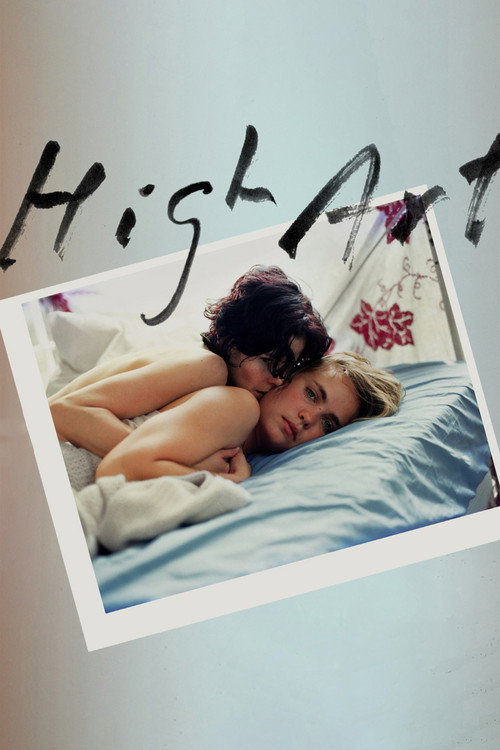
High Art
1998 · Lisa Cholodenko
For a late-night watch when you want something smart, grown-up, and slow-burning about desire and ambition — a mood piece to sink into rather than a comfort watch.
What it's about
Syd, an ambitious young editor at a prestigious photography magazine, traces a leak in her bathroom ceiling to the apartment upstairs — and finds Lucy, a celebrated photographer who vanished from the art world a decade ago into a haze of heroin and a fading relationship. Syd sees a career-making rediscovery; Lucy sees a reason to work again. As each uses the other, they fall into something neither can control.
The experience
Languid, sensual, and quietly sad — it moves at the drowsy tempo of the world it depicts, all late nights and loaded glances, then tightens around you. Seductive on the surface, with real melancholy underneath.
Performances
Ally Sheedy is a revelation as Lucy — gaunt, wry, and magnetic, the role that reframed her whole career — and Patricia Clarkson is mesmerizing as her heroin-becalmed girlfriend, a performance that introduced her to a much wider audience. Radha Mitchell holds the center as Syd with watchful, ambivalent poise.
The craft
Lisa Cholodenko's first feature won the screenwriting award at Sundance, and the writing is the star: every conversation runs on the double current of attraction and career calculus. The photography-world milieu feels lived-in, and the film's hazy, intimate look mirrors its subject's work.
Why it matters
A defining film of 1990s American independent cinema and a landmark of lesbian storytelling on screen, it launched Cholodenko's career and gave Sheedy and Clarkson their great second acts.
Snapshot
A young magazine editor in a New York walk-up discovers that the leak in her bathroom ceiling comes from the apartment above, and that the woman living there is a photographer who vanished from the art world a decade earlier. From that domestic accident, Lisa Cholodenko builds a film about the traffic between desire and ambition — how wanting a person and wanting to use a person can become, in a certain professional weather, indistinguishable. High Art was Cholodenko's first feature, developed out of her graduate work at Columbia, and it arrived at the 1998 Sundance Film Festival where it won the Waldo Salt Screenwriting Award. It gave Ally Sheedy the role that reframed her career after a decade of post–Brat Pack drift, introduced Patricia Clarkson to a wide audience as a heroin-becalmed veteran of Fassbinder's stock company, and established Cholodenko as a filmmaker interested in the erotics of proximity — people falling into each other because of where they happen to live and what they happen to need. The film's title carries its argument in two words: the high culture Syd is credentialing herself into, and the chemical condition that makes Lucy's world both seductive and terminal.
Industry & production
High Art belongs to the last full season of the American specialty-distribution boom before consolidation. It was produced independently, outside studio financing, by a team including Dolly Hall — whose credits already made her one of the essential producers of the decade's lesbian independent cinema, having shepherded The Incredibly True Adventure of Two Girls in Love (1995) and All Over Me (1997) — alongside Jeff Levy-Hinte and Susan Stover. It was shot in New York on a budget characteristic of the Sundance-competition tier; precise financing and grosses are not something I will assert, as the published figures vary and the film's commercial life was modest by design.
Distribution went to October Films, the boutique that had built its reputation on Mike Leigh, Lars von Trier, and Todd Solondz. October's position at that moment is part of the film's industrial story: Universal had acquired a controlling stake in 1997, and by 1999 October would be folded together with Gramercy into USA Films. High Art thus reached theaters through a company in the process of being absorbed — a fair emblem of what the film itself dramatizes, an independent sensibility being purchased and repackaged by an institution that admires it precisely for its outsider charge.
The 1998 Sundance Dramatic Competition where the film premiered was an unusually strong field; the Grand Jury Prize went to Marc Levin's Slam, and the year's broader independent slate included Happiness, Pi, Buffalo '66, and The Opposite of Sex. Cholodenko's screenwriting award positioned High Art as a writer's film first — an accurate reading, since its power lies less in incident than in the calibration of what characters say to each other while pursuing something they will not name.
Technology
The film was made at the end of the photochemical era and looks it, deliberately. It has been consistently described as originating on 16mm and blown up to 35mm for theatrical release — the standard economics for a first feature at this budget — and the resulting grain is not apologized for but used, a texture matched to the snapshot photography the film is about. Finishing was photochemical: color timing on a bench, no digital intermediate, so the murk of Lucy's apartment and the fluorescent cleanliness of the magazine office are separated by lighting and stock behavior rather than by a colorist's later intervention.
More interesting is the technology inside the film. High Art is set at the last moment when serious photography and magazine production were still fully analog. Lucy shoots film; the drama of her work involves negatives, contact sheets, and the physical archive of a life documented in boxes. Syd's professional power at Frame depends on the pre-digital apparatus of the art magazine: portfolios, transparencies, layout, the deadline that cannot be met by transmitting a file. The plot turns on scarcity — the images exist as objects, in one place, in one woman's possession. Within a few years that scarcity would be technologically dissolved, which is part of why the film now reads as a period piece about a vanished economy of the image.
Technique
Cinematography
Tami Reiker's photography is the film's most immediately distinctive element, and it works by opposition. Lucy's apartment is a smoke-and-lamplight interior shot close to available light — amber, underexposed, grain fully present, the frame often intruded on by bodies at the edges. The Frame offices and Syd's own apartment are cooler, flatter, more evenly lit, the visual register of professional daylight. Reiker shoots the drug scenes without the accelerated stylization that dominated the decade's heroin cinema; the camera goes slack rather than delirious, holding on faces in repose. Handheld coverage is used sparingly and without agitation, more a slight instability than a documentary shudder. The film's compositional signature is the crowded two-shot: Syd and Lucy pressed into the same frame in a small room, the space itself doing the work of erotic pressure before either woman admits to anything. Reiker would go on to shoot Gina Prince-Bythewood's Love & Basketball (2000) and, much later, The Old Guard (2020); High Art remains the clearest statement of her low-light intimacy.
Editing
Amy E. Duddleston, who would also cut Cholodenko's Laurel Canyon (2002), edits for duration rather than propulsion. Scenes are allowed to run past the point where their information has been delivered — the residue is where the film lives. There is a deliberate rhythmic difference between the two worlds: the magazine sequences are cut conventionally, on dialogue and reaction, while the apartment sequences drift, with dissolves and long holds that approximate the temporality of the drug without ever adopting a subjective "trip" grammar. The effect is that narrative time and chemical time compete, and the film's tragedy is partly that Syd's deadline-driven time wins.
Mise-en-scène / staging
The building is the film's central structural idea. Syd lives below with her boyfriend James in an apartment of order and beige competence; Lucy lives above with Greta and a rotating population of guests in a haze of ashtrays, bottles, and photographs. The ceiling leak is the film's founding metaphor made literal — the upstairs world seeping downward into the lower one, unstoppable, staining. Cholodenko stages entire scenes on the mattress and around the low furniture of Lucy's loft, keeping bodies horizontal and close, while Syd's professional life is staged vertically: standing at desks, in meetings, being appraised.
Lucy's photographs, present as production design, describe a body of work in the Nan Goldin idiom — intimate, flash-lit, drawn from the artist's own circle of lovers and addicts. The film is careful to make the pictures look like documents rather than compositions, which is what allows Syd's institutional enthusiasm for them to feel faintly predatory. A late excursion to the home of Lucy's mother, Vera (played by the Broadway veteran Tammy Grimes), introduces a third design register — bourgeois, upholstered, embalmed — that explains something about what Lucy has spent her life fleeing.
Sound
The score is by Shudder to Think, the Washington, D.C. post-hardcore band then in its brief and prolific film-music phase; Craig Wedren, its frontman, would become one of the busier composers of the following two decades. Their contribution here is atmospheric rather than propulsive — drifting, tonally uncertain cues that decline to instruct the audience how to feel about what it is watching. Around the music, the sound design favors room tone: the murmur of a party heard through a floor, the drip of water, the low continuous hum of an apartment where nothing is urgent. Dialogue is recorded and mixed close, often at a near-whisper, which forces the audience into the same intimate proximity the characters are negotiating.
Performance
Sheedy's Lucy is built almost entirely out of withholding — a low, flat vocal register, minimal gesture, a watchfulness that reads alternately as burnout and as predation. The casting is itself a performance text: an actress associated with the sunlit adolescence of The Breakfast Club and St. Elmo's Fire appearing as a woman who has spent ten years disappearing. Sheedy won the Independent Spirit Award for Best Female Lead, and the role has functioned ever since as the standard example of a mid-career reintroduction achieved through independent film.
Clarkson's Greta operates on an entirely different frequency: theatrical, accented, grandly self-pitying, a former Fassbinder actress whose past glamour is now a bit she performs for a dwindling audience. It is a comic performance inside a sad film, and the friction is exact. Radha Mitchell, then an Australian actress largely unknown to American audiences, plays Syd as a study in ambient watching — her ambition legible mostly in how long she looks at things. Gabriel Mann's James supplies the ordinary decency that the film neither mocks nor rescues, and Bill Sage, a Hal Hartley regular, threads the picture back into the wider fabric of downtown New York independent film. Anh Duong, herself a working artist and model, plays the magazine's editor Dominique, one of several casting choices that import genuine art-world affect rather than acting it.
Narrative & dramatic mode
The film's mode is chamber melodrama in a naturalist skin. Its engine is a triangle rather than a couple: Syd and Lucy's attraction is inseparable from Greta's slow dispossession, and much of the film's cruelty is directed at what happens to the person who was there first. Structurally, High Art runs two plots that appear to be one — a seduction and a professional acquisition — and the film's intelligence lies in refusing to separate them. Syd cannot know, and neither can we, whether she pursued Lucy because she wanted her or because a discovery would make her career; Lucy cannot know whether she is being loved or curated.
The dramaturgy is largely conversational, built from apartment scenes and editorial meetings, with the excursion upstate functioning as the traditional melodramatic detour that lets the lovers exist briefly outside their economy. The ending is not redemptive: the professional machinery consumes what it has found, and Lucy's overdose closes the film with the flat, unearned quality of an actual death rather than a dramatic climax. It is a downbeat resolution executed without irony, which distinguishes it from the register of much of its 1998 cohort.
Genre & cycle
High Art sits at the intersection of three cycles. It is a lesbian romance released at the moment when American queer film was moving past the coming-out narrative — its characters' sexuality is a settled fact, never the source of conflict — and into adult stories about work, money, and betrayal. It is an art-world film in the tradition that treats the gallery-and-magazine complex as a system that metabolizes authenticity. And it is, more warily, a heroin film, arriving after Drugstore Cowboy (1989), Trainspotting (1996), and the "heroin chic" fashion moment that the film's own visual milieu is implicated in. Cholodenko's contribution to that last cycle is a refusal of both glamour and hysteria; the drug here is neither transcendent nor a cautionary spectacle, just the sedative that has organized a decade of a woman's life.
Underneath all three sits the older armature of the melodrama of the fading star and the ambitious newcomer — the Sunset Boulevard / All About Eve configuration, reworked so that the newcomer's weapon is not talent but institutional access.
Authorship & method
Cholodenko came to filmmaking after working in Los Angeles film production, including editorial work, before entering the graduate film program at Columbia University; High Art grew out of that period and reflects an editor's sensibility in its patience with duration. She wrote the screenplay herself, and the Sundance screenwriting award correctly identified where the film's craft is concentrated: in dialogue that lets characters conceal their motives from themselves.
Her method here — and across her subsequent career — involves building films around domestic arrangements under pressure from an outsider. Laurel Canyon (2002) repeats the structure with a record producer and her son's fiancée; The Kids Are All Right (2010), which she co-wrote with Stuart Blumberg and which earned Academy Award nominations including Best Picture and Best Original Screenplay, does it with a sperm donor entering an established family. Her later television work, notably the HBO miniseries Olive Kitteridge (2014) and episodes of Unbelievable (2019), extends the same interest in the small betrayals inside intimate systems.
Her collaborators on High Art were essential to its texture: Reiker's low-light cinematography, Duddleston's slack rhythms, Shudder to Think's non-committal score. The producing team, particularly Dolly Hall, connects the film directly to the infrastructure that had made the preceding wave of lesbian independent features possible.
Movement / national cinema
The film is American independent cinema of the Sundance-and-specialty-distributor era, and specifically a late entry in the arc that B. Ruby Rich named New Queer Cinema in 1992. The first wave — Todd Haynes, Gregg Araki, Tom Kalin, Rose Troche, Cheryl Dunye — was formally aggressive and often historically polemical. By 1998 the movement had, in Rich's own later account, partly dissolved into the marketplace, and High Art is a document of that dissolution in both form and content. It is a conventionally beautiful, emotionally legible film about characters whose queerness is unremarkable, made by a filmmaker with a graduate degree and released by a company owned by Universal. Its subject — the absorption of an outsider artist by an institution that wants her rawness — describes its own moment with some accuracy.
Its other national affiliation is German, by citation: Greta's Fassbinder past is not a throwaway joke but an explicit lineage claim, tying the film to The Bitter Tears of Petra von Kant (1972) and to Veronika Voss (1982), Fassbinder's study of a drug-dependent former UFA star.
Era / period
1998 was a high-water year for American independent film and the last before the specialty landscape reorganized. The Sundance-to-October-Films pipeline that carried High Art would not exist in the same form five years later. The film also captures a specific New York — the pre-Giuliani-completion downtown of cheap-enough apartments, working artists living above magazine editors, an art economy still small enough that a single discovery could remake a career. Its representation of photography is likewise era-bound: film stock, contact sheets, the singular negative.
Culturally, it lands in the middle of the "heroin chic" controversy in fashion photography, an argument the film is aware of and quietly implicated in — Syd's magazine wants images of ruin, and the ruin is somebody's actual life.
Reception, canon & influence
Contemporary critical reception was strong, concentrated on the performances and on Cholodenko's control of tone. Sheedy's work drew the most attention and won her the Independent Spirit Award for Best Female Lead; Clarkson's Greta was widely singled out and functioned as her breakout, preceding by five years the run of The Station Agent and Pieces of April (2003) that brought her an Academy Award nomination. Radha Mitchell's performance launched an international career. Reviewers noted the film's refusal of both the coming-out template and the redemption arc; the most common reservation was that the film's languor could shade into inertia.
Looking backward, its influences are legible and were acknowledged in the discourse around the film: Nan Goldin's The Ballad of Sexual Dependency stands behind Lucy's photographic practice and the film's whole visual proposition, with Larry Clark's work a secondary reference point; Fassbinder is invoked by name inside the film and by structure outside it; the older Hollywood melodrama of the faded star and the ascendant protégée supplies the plot's skeleton; and the loose, performance-forward naturalism of American independent cinema after Cassavetes supplies its scene grammar.
Looking forward, its clearest legacy is Cholodenko's own body of work and the path it modeled — a queer-authored film that neither hid nor explained its characters' sexuality, made with mainstream craft, which is roughly the template The Kids Are All Right would take to the Academy Awards twelve years later. It is also the standard case study in the mid-career independent-film reintroduction, cited whenever an actor associated with a prior era is recast against type. Within lesbian screen history, High Art is routinely positioned as the pivot from coming-out narrative to adult tragedy, an inheritance visible in the register — if not necessarily the direct lineage — of later films such as Carol (2015) and Portrait of a Lady on Fire (2019); direct causal influence on those specific films is not something the record establishes, and I would not claim it. The film has been revisited in anniversary retrospectives and remains a fixture of programming on New Queer Cinema and on the 1990s American independent scene, valued less as a formal innovation than as an unusually honest account of what ambition does to love.
A Deleuzian reading
Water is coming through Syd's bathroom ceiling.
The full Deleuzian reading of High Art →
Reception
A Sundance 1998 breakout praised mostly as an Ally Sheedy comeback vehicle, it has since grown into something bigger: a cornerstone of the 90s lesbian film canon, rediscovered by a generation of Letterboxd users tracing Cholodenko back from The Kids Are All Right.
How High Art was received, from release to now →
How to watch High Art: what to notice on a first viewing
- Watch how differently the two apartments are lit. Syd's apartment is cool, flat, evenly lit; Lucy's upstairs is amber, underexposed, and grainy, shot close to available light. The two lighting schemes tell you which world is professional and which is something else entirely.
- Notice the water stain spreading across Syd's bathroom ceiling. The leak from Lucy's apartment above keeps reappearing throughout the film, the upstairs world seeping down into the ordered one below. Before you ever see Lucy, her world is already leaking into Syd's, unstoppable, from a space just out of frame.
- Listen for how quietly the dialogue is mixed throughout. Voices are recorded close and near a whisper, while room tone, a party through the floor, a dripping pipe, fills the space around them. The hush pulls you into the same close proximity the characters are negotiating with each other.
- Notice how little Lucy says or moves in any scene. Sheedy plays her in a low, flat register with minimal gesture, a watchfulness that could read as exhaustion or as something more calculating. Her stillness keeps you guessing whether she is burned out or quietly in control.
- Watch how often Syd and Lucy share one cramped frame. The film keeps pressing the two women into the same small space, bodies close on a mattress or low furniture, well before either admits to wanting the other. The room itself creates the attraction, so the dialogue does not have to state it.
The whole guide to watching High Art, with the keys for a rewatch →
Influences: the films it descends from and the films it influenced
- The Ballad of Sexual Dependency (1986) — Goldin's snapshot method — intimates photographed on their own beds in available tungsten and bounced lamp light, sequenced as duration against a pop soundtrack — is the literal model for Lucy Berliner's portfolio and the license for Tami Reiker's underexposed, color-cast apartment interiors.
- The Bitter Tears of Petra von Kant (1972) — Named inside the film via Greta's Fassbinder past, and inherited structurally: an entire erotic power hierarchy staged in one apartment, with women stacked in layered planes of a single crowded frame so that the person being excluded stays visible in the shot.
- Faces (1968) — Supplies the scene grammar — 16mm in close quarters, overlapping half-audible talk, and takes that run past the dramatic point until the actors' evasions rather than the dialogue carry the information.
- Chelsea Girls (1966) — Establishes the downtown-loft long take on people getting high and talking, where room tone, dead air and the camera's refusal to cut become the register in which drug time is rendered.
- Wanda (1970) — The 16mm-blown-up-to-35mm grain, available-light location shooting and drifting scene length in service of a woman's story that ends flat and unredeemed — the exact technical and tonal package High Art reassembles.
- The Panic in Needle Park (1971) — A fashion photographer turned director shoots heroin with no score at all, treating the fix as domestic procedure covered in ordinary light — the precedent for High Art's scoreless, unsensational drug scenes and its photographer's eye on them.
- Sunset Boulevard (1950) — Donates the plot skeleton and the staging idea behind it: the faded performer's apartment as a mausoleum of her own clippings, entered by a younger arriviste whose ascent is measured in how much of that interior they come to occupy.
- Kids (1995) — Clark's photographic method — flat frontal compositions holding young bodies mid-intoxication at close range without editorial comment — is the secondary visual reference beside Goldin, minus Clark's predatory proximity.
- Jeanne Dielman, 23 quai du Commerce, 1080 Bruxelles (1975) — Makes apartment geography itself the structure — the viewer learns the floor plan before the plot — which is how High Art builds meaning from the vertical relationship of Syd's flat to Lucy's loft and the leaking ceiling between them.
- The Incredibly True Adventure of Two Girls in Love (1995) — Same producer (Dolly Hall) and the same lesbian-indie 16mm apparatus, but High Art inverts its coming-out grammar: no discovery scene, no announcement, the attraction simply operative from the first frame.
- Laurel Canyon (2002) — Repeats Cholodenko's core architecture beat for beat: a bohemian older woman's household under pressure from a straight-arrow outsider who is seduced by the mess, again shot as a chamber piece where the house's layout stages the erotic triangle.
- The Kids Are All Right (2010) — Takes High Art's premise — queer characters neither hidden nor explained, filmed with mainstream coverage and comic-domestic timing — into a studio-scale intrusion plot, with the outsider entering an established family instead of an apartment.
- The Wrestler (2008) — The canonical descendant of High Art's casting-as-craft move — an actor indexed to a prior era recast against type and shot in Super 16 vérité so the performer's real wear reads as the character's, exactly the Ally Sheedy operation.
- Weekend (2011) — Two people in a flat over a compressed span, held in long available-light takes with drug use as ambient texture rather than plot, and an ending that separates them without moral — the post-coming-out chamber two-hander High Art prototyped.
- Carol (2015) — Shares the specific device of routing desire through a camera — the protagonist photographs the woman she wants, and the film's Super 16 blow-up grain mimics the photographic stock she'd be shooting — the same image-maker/subject asymmetry that structures Lucy and Syd.
- Portrait of a Lady on Fire (2019) — Literalizes the artist/subject power exchange as painter and sitter, with the same formal consequence: scenes built on who is permitted to look, and a downbeat ending that treats the finished work as what survives instead of the couple.
- One Night in Miami... (2020) — Tami Reiker's American-independent interior practice: shooting rooms off their own practical tungsten sources, letting skin go warm and the image go grainy rather than adding fill — the exact look of the Hampton House.
- All Over Me (1997) — Dolly Hall's immediately prior production: downtown New York on 16mm with an alt-rock needle-drop track doing the emotional work a score would otherwise do, the model High Art formalizes by hiring Shudder to Think outright.
- First Love, Last Rites (1997) — Shudder to Think's first film score, developing the same non-committal approach — a rock band writing drifting, unresolved cues that decline to tell the audience how to feel about a scene — carried directly into High Art.
Similar films
- Kids (1995) — influence & lineage
- Chasing Amy (1997) — shared sensibility
- Working Girls (1987) — shared sensibility
- Mulholland Drive (2001) — shared sensibility
- Death Becomes Her (1992) — shared sensibility
- The Last Days of Disco (1998) — shared sensibility
- Laurel Canyon (2003) — shared sensibility
- Basquiat (1996) — shared sensibility