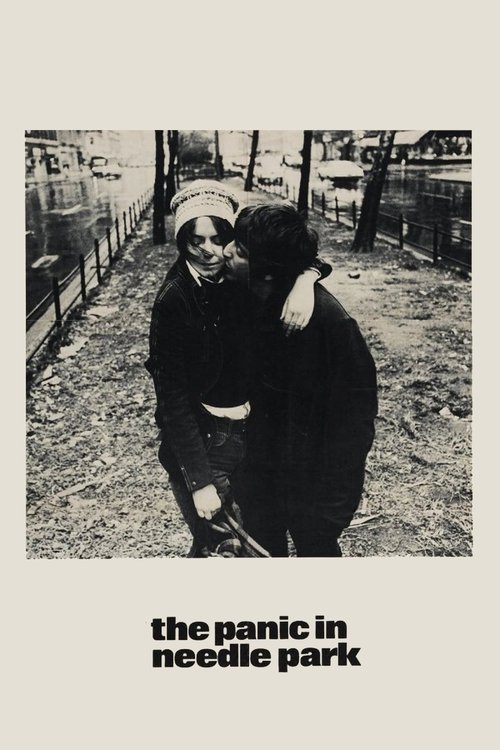
The Panic in Needle Park
1971 · Jerry Schatzberg
When you want something raw and true and can handle bleak — a film for a serious night, not an escape. Come to it curious about early-'70s New York and prepared to sit with discomfort.
What it's about
On a Manhattan traffic island the locals call Needle Park, small-time hustler Bobby and adrift newcomer Helen fall in love inside a community of heroin addicts. Their romance plays out against the daily grind of scoring, hustling, and betraying — and against a citywide 'panic,' the slang for a heroin drought that turns everyone desperate. It's a love story and an addiction story braided so tightly you can't pull them apart.
The experience
Stark, intimate, and quietly devastating — no music score, no glamour, just a documentary-flat gaze that makes the tenderness between the leads hurt more. It's a slow burn that leaves you hollowed out rather than lectured at.
Performances
Al Pacino, in his first lead role a year before The Godfather, is electric — charming, jittery, and heartbreaking — and Kitty Winn matches him with a performance of quiet erosion as Helen.
The craft
Joan Didion and John Gregory Dunne's screenplay strips out moralizing, and Jerry Schatzberg — a former fashion photographer — shoots real locations with an unflinching plainness, refusing any musical score at all. The result is a texture so authentic it feels closer to reportage than melodrama.
Why it matters
A landmark of the New Hollywood's street-level realism, it launched Pacino's film career and set the unsentimental template that later addiction dramas would follow or react against.
Snapshot
The Panic in Needle Park is a stark, unsentimental study of heroin addiction and the doomed love it corrodes, set among the addicts who congregated around Sherman Square on Manhattan's Upper West Side — the traffic island locals nicknamed "Needle Park." Adapted by Joan Didion and John Gregory Dunne from James Mills's 1966 nonfiction book, and directed by former fashion photographer Jerry Schatzberg in only his second feature, the film is best remembered today as the picture that gave Al Pacino his first leading role, one year before The Godfather. Its method is austere: location shooting, no musical score, a documentary flatness of surface that refuses both the glamour and the moralizing that had attached to earlier drug films. The "panic" of the title is a period slang term for a heroin drought — a shortage that spikes desperation — and the film uses that recurring crisis as the rhythm against which Bobby (Pacino) and Helen (Kitty Winn) attach themselves to each other and pull each other under.
Industry & production
The film sits squarely inside the transitional moment of American filmmaking around 1970, when studios, uncertain what audiences wanted after the collapse of the old system, financed comparatively cheap, director-driven pictures on adult subjects. It was produced by Dominick Dunne — brother of the co-screenwriter John Gregory Dunne — and released through 20th Century Fox. The source was James Mills's book, itself an outgrowth of his reporting for Life magazine, which lent the material a journalistic, observational pedigree that the filmmakers preserved rather than softened.
Schatzberg came to the project having directed only Puzzle of a Downfall Child (1970); he was not a career studio filmmaker but a celebrated stills photographer, and the production reflects a photographer's confidence with real light and real streets over sound-stage control. The film was shot on location in New York, and its casting broke from star convention: Pacino, whose screen experience amounted to a small part in Me, Natalie (1969), was cast in the lead, and Kitty Winn was a relative newcomer from the stage. Precise budget and box-office figures for the film are not well documented in the reliable record, and I won't invent them; what is clear is that this was a modest, adult-market release rather than a wide commercial event, and that its cultural afterlife has far outstripped whatever it earned on first run.
Technology
Technically the film belongs to the era's embrace of lightweight, location-friendly production. It was made on 35mm and works in the naturalistic, often low-light register that faster film stocks and portable equipment had made practical by the late 1960s — the same technological shift that underwrote the American vérité-influenced cinema of the period. Nothing about the film advertises technical novelty; its choices run the other way, toward stripping away artifice. The most consequential "technological" decision is a negative one: the filmmakers withheld the standard apparatus of a musical score, so the soundtrack is built from location and diegetic sound rather than orchestration. The result is a picture whose texture — grainy, available-light, hand-held where needed — reads as reportage, and that texture is inseparable from the equipment and stocks of its moment.
Technique
Cinematography
The photography is by Adam Holender, who had shot Midnight Cowboy (1969) and brought to Needle Park a comparable feel for the unflattering, unromantic texture of New York streets and interiors. The visual approach favors natural light, muted color, and a documentary sense of place: crowded sidewalks, cramped apartments, diner counters, the park itself. The camera tends to observe rather than editorialize, holding on faces and transactions with a plainness that makes the film's most disturbing content — needles, veins, the mechanics of a fix — land as fact rather than spectacle. Where many drug films of the era reached for hallucinatory or expressionist effects, Holender and Schatzberg keep the image sober and grounded, which is precisely what makes it harrowing.
Editing
Cut by Evan Lottman, the film's editing serves its observational aims. It is not built on montage bravura; it lets scenes play at something close to real duration, so that the tedium, waiting, and small negotiations of an addict's day accumulate their own weight. The recurring "panic" — the drying-up of supply — structures the film's rhythm, tightening the pace as desperation rises. The cutting is at its most clinical in the injection sequences, which are presented with an unblinking, procedural directness that was among the film's most transgressive qualities in 1971.
Mise-en-scène / staging
Schatzberg stages the film in real and realistic spaces, and the mise-en-scène is defined by clutter, confinement, and the geography of the neighborhood. Needle Park functions as a social hub — a place of congregation, gossip, and commerce — against which the private, deteriorating apartment interiors of Bobby and Helen are contrasted. The staging is loose and behavioral, giving actors room to inhabit the milieu rather than hit marks; the effect is of a world caught rather than composed. The park itself becomes a kind of character, the fixed point to which the drifting figures keep returning.
Sound
The absence of a conventional musical score is the film's signature sonic choice and one of its defining formal decisions. Without music to cushion or cue emotion, the audience is left with the ambient sound of the city and the flat exchanges of the characters, which intensifies the sense of documentary immediacy and denies the viewer the usual emotional guidance. Dialogue is naturalistic, overlapping and mumbled where the scene calls for it, in keeping with the performance style of the New Hollywood moment.
Performance
Performance is the film's engine. Pacino, in his first lead, plays Bobby with a restless, ingratiating charm that curdles into weakness and cruelty; it is an early, uncostumed display of the volatility and interior intensity that would define his career, and it is widely regarded as the work that announced him as a screen actor. Kitty Winn's Helen is the film's moral fulcrum — a woman who drifts into Bobby's orbit seeking stability and is instead drawn into addiction and, ultimately, betrayal. Winn's performance won the Best Actress prize at the 1971 Cannes Film Festival, a significant recognition for a relatively unknown actor. The two performances are calibrated to the film's realism: neither is pitched for sympathy, and both are willing to be unlovely.
Narrative & dramatic mode
The film's dramatic mode is observational tragedy rather than plotted melodrama. Its narrative is a downward spiral: Helen, adrift, attaches herself to Bobby; their relationship offers real tenderness even as heroin steadily reorganizes their priorities around the next fix; Helen herself becomes addicted; and the couple's bond is finally broken by the pressures of the drug economy, culminating in Helen's betrayal of Bobby to the authorities. The "panic" cycles — periods of scarcity — supply the external pressure that drives the internal collapse. There are no redemptive arcs and little conventional catharsis. The mode is closer to case study than to romance in the Hollywood sense, though the film insists on the reality of the love it depicts, which is exactly what makes its dissolution painful. The storytelling trusts accumulation over incident: we understand the doom not through a single turning point but through the grinding repetition of need.
Genre & cycle
Nominally a drama-romance-crime hybrid, The Panic in Needle Park belongs to the cycle of unflinching American drug films that emerged around 1971, when the subject of heroin moved to the center of several notable pictures — a cluster that also includes works like The French Connection (which foregrounded the trafficking side) and Born to Win, released the same year. Within that cycle, Needle Park is distinguished by its refusal of genre pleasures: no procedural thrills, no crime-world glamour, no cautionary uplift. It also participates in the broader New Hollywood tendency toward downbeat, morally unresolved character studies. If it has a genre, it is the American realist tragedy of the street, and it stands as one of the purest examples of that impulse.
Authorship & method
Schatzberg's authorship here is that of the observer-photographer: a director who trusts faces, real places, and unforced behavior over stylistic assertion, and who is willing to remove the crutches (score, sentiment, moral framing) that would make the material easier to watch. The film is the second panel in an early-career triptych of character-driven studies that would continue with Scarecrow (1973), again with Pacino, which won the Palme d'Or.
The screenplay by Joan Didion and John Gregory Dunne — one of the celebrated writing partnership's most respected film credits — brings a spare, unmoralizing precision to the adaptation of Mills's reportage, preserving the book's observational stance. Adam Holender's cinematography supplies the unglamorous visual grammar; Evan Lottman's editing sustains the observational tempo. The most audible authorial decision belongs collectively to the production: the choice to forgo a composed score, which more than any single technique defines the film's austere method. Dominick Dunne's involvement as producer links the project's authorship tightly to the Didion–Dunne circle. Together the collaborators pursued a single coherent aim — to depict addiction with clinical honesty and without the consolations of conventional drama.
Movement / national cinema
The film is a document of the New Hollywood — the "American New Wave" of roughly 1967–1975, when a generation of filmmakers, emboldened by the collapse of the Production Code and the influence of European art cinema and vérité documentary, made personal, adult, formally adventurous pictures inside (or adjacent to) the studio system. Needle Park absorbs the observational realism associated with cinéma vérité and applies it to a fiction feature, and it shares with its New York contemporaries a fascination with the unvarnished texture of the city. It is, specifically, a New York film — part of the strong current of location-shot Manhattan cinema of the late 1960s and 1970s that treated the city's grit as subject rather than backdrop.
Era / period
Made and set at the turn of the 1970s, the film registers a particular American moment: rising public alarm about heroin, an urban landscape widely perceived as in decline, and a movie industry newly willing to look at such subjects without flinching. The permissiveness that followed the end of the Production Code made possible the frank depiction of drug use that is central to the film's impact. It belongs to the same early-'70s wave of hard-edged urban American filmmaking that treated addiction, crime, and social decay as legitimate dramatic terrain, and it captures the period's mood of disenchantment with unusual directness.
Themes
The film's central theme is addiction as a totalizing force that reorganizes love, loyalty, and identity around a single need. Bound to this is the theme of codependency: Bobby and Helen's relationship is genuinely tender and genuinely destructive, and the film refuses to separate the two. Betrayal runs through the narrative — the way scarcity and desperation convert intimacy into leverage, culminating in Helen's informing on Bobby. The film also explores dependency in a doubled sense: Helen's search for stability leads her not to safety but into the very condition that guarantees instability. And underpinning all of it is a theme of environment and entrapment — the park as gravitational center, the neighborhood as a closed economy from which escape is barely imaginable. The film's realism is itself thematic: by withholding music and moral commentary, it argues that the truth of this life needs no dramatization.
Reception, canon & influence
Critically, the film's most concrete early laurel was Kitty Winn's Best Actress award at the 1971 Cannes Film Festival, which brought international attention to an otherwise modest release. Over time its reputation has rested above all on Pacino's breakthrough: the performance is routinely cited as the work that marked his arrival as a major film actor immediately before The Godfather (1972), and it is frequently discussed in that light. (The often-repeated account that this role directly shaped his Godfather casting is part of the film's lore; I'd treat the causal specifics as film legend rather than settled fact.) The picture has since been recognized as a landmark of unsentimental drug cinema and preserved as such — it was later released in a prestige home-video edition that affirmed its canonical standing among New Hollywood works.
Looking backward, the film's influences are legible: the journalistic realism of James Mills's source reporting; the vérité documentary tradition and European art-cinema restraint that shaped the New Hollywood generally; and the immediate example of Midnight Cowboy, whose cinematographer Holender carried a related visual sensibility into Needle Park. Looking forward, the film established a template for the honest, de-glamorized depiction of heroin addiction on screen — an approach whose lineage can be traced through decades of later addiction dramas that similarly refuse both spectacle and sermon. Its more direct legacy, though, is human: it launched one of American cinema's defining actors and confirmed Schatzberg as a serious director of character, a partnership the two would extend two years later in Scarecrow. As a film, The Panic in Needle Park endures less for what it earned than for what it proved possible — that a studio-released American picture could look at addiction with the flat, patient honesty of a document and let the tragedy speak for itself.
Reception
A modest, gritty release in 1971 that got overshadowed within months by everything Pacino did next; it's since been reappraised as one of New Hollywood's great street-level New York films, riding the broader cinephile rediscovery of Jerry Schatzberg.
How The Panic in Needle Park was received, from release to now →
Influences: the films it descends from and the films it influenced
- Bicycle Thieves (1948) — Neorealism's method of building tragedy through accumulated quotidian incident shot on real streets in available light — the direct template for Needle Park's 'accumulation over incident.'
- The Naked City (1948) — Actual-location NYC shooting and a documentary-procedural framing of the city as itself, the street-realist grammar Needle Park applies to junkies instead of cops.
- The Connection (1961) — Vérité real-time observation of addicts waiting for a fix, filming the sickness and the score without musical score or moral commentary.
- The Cool World (1963) — Immersive Harlem location shooting inside a drug milieu, embedding the camera in a real subculture rather than a set.
- Faces (1968) — Behavioral blocking and available-light long takes that trust unforced, near-improvised actor behavior over plotted incident.
- Pickpocket (1959) — The undramatized, procedural filming of a criminal act as pure choreography of hands and objects — echoed in Needle Park's clinical injection sequences.
- Chronicle of a Summer (1961) — Coined cinéma-vérité; established the observational-documentary ethic of watching real people that underwrites Needle Park's whole method.
- Midnight Cowboy (1969) — Adam Holender's grimy available-light NYC cinematography — the same DP carried that exact unglamorous visual grammar directly into Needle Park.
- The Man with the Golden Arm (1955) — Unflinching procedural realism of heroin dependency that deepens the screen-addiction lineage Golden Arm pioneered, stripping away the melodramatic packaging.
- Dog Day Afternoon (1975) — Pacino again in a scoreless, near-real-time, location-bound drama that refuses spectacle and lets a de-glamorized event unfold procedurally.
- Christiane F. (1981) — Extends the de-glamorized-heroin template into Berlin, filming the ritual of the fix and its squalor with unsentimental clinical honesty.
- Drugstore Cowboy (1989) — Procedural, ritual attention to the mechanics of using — the fix as behavior — depicted without sermon, spectacle, or redemptive framing.
- Requiem for a Dream (2000) — Inherits the procedural injection sequence as a formal motif, foregrounding the mechanics of the fix as recurring cinematic set-piece within an addiction tragedy.
- Heaven Knows What (2014) — Real-time NYC heroin street realism cast with an actual addict and shot on location — the most literal modern extension of Needle Park's location-vérité observation.
- Jesus' Son (2000) — Set the unglamorous, handheld vérité register of addiction — degraded naturalism and clinical fixing rituals — that the film's period-warmed photography both inherits and softens.
- Marty Supreme (2025) — Scoreless, documentary-grade immersion that drops a star (Pacino) into a fully observed subculture — the realist mode the Safdies revive with stars and amateurs intermixed.
- Beautiful Boy (2018) — Documentary-flat, largely unscored realism that presents the relapse cycle without melodramatic shaping.
- Good Time (2017) — Unglamorized, scoreless location shooting of the NYC drug underworld with naturalistic near-documentary performance is the exact deglamorized realism the Safdies rehearsed in Heaven Knows What and carried into Good Time.
- High Art (1998) — A fashion photographer turned director shoots heroin with no score at all, treating the fix as domestic procedure covered in ordinary light — the precedent for High Art's scoreless, unsensational drug scenes and its photographer's eye on them.
- Sid and Nancy (1986) — Addiction realism built from the junkie couple as the only surviving social unit, shot in unflinching real-time fixing scenes with available location light and no non-diegetic cushioning.
- Wanda (1970) — Available-light, near-documentary observational tragedy of a drifting woman built by accumulation and refusing any score or sentiment.
- The French Connection (1971) — Same-year NYC documentary-realist location shooting that de-glamorizes the cops-and-heroin world through handheld, grab-shot immediacy.
- Scarecrow (1973) — Schatzberg–Pacino reunion extending the character-driven observational study, with Vilmos Zsigmond's available-light road realism replacing plot with behavior.
- Mean Streets (1973) — Location-shot behavioral realism of a street subculture, letting handheld immediacy and actor behavior carry a plotless drift.
- Gloria (1980) — Pioneers the scoreless, raw New York street realism and on-location verité grit that situates Gloria's chase in an authentically dangerous city.
Similar films
- Dog Day Afternoon (1975) — influence & lineage
- Mean Streets (1973) — influence & lineage
- The French Connection (1971) — influence & lineage
- Serpico (1973) — shared sensibility
- Taxi Driver (1976) — shared sensibility
- Heat (1995) — shared sensibility
- Five Easy Pieces (1970) — shared sensibility
- Obsession (1943) — shared sensibility