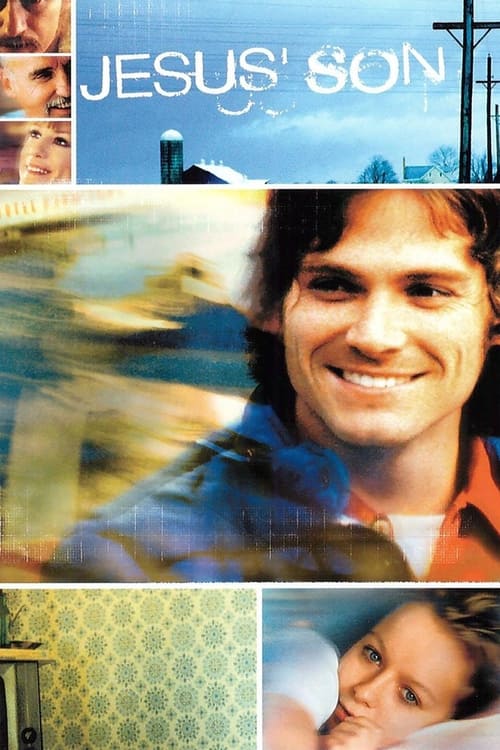
Jesus' Son
2000 · Alison Maclean
For a reflective night when you want to feel something bittersweet — sad and funny in equal measure, gentler than its subject suggests.
What it's about
A drifting young addict everyone calls FH wanders the American Midwest of the early 1970s through heroin, odd jobs, petty theft, and freak accidents, in love with Michelle, a woman as lost as he is. Told as a string of woozy, out-of-order episodes, it follows him from wreckage toward something that looks — hesitantly — like grace.
The experience
Loose, funny, and heartbreaking by turns, with a narrator whose scrambled memory makes even disaster feel tender. It floats where most addiction stories punish, and it leaves you moved rather than wrecked.
Performances
Billy Crudup gives FH a holy-fool sweetness that keeps the whole film aloft, Samantha Morton is piercing as Michelle, and Jack Black nearly walks off with it during one berserk hospital shift.
The craft
Alison Maclean matches Denis Johnson's fractured, lyrical stories with a structure that loops and stutters like memory, letting images turn briefly hallucinatory without losing warmth. The period grain and soundtrack give its early-'70s drift a faded-photograph beauty.
Why it matters
A beloved adaptation of a near-sacred American story collection, and proof that a film about addiction could be lyrical and forgiving instead of grim.
Snapshot
Jesus' Son is a literary adaptation of Denis Johnson's slim, incandescent 1992 short-story collection, a book that had by the late 1990s acquired near-talismanic status among American writers for its fractured lyricism about addiction and grace. The film follows an unnamed narrator — known in Johnson's prose and addressed onscreen by the unprintable nickname "Fuckhead," softened in publicity to "FH" — as he drifts through a haze of heroin, cheap wine, petty theft, and accidental violence across the American Midwest and West of the early 1970s, before stumbling toward something like recovery and tenderness. Billy Crudup plays FH; Samantha Morton plays Michelle, the lover who is both his fellow traveler in dissolution and the wound he cannot close. Directed by the New Zealand–raised, North America–based filmmaker Alison Maclean, the picture is less a conventional narrative than a sequence of vignettes — closely tracking the structure of Johnson's interlocking stories — held together by mood, voice-over, and Crudup's bewildered, beatific presence. It premiered on the festival circuit in 1999 (including Venice and Toronto) and received a limited U.S. release in 2000 through Lions Gate, where it became a critics' film and an enduring cult object rather than a commercial event.
Industry & production
The film is a product of the late-1990s American independent ecosystem, when literary properties with strong "voice" were courted by specialty distributors hoping to replicate the prestige of films like Trainspotting or the Sundance-incubated dramas of the period. Johnson's book — short, fragmentary, and famously beloved — was an unusual choice for adaptation precisely because it has so little conventional plot; its appeal lies in tone and language, the hardest things to translate to screen. The screenplay is credited to Elizabeth Cuthrell, David Urrutia, and Oren Moverman, the last of whom would go on to a significant screenwriting and directing career (I'm Not There, The Messenger). The producing apparatus drew on independent financing typical of the era, with Lions Gate Films handling U.S. distribution as the company was building its identity as a home for edgier specialty fare.
Casting was central to the film's identity and to its modest commercial profile. Crudup, then an emerging lead, anchors the picture, surrounded by a deep bench of recognizable performers in small, vivid roles: Denis Leary, Jack Black, Will Patton, Holly Hunter, Dennis Hopper, and Greg Germann among them. This ensemble strategy — stocking brief episodes with strong character actors — suited both the episodic source material and an independent budget, since each performer appears for only a fragment of the running time. Reliable, fine-grained budget and box-office figures for the film are not something I can state with confidence; it was, by every account, a small release that earned its reputation through reviews and word of mouth rather than ticket sales, and I will not invent numbers.
Technology
Jesus' Son was produced on 35mm film, consistent with virtually all theatrical narrative features of its moment; the digital-acquisition transition still lay several years ahead for fiction filmmaking of this scale. The technological story here is therefore not one of novel apparatus but of photochemical craft deployed expressively: grain, color timing, and the particular softness of film emulsion are used to evoke a 1970s texture and a narcotized subjectivity. The period setting is rendered through production design and costume rather than through any visual-effects intervention; this is a film of practical locations, vintage cars and clothing, and natural or naturalistic lighting. Whatever optical or post-production manipulation appears — the occasional dilation of time, the smearing of a moment of overdose or revelation — is achieved through editing rhythm and in-camera or lab technique rather than the computer-generated imagery that was, by 2000, transforming larger productions.
Technique
Cinematography
The photography, by Adam Kimmel, is one of the film's signal achievements and a key to its tone. Kimmel works in a register of warm, slightly degraded naturalism — sun-bleached interiors, the dingy fluorescence of hospitals and bars, the washed light of Midwestern flatlands — that locates the film firmly in a 1970s of memory rather than reconstruction. The camera frequently adopts FH's unreliable point of view, drifting and pausing in ways that mirror a consciousness on drugs: a scene can slow into reverie or fracture into disconnected impressions. Handheld and mobile framing alternate with stiller, composed shots, and the palette favors ambers, browns, and faded greens that read as both nostalgic and decayed. The cinematography never glamorizes the highs, but it does honor the visionary quality Johnson's prose finds in degraded experience — the sense that beauty and revelation arrive unbidden in squalid rooms.
Editing
Structurally, editing carries an unusual share of the storytelling burden, because the film inherits Johnson's anti-linear, episodic architecture. Scenes are arranged less by causality than by association and emotional rhyme; FH's voice-over openly acknowledges his own confusion about chronology, and the cutting embraces that unreliability, sometimes doubling back, repeating, or leaping across time. The film is among the editing work associated with Geraldine Peroni (a celebrated editor of the period, known for her collaborations with Robert Altman and others) together with Stuart Levy; readers should treat the precise division of credit as a matter to verify against the film's titles, but the sensibility — porous, mosaic-like, attentive to the gap between events — is unmistakable. The most discussed formal gesture is the film's play with narration and recall: FH narrates events he half-remembers, and the editing literalizes that hesitancy, so that the cut becomes a figure for memory's failure and sudden, lyrical return.
Mise-en-scène / staging
The film's staging is rooted in cluttered, lived-in environments — flophouses, emergency rooms, roadside bars, a Beverly Home for the disabled and elderly — dressed with a specificity that grounds the dreamlike narration in tactile reality. Maclean stages the famous set pieces (the hospital sequence in which a man arrives with a hunting knife in his eye; the car accident that opens the narrator's recollections) for a mixture of horror, absurd comedy, and grace, often holding on faces and small gestures rather than spectacle. The blocking tends to keep FH slightly passive within the frame, acted upon rather than acting, an arrangement that visually encodes his drift. Costume and color reinforce period and character: Michelle's and FH's clothing, the bric-a-brac of the apartments, the institutional drabness of the care facility all do quiet narrative work.
Sound
Sound design and music are essential to the film's interiority. Joe Henry, the singer-songwriter and producer, composed the score, and the soundtrack threads period and period-evoking music through the vignettes to anchor mood and era. Voice-over is the film's spine — Crudup's narration, drawn closely from Johnson's first-person prose, supplies the lyrical, self-aware, often funny commentary that the images alone could not. The sound mix at times privileges subjective experience: the muffling or sharpening of ambient noise to convey intoxication, withdrawal, or the eerie clarity of a sober moment. The interplay of music, narration, and naturalistic ambience is where the film comes closest to reproducing the texture of Johnson's writing.
Performance
Performance is the film's most lauded element. Crudup gives FH a guileless, almost holy blankness — a damaged sweetness that keeps the character from curdling into mere wreckage and lets his eventual movement toward compassion feel earned rather than sentimental. Samantha Morton, as Michelle, delivers a raw, volatile turn that critics singled out; her chemistry with Crudup carries the film's romantic and tragic weight. Around them, the cameo-scale roles register sharply: Jack Black as the unhinged hospital orderly Georgie, Denis Leary, Will Patton, Holly Hunter as a grieving widow, and Dennis Hopper as a man who has survived being shot — each compresses a whole figure into a few minutes. The ensemble's brevity is a feature, not a limitation: it matches the short-story form's habit of glancing encounters that leave a permanent mark.
Narrative & dramatic mode
The dramatic mode is episodic, retrospective, and confessional. There is no three-act engine; instead the film accretes incidents that the narrator recalls out of order, framing the whole as the testimony of a survivor looking back on a life he barely understood while living it. The title comes from the Velvet Underground's "Heroin" ("when I'm rushing on my run / and I feel just like Jesus' son"), and the film, like the book, treats addiction not as a problem to be solved through plot mechanics but as a condition of perception. Comedy and catastrophe sit side by side — the tonal instability is the point — and the arc, such as it is, bends from dissolution toward a fragile redemption located in small acts of attention and care. The drama is internal: the question is not what FH will do but whether he can become someone capable of feeling for others.
Genre & cycle
Nominally a comedy-drama with a romance at its center, Jesus' Son belongs more usefully to the cycle of American addiction and recovery films and to the late-1990s wave of literary-indie adaptations. It can be read alongside Drugstore Cowboy, Trainspotting, and other films that find lyricism and dark humor in junkie subculture, though it is gentler and more transcendental than most, less interested in the mechanics of scoring and the iconography of the high than in the spiritual residue of a wasted life. It also sits within a recovery-narrative tradition, but resists that genre's tidier consolations. As a literary adaptation, it is part of a moment when the indie sector mined contemporary American fiction for "voice-driven" projects.
Authorship & method
Alison Maclean came to the project with a reputation built on her unsettling 1992 New Zealand feature Crush and on acclaimed short work; she is a director attuned to atmosphere, psychological strangeness, and the unstable boundary between the everyday and the uncanny, all of which suit Johnson's material. Her method here is one of fidelity-by-translation: rather than impose conventional structure, she and her screenwriters (Cuthrell, Urrutia, and Moverman) preserved the book's fragmentation and its first-person voice, trusting tone over plot. The key collaborators extend that approach — Adam Kimmel's subjective, period-warmed cinematography; Joe Henry's score; the associative editing; and above all Crudup's narration, which keeps Johnson's sentences alive on the soundtrack. The authorship is genuinely shared between Maclean's directorial sensibility and Johnson's literary voice, with the adaptation's central wager being that the prose could survive the move to image.
Movement / national cinema
The film is best understood within American independent cinema, even as its director's New Zealand background and the international festival circuit complicate any simple national label. Maclean is part of a generation of Antipodean filmmakers who moved into North American and transnational production, and Jesus' Son reflects the porousness of "indie" filmmaking at the turn of the millennium: a story of the American heartland, told by a director from elsewhere, financed and distributed through the U.S. specialty system, and validated first at European and Canadian festivals. It is American in subject and texture, but cosmopolitan in its making.
Era / period
Two periods matter. The film depicts the early 1970s — its drug culture, its cars and clothes, its frayed post-counterculture exhaustion — with care, using that setting to evoke a specifically American comedown. And it was made at the turn of the millennium, in the late-1990s/2000 indie moment whose appetite for literary adaptation, ensemble character work, and morally ambiguous protagonists shaped its form and its reception. The gap between the depicted past and the production present is itself expressive: the film is structured as memory, looking back on the 1970s from a position of survival.
Themes
Its abiding themes are addiction and the distortion of perception; grace and redemption arriving in unlikely, even squalid places; compassion as the faculty FH must slowly recover; and memory's unreliability as both a moral and a formal problem. The title's invocation of "Jesus' Son" frames the addict's experience in quasi-religious terms — the rush as ecstasy, the wreckage as a kind of fall, recovery as resurrection — without endorsing piety; the spirituality is rueful and earned. Death, accident, and chance recur as forces that the narrator cannot control and only half-comprehends. Underneath runs a tender insistence that even the most damaged life can move toward care for others.
Reception, canon & influence
Critically, the film was warmly received as a faithful and unusually sensitive adaptation, with particular praise for Crudup's central performance and for Samantha Morton, and for the way Maclean preserved Johnson's voice without flattening it. It did not achieve broad commercial success; like many films of its kind, it built its standing over time as a cult favorite, frequently cited by admirers of Johnson's book as one of the rare adaptations to honor a "voice" work.
The influences on the film are clearest in two directions: Denis Johnson's source collection, whose structure, narration, and tonal mixture the film reproduces almost reverently; and the lineage of lyrical addiction cinema (the Gus Van Sant of Drustore Cowboy, the heightened subjectivity of Trainspotting) within which it positions itself, alongside the broader American independent tradition of episodic, character-driven storytelling. The Velvet Underground's "Heroin" supplies not just the title but a whole aesthetic permission to find transcendence in the drug experience.
Its influence forward is best measured in reputation and personnel rather than in any school of imitators. The film helped consolidate Crudup's standing as a serious leading actor and contributed to Samantha Morton's ascent at the turn of the millennium. Oren Moverman moved from this and contemporaneous screenwriting work toward a notable career as a writer-director. And the film endures as a reference point in debates about how — or whether — Johnson's prose can be filmed, cited whenever adaptations of "unadaptable" literary voices are discussed. The precise contours of its later critical rehabilitation are a matter on which the documentary record is thinner than for major studio releases, and I will not overstate it; what is clear is that Jesus' Son survives as a respected, beloved minor classic of American independent cinema, valued for its tenderness, its formal nerve, and its refusal to moralize.
A Deleuzian reading
Start with the cut that won't stay still.
The full Deleuzian reading of Jesus' Son →
Reception
Premiered at Venice in 1999 to warm reviews, then barely registered at the box office when Lionsgate released it in 2000 — since then it's ridden the ever-growing Denis Johnson cult into word-of-mouth rediscovery, passed hand to hand like the book itself.
How Jesus' Son was received, from release to now →
Influences: the films it descends from and the films it influenced
- Drugstore Cowboy (1989) — Established the template Maclean follows of deadpan addict voice-over laid over lyrical subjective drug-vision inserts that find beauty without endorsing the high.
- Trainspotting (1996) — Modeled the ironic first-person narration riding atop loosely episodic junkie vignettes, with the soundtrack and image bent to render altered perception rather than report events.
- Mean Streets (1973) — Source of the plotless string-of-incidents structure, location-shot grime, and period jukebox needle-drops that organize feeling in place of narrative cause-and-effect.
- Badlands (1973) — Pioneered the naive, faintly unreliable narrator whose flat voice-over floats free of the images, generating the same tender disjunction between what FH says and what we see.
- The Panic in Needle Park (1971) — Set the unglamorous, handheld vérité register of addiction — degraded naturalism and clinical fixing rituals — that the film's period-warmed photography both inherits and softens.
- Five Easy Pieces (1970) — Defined the early-1970s American-independent drift narrative built from discrete character encounters rather than a goal-driven plot, the BBS mode Maclean reaches back to.
- Midnight Cowboy (1969) — Introduced fractured subjective flashback editing intruding on a present-tense skid-row story, the associative cut-on-memory grammar the film's mosaic editing extends.
- Petulia (1968) — Earliest model for the associative, chronology-scrambling cut that splices past and future fragments into the present to mimic the slippage of unreliable memory.
- Morvern Callar (2002) — Carries forward the same subjective sound mix and associative drift in a literary adaptation, with Samantha Morton again the locus of an interior, near-wordless point of view.
- Factotum (2005) — Extends the model of adapting confessional addiction-prose as deadpan episodic vignettes bound by a detached, literary voice-over lifted near-verbatim from the page.
- The Messenger (2009) — Co-screenwriter Moverman's directorial debut carries the film's restrained, anti-moralizing character-study method — tone and performance over plot — into his own authorship.
- Naked Lunch (1991) — Companion experiment in adapting 'unfilmable' interior prose by privileging an author's voice and hallucinatory logic over conventional plot fidelity.
- Fear and Loathing in Las Vegas (1998) — Parallel near-contemporary attempt to film a beloved first-person drug-prose voice, leaning on wall-to-wall narration and subjective distortion to keep the sentences alive onscreen.
- Requiem for a Dream (2000) — Same-year addiction film achieving subjective drug-perception through an aggressively expressive sound mix and montage — the maximalist inverse of Maclean's hushed subjective track.
- Gummo (1997) — Contemporary episodic mosaic of American degradation assembled from associative tableaux with no through-line, sharing the trust in tone over story.
- Buffalo '66 (1998) — Shares the period-warmed, grainy subjective photography and the blank, wounded male lead whose interiority is carried by texture and stillness rather than exposition.
Similar films
- Five Easy Pieces (1970) — influence & lineage
- Short Cuts (1993) — shared sensibility
- Into the Wild (2007) — shared sensibility
- Jesus of Montreal (1989) — shared sensibility
- Beautiful Boy (2018) — shared sensibility
- High Fidelity (2000) — shared sensibility
- Urchin (2025) — shared sensibility
- Nickel Boys (2024) — shared sensibility