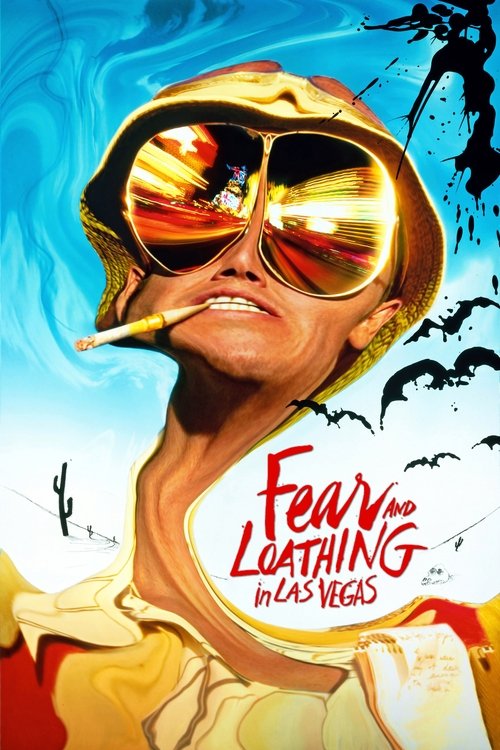
Fear and Loathing in Las Vegas
1998 · Terry Gilliam
For when you want chaos — a midnight movie with friends, a taste for the grotesque, and no need for a tidy plot. This is challenge viewing dressed as comedy; if you're after gentle laughs, save it for another night.
What it's about
A journalist and his attorney point a red convertible across the Mojave toward Las Vegas with a suitcase full of every drug imaginable, nominally to cover a motorcycle race. What follows is a two-man demolition derby through casinos, hotel rooms, and the wreckage of the American Dream, set in the early-'70s hangover after the '60s counterculture crested and broke. Based on Hunter S. Thompson's gonzo classic, it's a road movie where the destination is oblivion.
The experience
Loud, lurid, and relentless — the camera lurches and warps along with the characters, so you're never watching the trip from a safe distance, you're on it. It's very funny in a queasy way, exhausting on purpose, and shot through with sudden flashes of real melancholy about what the '60s promised and didn't deliver.
Performances
Johnny Depp's Duke is a full-body impersonation of Hunter S. Thompson — the pigeon-toed lope, the cigarette holder, the mutter — and Benicio del Toro, physically transformed, makes Dr. Gonzo genuinely menacing as well as funny. Together they're a great, unnerving double act.
The craft
Gilliam shoots almost everything on distorting wide-angle lenses, so hotel carpets crawl and faces balloon — the style itself is the hallucination. The production design piles on period detail and Vegas kitsch until it becomes nightmarish, and a wall-to-wall period rock soundtrack does half the storytelling. Good speakers earn their keep here.
Why it matters
A flop on release that became a durable cult favorite, it stands as the defining screen translation of gonzo journalism and one of the boldest studio-financed acts of formal derangement of the '90s.
Snapshot
Terry Gilliam's adaptation of Hunter S. Thompson's 1971 gonzo novel is a baroque hallucination masquerading as a road movie — a film that uses the conventions of the buddy-comedy and the Vegas-heist picture only to detonate them from within. Shot with distorting wide-angle optics and drenched in period rock, it follows journalist Raoul Duke and his attorney Dr. Gonzo through a pharmaceutical demolition of the American Dream, set during the precise historical moment when, as Thompson's famous "wave speech" laments, the high-water mark of the 1960s counterculture was receding. A commercial misfire on release, the film has since accumulated a fervent cult following and stands as the most formally faithful — and formally deranged — attempt to translate Thompson's literary voice into cinema.
Industry & production
The novel had circulated as a potential adaptation property for years before Gilliam attached himself. Alex Cox — director of Repo Man (1984) and Sid and Nancy (1986) — developed an earlier version with co-writer Tod Davies, and their draft remained a working document through the project's evolution. When the production shifted to Gilliam, he brought in Tony Grisoni, and the two rewrote the script rapidly, reportedly over a matter of days. A WGA credit arbitration resulted in a shared screenplay credit across all four writers, though the precise allocation was a source of friction: Cox has publicly contended that his contributions were underacknowledged. The production was financed and distributed by Universal Pictures through its specialty arm, with a budget reported in the range of $18–19 million. It opened to disappointing returns, falling well short of its production costs at the domestic box office.
Johnny Depp's casting was championed in part by Thompson himself, who had grown to know Depp socially. Depp famously moved into Thompson's Owl Farm compound in Woody Creek, Colorado for several months of immersive preparation — studying the author's speech patterns, physical mannerisms, and characteristic hunch over a typewriter. Thompson, by multiple accounts, said that Depp had effectively "stolen" his soul. Benicio del Toro, cast as the composite character Dr. Gonzo (based loosely on Chicano activist attorney Oscar Zeta Acosta), gained a reported forty-plus pounds for the role, physically transforming himself into a sweating, lurching presence that functions almost as Duke's id made flesh. Thompson himself appears in a brief cameo, a small consecration of the adaptation's legitimacy.
Principal photography took place primarily in Los Angeles, with locations dressed to double for early-1970s Las Vegas, supplemented by some actual Las Vegas shooting. The production design by Alex McDowell — later celebrated for his work on Fight Club (1999) and Minority Report (2002) — reconstructed the lurid palette of casino floors, neon-lit hotel rooms, and desert highways with period-obsessive intensity.
Technology
The film was shot on 35mm, exploiting analog grain and color saturation to visceral effect. Cinematographer Nicola Pecorini deployed an arsenal of extreme wide-angle and fisheye lenses to render perceptual distortion as a stylistic constant rather than an intermittent effect. The result is an image plane that warps inward at the frame's periphery, making the architecture of the casino — already an environment engineered to disorient — feel genuinely malevolent and elastic. Color temperature shifts, superimpositions, multiple exposures, and optical printing were used to externalize drug-induced states; the visual effects work blended in-camera techniques with limited post-production digital manipulation, consistent with mid-to-late-1990s practice in which digital compositing was increasingly available but had not yet supplanted photochemical methods.
The period soundtrack made considerable demands on music licensing. The film's needle-drops draw heavily from the classic rock and psychedelic canon — Jefferson Airplane's "White Rabbit" is used with almost programmatic literalness; Bob Dylan appears; the selection functions as a kind of collapsed archive of late-1960s optimism now audible as elegy. The sonic strategy of deploying familiar period music as ironic counterpoint to visible catastrophe connects Gilliam's film to a lineage running from The Graduate (1967) through early Scorsese.
Technique
Cinematography
Pecorini's work is the film's most immediately recognizable formal signature. His lenses — frequently 14mm or wider, placed close to actors' faces — produce an exaggerated foreground swelling that makes even mundane objects (a cigarette, a glass, a reptile hallucination) loom with hallucinatory menace. This is not naturalistic cinematography attempting to reproduce altered consciousness but a consistent stylistic commitment: the entire film is shot as though viewed through a mind already compromised. Deep focus is maintained even in extreme close-up, ensuring that the background continues to register — an important choice, since much of the comedy and horror depends on what is happening simultaneously in foreground and background. The desert sequences use the horizontal emptiness of the Mojave to entirely different effect, the wide aperture of the lens meeting the wide aperture of the landscape in a mutual blankness that feels like psychic as much as geographical openness.
Editing
Lesley Walker's editing maintains the film's paradoxical formal coherence: this is a picture that looks chaotic but is cut with consistent internal logic. The transitions between Duke's altered-state sequences and the deadpan voiceover passages that frame them are calibrated so that the viewer is perpetually uncertain of where the hallucination ends and the reportage begins — an effect faithful to Thompson's literary technique, in which the unreliable narrator's heightened perception is itself the subject. Walker manages pacing that accommodates both extended comic setpieces and the sudden, vertiginous gear-changes the material demands.
Mise-en-scène / staging
McDowell's production design is archaeologically precise in its period recreation while simultaneously pushed into a fever-dream register. The Mint Hotel rooms, the Circus-Circus casino, and the North Star Café diner each embody specific modes of American kitsch — the carpet patterns, the upholstery, the fluorescent signage — treated with enough fidelity that they feel documented even as Gilliam's staging renders them surreal. Costume designer Julie Weiss contributed enormously to the film's iconography: Depp's Duke uniform of Tilley hat, aviator sunglasses, cigarette holder, and tropical shirt has become one of the most widely imitated visual templates in popular culture. The staging of performance within these environments consistently foregrounds the hotel room and the car as theatrical boxes — closed environments in which the characters' dissolution can be observed.
Sound
The sound design operates on two registers: the hyperreal crash and reverb of the Las Vegas environment (slot machines, crowd noise, car engines processed into abstract threat) and the voiceover narration, delivered by Depp in Thompson's distinctive laconic drone. The narration track is itself a sonic artifact, the voice of the journalist-as-unreliable-witness providing a stabilizing irony against the visual excess. Music supervision gave the soundtrack its emotional spine: the deployment of period recordings as both nostalgic artifact and elegiac counterpoint constitutes one of the film's more disciplined formal strategies.
Performance
Depp's performance is one of the more technically demanding physical impersonations in mainstream 1990s cinema. He reproduces Thompson's vocal quality, movement vocabulary, and psychological weather — the oscillation between predatory alertness and narcoleptic stupor — with extraordinary precision, while simultaneously ensuring that Duke remains a comic creation rather than a biographical exhibit. Del Toro matches him with something rawer and more mercurial: Dr. Gonzo is physically overwhelming where Duke is svelte, reactive where Duke is detached, and del Toro plays him as an id in perpetual emergency, sweating through his shirt and threatening violence with the casualness of a man who has forgotten the difference between speech act and action. The chemistry between the two is grounded in a genuine contrast of acting methods and physical types.
Narrative & dramatic mode
The film's narrative is loosely episodic, organized around two Las Vegas trips — the first to cover a motorcycle race (the Mint 400), the second to attend a narcotics officers' convention — each of which disintegrates almost immediately into chaos. This double-arc structure mirrors the novel's two-book organization and suggests a failed quest pattern: the object of each journey is nominally professional but actually the pursuit of some terminal American experience, some edge of the map where the contradictions of the culture will finally become legible. The film does not resolve this quest. What it offers instead is Thompson's "wave speech" — delivered as voiceover by Depp over a montage of the Sunset Strip — as the film's emotional and philosophical center of gravity: a retrospective elegy for a historical moment, rendered in present tense. The dramatic mode is accordingly neither comedy nor tragedy but something Thompson himself named: gonzo, a first-person immersion so total that the reporter becomes the story.
Genre & cycle
Fear and Loathing inhabits and subverts several genre templates simultaneously. As a road movie it inverts the liberatory promise of the form: the road here leads not outward to freedom but deeper into interiority and waste. As a buddy film it presents a dyadic relationship defined by mutual exploitation rather than affection. As a Vegas picture it evacuates the mythos of gambling-as-mastery — the casino is not a site of skill or fortune but a backdrop for accelerating psychological disintegration. The film belongs to a loose cycle of 1990s literary adaptations aimed at countercultural legitimacy — alongside Naked Lunch (Cronenberg, 1991) and Trainspotting (Boyle, 1996) — that sought to translate the untranslatable formal experiments of transgressive prose into cinematic equivalents, with varying degrees of formal ambition. It also participates in the 1990s art-film cycle of narration-as-monologue (compare Ferris Bueller retroactively reimagined as dread), and in the decade's broader interest in unreliable subjectivity.
Authorship & method
Terry Gilliam had established himself across two decades as Hollywood's most committed fabulist — the ex-Python whose Brazil (1985) remains a landmark of dystopian cinema, whose The Fisher King (1991) demonstrated an ability to work within conventional emotional registers, and whose Twelve Monkeys (1995) had achieved genuine commercial success. His method tends toward overwhelming visual excess in service of thematic compression: the images do not illustrate the script but enact it, making argument through architecture. Fear and Loathing gave Gilliam source material peculiarly suited to his instincts — Thompson's prose is itself already maximalist, self-dramatizing, and hallucinatory — and permitted him to dispense with the narrative containment that had disciplined his previous studio work. The film shows some signs of Gilliam's chronic tendency toward excess overwhelming coherence, but in this particular case the argument could be made that the shapelessness is the point.
Nicola Pecorini, who became a frequent Gilliam collaborator after this film, brought an Italian cinematographic sensibility — influenced by the operatic visual traditions of Italian genre cinema — that proved compatible with Gilliam's taste for distortion and visual aggression.
Alex McDowell was at this point mid-career in production design and would go on to define his own practice around world-building methodology; his work here is a transitional demonstration of his capacity to design total environments that feel inhabited rather than constructed.
The writing credit's complexity — Gilliam, Grisoni, Cox, Davies — reflects the film's difficult development and the multiple hands that shaped its architecture, though the final film bears Gilliam's imprint far more than any other authorial signature.
Movement / national cinema
The film occupies an unusual position: a British director's interpretation of an essentially American literary phenomenon, made within the American studio system. Gilliam's expatriate perspective — he had been living and working in Britain since his Python years while retaining American citizenship — arguably enables a kind of anthropological remove, a capacity to treat the iconography of American excess as spectacle rather than naturalized environment. This aligns Fear and Loathing less with New Hollywood's insider mythologies than with the British satirical tradition of regarding American culture as simultaneously magnificent and grotesque. Thompson's own project — the gonzo journal as autopsy of the American Dream — is in this sense legible to Gilliam in a way it might not be to a native-born American filmmaker entirely inside that mythology.
Era / period
The film was produced in the mid-to-late 1990s, a period marked by the consolidation of the specialty film market and the mainstreaming of independent aesthetics. Its commercial failure notwithstanding, it reflects the decade's sustained appetite for formally ambitious literary adaptations and its interest in the pharmaceutical, in altered states as metaphor for late-capitalist experience. The late 1990s also saw a proliferation of films using subjective point-of-view and unreliable narration — Being John Malkovich (1999), Fight Club (1999), Magnolia (1999) — in ways that contextually frame Gilliam's film as a somewhat earlier iteration of that tendency. The film is set in 1971, which compounds its temporal complexity: it is a 1998 work about 1971, directed through a sensibility formed in the early 1970s, treating 1960s optimism as already historical. The layering of eras within the film's address is part of what gives it its peculiar elegiac charge.
Themes
The central thematic argument is Thompson's own: the American Dream as mythology exposed by its own excesses. Las Vegas — a city built on managed illusion, on the manufacture of luck, on the conversion of aspiration into revenue — serves as the ideal laboratory for this demonstration. Duke and Gonzo are not victims of Vegas; they are its mirror, producing through their own behavior an image of the culture's appetites stripped of their usual euphemisms.
The death of the counterculture haunts the film structurally. The wave speech names this explicitly: the moment in 1965 or 1966 when there was a palpable sense that anything was possible, that the energy of the youth movement might genuinely remake the culture, is recalled as already historical by 1971 — and in 1998, recalled again at a further distance. The film's temporal layering means that the elegiac note sounds twice: once within the diegesis, once from the position of the viewer.
Journalism and testimony are also substantive themes. Duke's role as reporter — supposedly there to cover events, actually becoming the event — enacts the epistemological problem of gonzo journalism: there is no neutral position from which to observe; the observer is always also the subject. This extends to the film's address of authenticity, performance, and the unstable boundary between lived experience and its narration.
Reception, canon & influence
Critical reception on release was sharply divided. Several major critics found the film's relentless assault of visual excess and its seeming refusal to locate an emotional center beyond exhaustion genuinely unwatchable; others recognized its formal ambitions even while questioning their execution. The film was not a critical triumph and its box-office disappointment reinforced its marginal status in the immediate post-release period.
Influences on the film: Thompson's 1971 novel — itself serialized in Rolling Stone before book publication — is the primary source and remains the film's constant reference point. Gilliam has cited his admiration for the New Hollywood tradition of films willing to implicate the viewer in protagonist misbehavior, and the film's use of hallucinatory imagery draws on a broader psychedelic cinema inheritance running from experimental filmmakers of the 1960s through Kenneth Anger and beyond. The picaresque road-movie tradition, from Bonnie and Clyde (1967) through Easy Rider (1969), provides the generic armature the film dismantles. Ralph Bakshi's animated experiments with extreme perspective and moral ambiguity in the early 1970s are also, at least stylistically, a relevant context.
Legacy and influence: The film's canonical status solidified gradually through home video and DVD-era cult absorption. It became a touchstone for a generation of viewers encountering Thompson's work simultaneously through the adaptation, shaping the popular image of gonzo journalism as much as the novel had. Its visual style — the fisheye distortion, the acidic color palette, the use of period rock as ironic accompaniment to visible catastrophe — has been widely imitated in music videos, advertising, and subsequent films exploring altered or transgressive states. Depp's performance and the film's iconography (the car, the hat, the cigarette holder) entered popular visual culture with unusual speed and thoroughness. Thompson's suicide in 2005 retroactively deepened the film's reception, lending it the quality of a document as well as an entertainment. Alex Cox subsequently expressed continuing grievances about the credit situation, ensuring that the film's production history remains a live scholarly and industry conversation. Within Gilliam's filmography, Fear and Loathing is generally considered alongside Brazil as his most fully realized articulation of a vision too large and too strange for comfortable commercial accommodation — which is to say, a failure that succeeded at precisely what it set out to do.
A Deleuzian reading
We're somewhere around Barstow when the bats arrive.
The full Deleuzian reading of Fear and Loathing in Las Vegas →
Reception
A notorious flop in 1998 — it bombed at the box office, split critics down the middle at Cannes, and got savaged in the mainstream press — before home video, stoner-canon word of mouth, and a Criterion edition turned it into a full-blown cult classic.
How Fear and Loathing in Las Vegas was received, from release to now →
Influences: the films it descends from and the films it influenced
- Where the Buffalo Roam (1980) — Bill Murray's physical impersonation of Thompson — the trademark hunch, cigarette holder, and slurred cadence — establishes the performance template Depp consciously studied and then deepened; Linson also deploys period rock as generational-elegy counterpoint in exactly the register Gilliam inherits.
- Easy Rider (1969) — Hopper deploys Steppenwolf, the Byrds, and Hendrix not as score but as cultural timestamp whose recognizability renders visible the countercultural myth it can no longer sustain — the needle-drop-as-elegy strategy that Thompson's wave-speech voiceover and Gilliam's soundtrack directly inherit.
- Midnight Cowboy (1969) — British director filming the American Dream's underside through wide-angle handheld and superimposed hallucination sequences; the failed buddy-quest structure collapses into mutual destruction rather than resolution, and Harry Nilsson's needle-drops function as American-myth elegy — the structural template for Duke and Gonzo's double-arc.
- Lolita (1962) — European satirist adapting a canonically unadaptable transgressive American novel via a first-person narrator whose voiceover retrospectively disqualifies its own credibility; Kubrick's template for rendering unreliable literary consciousness as visual comedy of dread is the formal lineage Gilliam explicitly works within.
- Performance (1970) — Roeg uses superimposition, in-camera color manipulation, and multiple-exposure printing to externalize drug-induced identity dissolution as consistent cinematic grammar rather than isolated effect — the principle that Pecorini's hallucination sequences directly inherit: altered consciousness expressed through the film's baseline optical register, not exceptional departures from it.
- The Graduate (1967) — Simon & Garfunkel's 'Sound of Silence' deployed as elegy-counterpoint to a generation's impending disillusionment — the dossier explicitly cites Nichols as origin point for the strategy of familiar period music operating ironically against visible catastrophe, a lineage Gilliam's soundtrack extends.
- Apocalypse Now (1979) — Willard's voiceover narrates self-destruction as literary witness whose reliability collapses with his sanity; the doubled structure (deteriorating narrator / impossible quest) and 'The End' as period elegy are direct craft precursors to Gilliam's unreliable-witness framing and the wave-speech's retrospective mourning.
- Brazil (1985) — Gilliam's own rehearsal of the visual toolkit deployed in F&L: extreme-wide-angle distortion of institutional architecture, production design as ideological critique, in-camera optical effects for fantasy intrusion, and the British-expatriate's satirical reading of Anglo-American bureaucratic capitalism that Gilliam then reroutes through Thompson.
- Fight Club (1999) — Alex McDowell — who designed F&L's Las Vegas production — brought the same period-artifact-as-ideological-critique design methodology to Fight Club; Fincher also deploys a voiceover narrator whose retrospective commentary the film's images steadily refute, extending F&L's unreliable-witness structure into a full plot mechanism.
- Requiem for a Dream (2000) — Matthew Libatique's snorricam and extreme wide-angle close-ups — objects lurching toward the lens — directly translate pharmaceutical subjective experience into consistent lens grammar, inheriting Pecorini's principle that the entire film must be shot as though through a compromised perceptual apparatus, not just its hallucination set-pieces.
- Enter the Void (2009) — Noé sustains first-person gonzo-immersion camera for the film's entire duration — blinking eyelids and all — making drug-induced altered consciousness not a set-piece but the film's only optical register, extending Gilliam's principle that the viewer must inhabit the protagonist's compromised perception without reprieve or cutaway to objectivity.
- Rango (2011) — The desert-highway hallucination that opens Rango — wide-angle distortion, a terrarium as the vehicle, and a literal Raoul Duke in the passing convertible — is Gilliam's Thompson grammar of subjective lens abuse and paranoid road space, with Depp reprising his own performance.
- Naked Lunch (1991) — Cronenberg adapts Burroughs' canonically unfilmable transgressive prose by making hallucination the narrative engine rather than a set-piece — talking typewriter-bugs, insectoid interzone — refusing throughout to distinguish drug-induced vision from diegetic reality, enacting the same unreliability contract with the viewer that Gilliam makes.
- Natural Born Killers (1994) — Road movie structured as violent demolition of American mythology; Stone's cutting between 8mm, 16mm, 35mm, and video within a single sequence generates grain-instability as psychological fragmentation — a formal strategy for externalizing altered consciousness that runs parallel to Pecorini's lens-distortion approach rather than descending from it.
- Ed Wood (1994) — Depp's physical impersonation methodology — adopting the subject's posture, verbal tics, and material props as character skeleton rather than mimicry — is the same technique he applies to Thompson four years later; the film's period production design reconstructs a specific decade's vernacular as simultaneously affectionate elegy and American Dream irony.
- The Big Lebowski (1998) — Contemporary sibling: the narrating Stranger openly confesses he barely knew the Dude, structuring the voiceover as self-undermining unreliable witness from the opening frame; the film's neo-noir quest collapses into pure failed-arc comedy via the same double-protagonist dissolution, and Creedence Clearwater Revival functions as California-myth elegy.
- Jesus' Son (2000) — Parallel near-contemporary attempt to film a beloved first-person drug-prose voice, leaning on wall-to-wall narration and subjective distortion to keep the sentences alive onscreen.
Similar films
- Easy Rider (1969) — influence & lineage
- The Big Lebowski (1998) — influence & lineage
- Naked Lunch (1991) — influence & lineage
- Performance (1970) — influence & lineage
- Brazil (1985) — influence & lineage
- Ed Wood (1994) — influence & lineage
- Blow (2001) — shared sensibility
- The Doors (1991) — shared sensibility