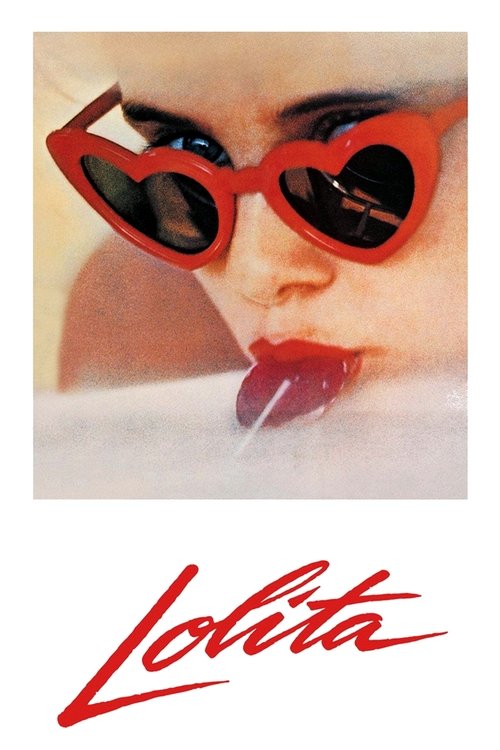
Lolita
1962 · Stanley Kubrick
When you want a provocation — a film to argue about afterward, not a comfortable watch. For nights when you're up for black comedy with a genuinely disturbing core.
What it's about
Humbert Humbert, a fastidious European novelist both appalled by and drawn to brash American culture, takes a room in widow Charlotte Haze's small-town boarding house — and becomes obsessed with her teenage daughter, Lolita. To stay close to the girl, he entangles himself in the household, while a slippery figure named Clare Quilty keeps turning up at the edges of his scheme. It's a portrait of obsession curdling into jealousy and self-destruction.
The experience
Queasy and darkly funny at once — Kubrick plays the monstrous material as corrosive black comedy, all innuendo and squirming social embarrassment, so you laugh while feeling implicated. The unease builds slowly and never lets you settle.
Performances
James Mason is extraordinary as Humbert, exquisitely self-deceiving and pathetic under the polish; Shelley Winters makes Charlotte both grotesque and heartbreaking; Peter Sellers, as the shape-shifting Quilty, slides through the film in a run of improvised disguises that steal it outright.
The craft
Working under ferocious censorship, Kubrick adapted Nabokov's unfilmable novel by displacing everything into suggestion — arch dialogue, loaded glances, black-comic set pieces — and the constraint becomes the style. The elegant black-and-white photography keeps the suburban settings looking respectable while the story rots underneath.
Why it matters
A landmark collision between a scandalous novel and the censorship of its era — 'How did they ever make a movie of Lolita?' ran the ads — and a key step in Kubrick's emergence as cinema's great ironist.
Snapshot
Stanley Kubrick's Lolita is the film that asked, on its own posters, "How did they ever make a movie of Lolita?"—and then answered the question by not quite making the movie of Lolita at all. Adapting Vladimir Nabokov's incendiary 1955 novel about Humbert Humbert, a European literary man consumed by desire for a twelve-year-old American girl, Kubrick and producer James B. Harris confronted the Production Code Administration and the Catholic Legion of Decency head-on and emerged with a work that displaces the novel's eroticism into innuendo, indirection, and black comedy. What survives is less a tragedy of pedophilia than a corrosive satire of obsession, jealousy, and middlebrow American culture, anchored by James Mason's exquisitely self-deceiving Humbert, Shelley Winters' grotesque-pathetic Charlotte Haze, Sue Lyon's knowing Dolores, and—above all—Peter Sellers' shape-shifting Clare Quilty, whose expanded role tilts the film toward absurdist comedy. It is the picture on which Kubrick relocated permanently to England, the one that paired him with Sellers (a partnership that produced Dr. Strangelove two years later), and a key case study in how mid-century censorship deformed and, paradoxically, sometimes sharpened American filmmaking.
Industry & production
Lolita was the work of Harris-Kubrick Pictures, the independent partnership between Kubrick and James B. Harris that had already produced The Killing (1956) and Paths of Glory (1957). Acquiring the rights to Nabokov's notorious bestseller was itself a provocation: the novel had been banned in several countries, and the very idea of filming it was treated as a scandal in the trade and popular press. The production was financed and distributed through Metro-Goldwyn-Mayer, but shot in England—at Associated British Elstree Studios—for a combination of reasons: tax advantages, lower costs, frozen overseas earnings that American studios needed to spend abroad, and a degree of distance from the most direct domestic scrutiny.
The central industrial fact about Lolita is that it was made inside, and against, the apparatus of self-censorship. The Production Code still governed mainstream American release, and the Legion of Decency's ratings could cripple a film's box office among Catholic audiences. To secure approval, Kubrick and Harris raised Lolita's apparent age, removed almost all explicit physical contact, and rendered the central relationship through ellipsis and implication. Kubrick said in later interviews—most extensively to Newsweek and in his conversations with Michel Ciment—that had he understood in advance how severe the constraints would be, he might not have made the film, because the erotic obsession that drives the novel could only be hinted at on screen. The picture nonetheless arrived with a high-profile marketing campaign built around that very difficulty, and around an iconic promotional image—Sue Lyon peering over heart-shaped sunglasses with a lollipop, photographed by Bert Stern—that appears nowhere in the finished film.
This was also Kubrick's reset after Spartacus (1960), the large studio production he had taken over from Anthony Mann at Kirk Douglas's behest and on which he chafed at his lack of final authority. Lolita returned him to the independent, author-driven mode he preferred, and his move to England for the shoot became permanent: he would direct the rest of his career from Britain.
Technology
Lolita is a black-and-white film shot on 35mm with spherical lenses, presented in a widescreen aspect ratio of roughly 1.66:1—the European-inflected mid-size frame common to British studio production of the period rather than the wider anamorphic CinemaScope formats MGM often favored. The choice of black-and-white in 1962, when color was increasingly standard for prestige releases, reads as a deliberate aesthetic decision: it suits the film's literary, interior, faintly noirish register and its satirical detachment, and it links the picture to the monochrome tradition of Kubrick's earlier independent work. Beyond these baseline facts, Lolita is not a film of conspicuous technological innovation; its achievements are those of staging, performance, and cutting rather than of any novel apparatus. The honest record here is that the picture's interest lies elsewhere than in technical firsts.
Technique
Cinematography
The cinematography is by Oswald Morris, one of the leading British directors of photography of the era, celebrated for his expressive, sometimes experimental command of black-and-white and color alike. In Lolita Morris and Kubrick favor long takes and fluid, observational camerawork over aggressive montage, letting scenes play out in extended duration so that performance and dialogue carry the weight. Kubrick's developing taste for deep, deliberate compositions and for the camera as a watchful, slightly clinical presence is already legible. Interiors—the Haze house, motel rooms, Quilty's cluttered mansion—are rendered with a controlled gray-scale tonality that lends the domestic American settings an oppressive, faintly absurd quality. The film's surveillance-like attentiveness to Humbert watching Lolita is achieved as much through patient framing as through cutting.
Editing
Anthony Harvey edited the film; he would later become a director in his own right (The Lion in Winter, 1968). The most consequential editorial-structural decision is the framing device: Lolita opens with its ending, as Humbert drives through morning mist to Quilty's mansion and shoots him, then flashes back four years to tell the story that leads there. This in medias res construction—Kubrick's invention, not Nabokov's ordering—primes the audience to read the entire narrative as the unspooling of a doom already sealed, and it foregrounds the Humbert-Quilty rivalry that the film makes central. Within scenes, the cutting is restrained, deferring to the long takes; the rhythm is conversational and theatrical rather than kinetic.
Mise-en-scène / staging
Staging is where Lolita is richest. Kubrick blocks his actors in extended, stage-like configurations—the school dance, the Haze living room, the climactic confrontation at Pavor Manor—where physical positioning and props (a ping-pong table, a pistol, a half-finished painting) carry meaning. The opening murder sequence, with Quilty hiding behind a portrait, donning a bedsheet, playing ping-pong and reciting nonsense as Humbert advances with the gun, is a masterclass in sustained, absurd-menacing staging. The American settings are dressed to satirize a culture of motels, soda fountains, PTA gentility, and pop ephemera that the European Humbert (and the European-émigré Nabokov) regard with appalled fascination, a tension the synopsis rightly flags.
Sound
The score is by Nelson Riddle, the celebrated arranger best known for his work with Frank Sinatra, with the recurring romantic "Lolita" theme composed by Bob Harris. The music sets a deliberately incongruous tone: a lush, almost saccharine love theme plays under the title sequence—Humbert tenderly painting Lolita's toenails—while a bouncy pop number, "Lolita Ya Ya," supplies a teenage, jukebox-American counterpoint. This ironic scoring, sweet melody against squalid subject, is integral to the film's satirical mode. Dialogue and its delivery dominate the soundtrack; the film is talky by design, befitting its literary source and its theatrical performances.
Performance
Performance is the film's engine. James Mason's Humbert is a study in articulate self-deception—suave, wounded, increasingly abject—delivered in voice-over and dialogue that preserve much of Nabokov's mordant register. Shelley Winters makes Charlotte Haze monstrous and pitiable at once, a vulgar, pretentious, lonely widow whose comic awfulness curdles into genuine pathos. Sue Lyon, a near-unknown teenager when cast, plays Dolores with a poised, gum-snapping ordinariness that refuses both the novel's mythic "nymphet" and easy sentimentality; she won a Golden Globe for new star of the year. And Peter Sellers, as Clare Quilty, improvises his way through a gallery of disguises—the leering conventioneer, the bogus German school psychologist Dr. Zempf, the menacing voice on the telephone—turning a relatively minor figure in the novel into the film's destabilizing comic-sinister center.
Narrative & dramatic mode
The film's dramatic mode is ironic tragicomedy filtered through an unreliable, confessional first person. Humbert's voice-over narration—drawn from the diary conceit of the novel—frames events as his self-justifying account, and the audience is invited to register the gap between his romantic self-image and the predatory reality the Code forces the film to keep offscreen. The flash-forward opening converts the story into a retrospective inevitability. Where Nabokov's novel sustains horror and lyric beauty in uneasy simultaneity, Kubrick's film shifts the balance toward comedy of manners and farce, especially through Sellers, while preserving an undertow of jealousy, humiliation, and grief in the back half, as Humbert loses Lolita and pursues his phantom rival.
Genre & cycle
Lolita sits at the intersection of the literary prestige adaptation, the black comedy, and a faint strain of noir (the doomed-man-with-a-gun frame, the obsession, the murder). It belongs to a late-Code cycle of "adult" American films in the early 1960s that pressed against the boundaries of permissible subject matter—pictures testing what could be shown about sexuality, addiction, and transgression as the Code's authority eroded and would, by 1968, give way to the MPAA ratings system. Within Kubrick's filmography it marks his decisive turn toward satire and toward Sellers, a turn consummated in Dr. Strangelove (1964).
Authorship & method
Lolita is doubly authored, and the relationship between its two authors is one of the most discussed in adaptation studies. Vladimir Nabokov is the sole credited screenwriter and received an Academy Award nomination for the screenplay, but the script that reached the screen was substantially the work of Kubrick and Harris. Nabokov's own screenplay, written at Kubrick's invitation, ran to an unfilmable length; he later published a version of it (1974) and noted, with characteristic irony, how little of his text survived. Kubrick retained Nabokov's name—both for its prestige and, plausibly, as cover—while reshaping structure, dialogue, and emphasis, most notably the expansion of Quilty and the reordering of the plot.
Kubrick's method here is the controlling-author mode he would refine for the rest of his career: total creative authority within an independent production, meticulous staging, extended takes, and a willingness to let a gifted comic actor (Sellers) improvise within tightly designed scenes. His key collaborators reinforce the picture's character—cinematographer Oswald Morris for the expressive monochrome, editor Anthony Harvey for the disciplined cutting and the bold flash-forward, Nelson Riddle and Bob Harris for the ironic score, and producer James B. Harris as the steady partner of Kubrick's independent phase (their collaboration ended after this film). The casting of Sellers is itself an authorial act whose consequences extended directly into Kubrick's next project.
Movement / national cinema
Lolita is a hybrid: an American production, financed by an American studio and steeped in American subject matter, but physically made in Britain with substantially British craft personnel (Morris, Harvey, the Elstree facilities) and a transatlantic, émigré sensibility derived from Nabokov and embodied by the European Humbert. It does not belong to any single national movement; rather it exemplifies the runaway, internationally financed production that became common as Hollywood decentralized in the late 1950s and 1960s. For Kubrick personally it inaugurated the English base from which he made every subsequent film, making him a singular case of an American auteur working at a deliberate remove from Hollywood.
Era / period
The film is a creature of the early 1960s, the last years of the Production Code's effective authority. Its evasions, ellipses, and reliance on innuendo are direct artifacts of that censorship regime; the same material would be filmed far more explicitly by Adrian Lyne in 1997, after decades of liberalization. Lolita thus stands as a document of a transitional moment, when ambitious filmmakers smuggled transgressive themes past the censors through indirection, comedy, and the prestige of literary source material—an aesthetics of constraint that the period imposed and that Kubrick turned, partially, to expressive advantage.
Themes
At its core Lolita dramatizes obsession and the self-justifying narratives desire constructs around itself. Humbert's voice-over is a sustained act of rationalization, and the film's irony lies in our seeing through it. Jealousy and the doubling of Humbert and Quilty—predator and rival predator, the man who wants to possess and the man who casually takes—structure the back half and the framing murder. Running beneath is a satire of mid-century American culture: its motels and conventions, its therapeutic jargon (skewered through Sellers' Dr. Zempf), its suburban pretensions (Charlotte), its commodified adolescence. The film also meditates, more obliquely than the novel, on the gap between the mythologized object of desire and the ordinary, unknowable girl who is its victim—though the Code's constraints blunt the novel's full reckoning with that harm, a limitation honest criticism must name.
Reception, canon & influence
Critical reception in 1962 was mixed and much preoccupied with the adaptation problem: reviewers debated whether the novel could or should have been filmed, and how much of Nabokov survived. Performances drew wide praise, particularly Sellers and Mason, with Winters and the newcomer Lyon also singled out; Lyon's Golden Globe and Nabokov's screenplay Oscar nomination registered the film's standing. Over time critical estimation rose, and Lolita is now regarded as a significant, if compromised, entry in Kubrick's filmography and a touchstone in discussions of censorship and literary adaptation, even as some critics continue to judge it the lesser of the two Kubrick films Sellers anchored.
Looking backward, the film's influences are clear and acknowledged: Nabokov's novel above all, the European literary and émigré sensibility, and Kubrick's own developing interest in obsession and moral irony traceable through The Killing and Paths of Glory. Looking forward, its most direct and well-documented legacy is Dr. Strangelove (1964): the Lolita collaboration convinced Kubrick to build his next film around Sellers in multiple roles, extending the improvisatory, multi-character comic mode that Quilty's disguises had piloted. More broadly, Lolita became a permanent reference point in arguments about what cinema may represent—its very title a cultural shorthand—and the basis for Adrian Lyne's more explicit 1997 remake, whose troubled production and distribution underscored how charged the material remained decades later. The poster iconography of the heart-shaped glasses, detached from the film itself, persists as one of the most recognizable images in twentieth-century film advertising, evidence of how thoroughly the picture entered the cultural bloodstream even where its actual contents are misremembered.
A Deleuzian reading
Begin with the man behind the painting.
The full Deleuzian reading of Lolita →
Reception
Scandalous on release — censors defanged it and many critics called it a pale shadow of Nabokov — but it's since been reappraised as a sly black comedy, with Peter Sellers' shape-shifting Quilty now seen as a dry run for Dr. Strangelove.
How Lolita was received, from release to now →
Influences: the films it descends from and the films it influenced
- Citizen Kane (1941) — Supplies the in-medias-res architecture Kubrick borrows—opening on the protagonist's end (Quilty's killing) and then circling back through deep-focus expressive monochrome to reconstruct how he got there.
- Sunset Boulevard (1950) — Models the doomed-narrator flashback frame in which a killing shown at the outset is retold in confessional voice-over, the device Humbert's narration and the gun-in-the-mansion prologue replicate.
- Double Indemnity (1944) — Establishes the first-person voice-over of a guilty man narrating his own moral self-destruction with sardonic detachment, the unreliable-confessional register Mason's Humbert inherits.
- The Blue Angel (1930) — Provides the abjection template of a respectable older man (Jannings) reduced to groveling humiliation by erotic fixation on a younger performer—the self-deceiving degradation arc Mason plays.
- M (1931) — Pioneers placing a child predator at the moral center of an ironic frame, forcing audience proximity to a monstrous subject without endorsement—the representational tightrope Lolita walks under the Production Code.
- The Killing (1956) — Kubrick and Harris's independent fractured-chronology heist film whose nonlinear, flash-forward cutting licensed the editor Anthony Harvey's bold reordering of Lolita's plot.
- Paths of Glory (1957) — Establishes Kubrick's controlling-author method of meticulous extended-take tracking and corrosive moral irony that he carries directly into Lolita's staged long takes.
- The Ladykillers (1955) — Ealing black comedy that crystallized Peter Sellers's chameleon, multi-voice disguise mode—the improvisatory shape-shifting Quilty's serial impersonations exploit.
- A Place in the Sun (1951) — Kubrick uses telephoto close-up to render Humbert's self-justifying romantic gaze — the desired face in shallow focus, abstracted from social context — extending Stevens's technique for the morally compromised male protagonist whose romantic self-narration the camera endorses visually while condemning structurally.
- Dr. Strangelove (1964) — The documented direct heir: the Lolita partnership convinced Kubrick to build the film around Sellers in multiple roles, extending the improvise-within-tight-design comic method Quilty piloted.
- A Clockwork Orange (1971) — Extends Lolita's seductive unreliable first-person voice-over that lures the viewer into complicity with a charming monster, paired with ironically deployed classical scoring.
- Barry Lyndon (1975) — Carries forward the ironic narration that continually undercuts and judges its self-deceiving protagonist, the detached authorial commentary Lolita's structure first set against Humbert.
- Lolita (1997) — The explicit re-adaptation of the same Nabokov source, whose troubled distribution measured how much of the charged material Kubrick had to encode rather than show.
- Dr. Strangelove or: How I Learned to Stop Worrying and Love the Bomb (1964) — Sellers' improvisational performance as Quilty — multiple disguises, shifting accents, mid-scene tonal pivots — was developed in close collaboration with Kubrick, establishing the directorial method of capturing live improv rather than scripted performance that Kubrick then applied wholesale to all three Strangelove roles.
- Fear and Loathing in Las Vegas (1998) — European satirist adapting a canonically unadaptable transgressive American novel via a first-person narrator whose voiceover retrospectively disqualifies its own credibility; Kubrick's template for rendering unreliable literary consciousness as visual comedy of dread is the formal lineage Gilliam explicitly works within.
- Badlands (1973) — Deploys a naive, affectless voice-over that ironically counterpoints a transgressive older-man/young-girl flight, the same gap between innocent narration and predatory act Lolita engineers.
- The Graduate (1967) — Builds a satire of American culture on an illicit intergenerational seduction scored with pointedly ironic pop music—the tonal recipe of comedy-over-discomfort Lolita pioneered for the subject.
- American Beauty (1999) — Narrates a middle-aged suburbanite's obsession with a teenage girl from beyond the grave, fusing the dead/doomed-narrator frame with Lolita's satire of American domestic respectability.
- Manhattan (1979) — Treats an older man's affair with a teenage girl through sophisticated black-and-white irony, inheriting Lolita's strategy of rendering taboo as urbane comedy of self-justification.
- The Servant (1963) — Contemporaneous Pinter-scripted chamber piece of erotic psychological manipulation and role-reversal in expressive monochrome—the same year's British exercise in obsession-as-power-game that mirrors Quilty's gamesmanship with Humbert.
Similar films
- Lolita (1997) — influence & lineage · often watched together
- A Clockwork Orange (1971) — influence & lineage
- The Graduate (1967) — influence & lineage
- Sunset Boulevard (1950) — influence & lineage
- The Trial (1962) — often watched together
- Belle de Jour (1967) — often watched together
- The Shining (1980) — shared sensibility
- Pandora's Box (1929) — shared sensibility