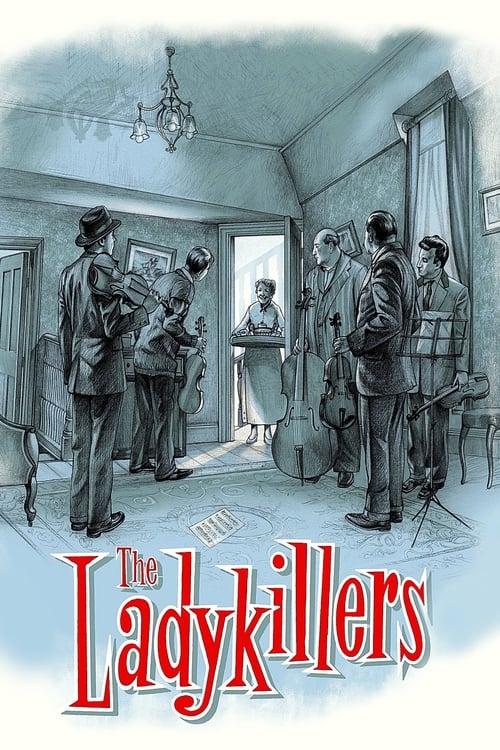
The Ladykillers
1955 · Alexander Mackendrick
For a cozy night in when you want to laugh at something dark — vintage comfort viewing with real bite, perfect with tea and zero guilt.
What it's about
Five crooks planning a big robbery need a respectable front, so they rent rooms from Mrs Wilberforce, a tiny, sweet, unshakeably proper old widow, and pose as a string quintet rehearsing in her spare room. The heist is the easy part. The hard part is the landlady — whose innocent good manners keep colliding with their scheme, with increasingly lethal consequences for the gang.
The experience
A wickedly funny black comedy wrapped in doilies and teacups — genteel on the surface, gleefully macabre underneath. It's brisk, beautifully constructed, and gets funnier as the criminals' luck gets worse.
Performances
Alec Guinness is a grotesque delight as the snaggle-toothed Professor Marcus, Katie Johnson steals the whole film as the serenely oblivious Mrs Wilberforce, and a young Peter Sellers rounds out a flawless criminal ensemble.
The craft
William Rose's screenplay is a machine of comic escalation — every polite English convention turned into a trap — and Mackendrick directs it with painterly Technicolor charm, all crooked little houses and steam trains. The contrast between chocolate-box visuals and body count is the joke, and it lands every time.
Why it matters
One of the last and darkest of the great Ealing comedies, it capped a golden age of British film humor, shaped generations of black comedy, and was remade in Hollywood half a century later.
Snapshot
The Ladykillers is among the last and darkest of the Ealing comedies, a macabre farce in which a gang of mismatched criminals, posing as an amateur string quintet, rents lodgings from a frail Edwardian widow whose unwitting decency proves more lethal than anything they could devise. Directed by Alexander Mackendrick from a William Rose screenplay that Rose claimed arrived fully formed in a dream, the film turns a genteel King's Cross sitting room into a slaughterhouse of comic attrition, the robbers eliminating one another while the old lady remains serenely oblivious. Built on Alec Guinness's grotesque, snaggle-toothed Professor Marcus and Katie Johnson's indomitable Mrs Wilberforce, it fuses the cozy English comedy of manners with a strain of black comedy that anticipates much later work. Released as Ealing Studios itself was being dismantled, it functions both as a polished entertainment and as an inadvertent elegy — for a studio, a comic tradition, and the antique England the widow embodies.
Industry & production
The Ladykillers was a Michael Balcon production made at Ealing Studios, the small West London plant that under Balcon's stewardship had become synonymous with a particular brand of modestly scaled, sharply observed British comedy. By 1955 Ealing's independence was effectively over: the studio buildings had been sold to the BBC, and the production unit was in the process of relocating to facilities at MGM's Borehamwood lot. The film thus belongs to the very end of the classic Ealing period, made by a company already in retreat, and it is frequently grouped with Kind Hearts and Coronets (1949), The Lavender Hill Mob (1951) and The Man in the White Suit (1951) as one of the studio's defining comedies.
The picture was produced under Balcon's overall control, with Seth Holt serving as associate producer; Holt, then an Ealing editor moving toward direction, was part of the studio's house ecosystem of multi-skilled craftsmen. Production design was by Jim Morahan, whose construction of the lopsided Wilberforce house — a structure visibly subsiding beside a railway cutting — is central to the film's visual conception. Location work was undertaken in the King's Cross / Frederica Street area of north London, with the cul-de-sac and the looming railway tunnel exploited as both real geography and symbolic landscape. Beyond these well-documented facts the granular production record is comparatively thin in the popular literature, and specific budget and shooting-schedule figures are not something I can state with confidence.
Technology
The film was shot in Technicolor, a notable choice for an Ealing comedy of the period, many of which remained in black and white. Color here is not deployed for spectacle but for a muted, sooty palette appropriate to a smog-bound London of brick, soft furnishings and railway steam — the saturated Technicolor process pushed toward grime rather than glamour. The other technological motif that the film foregrounds diegetically is the gramophone: the gang masks its planning sessions by playing a recording of a Boccherini minuet, so that the machinery of mechanical sound reproduction becomes a plot device, the recorded music standing in for the live performance the criminals cannot actually give. Beyond these, the production relies on conventional mid-1950s studio technique — soundstage interiors married to location exteriors — rather than any technical innovation.
Technique
Cinematography
The photography is by Otto Heller, the Czech-born cinematographer later responsible for the very different worlds of Peeping Tom (1960) and The Ipcress File (1965). Heller's work here is disciplined and largely classical, organized around the cramped geography of the Wilberforce house and the vertiginous drop to the railway lines below. The compositions repeatedly exploit the building's tilt and the steep angles down into the cutting, so that the trains — into whose passing wagons the bodies are eventually tipped — are established as a constant visual presence. Heller and Mackendrick favour framings that trap the oversized, sinister gang within the doll's-house scale of the widow's rooms, the men too large for the furniture, their criminal bulk comically and then menacingly ill-fitting. The Technicolor exteriors of London under a pall of smoke give the film a distinctive atmospheric heaviness that offsets the brightness of the comedy.
Editing
The editing — credited to Jack Harris, a veteran British cutter — serves the film's escalating logic of elimination. The comedy depends on rhythm: the repeated rituals of the false rehearsals, the gramophone covering the planning, the increasingly frantic disposal of bodies. As the gang is whittled down, the cutting must manage a delicate tonal balance, keeping the killings brisk and bloodless enough to remain funny while sustaining suspense. The film's structure is essentially that of a countdown, and the editing tracks the diminishing membership of the gang with a grim, accelerating economy.
Mise-en-scène / staging
Staging is the film's great strength. The Wilberforce house is conceived as a closed, overstuffed Edwardian world — antimacassars, caged parrots, framed photographs, a clutter of Victorian sentiment — into which the modern criminal element intrudes and is, in effect, digested. Mackendrick repeatedly stages the gang as an awkward tableau: five large men squeezed into the widow's parlor, obliged to take tea, to humor her friends, to "perform" their non-existent musicianship. The subsiding architecture is itself a staging device, the off-kilter rooms externalizing the moral disequilibrium of the plot. The railway cutting at the rear functions as an off-screen abyss, the disposal mechanism that the staging keeps gesturing toward.
Sound
Sound is woven into the narrative more than usual. The Boccherini minuet, played on the gramophone, is the gang's acoustic alibi and recurs as a leitmotif of their imposture; the gap between the genteel chamber music and the brutish reality of the men is a running joke. The passing trains supply a recurrent rumble and shriek of whistles that punctuate the action and cover the sounds of violence. Mrs Wilberforce's chirping, the squawk of her parrot General Gordon, and the clink of teacups build the dense domestic soundscape against which the criminal conspiracy must operate in whispered concealment.
Performance
Performance is where the film's reputation largely rests. Alec Guinness, in one of his most celebrated character transformations, plays Professor Marcus with protruding teeth, a long scarf, lank hair and an unctuous, faintly cadaverous manner often noted as evoking Alastair Sim; it is a study in oily menace masked by exaggerated courtliness. Around him the gang is sharply differentiated: Cecil Parker as the bluffing, bogus "Major" Courtney; Herbert Lom as the genuinely dangerous, humorless Louis; Danny Green as the slow, soft-hearted muscle "One-Round"; and Peter Sellers, in one of his earliest substantial screen roles, as the spivvish young Harry. Against this rogues' gallery, Katie Johnson's Mrs Wilberforce is the still center — tiny, birdlike, relentlessly polite and morally immovable. Her performance, which earned her a BAFTA award as Best British Actress, supplies the film's emotional and comic ballast: the gang is undone not by cunning but by the sheer ungovernable force of her propriety.
Narrative & dramatic mode
The dramatic mode is black comedy organized as a closed-system fable. The premise is a heist, but the heist itself is dispatched efficiently; the true engine of the plot is what happens afterward, when the gang must extract its money from the orbit of the old woman who has, without understanding it, become an accessory. The narrative proceeds by a logic of grim inevitability: each attempt to remove the obstacle of Mrs Wilberforce — and then to silence one another — leads to a fresh death, until the gang has self-destructed entirely and the loot falls, absurdly, to the one innocent who cannot be made to keep it through any normal means. The film's comic irony is structural: virtue triumphs not through agency but through obliviousness, and the criminals are destroyed less by the law than by their own incompatibility with the antique decency they have invaded. The ending, in which the police decline to believe the widow's story and effectively let her keep the money, completes the fable's wry moral inversion.
Genre & cycle
The Ladykillers sits at the intersection of the British crime caper and the Ealing comedy, and it is usually read as the point at which the Ealing tradition curdled into something darker. Where earlier Ealing comedies celebrated plucky communities defending their way of life — the breakaway borough of Passport to Pimlico, the village railway of The Titfield Thunderbolt — The Ladykillers turns the formula sardonic: the "community" is a criminal gang, and the cozy English world it threatens proves quietly invincible. It belongs to a small cycle of British black comedies that includes Mackendrick's own The Man in the White Suit and, most pointedly, Kind Hearts and Coronets, the other great Ealing exercise in serial death played for laughs. As a heist film it inverts the genre's usual sympathies, denying the audience the pleasure of a successful score.
Authorship & method
Alexander Mackendrick is the presiding intelligence. Boston-born and Scottish-raised, he had emerged as one of Ealing's sharpest directorial talents with Whisky Galore! (1949), The Man in the White Suit and The Maggie (1954), films marked by a cool, unsentimental view of human self-interest beneath their comic surfaces. The Ladykillers extends that skepticism to its bleakest Ealing conclusion. Mackendrick was a famously analytical director — he would later become a revered teacher and dean of film at the California Institute of the Arts, leaving behind influential writings on dramatic construction — and the film's tight architecture reflects that rigor. It proved his last film for Ealing; he soon decamped to Hollywood for the corrosive Sweet Smell of Success (1957).
The screenplay is by William Rose, an American writer working in Britain who reported that the entire story came to him in a dream, after which he reconstructed it on waking. Rose, who also wrote Genevieve and would go on to It's a Mad, Mad, Mad, Mad World and Guess Who's Coming to Dinner, supplied the film's clockwork plotting and its mordant tone; his screenplay was nominated for an Academy Award. The other key collaborators are cinematographer Otto Heller, editor Jack Harris, designer Jim Morahan, and composer Tristram Cary, an early pioneer of British electronic and concrète music whose score frames the diegetic Boccherini with original underscoring. Producer Michael Balcon presided, as he had over the whole Ealing enterprise.
Movement / national cinema
The film is a quintessential artifact of British national cinema in its post-war, pre-New-Wave phase, and specifically of the Ealing project of representing a certain idea of England to itself. Ealing's comedies traded in images of an eccentric, fundamentally decent, small-scale Britain, and The Ladykillers both fulfils and critiques that vision. Mrs Wilberforce — with her memories of Edwardian propriety, her ineradicable trust in authority, her teas and her parrot — is a figure of the old England, and the film stages the encounter between that England and a coarser, acquisitive modernity embodied by the gang. That the old order survives by sheer inertia gives the film a melancholy, faintly satirical patriotism. Coming as the studio closed, it reads in retrospect as Ealing's valediction to its own founding myth.
Era / period
Made in 1955, the film is steeped in the texture of mid-1950s Britain: a London still bearing the marks of war and austerity, smoke-blackened, bounded by railways, presided over by survivors of an earlier age. The widow's house, with its subsidence and its bomb-haunted neighborhood, evokes a city literally and figuratively unsteady. The period's deference to authority — Mrs Wilberforce's automatic recourse to the local police, the constables' indulgent treatment of a respectable old lady — is essential to the plot's final irony. The film captures a moment of transition, when the certainties of an older, class-bound, imperial England were beginning to give way, and it locates its comedy precisely in the friction between the residual and the emergent.
Themes
The film's central theme is the lethal resilience of innocence: Mrs Wilberforce destroys the gang simply by being what she is, her decency an immovable object against which criminal cunning shatters. Closely related is the persistence of the old order — the antique, genteel England that absorbs and neutralizes the modern criminal threat. The film meditates, too, on imposture and performance: the gang's entire scheme depends on a pretense of culture (the bogus quintet), and the comedy flows from the gap between their pose and their nature. There is a running concern with greed and self-destruction, as the criminals' mutual distrust turns them murderously against one another. And beneath the farce runs a thread of mortality and the macabre — death rendered as comic mechanism — that distinguishes the film from the gentler Ealing comedies and gives it its lasting edge.
Reception, canon & influence
The Ladykillers was well received on release and has only grown in stature, now widely regarded as one of the finest British comedies and a high point of the Ealing canon. Katie Johnson's performance was honored with a BAFTA award, and William Rose's screenplay received an Academy Award nomination, marking the film's contemporary critical standing; precise box-office figures I won't assert. In the decades since, it has been a fixture of British film polls and retrospectives and a touchstone for the Ealing legacy.
Looking backward, the film draws on the established Ealing comedy tradition that Balcon had cultivated, and on the strain of English black comedy crystallized by Kind Hearts and Coronets; Mackendrick's own earlier work supplies its analytical coolness, and Guinness's gallery of disguises across the Ealing films informs his Professor Marcus. Looking forward, its influence is considerable. It helped legitimize a darkly comic, morally ambiguous register in British cinema, and Mackendrick's craft fed directly into his masterly American film Sweet Smell of Success. Its clearest single legacy is the 2004 Coen Brothers remake, which transplanted the story to the American South with Tom Hanks in the Guinness role — a homage that, whatever its merits, confirmed the original's status as a durable comic template. More broadly, the image of suave criminals undone by an unkillable little old lady, and the spectacle of a heist that consumes its own perpetrators, has echoed through caper comedy ever since.
A Deleuzian reading
Five large men sit in a small parlor, knees jammed against the doll's-house furniture, balancing teacups they have no idea how to hold, while a gramophone plays a Boccherini minuet they cannot actually perform.
The full Deleuzian reading of The Ladykillers →
Reception
A hit from day one — one of the last and darkest of the Ealing comedies, it earned William Rose an Oscar nomination and has never really left the canon; if anything its stock has risen as the black-comedy strain that once seemed shocking now reads as its greatest asset.
How The Ladykillers was received, from release to now →
Influences: the films it descends from and the films it influenced
- Kind Hearts and Coronets (1949) — Crystallized the Ealing strain of murder played as decorous social ritual, and its single actor cycling through a gallery of disguises is the template Guinness extends into Professor Marcus's false-toothed grotesque.
- Whisky Galore! (1949) — Mackendrick's own debut establishes the closed-community fable governed by an unsentimental, analytical reading of human self-interest beneath the comic surface.
- The Man in the White Suit (1951) — Pairs Guinness with Mackendrick's clockwork satirical mechanism in which a sealed social system grinds an outsider down — the same structural rigor that powers the heist's self-destruction.
- The Lavender Hill Mob (1951) — Supplies the Ealing heist-caper architecture and the mild, soft-spoken mastermind (Guinness) whose meticulous plan is undone by mundane accident.
- Passport to Pimlico (1949) — Models the Ealing device of an enclosed micro-society standing in for England, the dolls-house confinement that Mackendrick literalises in the King's Cross lodging house.
- Arsenic and Old Lace (1944) — Establishes the black-comic engine of homicide concealed inside genteel domestic respectability, the lethal-innocence collision of sweet old ladies and bodies in the house.
- The Maggie (1954) — Mackendrick's immediately prior fable of a wily small operation outlasting a confident interloper sharpens the cool moral arithmetic he brings to the gang's comeuppance.
- Monsieur Verdoux (1947) — Carries the murderous-politeness formula into Ealing black comedy, staging homicidal conspiracy inside a genteel domestic space where lace-curtain respectability masks the body count.
- It's a Mad, Mad, Mad, Mad World (1963) — Rose again builds an ensemble of greedy schemers annihilated by their own avarice, the heist-consumes-its-perpetrators logic blown up to epic scale.
- Sweet Smell of Success (1957) — Mackendrick carries the same corrosive view of predation and the analytical, architecturally tight construction directly into his American masterpiece.
- The Ladykillers (2004) — Direct remake transplanting the closed-system fable and the Guinness role (Tom Hanks) to the American South, preserving the still-center landlady and the gang's serial self-destruction.
- Fargo (1996) — Extends the craft of a tidy criminal plan that consumes its own perpetrators through escalating accident, set against an unbudgeable figure of plain decency.
- Burn After Reading (2008) — Reworks the closed-system caper as a chain of incompetent conspirators picked off one by one by the very scheme they devised.
- A Fish Called Wanda (1988) — Crichton returns to the Ealing caper to stage thieves double-crossing and destroying one another, the gang-undone-by-its-own-greed structure in modern dress.
- Lock, Stock and Two Smoking Barrels (1998) — Inherits the British underworld-comedy mechanism of an over-clever criminal plan collapsing into a cascade of bodies through pure mischance.
- In Bruges (2008) — Continues the British black-comic register that yokes lethal violence to genteel diction and moral fastidiousness, the comedy arising from killers' incongruous propriety.
- Lolita (1962) — Ealing black comedy that crystallized Peter Sellers's chameleon, multi-voice disguise mode—the improvisatory shape-shifting Quilty's serial impersonations exploit.
- I Love Boosters (2026) — Ealing ensemble heist farce whose meticulously mistimed comic beats and grotesque character-actors model the crew-comedy timing.
- Panchatanthiram (2002) — Ealing black-comedy template in which a criminal scheme collapses into escalating body-disposal problems and mutual destruction, tuning dark subject matter to a genial comic register.
- Soodhu Kavvum (2013) — Ealing's model of playing homicide and a 'foolproof' criminal scheme as deadpan black comedy, letting the ensemble of mismatched crooks — not the violence — drive the humor.
- Genevieve (1953) — Shares William Rose's screenwriting hallmark — clockwork comic plotting in which a small obsessive scheme escalates with mechanical inevitability.
- Big Deal on Madonna Street (1958) — Contemporary crooks-comedy built on the same engine of a criminal scheme self-destructing through the incompatible frailties of its own gang members.
Similar films
- Kind Hearts and Coronets (1949) — influence & lineage
- Arsenic and Old Lace (1944) — influence & lineage
- Witness for the Prosecution (1957) — shared sensibility
- Double Indemnity (1944) — shared sensibility
- Monsieur Verdoux (1947) — shared sensibility
- The Gentlemen (2020) — shared sensibility
- Great Expectations (1946) — shared sensibility
- Rope (1948) — shared sensibility