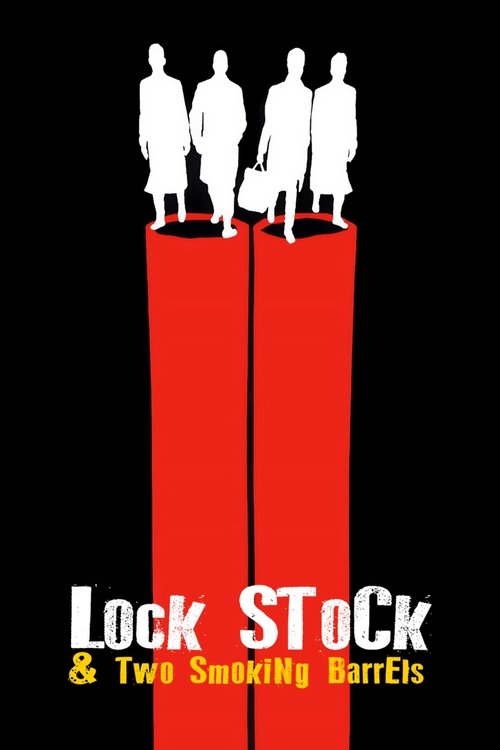
Lock, Stock and Two Smoking Barrels
1998 · Guy Ritchie
For a rowdy night in when you want to laugh at bad decisions — ideal with mates, a takeaway, and no obligation to take anything seriously. Pure comfort, zero homework.
What it's about
Four East End friends pool their savings to stake one of them in a high-stakes card game run by a porn-baron gangster — and walk out owing half a million pounds. Their solution: rob the small-time crooks operating out of the flat next door, who are themselves planning a robbery of their own. Debt collectors, weed growers, a pair of antique shotguns, and half the London underworld get tangled in the fallout.
The experience
Fast, loud, and very funny — a clockwork farce where every scheme collides with every other scheme at maximum speed. The pleasure is in the slang, the swagger, and watching the dominoes fall exactly wrong.
Performances
The ensemble runs on collective banter more than star turns, with Vinnie Jones — the former footballer in his screen debut — a deadpan standout as an impeccably dressed debt collector.
The craft
Guy Ritchie's debut announces his whole style at once: whip-fast cutting, freeze-frames, voiceover, a wall-to-wall soundtrack, and a script that braids half a dozen criminal plots into one interlocking machine. Made on a shoestring, and the scrappiness is part of the charm.
Why it matters
A surprise smash that launched Guy Ritchie's career, made stars of its cast, and kicked off a wave of fast-talking British gangster comedies at the turn of the millennium.
Snapshot
Lock, Stock and Two Smoking Barrels is the feature debut of writer-director Guy Ritchie, a low-budget British crime comedy that arrived in 1998 and became one of the defining commercial successes of a brief, late-1990s revival of British gangster cinema. Its plot is a clockwork farce of intersecting underworld errands: four young East End friends pool their money to seat one of them, Eddy, in a high-stakes card game run by the pornographer-gangster Hatchet Harry; the game is rigged, Eddy emerges owing half a million pounds, and the friends scramble to raise the debt by robbing the small-time crooks next door — who are themselves planning to rob a pair of upper-class cannabis growers. The film braids together perhaps half a dozen criminal enterprises — debt collectors, antique-shotgun hunters, drug dealers, hired muscle, scrap-metal traders — and lets them collide through coincidence and bad luck until almost everyone is dead and the surviving quartet is left holding loot they don't understand. Its tone is jocular, profane, and rhythmically propulsive; its register is comic rather than tragic; and its formal signature — freeze-frames, narration, sudden speed ramps, ensemble cross-cutting — announced a director with an unusually pronounced and marketable style. The film is significant less for thematic depth than for the way it crystallized a particular cocktail of Cockney argot, designer violence, and music-video kineticism that would shape British genre cinema and Ritchie's own career for the following decade.
Industry & production
The film's production story is, by now, a well-circulated part of its legend, and several elements of it are firmly established. Lock, Stock was made cheaply by a first-time director who had previously shot a short film, The Hard Case, and who used that calling card to attract financing. The picture was produced through Matthew Vaughn, then a novice producer, and the financing was famously assembled from private investors rather than the major studios — a patchwork that has been widely reported to include contributions connected to figures outside the conventional film-finance world. The exact composition of the budget is recounted in various forms across interviews and trade coverage, and because the specifics differ between accounts I will not assert a single precise figure; what is reliably documented is that the film was made for a modest sum by feature standards and returned a strong multiple of its cost, particularly through British box office and subsequent home-video and television sales.
The commercial outcome mattered as much as the film itself. Lock, Stock became a sizable domestic hit in the United Kingdom and traveled internationally on the strength of word of mouth and its distinctive packaging. Its success launched the careers of an unusually large cohort: Guy Ritchie as a brand-name director, Matthew Vaughn as a producer (and later director), and several cast members, most conspicuously the former footballer Vince Jones — billed as Vinnie Jones — whose performance as the debt-enforcer Big Chris turned a sportsman into a working screen actor. The film also seeded a franchise impulse: Ritchie and his collaborators developed a television spin-off, Lock, Stock..., that extended the universe and characters into a series, reflecting how thoroughly the film was understood as a property and a style rather than a one-off.
Technology
Lock, Stock was shot on 35mm film in the late 1990s, before digital acquisition had any foothold in feature production, and its technological interest lies less in capture format than in post-production and processing. The film is notable for its aggressive use of color manipulation, exposure tricks, and laboratory and optical effects to differentiate its many subplots and to give a small budget the gloss of a much more expensive picture. Sequences are tinted, pushed, and stylized — saturated golds and sickly greens, high-contrast interiors, deliberately degraded or smeared looks for drug-haze passages — and the film leans on speed manipulation (under-cranking, ramping, freeze-frames) achieved through a mixture of in-camera technique and post work. These choices align the film with the visual vocabulary of contemporaneous music videos and commercials, a milieu Ritchie came out of, and they demonstrate how late-analog craft could simulate a designed, almost graphic surface without the digital toolset that would dominate a few years later. Beyond this, the film does not represent a technological landmark; its innovations are stylistic applications of existing photochemical and optical tools rather than new instruments.
Technique
Cinematography
The cinematography, by Tim Maurice-Jones — a collaborator who came, like Ritchie, from the commercials and music-video world — is the film's most immediately legible signature. Maurice-Jones favors wide-angle lenses, low and canted angles, and a restless, prowling camera that pushes into faces and money and weapons with predatory intimacy. The palette is heavily art-directed: warm tobacco-and-amber tones for the criminal interiors, cooler and harder light for confrontation, and stylized grading throughout that keeps the image from ever looking naturalistic. The visual approach treats the East End milieu as a designed, almost theatrical space rather than a documentary one. Crucially, the photography is built to be cut: compositions are graphic and emphatic so that they read instantly in rapid montage, a discipline carried over from advertising, where an image must communicate in a fraction of a second.
Editing
Editing is arguably the film's true authorial instrument, and the cutting — credited to Niven Howie — is where Lock, Stock's personality lives. The film moves between multiple criminal storylines that must remain legible while constantly interrupting one another, and the editing solves this with brisk cross-cutting, montage sequences set to music, freeze-frames that introduce or punctuate characters, and time-compression devices that telescope hours of plot into seconds. Speed ramps accelerate and decelerate action for comic and rhythmic effect; transitions are often abrupt and percussive, cut to the beat of the soundtrack. The editing's job is fundamentally architectural: it keeps half a dozen schemes balanced in the viewer's mind and times their collision for maximum farce. This music-driven, montage-heavy cutting is the most imitated aspect of the film.
Mise-en-scène / staging
The staging is dense with props and texture — cash, antique shotguns, cannabis plants, sports memorabilia, the cramped flats and dim pubs of a stylized London underworld. Ritchie blocks his ensembles in tight, talky clusters and stages violence in confined interiors where geography becomes a comic engine: the entire plot turns on the thinness of a wall between two flats. The production design renders a London that is recognizably contemporary yet slightly heightened, a lived-in but caricatural East End. Staging frequently emphasizes objects passing from hand to hand — the shotguns of the title, bags of money, the stolen drugs — so that the mise-en-scène itself tracks the film's economy of theft and exchange.
Sound
Sound and music are inseparable from the film's effect. The soundtrack is a curated jukebox of funk, soul, reggae, ska, and rock that drives the montage sequences and supplies much of the film's swagger; music is used not as underscore but as rhythmic motor, with cuts and camera moves keyed to the tracks. The dialogue track is equally distinctive: thick with Cockney rhyming slang, criminal jargon, and rapid overlapping insult, it foregrounds language as both comedy and texture (the film became notorious for requiring some non-British audiences to lean hard into the argot). A wry voice-over narration frames and connects the storylines, lending the film a storyteller's cadence and helping the audience keep its sprawling cast straight.
Performance
Performance is pitched toward ensemble verve rather than psychological depth. The four leads — including Jason Flemyng, Dexter Fletcher, Nick Moran, and the musician Jason Statham in his feature debut — play with a fast, bantering, mate-ish chemistry that grounds the chaos. Statham's casting is historically consequential: a former competitive diver and market trader, he would build a major action career from this start. The film also deploys established character actors to anchor its underworld with menace and comic gravity, and it turned Vinnie Jones's hard physical presence into a genuinely effective screen performance as Big Chris. The acting style throughout is broad, verbal, and rhythmic — closer to comic theater than to social realism.
Narrative & dramatic mode
Lock, Stock is a multi-strand caper built on the comedy of converging schemes and escalating coincidence. Its dramatic mode is farce dressed as crime thriller: the engine is not suspense about whether a single plan will succeed but the audience's privileged overview of many incompatible plans heading toward the same room. Dramatic irony is the dominant device — we know more than any character, and the pleasure lies in watching ignorance and greed steer everyone into collision. The structure is intricate and clockwork, with a narrator to manage exposition, freeze-frames to label the players, and a plot that resolves through a cascade of misunderstandings and lucky-unlucky timing rather than through any character's mastery. Tonally it keeps violence comic and consequence-light for its protagonists, who survive largely by accident; the famous final beat leaves the survivors literally dangling over a decision, a punchline rather than a moral reckoning. This is plotting as machinery — admired for its construction more than for emotional stakes.
Genre & cycle
The film belongs to the British crime-comedy tradition and, more specifically, to a short late-1990s cycle of stylish home-grown gangster pictures that briefly made the London underworld fashionable on screen again. It sits in a lineage of British caper and crime comedy reaching back to the Ealing comedies and forward through the harder-edged London crime films of the 1970s and 1980s, but it fuses that heritage with the surface and tempo of American post-Tarantino crime cinema and of contemporary music video. Its commercial success helped define and accelerate the cycle, and Ritchie's own follow-up, Snatch (2000), is effectively a louder, starrier elaboration of the same formula. The cycle was real but also short-lived and quickly parodied; Lock, Stock is both its breakout and, in retrospect, its template.
Authorship & method
The film is a strong example of a director's sensibility imposed wholesale, and its authorship is genuinely collaborative within a tight unit drawn from the commercials world. Guy Ritchie wrote and directed, and the screenplay's interlocking structure, slang-saturated dialogue, and comic timing are central to his authorial identity; Lock, Stock established the stylistic template he would reuse and refine. Producer Matthew Vaughn was the crucial enabling partner, assembling the finance and later becoming a significant director in his own right. Cinematographer Tim Maurice-Jones translated Ritchie's commercial-honed visual instincts into the film's saturated, wide-angle look. Editor Niven Howie shaped the montage-driven rhythm that is arguably the film's defining technique. The score and song selection — the film's music is widely credited as a co-author of its tone — combine original scoring (the music is associated with composer John Murphy, who would collaborate with Ritchie again) with an extensive licensed soundtrack; because crediting conventions on the music vary across sources, I note the licensed-track curation as at least as important as the original score. The method throughout is recognizably that of advertising and music-video makers scaling up: graphic images, music-cut editing, and maximal style extracted from minimal budget.
Movement / national cinema
Lock, Stock is a quintessentially British film and a landmark in the commercial wing of late-1990s British cinema. It emerged in a period when British film was searching for exportable identities beyond heritage drama and social realism, and it offered a third path: hip, genre-driven, music-led entertainment with a strong national accent. The film's Britishness is not incidental but constitutive — its slang, its geography, its class types (the East End villains, the public-school dope growers, the African and ex-con peripheral players) are the substance of its comedy. It is best understood not as part of an art-cinema movement but as a key text in the commercialization and rebranding of British genre film for a young, international audience, riding the same late-1990s "Cool Britannia" cultural moment that propelled British music and design.
Era / period
The film is deeply of its late-1990s moment. It reflects a post-Tarantino, post-Trainspotting media environment in which crime could be cool, soundtracks were marketing engines, and the visual grammar of MTV had fully colonized feature filmmaking. Its lad-culture register — male friendship groups, pub-and-banter masculinity, designer violence — is characteristic of British popular culture at the turn of the millennium. It also belongs to the last era of purely photochemical, pre-digital low-budget production, achieving its gloss through lab and optical craft. Watched now, it is both a vivid period artifact of 1990s Britain and a film whose techniques became so widely imitated that its once-startling style can read as familiar.
Themes
Lock, Stock is not a thematically ambitious film, and it is honest to say its concerns are narrow and largely in service of comedy. Greed and the chain of debt drive the plot: money is the universal solvent and motive, passing from hand to hand and dragging characters into violence. Chance and consequence form a loose comic philosophy — the film repeatedly shows that schemes fail and survival is luck, undercutting any fantasy of criminal competence. Masculinity and male friendship are its emotional center; the quartet's loyalty is the only relationship the film treats with real warmth. Class is present as comic texture, juxtaposing the East End working-class villains with the languid upper-class drug growers. But the film resists moralizing: crime is neither punished nor endorsed so much as played for spectacle and laughs. Its values are stylistic — cool, wit, nerve — more than ethical.
Reception, canon & influence
On release, Lock, Stock was received as a brash, energetic crowd-pleaser and a striking debut, and it became a substantial commercial success in Britain that established Ritchie as a major new commercial voice. Critical opinion was largely positive about its energy and craft while some reviewers noted its thinness of substance and its debt to American models; this mixed-but-favorable reception is well documented in general terms, and I avoid attributing specific verdicts I cannot quote precisely.
Looking backward, the film's influences are clear: the post-Pulp Fiction American crime cinema of Quentin Tarantino (interlocking storylines, pop-soundtrack swagger, comic-violent tone); the British crime tradition from the Ealing capers through harder London gangster films; and the aesthetics of 1990s music video and advertising from which Ritchie and his key collaborators came.
Looking forward, its legacy is considerable within popular genre cinema. It launched Guy Ritchie, who immediately expanded the formula in Snatch (2000) before a longer mainstream career; it gave Jason Statham his first role en route to global action stardom; it established Matthew Vaughn as a producer-director; and it turned Vinnie Jones into a working actor. More broadly, it codified a recognizable "British gangster" idiom — slang-heavy ensembles, freeze-frame introductions, music-cut montage, designer violence — that was widely imitated and eventually parodied across British film and television, including its own Lock, Stock... TV spin-off. Its standing in the canon is that of a hugely influential popular film rather than an art-cinema landmark: a debut that defined a director, a style, and a brief national cycle, and whose techniques became part of the common vocabulary of commercial crime cinema.
A Deleuzian reading
Ritchie stops the film to introduce you to a man.
The full Deleuzian reading of Lock, Stock and Two Smoking Barrels →
Reception
A word-of-mouth smash in 1998 Britain that critics initially filed under 'Tarantino knock-off with cockney accents' — now it's remembered as the film that rebooted the British gangster movie and launched Ritchie, Statham and Vinnie Jones in one go.
How Lock, Stock and Two Smoking Barrels was received, from release to now →
Influences: the films it descends from and the films it influenced
- Pulp Fiction (1994) — Supplied the template of interlocking, time-shuffled crime strands that converge on a single MacGuffin (here the antique shotguns), plus the comic-violent tonal register Ritchie transposes to London.
- Reservoir Dogs (1992) — Modeled the all-male criminal ensemble defined through profane, digressive banter and a curated pop-song needle-drop standing in for an orchestral score.
- GoodFellas (1990) — Source of the wall-to-wall voice-over narration married to music-cut montage and freeze-frames that punctuate and editorialize the criminal action.
- Trainspotting (1996) — Immediate British precedent for freeze-frame character introductions, kinetic music-video cutting and a jukebox soundtrack scoring working-class lowlife energy.
- The Long Good Friday (1980) — Established the modern London-underworld idiom — territorial gangland politics, hard-man archetypes and cockney menace — that Ritchie restyles as comedy.
- Get Carter (1971) — Defined the laconic, brutal British crime hero and location-shot grit that underwrites Ritchie's designer-violence underworld.
- Performance (1970) — Pioneered the fusion of London gangster milieu with fractured, fashion-conscious editing — the art-school-meets-underworld lineage Ritchie commercializes.
- The Lavender Hill Mob (1951) — Ealing-caper ancestor of the bungled-heist comic structure where an amateur crew's meticulous plan unravels through farcical mischance.
- The Italian Job (1969) — Cemented the cheeky-cockney ensemble caper with jaunty period soundtrack and Britishness-as-swagger that Ritchie inherits.
- The Ladykillers (1955) — Inherits the British underworld-comedy mechanism of an over-clever criminal plan collapsing into a cascade of bodies through pure mischance.
- Shallow Grave (1994) — Takes the surface Shallow Grave licensed — heavily gelled saturated interiors, wide-angle low-angle framing of criminals in flats, and a wall-to-wall pop needle-drop track carrying exposition — applied to a bag-of-money plot but without its single-set structural rigor.
- Snatch (2000) — Ritchie's immediate self-remake, doubling down on the multi-strand caper, freeze-frame intros, speed-ramping and slang voice-over of the original.
- Layer Cake (2004) — Lock, Stock producer Vaughn's directorial debut extends the slick London-gangster idiom with the same commercials-honed grading and music-cut montage, minus the comedy.
- RocknRolla (2008) — Later Ritchie reprise of the interlocking-London-crime structure, ensemble-verve casting and voice-over framing device.
- Kick-Ass (2010) — Carries the Lock, Stock crew's speed-ramped, music-cut 'designer violence' set-piece grammar into comic-book action.
- Kingsman: The Secret Service (2015) — Vaughn produced it; its British-geezer genre kineticism — snap cuts, needle-drop scoring and freeze-frame character intros — is the editorial dialect Kingsman speaks.
- Intermission (2003) — Source of the British-Isles crime-comedy verve: interlocking dim-criminal schemes, geezer banter, and a hurtling editorial pace dressing a heist in working-class slang.
- Survive Style 5+ (2004) — Commercial-director kinetic cutting laid over converging criminal strands, and the source of Vinnie Jones's transplanted British hard-man persona used as an imported comic object.
- Soodhu Kavvum (2013) — Built the interlocking-ensemble caper as clockwork: separate criminal schemes converging toward a rug-pull payoff, propelled by score-driven comic timing.
- Aavesham (2024) — Progenitor of the eccentric-gangster comedy where a chorus of hangers-on and comic-timed, tonally whiplashing editing turn criminal milieu into farce.
- The Gentlemen (2020) — The source template Ritchie deliberately returns to: interlocking criminal factions colliding over one commodity, caption-and-freeze-frame character introductions, and a dialogue-forward mix that pushes accent and idiom above the score.
- Sexy Beast (2000) — Fellow commercials/music-video director applying saturated wide-angle stylization and rhythmic cutting to the British-gangster picture in the same Cool Britannia moment.
- Go (1999) — Contemporary post-Tarantino multi-strand crime caper built on overlapping timelines, dramatic irony and a club-music jukebox score.
- Run Lola Run (1998) — Same-year exemplar of music-video kineticism — propulsive cross-cutting, freeze-frame stills and pop-rhythm editing driving a ticking-clock crime plot.
- In Bruges (2008) — Extends the British-Isles crime-comedy ensemble built on profane vernacular dialogue and comic dramatic irony among bungling criminals.
Similar films
- Snatch (2000) — influence & lineage · same viewing thread · often watched together
- The Italian Job (1969) — influence & lineage · same viewing thread
- GoodFellas (1990) — influence & lineage · often watched together
- Reservoir Dogs (1992) — influence & lineage
- Pulp Fiction (1994) — influence & lineage
- Trainspotting (1996) — influence & lineage
- The Long Good Friday (1980) — influence & lineage
- Go (1999) — influence & lineage · same viewing thread
All the films related to Lock, Stock and Two Smoking Barrels →
Watch it with: curated runs of related films
- Schemers, Crews, and the Big Score — A run of witty crime pictures where somebody always has an angle — watch these together for intricate plans, colliding crooks, and heists that go gloriously sideways.