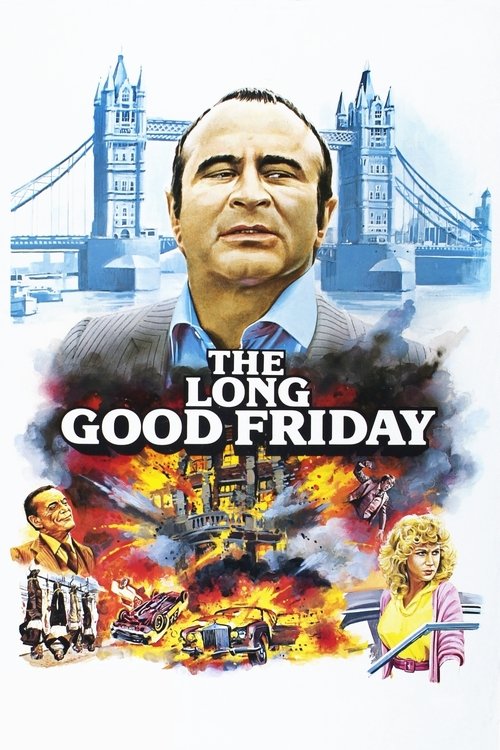
The Long Good Friday
1980 · John Mackenzie
For when you want a lean, hard-nosed crime thriller with real teeth — something gripping and grown-up that leaves you a little stunned. A challenge worth taking, not a comfort watch.
What it's about
Over one Easter bank holiday weekend in late-1970s London, Cockney crime boss Harold Shand is on the verge of going legitimate — courting American Mafia money to redevelop the derelict Docklands into a gleaming Olympic-ready waterfront. Then bombs start going off across his empire, on the exact weekend his investors are in town. Convinced there's a traitor in his organization, Shand tears through the city to find out who is dismantling everything he's built — and discovers the answer is bigger and stranger than gangland rivalry.
The experience
Fast, furious, and increasingly claustrophobic — a swaggering man watching his world come apart in real time, with flashes of dark humor and sudden brutality. The tension builds like a fuse, and the final minutes land with a force few thrillers ever manage.
Performances
Bob Hoskins is volcanic — a bulldog of ambition, charm, and rage whose face alone carries the ending — and a young Helen Mirren gives his elegant partner Victoria steel and intelligence far beyond the usual gangster's-moll part.
The craft
Barrie Keeffe's screenplay compresses an empire's collapse into a single weekend, and John Mackenzie directs it with punchy economy — vivid London locations, from casinos to slaughterhouses, shot with a documentary grit. Francis Monkman's pulsing synth score drives it forward, and the wordless closing shot is one of the boldest endings in British film.
Why it matters
A cornerstone of British gangster cinema that launched Bob Hoskins internationally and set the template for every London crime film that followed. Its snapshot of Thatcher-era ambition and Docklands redevelopment now plays as eerie prophecy.
Snapshot
A Cockney crime baron's bid to legitimize his empire through a Docklands property deal collapses over a single catastrophic Bank Holiday weekend, undone not by a rival gangster but by the IRA. Barrie Keeffe's screenplay delivers a film that operates simultaneously as taut thriller, character study, and mordant political allegory: Harold Shand, the self-made entrepreneur dreaming of Olympic regeneration, turns out to be standing on the fault-line between the post-war criminal economy and the paramilitary politics of the Troubles. The closing image — Shand motionless in the back of a car, his face cycling through fury, incomprehension, and something approaching grief, the camera holding on him in silence — is among the most formally daring endings in British cinema.
Industry & production
The Long Good Friday was financed by Black Lion Films and Calendar Productions for ITC Entertainment, the television and film empire then run by impresario Lew Grade. Grade's organization provided the budget but, on viewing the finished cut, reportedly balked at the combination of graphic violence and, more acutely, the film's frank representation of IRA activity at a moment of acute political sensitivity — the film was completed in 1979, the year Lord Mountbatten was assassinated and the Warrenpoint ambush killed eighteen soldiers. ITC declined to give it a theatrical release and explored the possibility of selling it directly to American television.
It was George Harrison and Denis O'Brien of HandMade Films who intervened, acquiring the theatrical rights and releasing the film in the United Kingdom in 1980. HandMade, founded initially to rescue Monty Python's Life of Brian (1979) from distributor collapse, was thus briefly positioned as a home for commercially ambitious British films that larger organizations found awkward. The rescue of The Long Good Friday stands as one of the more consequential acts of independent British film distribution of the decade.
The film was shot on location primarily in London, with the derelict wharves and warehouses of the Isle of Dogs and the broader Thames estuary serving not merely as backdrop but as argument: the emptied infrastructure of imperial maritime trade, awaiting whatever comes next.
Technology
Shot on 35 mm with conventional spherical lenses, the film does not foreground technological novelty. Cinematographer Phil Méheux — who had cut his teeth on television production and would later shoot the Pierce Brosnan Bond films — worked within the constraints of available-light location shooting, managing the textures of London: river fog, strip-lit hotel corridors, the cavernous shadows of abandoned warehouses. The film's visual grammar is practical rather than experimental, its technical choices subordinated to narrative drive and performance. There is no evidence of particular innovation in camera or laboratory process; the film's achievement is one of craft intelligence rather than technological ambition.
Technique
Cinematography
Méheux's work is distinguished by an ability to hold contrasting registers in a single film. The opening montage — wordless, scored to Francis Monkman's insistent synthesizer pulse — cuts across globe-trotting business dealings and returning criminals with a kinetic confidence that announces a certain transatlantic ambition. Subsequently, the camera settles into a more observational mode. Interior scenes at the hotel, the yacht, and the abattoir are lit and framed to prioritize Hoskins's face as an instrument of dramatic information, while the Docklands exteriors exploit the photogenic melancholy of industrial vacancy. A key compositional habit is the medium two-shot that refuses to give either interlocutor a clear spatial advantage, reflecting the power dynamics of the script.
Editing
The film's editing — by Mike Taylor — is largely classical in structure but gains its charge from rhythm and juxtaposition. The opening sequence is the most formally ambitious: a montage that introduces Shand's criminal world through ellipsis and inference rather than exposition, trusting the audience to assemble the picture. Elsewhere, the intercutting between the multiple bombings sustains pressure without confusion, and the pacing knows when to step back and let performances breathe. The finale, with its extended single-shot hold on Hoskins in the car, requires the editor to resist the cut — a discipline that repays the patience it demands.
Mise-en-scène / staging
Mackenzie's staging is at its most sophisticated in scenes of concentrated social performance: the hotel luncheon where Shand pitches the Americans, the abattoir interrogation sequence where upended gangsters hang like carcasses while Harold paces beneath them. The latter is justly famous — a scene that works simultaneously as dark farce and revelation of character, Shand's brutality and his showmanship inseparable from each other. The production design identifies Shand's world through its transitional aesthetic: the plush new money of the yacht and the hotel against the raw vacancy of the docks, with Shand positioned as the agent supposed to bridge them.
Sound
Francis Monkman's score — Monkman was then a member of the group Sky, having previously co-founded Curved Air — deploys synthesizers and jazz-inflected orchestration to locate the film in a recognizably late-1970s British idiom while also gesturing toward the American crime scores it implicitly cites. The pulsing electronic motif of the opening montage functions as a kind of ironic overture, implicating Shand's enterprise in the modernity he aspires to. The film's use of diagetic London sound — the Thames, pubs, the noise of the city — grounds the thriller mechanics in a specific, documentable place.
Performance
Bob Hoskins's performance as Harold Shand is one of the defining performances in British film acting. Hoskins had worked extensively in television and theater (he came to prominence in Pennies from Heaven, Dennis Potter's 1978 BBC serial) but the role of Shand is the one that established his screen authority. The performance achieves something unusual: Harold is violent, vain, and capable of casual cruelty, yet Hoskins makes him comprehensible without making him sympathetic in any sentimental sense. The final minutes in the car, in which Hoskins performs an entire psychological disintegration without dialogue, demonstrate what the concentrated close-up can extract from a prepared actor.
Helen Mirren plays Victoria, Harold's partner and advisor, with a precision that manages the implicit difficulty of the role: Victoria is Harold's equal in intelligence and arguably his superior in emotional control, yet the script gives her less space. Mirren locates Victoria's authority in stillness and registered observation. Pierce Brosnan appears in an early and essentially wordless role as an IRA operative, a casting detail that accrued retrospective significance as Brosnan's career developed. The ensemble of British character actors in the supporting cast — drawn from television and theater — gives the film a density of credible life at its edges.
Narrative & dramatic mode
Keeffe's screenplay is a classical thriller in its architecture — countdown structure, gathering catastrophe, revelation of the true antagonist — but its governing dramatic mode is irony. The film's central joke is that Harold Shand, who thinks he is in a gangster film about loyalty and betrayal, is actually in a film about history: the IRA is not a rival gang to be outmanoeuvred but an impersonal historical force, and the bombings that destroy his weekend are the consequence not of any present betrayal but of a past action Harold barely remembers authorizing. The script's sophistication lies in this gap between Harold's operational intelligence — considerable — and his historical blindness.
The narrative also sustains a parallel irony about legitimacy. Harold's entire project is the conversion of criminal capital into respectable property development, and the film understands this as continuous with Thatcherite aspiration rather than opposed to it. The Docklands regeneration Harold imagines will, in historical fact, occur — just without him.
Genre & cycle
The Long Good Friday belongs to the British gangster film, a genre with roots in the late 1940s and 1950s (Brighton Rock, 1947; The Blue Lamp, 1950) that had undergone intermittent renewal. By the late 1970s, the genre had grown stale in its British incarnations and was competing with the reinvigorated American crime cinema of Coppola, Scorsese, and Lumet. Keeffe and Mackenzie's achievement is to absorb those American influences — the scale of ambition, the operatic emotional register, the willingness to treat criminal enterprise as a lens on capitalism — while insisting on a specific and unrepeatable London.
The film inaugurated or sharpened a cycle of British crime films that would include Mona Lisa (1986), The Krays (1990), and, at a further generational remove, Lock, Stock and Two Smoking Barrels (1998). It is also a touchstone for the 1990s British crime revival associated with Tarantino-influenced work, though its own relationship to American cinema is more anxious and less celebratory than those later films.
Authorship & method
John Mackenzie was a television director who had worked extensively for the BBC — including the Play for Today strand — before making this, his most significant theatrical feature. His background in the single play tradition informs the film's respect for the integrity of performance and its comfort with extended dialogue scenes, while his familiarity with location-based production shapes its visual pragmatism. Mackenzie is not an auteur in the European sense; the film's authorial center of gravity lies as much with its writer.
Barrie Keeffe, who wrote the screenplay, was a playwright associated with the British political theater of the 1970s — his stage work engaged working-class experience and class antagonism with a directness that carried over into the script. The screenplay went through development over several years; Keeffe has spoken in interviews about the research that grounded the film's criminal milieu and its political dimensions, though the details of that development process are not exhaustively documented.
Phil Méheux (cinematographer) and Francis Monkman (composer) are discussed above. The film's editor, Mike Taylor, contributed to the propulsive efficiency of the cutting, though his individual contribution is less documented in the critical literature than those of the lead collaborators.
Movement / national cinema
The Long Good Friday is unambiguously a film of British national cinema, and more specifically of a London tradition that extends from Dickens through the post-war crime novel. It arrives at the end of the decade in which the British New Wave had matured and dispersed, and shares with that tradition a commitment to working-class experience rendered without condescension — though Harold Shand is by 1979 no longer working-class in any simple sense; he is the embodiment of a class aspiration that the film treats as both admirable and fatal.
It also participates in the specifically Irish-British political cinema of the period. The Troubles were an inescapable feature of British public life throughout the 1970s, and films that engaged them directly were rare, partly out of institutional caution and partly out of genuine creative difficulty. The Long Good Friday approaches the IRA obliquely — as an opaque, lethal force rather than a subject requiring explication — and this reticence is itself politically meaningful.
Era / period
The film was shot in 1979, the year of Margaret Thatcher's election, and released in 1980 as her program was beginning to take institutional shape. It is tempting, and not entirely wrong, to read Harold Shand as a dark avatar of Thatcherite entrepreneurialism: the self-made man, disdainful of old hierarchies, convinced that energy and vision can transform derelict infrastructure into value. The film's ending — in which this figure is delivered, speechless, into the hands of history — acquires its full resonance against that political backdrop.
The Docklands setting has further period significance. The Isle of Dogs and the surrounding areas were indeed in advanced physical dereliction by the late 1970s, the consequence of container shipping's displacement of London's traditional port economy. The London Docklands Development Corporation would be established in 1981; Canary Wharf would follow. The film, in this respect, is documentary as well as fiction.
Themes
Legitimacy and its limits: The film's central concern is the fantasy of conversion — of criminal into legitimate, of derelict into developed, of violence into enterprise. Harold's project fails not because legitimacy is unattainable in principle but because the past cannot be managed away.
History as antagonist: Where most gangster films locate the protagonist's nemesis in a rival, a traitor, or the law, The Long Good Friday makes history itself the force that destroys Harold. His blindness to the weight of past actions — a weapons deal, a connection, something half-remembered — is the structural irony on which the film turns.
Class and aspiration: Harold is of the working-class East End but no longer within it; the Docklands project is partly about escaping a class origin even as it is dressed in the language of return and regeneration.
London as site: The film conducts a specific argument about the city, its emptied industrial spaces and their possible futures, that is inseparable from its narrative and thematic content.
Reception, canon & influence
Critical reception: The film received strong notices on release and was rapidly recognized as exceptional within the British genre. Bob Hoskins received a BAFTA nomination for Best Actor, and the film secured other nominations. Over subsequent decades its critical standing has only strengthened; it regularly features in critical surveys of British cinema and in lists of the finest crime films of its era. Its standing in the canon is secure.
Influences on the film (backward): The film absorbs the American crime cinema of the 1970s — particularly The Godfather (1972) and its attention to the interface between organized crime and legitimate business — and the earlier British gangster tradition. The Play for Today strand of British television drama, with its emphasis on social specificity and performance quality, is a less-cited but substantial formal influence, mediated through Mackenzie's own career. Keeffe's theatrical background in political drama is visible in the script's structural ambitions.
Legacy and forward influence: The Long Good Friday effectively recalibrated what the British crime film could aspire to be. Neil Jordan's Mona Lisa (1986) is the most direct descendant in register and seriousness. The Krays (1990) and other period gangster films of the early 1990s are less formally ambitious but exist in a landscape reshaped by Mackenzie and Keeffe's film. The Guy Ritchie films of the late 1990s — Lock, Stock and Two Smoking Barrels (1998), Snatch (2000) — drew on the British gangster tradition the film had renewed, though their tone is ironic and affectionate where The Long Good Friday is tragic. Jonathan Glazer's Sexy Beast (2000) is the film that most directly inherits its seriousness.
Bob Hoskins's performance established a template for what British character acting could accomplish at the center of a commercial genre film, influencing the deployment of stage-trained actors in British crime cinema for at least two decades. The closing shot has been cited by numerous directors and critics as a formal reference point: the single extended close-up as culminating structural device, demanding an actor capable of sustaining it and an editor disciplined enough to resist the cut.
A Deleuzian reading
Start at the end, because the film does.
The full Deleuzian reading of The Long Good Friday →
Reception
Lew Grade's ITC nearly buried it — the plan was to cut it down and dump it on TV, with Bob Hoskins' cockney accent partly dubbed for overseas ears — until George Harrison's HandMade Films rescued it for a proper 1981 cinema release. From near-shelved to routinely crowned the greatest British gangster film ever made.
How The Long Good Friday was received, from release to now →
Influences: the films it descends from and the films it influenced
- Odd Man Out (1947) — Reed's Belfast countdown — an IRA commander bleeding through a city whose social fabric cannot absorb him — supplied the structural template of a criminal leader destroyed by political-historical forces exceeding his personal power, the architecture TLGF transplants directly to Thatcherite London with a literal IRA reprisal as its triggering mechanism.
- Kes (1969) — Loach and cinematographer Chris Menges's available-light Yorkshire location method — ambient diegetic sound, real geography as social argument, non-professional textures alongside trained performers — is the documentary grammar of British social cinema that Mackenzie's Play for Today background absorbed and applied to TLGF's Docklands milieu.
- Performance (1970) — Roeg and Cammell embedded authentic London criminal vocabulary — accent, address, social ritual — as dramatic texture rather than genre decoration, establishing that British crime cinema could bear the weight of its actual milieu rather than borrowing American stylization, the precedent for Mackenzie's East End social specificity.
- Get Carter (1971) — Hodges's unglamorous Newcastle location shooting — gray industrial skylines, working-men's clubs, the mundane texture of provincial criminal life — proved that British crime cinema could sustain moral tragedy through environment rather than genre glamour, the formal argument Mackenzie develops along the Thames Docklands.
- Villain (1971) — Tuchner's casting of Richard Burton — classically stage-trained, carrying theatrical intensity into commercial crime genre — established the British model of deploying a serious actor at genre center that Hoskins's performance directly extends, including the refusal to soften the criminal's homosexuality or violence.
- The Godfather (1972) — Coppola's structural invention of the crime boss as legitimate-world political operator — the business negotiation as power scene, the interface between underworld and civic authority — is the direct template for Harold's EEC hotel summit and his aspiration to convert Mafia capital into City-of-London capital.
- The Friends of Eddie Coyle (1973) — Yates's Boston location crime film demonstrated that unglamorous social specificity — the diner transaction, the car park exchange, the mundanity of criminal organization — could carry tragic weight without glamorization; TLGF absorbs this method and transposes its moral seriousness into British class register.
- Brighton Rock (1948) — Ends on a sustained close-up of the criminal's face as damnation arrives — the terminal fixation Brighton Rock invented — and marries real Docklands location shooting to moral extremity, with the abattoir violence largely displaced off-frame.
- Mona Lisa (1986) — Jordan carries Bob Hoskins directly from TLGF and extends the performance template established there: the working-class man out of depth in a world of excessive criminal violence, sustained by close-up disintegration work that Harold Shand's final shot had already codified as Hoskins's definitive register.
- The Krays (1990) — Medak's period gangster film inhabits a landscape TLGF's critical elevation helped create — the British crime film as deserving serious formal ambition — and its theatrical casting (Billie Whitelaw as matriarch, trained stage performers at genre center) draws directly on the tradition Hoskins validated.
- Nil by Mouth (1997) — Oldman's South London film inherits the available-light location grammar of Mackenzie's BBC television background — diegetic ambience, real geography as social argument — and the stage-trained performance tradition (Ray Winstone, Kathy Burke) that TLGF demonstrated could anchor British working-class crime cinema.
- Lock, Stock and Two Smoking Barrels (1998) — Ritchie draws directly on the British gangster genre that TLGF's critical success legitimized, retaining the overlapping criminal economies and class-inflected London geography while inverting the tragic register into affectionate irony — the form's ambition is TLGF's bequest, the tone its deliberate refusal.
- Sexy Beast (2000) — Glazer inherits TLGF's formal device of the extended performance set-piece as structural and moral fulcrum: Kingsley's Don Logan interrogation sequences descend from Mackenzie's abattoir staging, and the film's use of theatrical stillness as menace — the mode Mirren established in TLGF — is its direct formal bequest.
- Gangster No. 1 (2000) — McGuigan's film extends the theatrical performance tradition TLGF established — McDowell and Bettany carry the stage-trained intensity Hoskins modeled — while its class-as-violence subject and the boss's social performance as fragile construct develop the psychological-political register Keeffe's screenplay first staked out in British crime cinema.
- Snatch (2000) — Mackenzie's film establishes the genre blueprint Ritchie inherits and comedically inverts: the professional London criminal world rendered through unglamorous East End locations, British working-class character actors playing men of hard competence, and a gangland hierarchy whose authority is perpetually threatened by incompetent outsiders.
- In Bruges (2008) — Bob Hoskins's Harry Shand established the British crime film's operatic antagonist type—voluble, class-conscious, alternating between charm and lethal fury within a single speech—that Ralph Fiennes's Harry Waters inherits precisely in verbal register and eruptive physical delivery.
- Layer Cake (2004) — Models the gangster-as-CEO whose business is collapsing around him over a compressed timeframe, supplying Layer Cake's 'crime-as-business' frame and its anxious-executive protagonist.
- Luther: The Fallen Sun (2023) — Sets the template for grounded London-texture crime realism — the prestige British crime drama's debt to a city rendered as a working, specific place rather than a backdrop.
- The Crying Game (1992) — Establishes the IRA-intrudes-on-London-underworld crossing that Jordan's second half inherits, and ends on the sustained held take of a face arriving at comprehension — the duration bet Kant Pan makes again on the reveal and the prison coda.
- The Gentlemen (2020) — The plot engine: a gangster attempting to sell his empire to a foreign buyer across one deal-week, with the boardroom pitch (Shand's speech on the boat) replacing the heist as the film's set piece — Mickey's courtship of Matthew is the same scene reshot in tweed.
- The Hit (1984) — Frears's British crime film shares TLGF's countdown structure and existential register — a man transported toward his own death through a landscape indifferent to his fate — and similarly deploys stage-trained performers (Terence Stamp, John Hurt) in a genre framework that refuses cathartic resolution.
- Eastern Promises (2007) — Cronenberg's portrait of Russian organized crime colonizing legitimate London business space — the restaurant, the clinic, the civic surface as criminal cover — extends TLGF's structural device of criminal enterprise inhabiting respectable geography, while Mortensen's performance of a controlled social mask dissolving under pressure descends from TLGF's model of the boss's public self as fragile construct.
Similar films
- Get Carter (1971) — influence & lineage
- Mona Lisa (1986) — influence & lineage
- Lock, Stock and Two Smoking Barrels (1998) — influence & lineage
- Performance (1970) — influence & lineage
- Brighton Rock (1948) — shared sensibility
- Threads (1985) — shared sensibility
- The Sting (1973) — shared sensibility
- Frenzy (1972) — shared sensibility
All the films related to The Long Good Friday →