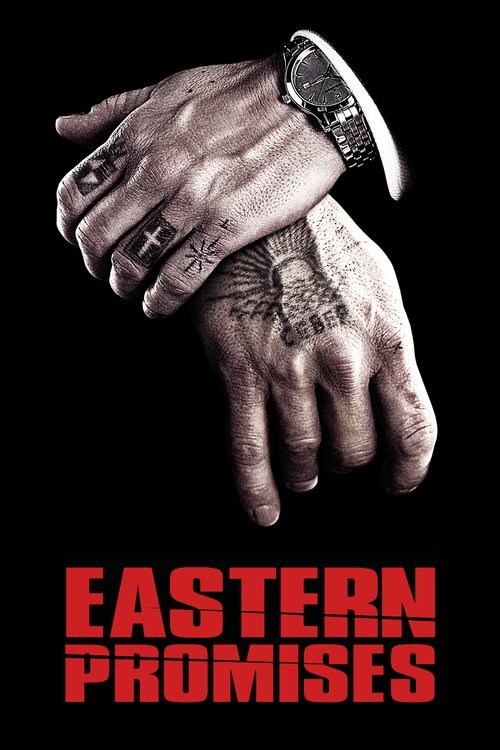
Eastern Promises
2007 · David Cronenberg
When you want a crime film for grown-ups — tense, serious, and unsentimental — and you can stomach a few moments of genuinely wince-inducing violence.
What it's about
A London midwife delivers the baby of a fourteen-year-old Russian girl who dies in childbirth, leaving behind a diary. Trying to trace the child's family, she crosses into the world of the Russian mob operating behind a genteel restaurant — and into the orbit of Nikolai, the organization's coolly unreadable driver and cleaner, whose tattoos tell a story of their own.
The experience
Cold, controlled, and coiled — long stretches of quiet menace broken by violence so sudden and physical it leaves the room silent. It's a gangster film that feels closer to a moral chess game than a shoot-em-up.
Performances
Viggo Mortensen is mesmerizing as Nikolai, building a whole hidden life out of stillness, accent, and the tattoos mapped across his body — a performance of total physical commitment. Armin Mueller-Stahl's soft-spoken patriarch is chilling precisely because he's so grandfatherly.
The craft
Steven Knight's script grounds the story in the real codes of the vory v zakone, the criminal brotherhood born in the Soviet gulags, where tattoos serve as a man's résumé. David Cronenberg directs with surgical precision, and the film's centerpiece hand-to-hand fight is famous for its raw, unglamorous brutality.
Why it matters
It cemented Cronenberg's late-career turn from body horror to austere crime drama, deepened one of the great modern director-actor partnerships with Mortensen, and set a new bar for unflinching screen combat.
Snapshot
Eastern Promises is David Cronenberg's second consecutive collaboration with actor Viggo Mortensen, following A History of Violence (2005), and it consolidates the director's twenty-first-century turn away from overt biological horror toward a colder, more classical study of violence, identity, and the criminal organism. Written by the British screenwriter Steven Knight, the film transplants the Russian vory v zakone — the "thieves-in-law," a criminal fraternity with roots in the Soviet gulag system — into contemporary London. Its narrative braids together a midwife, Anna (Naomi Watts), who inherits the diary of a dead fourteen-year-old Russian girl, and Nikolai (Mortensen), a taciturn "driver" and undertaker for a crime family fronted by the restaurateur Semyon (Armin Mueller-Stahl). The film became famous almost instantly for a single scene — a naked knife fight in a bathhouse — but its lasting interest lies in how Cronenberg treats the tattooed body as a legible text, a document of criminal biography inscribed in flesh. It premiered at the Toronto International Film Festival, where it won the People's Choice Award, and earned Mortensen an Academy Award nomination for Best Actor.
Industry & production
The film was an international co-production, mounted primarily through the American distributor-producer Focus Features together with BBC Films and Canadian and British production partners, a financing structure that reflects Cronenberg's long-standing position as a Canadian auteur working across the UK, Canada, and the United States. It follows directly from the working relationship established on A History of Violence, which had been both a critical success and Cronenberg's most commercially visible film in years; Eastern Promises extended that partnership with Focus and with Mortensen. Production was based in London, with location and studio work in and around the city standing in for the Russian émigré underworld of the capital. The budget was modest by studio standards — this was a prestige adult drama, not a tentpole — and the film performed as a respectable specialty release rather than a blockbuster. I would flag that precise, reliable budget and box-office figures vary across sources, so I will not assert exact numbers here; what is secure is that it was positioned and received as an awards-season arthouse title. The picture reunited Cronenberg with the core of his repertory crew — cinematographer Peter Suschitzky, composer Howard Shore, editor Ronald Sanders, and production designer Carol Spier — the same collaborators who define the technical consistency of his filmography.
Technology
Eastern Promises is not a film defined by technological innovation, and it would be a distortion to claim otherwise. It was shot photochemically on 35mm film, the format Cronenberg and Suschitzky favored throughout their partnership, and it relies on traditional lighting, lensing, and physical effects rather than digital spectacle. Its most technically demanding elements are practical rather than computational: prosthetic and makeup work for throat wounds and corpses, and — most conspicuously — the extensive body tattoos applied to Mortensen and other actors, which had to read as authentic vory markings under close scrutiny and in motion. The bathhouse fight was staged and executed as physical stunt choreography rather than through digital augmentation, which is precisely why it registers as so visceral. In short, the film's "technology" is old-school craft — film stock, makeup, tattoo application, fight choreography — deployed with unusual rigor, not any novel apparatus.
Technique
Cinematography
Peter Suschitzky photographs London as a place of institutional greens, browns, and cold interiors — the restaurant, the barber's chair, the hospital, the bathhouse — with a controlled, unshowy classicism that suppresses glamour. His camera tends toward stillness and deliberate framing; violence, when it erupts, is not stylized with slow motion or kinetic cutting but presented with a clinical directness that makes it harder to watch. The film's most celebrated sequence, Nikolai's fight against two Chechen assassins in a Turkish bath, is shot to emphasize vulnerability: the naked body, tiled surfaces, steam, and the sickening physics of edged weapons against unprotected skin. Suschitzky's restraint is the point — the images refuse to aestheticize brutality, which is consistent with Cronenberg's lifelong interest in the body's material reality.
Editing
Ronald Sanders, Cronenberg's editor for decades, cuts in the director's characteristic mode of composed patience punctuated by sudden, unsoftened shock. The bathhouse fight is the showcase: rather than fragmenting the action into an unreadable blur, the editing keeps the combat legible and continuous enough that the audience registers each wound. The film generally holds shots longer than genre convention would dictate, allowing performance and menace to accumulate; the effect is a slow tightening rather than a chase-driven propulsion.
Mise-en-scène / staging
Carol Spier's production design builds a self-contained diaspora world — Semyon's Trans-Siberian restaurant with its folk songs and borscht functioning as a respectable front for the vory, the barbershop, the domestic interiors heavy with Old-World Russian iconography. The staging repeatedly frames the body as surface and text: the tattoo, the corpse to be disposed of, the newborn to be protected. Cronenberg stages Semyon as a courtly patriarch whose warmth masks predation, and the physical spaces — kitchens, cellars, baths — carry the film's thematic weight of concealment and hidden labor beneath a civilized veneer.
Sound
Howard Shore's score leans on Russian and Eastern European musical color, threading folk and liturgical textures through his orchestral idiom to underscore the émigré milieu without tipping into pastiche. The sound design is spare and functional, giving weight to the film's silences and to the ugly, concrete sounds of violence. As with the cinematography, the sonic approach is one of restraint that amplifies impact.
Performance
The film is anchored by Mortensen's Nikolai, a performance built on stillness, watchfulness, and an accent and physicality the actor researched intensively — including study of Russian criminal culture and the meaning of vory tattoos, which function in the film as a spoken and read language of status and biography. Mortensen's willingness to perform the bathhouse fight fully nude became emblematic of the role's commitment and drew an Academy Award nomination. Armin Mueller-Stahl gives Semyon a genteel, grandfatherly menace that is arguably the film's most unsettling element. Vincent Cassel plays the son Kirill as volatile, weak, and self-loathing — a coward whose insecurities, including a suppressed sexuality the film treats obliquely, drive much of the plot's cruelty. Naomi Watts grounds the outsider's-eye storyline as Anna, the film's moral center and audience surrogate.
Narrative & dramatic mode
The film operates in the mode of a moral thriller with the architecture of a tragedy of concealment. Its engine is the diary of the dead girl, Tatiana — a written document that, like the tattoos, must be read and translated to reveal buried crime. The plot turns on a late revelation about Nikolai's true allegiance (his role is not what the family, or the audience, assumes), a structural twist that recasts everything preceding it and shifts the film from underworld procedural toward a study of an identity worn as a disguise. Dramatically, Cronenberg favors withholding: motivations surface slowly, warmth and threat are indistinguishable on the surface, and the violence arrives as rupture rather than escalation. The dual-protagonist design — Anna's investigation and Nikolai's ascent within the family — lets the film hold the ordinary world and the criminal one in tension until they collide.
Genre & cycle
Eastern Promises belongs to the gangster film and the crime thriller, but it is best understood within a specific late-90s/2000s cycle of films about hidden immigrant economies in global cities — the underworld beneath the visible metropolis. It is a natural companion to screenwriter Steven Knight's earlier Dirty Pretty Things (2002), also set among London's clandestine migrant labor and its criminal exploitation. Against the tradition of the American mafia epic, the film substitutes the vory v zakone, with its distinct codes, hierarchy, and tattoo iconography, giving the gangster genre an ethnographic specificity rooted in post-Soviet criminality. Within Cronenberg's own filmography it forms an informal pairing with A History of Violence as a two-film meditation on violent men, false identities, and the family as a site of danger.
Authorship & method
Cronenberg's authorship here is legible precisely because it is understated. The director who once literalized bodily transformation in Videodrome and The Fly here displaces that obsession onto the tattooed skin — the body as a document that can be read, forged, and used to lie. Violence remains anatomically precise and unglamorous, a Cronenberg signature. His method depends on a stable creative family: Peter Suschitzky (cinematography), whose cold, classical images define the film's look; Howard Shore (composer), a collaborator across nearly the whole of Cronenberg's career, supplying an emotionally reticent, culturally specific score; Ronald Sanders (editor), whose patient rhythms and shock cuts are integral to the director's tempo; and Carol Spier (production design). The screenplay is Steven Knight's, and the film reflects his documented interest in London's invisible immigrant substrata; Cronenberg has spoken of the tattoos and the vory world as the elements that drew him to the material, and Mortensen's own research became a substantive part of the film's authenticity.
Movement / national cinema
The film resists tidy placement in any single national cinema, which is itself characteristic. Cronenberg is the central figure of modern English-Canadian art cinema, and Eastern Promises carries his authorial stamp, yet it is a London-set, British-financed and -crewed production with an international cast playing Russians. It thus sits at the intersection of Canadian auteurism, British social-realist-adjacent crime cinema (via Knight), and transnational co-production. If it belongs to a "movement," it is the broader early-2000s tendency toward globalized crime narratives that trace diaspora, migration, and organized crime across borders rather than within a single national frame.
Era / period
Produced and released in 2007, the film is a product of the specialty-division era of Hollywood, when studio subsidiaries like Focus Features financed adult, director-driven dramas aimed at critics and awards. It reflects a post-Soviet, post–Cold War imagination in which the villain is no longer the state but the privatized criminal network that flowed out of the Soviet collapse — the vory as a mafia hardened in the gulag and exported to Western capitals. Its setting is emphatically contemporary, engaging present-tense anxieties about human trafficking, sex work, and the exploitation of migrant women in the Europe of its moment.
Themes
The film's governing theme is the body as text and the self as forgery. Tattoos are a literal résumé of a criminal life — where a man was imprisoned, what he has done, his rank — and the plot hinges on the fact that such a text can be read, and therefore also faked, worn as a costume over a hidden identity. Around this sit Cronenberg's persistent concerns: violence rendered in clinical anatomical detail; the family as an incubator of cruelty (Semyon's paternal warmth is inseparable from his monstrousness); and identity as performance. The film also carries a strong current of social critique — the trafficking and rape at the story's origin, the disposability of migrant women like Tatiana, and the newborn child who becomes the object worth protecting. Concealment recurs at every level: the restaurant hides the syndicate, the tattoos hide and reveal history, and the protagonist's very allegiance is buried until the end.
Reception, canon & influence
Critical reception was strongly favorable. The film premiered at Toronto in 2007 and took the festival's People's Choice Award; Mortensen's performance was the most widely praised element and earned him an Academy Award nomination for Best Actor, along with numerous other nominations and critics'-group honors. Reviewers singled out the bathhouse fight as an instant set piece and admired the film's restraint and Mueller-Stahl's insinuating villainy, though some critics found the plot's late revelations and resolution more conventional than the filmmaking around them. I would note that the fuller ledger of specific critics'-group prizes varies by source, so I'll characterize the reception in the aggregate — high acclaim centered on performance and craft — rather than enumerate awards I cannot verify precisely.
Looking backward, the film's influences are legible: the American gangster tradition against which it defines itself; Knight's own Dirty Pretty Things and its concern with London's hidden migrant world; and, crucially, the real subculture of Russian criminal tattooing, which had entered wider awareness through documentary and photographic work on the vory (Alix Lambert's documentary The Mark of Cain is frequently cited in connection with this milieu, and the film's tattoo authenticity drew on such research). Looking forward, Eastern Promises helped cement the vory and their tattoo iconography as a recurring signifier of Russian organized crime in subsequent screen fiction, and it stands with A History of Violence as a touchstone for a certain restrained, morally serious mode of the 2000s crime film. It further solidified the Cronenberg–Mortensen partnership, which continued in A Dangerous Method (2011) and beyond — arguably the defining actor-director collaboration of the director's late period. Talk of a sequel circulated for years without materializing; absent a confirmed production, that should be treated as unrealized development rather than fact. What endures is the film's central image — a man whose whole history is written on his skin, in a language that lies as easily as it tells the truth.
A Deleuzian reading
Steam and white tile, and a man with nothing on.
The full Deleuzian reading of Eastern Promises →
Reception
A hit out of the gate — it won the People's Choice Award at Toronto in 2007 and earned Viggo Mortensen his first Oscar nomination — and its stock has only risen as fans reclaim stacked-year 2007 and rank its bathhouse fight among the greatest scenes of the century.
How Eastern Promises was received, from release to now →
Influences: the films it descends from and the films it influenced
- A History of Violence (2005) — The immediately prior Cronenberg–Mortensen–Suschitzky–Shore–Sanders film that established the template Eastern Promises extends: an anatomically precise, legible-continuous style of violence and a concealed-identity protagonist whose past is a forgery, staged with clinical restraint rather than kinetic montage.
- The Departed (2006) — Viggo Mortensen's Nikolai embodies undercover identity dissolution in direct extension of The Departed's Costigan register — the agent whose performed self has colonized his actual one — with Cronenberg adding the body as inscription surface: the tattoos and the bathhouse staging literalize what The Departed keeps psychological.
- Donnie Brasco (1997) — Undercover Russian mob infiltration with behavioral bifurcation (Mortensen's Nikolai performing criminal identity as cover), unglamorous milieu, restrained score, observational closeup — the most structurally direct descendant of Donnie Brasco's undercover-in-the-mob formal grammar.
- Layer Cake (2004) — Extends the criminal-strata design and crime-as-organization theme into sober, surface-cool register, the same elevation of gangster material to prestige drama Layer Cake demonstrated.
- Dirty Pretty Things (2002) — Steven Knight's own earlier screenplay working the identical method — dramatizing London's invisible migrant-labor substrata (trafficking, illicit bodies-for-sale economies) through a genre thriller — which he ports directly into Eastern Promises' vory underworld.
- The Godfather (1972) — Source of the dynastic-crime grammar the film inverts: the crime family as respectable institution masking succession and cruelty, with the restaurant/business as legitimizing front — Semyon's Trans-Siberian restaurant is a deliberate descendant of the Corleone facade.
- Videodrome (1983) — The Cronenberg ancestor that first literalized the body as an inscribable, readable surface (the abdominal 'slot,' flesh as media); Eastern Promises displaces that obsession onto tattooed skin as a document that can be authored, forged, and read.
- The Fly (1986) — Establishes Cronenberg's signature of anatomically exact, unglamorous bodily damage rendered with medical detachment — the clinical gaze on wounds and mutilation that governs the throat-cutting and bathhouse violence here.
- Little Odessa (1994) — Ancestor in the specific milieu of Russian-émigré organized crime rendered in cold, hushed, classically composed frames rather than operatic gangster spectacle — the restrained diaspora-crime register Eastern Promises adopts.
- The Mark of Cain (2000) — The documentary on Russian prison tattooing that entered the vory tattoo lexicon into wider awareness; its ethnography of skin-as-criminal-CV is the direct research substrate for the film's tattoo authenticity and Mortensen's own preparation.
- Goodfellas (1990) — The apex of the American mob-voiceover/procedural tradition against which Eastern Promises defines itself by refusal — stripping out the seductive narration, needle-drops, and velocity to leave the crime world affectless and bureaucratic.
- Gorky Park (1983) — Earlier Western thriller decoding Russian criminality as a forensic reading problem — bodies and marks that must be interpreted by an outsider investigator — anticipating the film's premise of skin as evidentiary text.
- A Dangerous Method (2011) — The next Cronenberg–Mortensen–Shore–Suschitzky collaboration, extending the same restrained, verbally poised, emotionally reticent mode and cementing Mortensen as the vehicle for the director's late-period 'clothed,' talk-driven authorship.
- Sicario (2015) — Descendant of the clinical-restraint crime film: cold, classical widescreen photography and held, slowly tightening shots that treat organized violence as procedural and inevitable, plus a dual-protagonist structure hinging on a concealed operator's true identity.
- We Own the Night (2007) — Sibling from the same year working the Russian-mafia-in-the-diaspora subject in a muted, morally serious register, with violence staged for weight and consequence rather than thrill.
- No Country for Old Men (2007) — Sibling of the 2007 specialty-division moment: the same restrained, near-silent, morally grave crime cinema in which violence is precise, sudden, and de-scored — a parallel repudiation of genre kineticism.
Similar films
- A History of Violence (2005) — influence & lineage
- Gomorrah (2008) — influence & lineage
- The Godfather (1972) — influence & lineage
- Little Odessa (1994) — influence & lineage
- No Country for Old Men (2007) — influence & lineage
- Pusher II (2004) — same viewing thread
- Pusher 3 (2005) — same viewing thread
- Gone Baby Gone (2007) — same viewing thread
All the films related to Eastern Promises →
Watch it with: curated runs of related films
- Undercover and Underworld — A run of cops, criminals, and the moles planted between them — watch these back-to-back for how loyalty curdles into betrayal across one corrupt city after another, from the Boston docks to Hong Kong to Marseille-by-way-of-New-York.