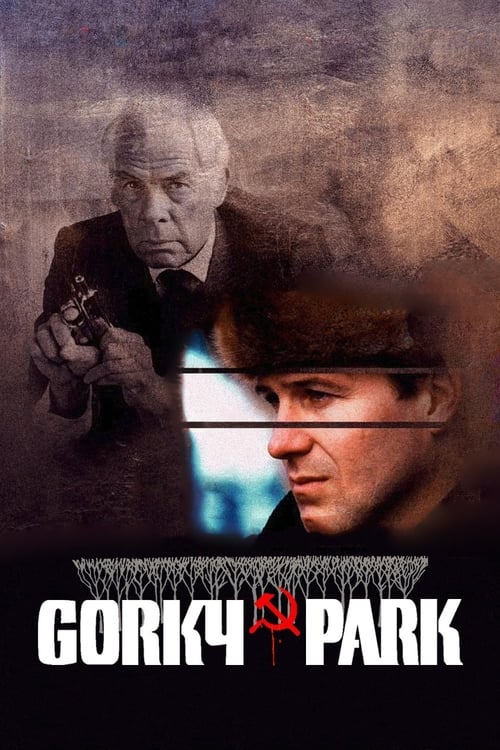
Gorky Park
1983 · Michael Apted
For a long dark evening when you want a proper detective story to sink into — something twisty and atmospheric that respects your attention. Challenge-adjacent comfort: demanding of focus, but satisfying like a good novel.
What it's about
Three bodies turn up under the snow in Moscow's Gorky Park, faces and fingertips cut away so no one can identify them. Homicide inspector Arkady Renko takes the case and quickly wishes he hadn't: the KGB hovers, his superiors stall, and an urbane American fur dealer keeps appearing at the edges of the investigation. The deeper Renko digs, the clearer it becomes that the murders reach into places a Moscow cop is not supposed to look.
The experience
A patient, wintry procedural — more chess match than shootout — that generates its tension from paranoia and institutional menace rather than action. It's absorbing in a grown-up, slow-burn way, with a permanent chill hanging over everything.
Performances
William Hurt gives Renko a weary, watchful intelligence — a decent man navigating a system built on distrust — and Lee Marvin, in one of his last major roles, is silkily menacing as the American dealer.
The craft
Adapted from Martin Cruz Smith's bestseller with a screenplay by Dennis Potter, the film is a rare Hollywood thriller set entirely inside the Soviet Union, its Moscow convincingly conjured in a stand-in city. The snowbound locations and gray institutional interiors give it a texture most Cold War thrillers only gesture at.
Why it matters
One of the defining Cold War thrillers of the early 1980s, it brought one of crime fiction's great detectives to the screen and showed that a Soviet-set procedural could work as mainstream entertainment.
Snapshot
Gorky Park is a Cold War procedural thriller adapted from Martin Cruz Smith's 1981 bestseller, in which Moscow homicide inspector Arkady Renko (William Hurt) investigates three frozen, mutilated corpses unearthed in the city's premier public park — their faces and fingertips excised to defeat identification. What begins as a forensic puzzle widens into a study of institutional rot, as Renko's pursuit collides with the KGB, with an urbane American sable dealer (Lee Marvin), and with the suffocating self-interest of his own superiors. The film occupies an unusual seam in early-1980s American cinema: a major-studio thriller set wholly within the Soviet Union, shot in a Western surrogate city, and scripted by the British television dramatist Dennis Potter. It is at once a glossy genre entertainment and a sober, procedural-realist portrait of a man trying to do honest work inside a dishonest system. Its reputation rests less on commercial impact than on its atmosphere, its forensic ingenuity, and Hurt's deliberately interiorized lead performance.
Industry & production
The film was produced for Orion Pictures, the filmmaker-friendly studio then at a creative high, by Gene Kirkwood and Howard W. Koch Jr. The source novel had been a publishing phenomenon, and its acquisition placed the production in the familiar early-'80s pattern of prestige literary thrillers mounted for adult audiences. The central logistical problem defined the production: filming a story set entirely in Moscow during a period of frozen U.S.–Soviet relations (this is pre-Gorbachev, pre-glasnost, the early Reagan years) without access to the actual locations. The solution was to shoot largely in Helsinki, Finland, whose Russian-influenced architecture, climate, and northern light could plausibly stand in for the Soviet capital, supplemented by Stockholm and studio interiors. This act of geographic substitution is itself a production fact of consequence: the film's "Moscow" is a constructed, slightly displaced city, and its winter bleakness is genuine northern-European cold rather than set-dressing.
Casting drew an Anglo-American ensemble around an East European discovery. William Hurt, fresh from Body Heat and The Big Chill, took the lead; Lee Marvin, late in his career, played the antagonist Jack Osborne; Brian Dennehy appeared as the New York detective William Kirwill; and the veteran British actor Ian Bannen played the prosecutor Iamskoy. The Polish actress Joanna Paçula was cast as Irina Asanova in what became her English-language breakthrough. A recurring point of commentary at the time — and since — was the production's decision not to impose Russian accents uniformly: Hurt played Renko in his own American voice while several supporting players adopted accented English, an inconsistency that some critics read as distracting and others as a pragmatic concession to legibility. I have not been able to confirm precise budget or box-office figures from a reliable source, so I will not assert them; contemporaneous accounts generally treat the film as a respectable rather than a breakout commercial performer.
Technology
Gorky Park is a conventional 35mm photochemical production of its era, with no notable optical or process innovation; its interest on the technology axis is thematic and forensic rather than cinematic. The film foregrounds a genuine technology of investigation: forensic facial reconstruction. A key sequence dramatizes a Soviet professor rebuilding the victims' faces in clay over their recovered skulls — a real anthropological technique associated with the Soviet scientist Mikhail Gerasimov and his school, here used as both plot engine and visual set-piece. The reconstruction scenes give the film a procedural, almost documentary fascination with method, and they anchor its claim to realism. Beyond this, the story turns on the smuggling of live sables — the biological "technology" of a state fur monopoly and the attempt to break it — which functions as the conspiracy's MacGuffin. The film thus locates its tension less in gadgetry than in the apparatus of the state: surveillance, bureaucratic control of information, and the monopoly economics of the Soviet system.
Technique
Cinematography
The photography is by Ralf D. Bode, an experienced craftsman whose résumé included Saturday Night Fever, Coal Miner's Daughter (his prior collaboration with Apted), and Dressed to Kill. Bode's work here is keyed to a muted, wintry palette — gray skies, snow, sodium and tungsten interiors — that converts the Helsinki locations into a convincingly oppressive Moscow. The cinematography favors a restrained, observational classicism over expressionist flourish, in keeping with the film's procedural register; light is often flat and cold, sourced to feel institutional. The opening discovery of the bodies in the snow is the film's signature image, exploiting the contrast of dark figures against white ground. Where the film reaches for atmosphere it does so through environment and weather rather than through aggressive camera movement.
Editing
Cut by Dennis Virkler, the film adopts the measured pacing of an investigative thriller built around accumulation of detail rather than action set-pieces. The editing services exposition and procedure: the rhythm is deliberate, sometimes criticized as slow, prioritizing the methodical unfolding of Renko's inquiry over momentum. The forensic-reconstruction sequence and the gradual revelation of the conspiracy are structured to reward patience, and the film's suspense is cumulative.
Mise-en-scène / staging
Production design renders a Soviet world of cramped apartments, official corridors, snowbound parks, and the markers of a controlled society — a texture of scarcity and surveillance. The staging emphasizes hierarchy and constraint: Renko is repeatedly framed within the bureaucratic spaces that hem him in, his autonomy visibly bounded by the institutions around him. The contrast between Soviet drabness and Osborne's Western affluence is built into the décor, so that the smuggler's privilege reads as a violation of the surrounding austerity.
Sound
The sound design supports the realist surface — winter ambience, the muffled acoustics of snow and interiors — over which James Horner's score supplies the film's emotional and suspense architecture (see Authorship). The accent question (discussed above) is as much a sound-design and performance decision as a casting one, and it shapes how the film's "Russianness" registers on the ear.
Performance
Hurt's Renko is the film's interpretive center: a contained, watchful, morally stubborn performance that withholds rather than projects, consistent with the actor's early-'80s persona. The choice to play Renko quietly — intelligence signaled through restraint — divides viewers, but it is plainly deliberate. Lee Marvin brings weary menace and charisma to Osborne, trading on his iconic screen authority in one of his final major roles. Joanna Paçula's Irina is the emotional and erotic axis of the story, and the role launched her international career. Brian Dennehy supplies blunt American counterweight as Kirwill, and Ian Bannen adds practiced ambiguity. The ensemble's mixed vocal approach is the recurring caveat in assessments of the acting.
Narrative & dramatic mode
The film operates in the investigative-procedural mode: a detective story whose engine is the methodical reconstruction of a crime, expanding outward into political conspiracy. Structurally it follows the classic widening-gyre pattern of the paranoid thriller — a contained homicide that proves to be the visible tip of corruption reaching "the highest levels." Renko is a lone-honest-man protagonist, an investigator whose integrity is itself the source of his danger, isolated by a system that would prefer the case unsolved. A romance subplot (Renko and Irina) supplies emotional stakes and moral complication, since Irina is entangled with the victims and the conspiracy. The dramatic mode is realist and sober rather than kinetic; tension derives from institutional menace and the protagonist's vulnerability rather than from chases or gunplay, though the narrative builds toward a more conventional confrontation in its final movement. Dennis Potter's screenplay compresses Smith's dense novel into this procedural arc.
Genre & cycle
Gorky Park sits at the intersection of the police procedural, the Cold War espionage thriller, and the adult literary-adaptation prestige picture characteristic of early-'80s Hollywood. It belongs to a small cycle of Western productions that took the Soviet interior as their subject during the late Cold War — films that imagined life behind the Iron Curtain rather than treating the USSR merely as an external adversary. Within the thriller tradition it is a "conspiracy" or paranoid procedural, closer in temperature to the disillusioned 1970s political thrillers than to the action-espionage of the contemporaneous Bond and proto-Clancy strain. Its distinctiveness in the cycle is its insistence on a Soviet protagonist whose antagonists include both his own state and a corrupting Western capitalist — a structure that refuses easy Cold War moralism.
Authorship & method
Director — Michael Apted. Apted is among the most genre-spanning directors of his generation, equally identified with documentary and fiction. He was already the custodian of the landmark Up documentary series (begun as Seven Up! in 1964 and continued at seven-year intervals), and in features he had just made Coal Miner's Daughter (1980); he would go on to Gorillas in the Mist, Nell, and the Bond film The World Is Not Enough. That documentary sensibility — patient observation, attention to milieu and process, a sociological interest in how institutions shape individuals — is legible in Gorky Park's procedural realism and its concern with the texture of Soviet life. Apted's method here is restraint: he subordinates spectacle to atmosphere and character.
Screenwriter — Dennis Potter. The most singular authorial fact about the film is that its screenplay is by Dennis Potter, the British television dramatist celebrated for boundary-breaking, non-naturalistic work such as Pennies from Heaven and, later, The Singing Detective. A straight-ahead adaptation of a commercial thriller is markedly against Potter's grain, and his involvement is one of the production's intriguing anomalies; the resulting script is a relatively conventional condensation of Smith's novel rather than a vehicle for Potter's signature formal experiments.
Cinematographer — Ralf D. Bode and editor — Dennis Virkler (discussed under Technique) supplied the film's cold realist surface and deliberate rhythm.
Composer — James Horner. The score comes early in Horner's career, in the same period as Star Trek II: The Wrath of Khan (1982) and Krull — before his blockbuster ascendancy. His music provides the film's romantic and suspense scaffolding and its sense of foreign, melancholy place.
Movement / national cinema
The film is an American studio production (Orion) realized through a multinational European shoot, and it does not belong to any film movement in the formal sense. Its relevant context is the late-Cold-War Hollywood thriller and the prestige literary adaptation. There is, however, a meaningful national-cinema dimension in its surrogate geography: a story of Russia made without Russia, "performed" by Finland and Sweden, with an Anglo-American-Polish cast. The film is thus a Western imagining of the Soviet Union from the outside — a construction of "Moscow" assembled from accessible Nordic equivalents — and its authenticity is, by necessity, a matter of artful approximation rather than location truth.
Era / period
Gorky Park is firmly a product of the early-1980s Cold War freeze, released into a moment of renewed superpower antagonism before the thaw of glasnost. Its vision of the USSR — austere, surveilled, bureaucratically corrupt, economically constrained — reflects the Western imagination of the Soviet Union at that historical juncture. Within Hollywood, it belongs to the Orion-era moment of adult, mid-budget, star-driven thrillers adapted from bestsellers, a production category that the industry would largely abandon in later decades. The film's interest in a morally upright individual ground down by an unaccountable system also echoes the post-Watergate skepticism toward institutions that had shaped American thrillers across the preceding decade.
Themes
The film's governing theme is individual integrity against institutional corruption: Renko's refusal to let the case be buried marks him as a man whose honesty is dangerous in a system organized around concealment. Closely related is the theme of truth and its suppression — literalized in the mutilated, faceless corpses and the painstaking work of restoring their identities, so that the forensic reconstruction becomes a metaphor for recovering suppressed truth itself. A third strand is the convergence of Soviet and Western corruption: the conspiracy implicates both a self-serving Soviet officialdom and a predatory American capitalist, complicating Cold War binaries and suggesting that greed and power operate alike on both sides of the divide. The romance introduces themes of trust, complicity, and the cost of loyalty, as Renko must weigh love against the integrity that defines him. Underlying all of these is a pervasive atmosphere of cold — climatic, emotional, political — as the film's organizing sensory metaphor.
Reception, canon & influence
Critical reception. Contemporary critics generally received Gorky Park as a handsome, intelligent, atmospheric thriller weakened by pacing and by the dissonance of its accent strategy and Hurt's deliberately cool central turn. Praise tended to fall on the production's mood, its convincingly grim evocation of Soviet life, the forensic ingenuity of the central investigation, and Lee Marvin's villainy; reservations centered on length, deliberateness, and the difficulty of warming to its withheld protagonist. Joanna Paçula's debut drew notice as a discovery. I want to be candid that I cannot here verify specific awards or numeric grosses from a confirmed source, and so I refrain from citing them; the film is best characterized as a well-regarded but not canonized entry in the early-'80s thriller field.
Influences on the film (backward). It descends from the literary spy and conspiracy tradition — the morally ambiguous Cold War fiction of writers like John le Carré — and from the paranoid political thrillers of 1970s American cinema, with their lone investigators and corrupt institutions. The procedural emphasis links it to the detective-fiction tradition of methodical inquiry, and the forensic-reconstruction motif draws on real Soviet anthropological science.
Legacy (forward). The film's most durable contribution is the popularization of Martin Cruz Smith's Arkady Renko on screen, though notably it generated no film sequels despite Smith's long-running novel series (Polar Star, Red Square, and beyond) — Renko remained a literary rather than cinematic franchise. As an artifact, Gorky Park stands as a prominent example of the late-Cold-War Western attempt to dramatize Soviet interiors sympathetically, anticipating a small wave of such films, and it remains a touchstone for the challenge of filming "the other side" without access to it. Its afterlife is that of a respected, atmospheric Cold War thriller — valued by genre enthusiasts and by admirers of its makers (Apted, Potter, Hurt, Marvin, Horner) — rather than a widely cited influence on subsequent filmmaking. Where the historical record on its precise commercial and awards standing is thin or uncertain, that uncertainty is itself part of an honest account of a film whose reputation has rested more on craft and mood than on cultural ubiquity.
A Deleuzian reading
A body lies in the snow with no face.
The full Deleuzian reading of Gorky Park →
Reception
In 1983 it landed as a respectable, mid-budget adult thriller — decent reviews, modest box office, overshadowed by the year's bigger films. Today it's a quiet rediscovery favorite, regularly cited as one of the underrated Cold War thrillers of the '80s.
How Gorky Park was received, from release to now →
Influences: the films it descends from and the films it influenced
- The Spy Who Came in from the Cold (1965) — Establishes the deglamorized, drained-gray Cold War surface — Oswald Morris's flat cold light and a withheld, morally compromised protagonist — that Gorky Park adopts as its realist register.
- Doctor Zhivago (1965) — Pioneers the surrogate-geography strategy (Finland and Spain standing in for Russia) and the staging of human figures isolated against vast snowfields that Apted recreates from Helsinki and Stockholm.
- Klute (1971) — Gordon Willis's underlit, flat-cold palette and paranoid framing of the lone watcher supply the visual grammar of surveillance dread Gorky Park inherits.
- The Day of the Jackal (1973) — Models the near-documentary procedural — deliberate, methodical step-by-step inquiry treated as suspense — that governs Gorky Park's pacing.
- Chinatown (1974) — The detective's methodical inquiry that widens into systemic institutional corruption, ending with the lone honest man powerless against entrenched power, is Renko's narrative template.
- The Conversation (1974) — Gene Hackman's interiorized, emotionally withheld technician absorbed in a forensic process prefigures William Hurt's deliberately cool, restrained Renko.
- The Parallax View (1974) — Supplies the widening-gyre conspiracy architecture in which a lone investigator's pursuit steadily reveals an apparatus larger than he can survive.
- Three Days of the Condor (1975) — The lone honest man discovering corruption inside his own state intelligence apparatus is the moral engine Gorky Park transplants into the Soviet militsiya.
- All the President's Men (1976) — Demonstrates suspense built from the patient accretion of investigative detail rather than action — the procedural deliberateness Apted prizes over spectacle.
- The Russia House (1990) — Continues the le Carré-derived project of filming 'the other side' with moral ambiguity, advancing past Gorky Park by gaining actual Moscow access.
- Citizen X (1995) — A direct extension: a Soviet forensic murder procedural in which a lone honest investigator's methodical work is throttled by bureaucratic confinement and Party obstruction.
- Smilla's Sense of Snow (1997) — Carries forward the wintry-palette procedural built on figures against snow and an interiorized, prickly lone investigator decoding a forensic anomaly.
- Enemy at the Gates (2001) — Sustains the Western surrogate-geography dramatization of the Soviet world, rendering its interiors in the same flat-cold realist surface.
- The Lives of Others (2006) — Renders bureaucratic confinement and surveillance through flat-cold Eastern Bloc interiors and a performance of interiorized restraint that descends from Gorky Park's staging of the watched state.
- Tinker Tailor Soldier Spy (2011) — Refines the deglamorized Cold War procedural — wintry flat light, bureaucratic interiors, and performances of clenched interior restraint — into its most austere modern form.
- Child 44 (2015) — A late, direct heir: a Stalinist-era murder procedural with a lone honest investigator crushed by bureaucratic confinement, staged in wintry surrogate geography.
- Coal Miner's Daughter (1980) — Apted's immediately prior feature carries the same documentary-rooted attention to milieu texture and how institutions shape individuals that surfaces as Gorky Park's procedural realism.
- White Nights (1985) — Extends the mid-'80s Western attempt to dramatize Soviet interiors sympathetically using surrogate locations, the same impossible-access problem Gorky Park confronts.
- The Silence of the Lambs (1991) — Builds a procedural set-piece around clay facial/forensic reconstruction to identify a victim — the same Gerasimov-style anthropological technique Gorky Park makes its investigative centerpiece.
- Eastern Promises (2007) — Earlier Western thriller decoding Russian criminality as a forensic reading problem — bodies and marks that must be interpreted by an outsider investigator — anticipating the film's premise of skin as evidentiary text.
Similar films
- The Lives of Others (2006) — influence & lineage
- Three Days of the Condor (1975) — influence & lineage
- The Spy Who Came In from the Cold (1965) — influence & lineage
- The Parallax View (1974) — influence & lineage
- The Conversation (1974) — influence & lineage
- Chinatown (1974) — influence & lineage
- Two Prosecutors (2025) — shared sensibility
- The Berlin File (2013) — shared sensibility