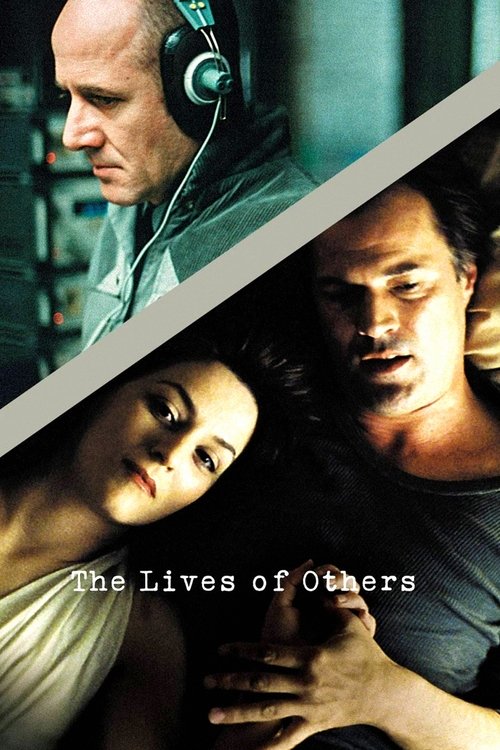
The Lives of Others
2006 · Florian Henckel von Donnersmarck
For when you want a film that restores your faith in what movies can do — gripping enough for a tense night in, deep enough to sit with for a week. Bring tissues.
What it's about
East Berlin, 1984. Gerd Wiesler, a coldly meticulous officer of the Stasi secret police, is assigned to bug the apartment of a celebrated playwright and his actress partner and listen to everything they do. Headphones on in the attic above their flat, night after night, he absorbs a life full of art, love, and risk — and the surveillance begins to work on the watcher.
The experience
Quiet, suspenseful, and profoundly moving — a slow-tightening thriller that's really about conscience. It builds to an emotional payoff that regularly leaves people in tears, earned entirely without sentimentality.
Performances
Ulrich Mühe gives one of the great screen performances as Wiesler, conveying an entire moral transformation almost without dialogue — a face learning, in tiny increments, how to feel.
The craft
A stunningly assured debut, told in muted greens and grays that make the GDR feel like a held breath, with production design precise down to the listening equipment. The writing is watchmaker-tight: every small choice pays off, and the film knows exactly when silence says more than the score.
Why it matters
It won the Academy Award for Best Foreign Language Film, became the defining screen account of life under the Stasi, and remains the benchmark for drama about state surveillance and personal conscience.
Snapshot
Set in East Berlin in 1984 — the year borrowed pointedly from Orwell — The Lives of Others (Das Leben der Anderen) follows Hauptmann Gerd Wiesler, a precise and ideologically certain Stasi officer who is assigned to surveil the playwright Georg Dreyman and his partner, the stage actress Christa-Maria Sieland. Surveillance, which Wiesler has practiced as a science, gradually undoes him: listening to a life richer in art, love, and moral courage than his own, he begins to act against his institution rather than for it. Florian Henckel von Donnersmarck's feature debut won the Academy Award for Best Foreign Language Film in 2007 and immediately entered discussions of the greatest films about state power, artistic conscience, and the slow interior weather of a man who chooses, once, to be good.
Industry & production
The film was produced by the Munich-based company Wiedemann & Berg Filmproduktion, in co-production with Bayerischer Rundfunk and Arte, with support from FilmFernsehFonds Bayern and Medienboard Berlin-Brandenburg. The budget was modest by international standards — publicly reported figures place it in the low single-digit millions of euros — and the production required exhaustive practical recreation of GDR interiors and street life, since unified Berlin had largely effaced or converted the physical fabric of the East. Von Donnersmarck wrote the screenplay himself over a period of several years, conducting extensive research into the Stasi's operational methods: its surveillance technology, its filing systems, its psychological culture. He interviewed former Stasi officers and their subjects, and studied the archives made public after reunification by the Behörde für die Unterlagen des Staatssicherheitsdienstes (BStU, commonly called the Birthler-Behörde after its director). The screenplay was, by the time of production, unusually developed and precisely sourced, which gave it a documentary texture that fiction films about the GDR rarely achieved. The film shot for approximately 37 days, largely on location and on sets built to replicate the specific visual register of mid-1980s East German domestic and institutional life.
Technology
The Lives of Others was shot on 35mm film, a deliberate choice aligned with both the period setting and the tonal intentions of the cinematographer Hagen Bogdanski. The format's grain and tonal depth suited the production's muted, de-saturated palette; digital acquisition would have imposed a cleaner, more clinical texture at odds with the film's tactile investment in material bleakness. The Stasi technology depicted — reel-to-reel audio recorders, typewriters, carbon-paper logs, the smell-sample jars used for scent-based tracking — was sourced or replicated from actual surviving equipment and was not embellished for dramatic effect: the GDR's surveillance infrastructure was, in documented practice, precisely as methodical and low-tech as the film portrays. The production design (by Silke Buhr) relied heavily on archival photographs of GDR interiors, sourcing period-correct wallpapers, light fixtures, and furniture from estate sales and storage lots in the former East, since West German homes and offices of the same era had a visually distinct character.
Technique
Cinematography
Bogdanski's work on The Lives of Others has become a reference point for what might be called bureaucratic realism in photography: a palette of institutional greens, battleship grays, and tobacco yellows that does not caricature East German drabness but finds in it a subdued visual logic. The surveillance attic where Wiesler sits with his headphones is lit with the bare functional minimum — a single overhead source — which both literalizes his isolation and creates a formal counterpoint to the warmer, lamp-lit scenes in Dreyman's apartment below. Bogdanski makes purposeful use of shallow-focus close-ups on Ulrich Mühe's face to register the micro-adjustments of a man whose professional training has suppressed visible response: the camera treats expression itself as a form of surveillance. Wide shots of GDR architecture — Plattenbau facades, gray-carpeted ministry corridors — are held long enough to register as spatial argument rather than atmosphere. The film also uses motivated symmetry: Wiesler's blank apartment, introduced early, rhymes formally with his surveillance post, suggesting that his domestic and professional lives are the same sterile room.
Editing
The film was edited by Patricia Rommel, whose approach is essentially classical in structure but calibrated to a very particular rhythm of delayed revelation. The fundamental irony of the film — that Wiesler is altering his reports to protect the people he is watching — is disclosed to the audience before the characters discover it, requiring the editing to manage several layers of dramatic time simultaneously: what is happening in the apartment, what is happening in the attic, and what will later appear in the official record. Rommel's cuts are largely invisible in the formalist sense; there are no conspicuous transitions or temporal montage effects. The film's pacing is notably patient, trusting long scenes to accumulate emotional charge rather than accelerating through them. The final two sequences — the discovery of the hollow book and, after the temporal ellipse of reunification, Wiesler in the bookshop — are edited with extreme economy, allowing silence and physical action to carry the weight that dialogue is not given.
Mise-en-scène / staging
Von Donnersmarck stages the surveillance-and-surveilled structure with geometric care. The physical separation between attic and apartment — two floors, two worlds — is established early and maintained with spatial consistency, so that the audience always knows where each character is in relation to the others. The playwright Dreyman's apartment is a controlled exception to the GDR visual register: books, a piano, art on the walls, objects that indicate a self that has been allowed to cohere. Wiesler's surveillance post directly above is its photographic negative. Key staging choices are those of restraint: when Dreyman plays the sonata at the piano after the death of his friend and mentor Jerska, von Donnersmarck holds the camera still and at distance, refusing to cut for emotional emphasis. The scene's effect depends entirely on the spatial and sonic fact of what Wiesler — above, listening — is experiencing alongside the audience. That the minister Hempf's appetites are staged in contrast to this — coarse, spatially dominating, lit with institutional brightness — is a visual argument about the relationship between power and art.
Sound
The film's sound design treats the wire-tap recordings as a second visual layer: Wiesler's world is largely a world of what is heard through imperfect microphones, and the production records this with a slight degradation in acoustic quality that distinguishes the surveillance feed from the direct-sound scenes below. Gabriel Yared and Stéphane Moucha composed the score — though attributions for individual cues are not thoroughly documented in public sources, and the record on their specific division of labor is thin. The film's most crucial musical element is the piano piece "Sonata for a Good Man," which is heard in the apartment scene after Jerska's suicide and which Dreyman dedicates, after the Wall falls, to "HGW XX/7" — Wiesler's operational code. Whether composed specifically for the film or adapted from another source is not something this account can confirm without access to the original production documentation; what is established in the film's narrative logic is that the piece functions as both turning point and memorial — the moment at which Wiesler's bureaucratic self cracks open, and the evidence that Dreyman later understood, if not fully knew, that someone had protected him.
Performance
Ulrich Mühe's performance as Wiesler is among the most technically controlled in European cinema of the 2000s. Mühe was himself, by his account, subject to Stasi surveillance — including, he stated publicly, by his then-wife, a claim that generated some public dispute after the film's success and after his death from stomach cancer in July 2007. Whether or not all the specifics of his personal history are verifiable in detail, his identification with the material is palpable in the performance: Wiesler's conversion is registered in almost no dialogue and very little visible emotion, only in a sequence of minute recalibrations — a hesitation before a keystroke, a slight adjustment in how he positions himself in his chair — that only accumulate their meaning in retrospect. Sebastian Koch plays Dreyman with a different but equally precise kind of reserve: confident in his social position as a tolerated dissident, not fully aware of how much protection that position requires. Martina Gedeck as Christa-Maria carries the film's most structurally difficult role — a character whose complicity is coerced and whose self-destruction is structural — and grounds it in physical specificity rather than melodrama.
Narrative & dramatic mode
The film's narrative mode is classical dramatic irony sustained at length. The audience understands Wiesler's covert interventions before any other character does, which transforms what might have been a straightforward surveillance thriller into something closer to a secret ethics: the protagonist's heroism must be invisible to the people he helps and to his own institution in order to work, and the film's grammar is organized around that secrecy. The structure is binary — 1984, then a near-wordless coda set after reunification — with the ellipsis functioning as both historical fact (the Wall fell; the Stasi was dissolved; its files were opened) and formal argument (some things can only be known afterwards). The hollow book that conceals Dreyman's typewriter is the film's central material symbol: literature as something that must be hidden inside literature. Von Donnersmarck works largely within cause-and-effect classical narration but the film's emotional architecture is essentially lyric — built toward a single terminal image, the bookstore scene, that completes every withheld feeling.
Genre & cycle
The Lives of Others belongs formally to the political thriller but reorients the genre away from action and toward interiority. Its closest generic antecedents are films in which surveillance becomes a moral instrument of self-knowledge: Francis Ford Coppola's The Conversation (1974) is the most frequently cited predecessor, with Harry Caul as a kind of negative template — the wire-tapper who also undergoes transformation, but toward dissolution rather than conscience. The film appeared in a cycle of post-reunification German reckonings with GDR history that also includes Wolfgang Becker's Good Bye, Lenin! (2003), though the two films approach the same history from near-opposite emotional directions: Becker's film is elegiac-comic, von Donnersmarck's is moral and largely tragic. The surveillance-state thriller gained renewed critical attention in the years following the 2013 Snowden disclosures, when The Lives of Others was widely cited in public commentary — a secondary afterlife the film did not design for but which it accommodated because its subject (the ethics of the apparatus and those who operate it) is not historically bounded.
Authorship & method
Von Donnersmarck was 31 when The Lives of Others was released. He had made short films previously — "Dobermann" (2001) drew some attention — but the feature was a project he had been developing since his early to mid-20s. His method was research-intensive to an unusual degree for a debut: years of archival study, interviews with former Stasi officers (some cooperative, some not), and extensive conversation with survivors and dissident artists. He has spoken about the philosophical ambition of the project — the question of whether a person formed entirely by a totalitarian system could exercise free will within it — in terms that identify him as an author concerned less with political exposé than with metaphysical argument. Hagen Bogdanski as cinematographer brought a sober, observational style without aestheticizing poverty or institutional ugliness. The production design team's commitment to period accuracy was a form of authorial argument in itself: the film insists that the GDR looked a specific way, not a generically Soviet way, and that precision carries political content.
Movement / national cinema
The film belongs to a substantial tradition of post-reunification German cinema working through the legacy of the GDR — what German critics sometimes call Vergangenheitsbewältigung in its eastern variant. Unlike the Westerns of the New German Cinema or the postwar reckoning films of the 1970s and 1980s, this cycle deals with a more proximate and still-contested history: the GDR was sovereign until 1990, and millions of living Germans were subjects of, employed by, or complicit with the Stasi and its associated institutions. The film was controversial in some quarters precisely because its central figure is a Stasi officer made sympathetic — several historians and survivors of political imprisonment argued publicly that the redemption narrative misrepresented the system's actual psychology and let its perpetrators off too easily. Others, including some former dissidents, defended the film's moral seriousness. This controversy is itself a feature of the national cinema context: no equivalent film could be made about the Stasi without provoking it.
Era / period
The film was produced and released in the mid-2000s, in what was — in European and particularly German cinema — a period of sober historical accounting. The 2004 Stasi file-access reforms had made more material available to researchers and survivors. The fifteenth anniversary of reunification fell in 2005, prompting considerable public reflection. Internationally, the film appeared at a moment of rising anxiety about surveillance states that was pre-Snowden but post-9/11, and its American reception — strong, culminating in the Oscar — was inflected by the context of the Patriot Act and NSA expansion debates that were already circulating in public discourse. That timing shaped how the film was read outside Germany even though von Donnersmarck was not making a film about the United States.
Themes
The film's central themes are surveillance as a mode of knowing and the possibility of moral action within a system that forecloses it structurally. Wiesler's transformation is not a rejection of the Stasi's methods but a redirecting of them: he continues to listen, to observe, to record; he simply stops transmitting his observations accurately. The film is therefore as much about the ethics of epistemology — what one does with knowledge of another's private life — as it is about political allegory. Art's relationship to power is a second major theme: Dreyman and Jerska represent the two fates of artists under totalitarian patronage, the tolerated and the destroyed, and the film argues implicitly that the distinction is not a matter of talent or courage alone but of political circumstance and who is watching. Redemption as a theme is handled with notable formality: Wiesler is never forgiven, never revealed, never reconciled with the people he protected. His reward is entirely private, a book dedicated to a code name, purchased in a bookshop among strangers. This is the film's most rigorous formal choice.
Reception, canon & influence
The Lives of Others was critically acclaimed on its German release in March 2006 and its international rollout through the year. It won the German Film Prize (Lola) for Best Film, Best Direction, Best Screenplay, and Best Actor (Mühe), and the European Film Award for Best Film. Its Academy Award for Best Foreign Language Film in February 2007 was the first such win for a German film in two decades. Reviews in English-language press were almost universally strong, with particular emphasis on Mühe's performance and the script's intellectual architecture.
The film's influences backward are traceable with reasonable confidence: The Conversation is the clearest structural precedent in the surveillance-thriller mode. The Orwellian date of 1984 signals a literary inheritance that the film takes seriously but does not replicate — Wiesler is not Winston Smith; the system is more procedural and less grotesque than Oceania. The tradition of German literary and theatrical engagement with political repression — Brecht, the postwar documentary theater — forms a less direct but culturally legible context.
The film's influence forward is documented if not always causal. It revitalized international interest in GDR history and generated several subsequent German television productions about the Stasi and the surveillance state. Its critical reputation grew rather than faded after the 2013 Snowden revelations, when it was cited extensively in journalism and academic writing about mass surveillance; in that second wave of attention the film was sometimes read as prophetic, a reading von Donnersmarck has addressed with appropriate caution. It remains on curricula in film studies, political philosophy, and German history courses. The final bookshop scene — "Nein. Es ist für mich" — is among the most cited single scenes in 21st-century European cinema.
Ulrich Mühe died in July 2007 at the age of 54, seven months after the film's Oscar win. He did not live to see the full extent of the canonical status the film would acquire, or the second cycle of attention it received after 2013. His performance remains the film's irreplaceable element.
A Deleuzian reading
A single bulb in an attic.
The full Deleuzian reading of The Lives of Others →
Reception
It arrived as an instant phenomenon — a debut feature that swept the German awards and took the 2007 Best Foreign Language Film Oscar — and its standing has only hardened since, helped (unfairly or not) by the director's later career making it look like a one-off miracle.
How The Lives of Others was received, from release to now →
Influences: the films it descends from and the films it influenced
- M (1931) — Lang organizes Berlin as a collective observation network and uses off-screen sound — the killer's compulsive whistling — to acoustically track an unseen figure, establishing the German surveillance-thriller grammar of institutional space built for watching that The Lives of Others inherits for its Stasi apparatus.
- The Third Man (1949) — Reed and Robert Krasker photograph Vienna's occupation zones as moral geography encoded in depth of field and Dutch angles, with a divided city's architecture representing distinct ethical registers — the formal model for The Lives of Others' use of attic-versus-apartment as a spatial diagram of complicity and conscience.
- Pickpocket (1959) — Bresson's performance methodology — the face systematically emptied of expression while hands and physical action carry the moral weight — is the direct ancestor of Ulrich Mühe's Wiesler; both films culminate in a wordless gesture through a barrier that discloses an entire arc of interior transformation, establishing the lyric architecture of postponed revelation that The Lives of Others inherits.
- Le Samouraï (1967) — Melville stages his police surveillance operation as a formal problem in spatial geometry — officers placed in observation posts watching Costello's apartment from above — and casts Alain Delon in a performance of total suppressed expression, establishing the formal premise The Lives of Others inherits: a man whose institutional role requires the systematic elimination of visible interior life.
- The Conformist (1970) — Bertolucci and Vittorio Storaro use fascist rationalist architecture — geometric Ministry corridors, grid-planned interiors — to externalize the protagonist's surrender of individuality to state ideology, establishing the formal principle that institutional space is a spatial argument about ideological conformity, which The Lives of Others maps directly onto its vertical attic/apartment binary.
- The Conversation (1974) — Walter Murch's sound design — using tape hiss, ambient bleed, and signal degradation to externalize the epistemological uncertainty of surveillance listening — is the direct technical ancestor of The Lives of Others' acoustic-degradation wiretap aesthetic, and both films structure their moral crises around a professional eavesdropper undone by the human content his technology captures.
- Three Colors: Red (1994) — Kieślowski's retired judge who taps his neighbors' phone calls and is humanized by what he overhears is the closest narrative ancestor of Wiesler; Piotr Sobociński's shallow-focus close-ups registering micro-adjustments in the judge's listening face model the cinematographic strategy Hagen Bogdanski deploys for Mühe, and both films rest on the observation-transforms-the-observer structure The Lives of Others makes its moral engine.
- The Spy Who Came In from the Cold (1965) — The film's structural irony — a Stasi surveiller who discovers the moral equivalence of his own system — directly enacts Ritt's thesis about institutional moral parity: the Eastern apparatus uses identical methods to the Western one, and both destroy the individuals who serve them faithfully.
- The End of Violence (1997) — Revives the Conversation-lineage figure Wenders reworked — the surveillance operative whose conscience turns against the apparatus he serves — within a state-monitoring frame.
- Good Bye, Lenin! (2003) — The sober surveillance counter-narrative that adopts the same GDR set-dressing-as-history method but redirects it from affectionate comedy toward Stasi dread, framing the memory debate Lenin opened.
- Gorky Park (1983) — Renders bureaucratic confinement and surveillance through flat-cold Eastern Bloc interiors and a performance of interiorized restraint that descends from Gorky Park's staging of the watched state.
- Mephisto (1981) — Builds on Mephisto's model of the serious European political drama that studies a theater artist's compromise and surveillance under dictatorship through one intimate, ambivalent protagonist.
- Tinker Tailor Soldier Spy (2011) — Hoyte van Hoytema's cinematography directly inherits The Lives of Others' bureaucratic-realism palette — institutional khakis, muted grays, amber fluorescents — and Alfredson deploys Bogdanski's shallow-focus close-up strategy on Gary Oldman's face to register micro-adjustments of a man trained in concealment; Dino Jonsäter's editing replicates the delayed-revelation structure in which audience knowledge runs persistently ahead of character knowledge.
- Barbara (2012) — Hans Fromm's photography replicates Bogdanski's 1980 GDR palette with near-exactitude, and Nina Hoss's performance methodology — face withholds, hands and eyes disclose — inherits directly from Mühe's Wiesler; Petzold uses the same vertical spatial binary (official clinic versus private coastal space) to encode a protagonist's divided loyalties under Stasi surveillance, making Barbara the most direct formal descendant of The Lives of Others.
- The Hunt (2012) — Vinterberg deploys a Danish village community as a collective surveillance apparatus whose bureaucratic credulity mirrors the Stasi's — institutional trust in an accusation functioning like a mandatory Stasi report — and structures the editing to sustain the same dramatic irony as The Lives of Others: the audience's knowledge of the protagonist's innocence is withheld from the institutional observers, generating tension from the gap between what is known and what the official record shows.
- Ida (2013) — Łukasz Żal and Ryszard Lenczewski stage figures in the lower third of the wide anamorphic frame against flat Polish sky and institutional ceilings — a bureaucratic spatial grammar for Communist Poland that inherits from Bogdanski's GDR work — and Agata Trzebuchowska's suppressed-interiority performance follows the same Bressonian model Mühe employs: accumulated silence and minimal gesture carrying the weight of a transformation the face refuses to display.
- Son of Saul (2015) — Mátyás Erdély's extreme shallow focus — the background of the Auschwitz operation blurred almost to abstraction while Saul's face holds the foreground — inverts The Lives of Others' surveillance optic (there the camera looks past the watcher into the observed space; here it refuses to look past the subject into surrounding horror) but inherits the formal principle that depth of field is an ethical argument about what the camera chooses and refuses to see.
- The Seed of the Sacred Fig (2024) — Constructs a complete sound-design grammar for domestic surveillance — microphones in walls, the audible breath of the monitored subject, the Stasi listener's headphones as a second frame around domestic sound — that transforms the interior into a site of permanent state audition; Rasoulof's sound design of domestic tension inherits this vocabulary of the heard-but-unseen apparatus.
- A Most Wanted Man (2014) — A surveillance state rendered through restrained, static observation and muted color, treating the act of monitoring as a slow moral drama rather than a thriller — the European tonal register Corbijn shares.
- The Resistance Banker (2018) — Model for the seed's 'threat-of-being-overheard' sound design and surveillance dread — tension built from listening, restraint, and the fear of a single overheard word.
- Never Look Away (2018) — Establishes von Donnersmarck's signature engine of sustained dramatic irony — the audience holding decisive knowledge a character lacks — and hands forward collaborators Sebastian Koch (again the compromised authority figure) and editor Patricia Rommel, whose long-arc suspense cutting shapes both films.
- Goodbye, Lenin! (2003) — Becker and production designer Lothar Holler reconstruct GDR material culture with the same documentary exactitude The Lives of Others applies to Stasi technology — period-correct wallpapers, consumer goods, institutional signage — deploying that precision as emotional argument, and both films use the narrative device of a character who knows more than the state apparatus and must manage that dangerous asymmetry of knowledge.
- Caché (2005) — Haneke builds his film around unattributed long static shots that mimic the patience of surveillance-camera footage, forcing the viewer into the same act of observation-as-complicity that The Lives of Others foregrounds; both films withhold the identity and motive of the surveillance apparatus and use delayed disclosure as the structural mechanism through which audience watching becomes an ethical question.
- 4 Months, 3 Weeks and 2 Days (2007) — Oleg Mutu's photography deploys the same bureaucratic-realism palette — Communist-era institutional grays, de-saturated domestic interiors, harsh overhead fluorescents — that Bogdanski uses for the GDR, and both films give characters a suppressed-interiority performance challenge identical in source: navigating state surveillance while concealing the true content of their actions from every institutional observer.
- The White Ribbon (2009) — Christian Berger's high-contrast black-and-white photography renders a Protestant village community as a mutual surveillance network in which every transgression is observed and recorded, using the same formal structure as The Lives of Others — a narrator-watcher who cannot explain what he has observed — with suppressed-interiority ensemble performance and an editing architecture of withheld institutional disclosure.
- Number 24 (2024) — Von Donnersmarck's ambient sound design makes listening to normalized domestic life the formal register of occupation's threat — a precise precedent for Number 24's ambient occupation texture technique of making ordinary sound morally charged.
- Bridge of Spies (2015) — Divided-Berlin surveillance-state drama in which quiet moral courage is conveyed through stillness, watching, and withheld reaction—the same monastic register as Rylance's Abel.
- Relay (2025) — Builds suspense and moral reversal from a listener mediated by headphones and surveillance feeds, the disembodied voice as ethical fulcrum — kin to Relay's intermediary-as-conduit device.
- 1984 (1956) — It realizes the surveillance state through the aural saturation of eavesdropping — the bugged apartment and the listening agent — the same sound-of-being-watched craft, grounded in historical Stasi practice.
- The Death of Stalin (2017) — Shares the cold institutional-drab palette — muted grays and bureaucratic interiors — that visualizes the surveillance state as a machinery of dread, here repurposed as the backdrop to farce.
- The Secret in Their Eyes (2009) — Reckons with state-terror history through a slow-burn moral procedural and a long-delayed, quiet epilogue of belated recognition rather than active justice.
Similar films
- Caché (2005) — influence & lineage
- The Conversation (1974) — influence & lineage
- Good Bye, Lenin! (2003) — influence & lineage
- The White Ribbon (2009) — influence & lineage
- The Baader Meinhof Complex (2008) — shared sensibility
- The Berlin File (2013) — shared sensibility
- Never Look Away (2018) — shared sensibility
- Great Freedom (2021) — shared sensibility
All the films related to The Lives of Others →