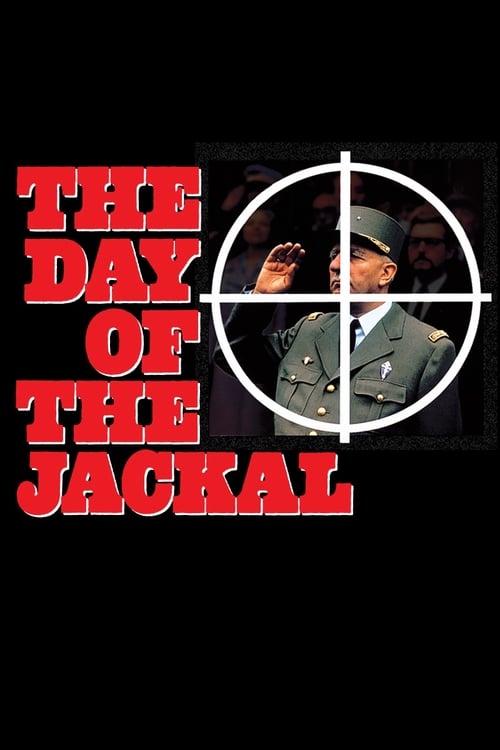
The Day of the Jackal
1973 · Fred Zinnemann
For a night when you want total absorption without a wasted minute — a long, immaculate thriller to sink into alone with your phone off. Comfort food for anyone who loves competence on screen.
What it's about
In the wake of Algerian independence, embittered French paramilitaries hire an anonymous English professional — codename the Jackal — to assassinate President Charles de Gaulle. The film follows both sides of the clock: the assassin patiently building a false identity, a custom weapon, and a plan, while a rumpled, methodical French detective races to identify a man who officially doesn't exist.
The experience
Cool, precise, and almost unbearably tense — remarkable given that history tells you de Gaulle survived. It plays like watching two master craftsmen work in parallel, and the suspense comes entirely from process: every forged passport and every phone trace tightens the screws.
Performances
Edward Fox makes the Jackal magnetic through sheer poise — charming, unreadable, and chilling precisely because he never raises his voice.
The craft
Fred Zinnemann shoots it like a documentary: real European locations from London to Paris, no showy score, no fat, just clean editing that keeps two intricate procedures ticking in parallel. It's a masterclass in generating suspense from pure information.
Why it matters
It set the template for the modern procedural thriller — the assassin-versus-investigator structure and the tradecraft-heavy style echo through decades of spy and hitman films that followed.
Snapshot
The Day of the Jackal is a procedural thriller of exceptional cool and precision, adapted from Frederick Forsyth's bestselling 1971 novel and directed by Fred Zinnemann at the height of his late-career command. Its premise is a wager against suspense itself: in the aftermath of Algerian independence, the embittered paramilitary remnants of the OAS hire an anonymous English professional — known only by the codename "the Jackal" — to assassinate President Charles de Gaulle, a man whose survival into the 1970s is a matter of public historical record. The audience therefore knows from the first reel that the killer must fail; the film's entire achievement is to make that foregone conclusion almost unbearably tense. Zinnemann builds the picture as two meticulous parallel processes — the Jackal's patient assembly of a false identity, a custom rifle, and an escape route, set against the methodical counter-investigation of a rumpled French detective, Claude Lebel — and lets the gap between hunter and quarry narrow with the inexorability of clockwork. Shot in a flat, semi-documentary register across France, Italy, Austria, and London, with a near-total absence of music and a cast chosen for anonymity rather than star wattage, it became one of the defining thrillers of its decade and the template for a whole subsequent genre of procedural assassin cinema. Edward Fox's blank, immaculate Jackal — courteous, ruthless, and finally unknowable — remains its enduring image.
Industry & production
The film was an Anglo-French co-production mounted for Universal Pictures, produced by John Woolf, the veteran British producer whose Romulus organization had backed pictures from The African Queen to Oliver! The source was a publishing phenomenon: Forsyth, a former Reuters and BBC correspondent who had reported from France and Biafra, drew on his journalistic knowledge of the OAS conspiracies against de Gaulle to write a thriller whose authority derived from a dense accumulation of procedural and bureaucratic detail. The novel's reputation for verisimilitude — the sense that it functioned almost as a manual — was central to its appeal, and Zinnemann's adaptation deliberately preserved that documentary texture rather than inflating it into conventional movie melodrama.
The screenplay was written by Kenneth Ross, who would go on to adapt another Forsyth property, The Odessa File. Ross's principal task was compression: distilling Forsyth's exhaustive narrative into a film that runs roughly two and a half hours while retaining the dual-track structure and the wealth of operational detail. Zinnemann, an Austrian-born émigré of the classical Hollywood generation whose credits already included High Noon, From Here to Eternity, The Nun's Story, and A Man for All Seasons, approached the material with the unfussy discipline that characterized his work; by his own reputation he was a director of conscience and craftsmanship rather than flamboyance, and the Jackal suited his temperament for restraint.
A defining production decision was casting. Rather than anchor the film with an international star — which would have undercut both the Jackal's required anonymity and the audience's uncertainty — Zinnemann cast the then-little-known English actor Edward Fox in the title role, surrounding him with a deep bench of distinguished but not headlining European and British character players. The French detective Lebel went to the Anglo-French actor Michael Lonsdale (Michel Lonsdale); the supporting ranks included Cyril Cusack as the discreet gunsmith, Alan Badel, Tony Britton, Eric Porter, Donald Sinden, Delphine Seyrig, and a young Derek Jacobi as Lebel's assistant. The production shot extensively on real locations across France — including the south and Paris — as well as Genoa, Vienna, and London, lending the film a geographic authenticity that studio recreation could not have matched.
Technology
The Day of the Jackal is a conventionally photographed 35mm production of the early 1970s, and it advances no technological innovation; its sophistication is one of method, not apparatus. Where technology figures, it does so as subject matter rather than means. The film's most celebrated set pieces are essentially demonstrations of craft hardware: the bespoke, breakdown sniper rifle commissioned from an underworld gunsmith — a precision instrument disguised, concealed, and tested with melons in a sun-struck field — and the forging of identity documents, the procurement of stolen passports, the chemistry of disguise. The picture treats these processes with an almost fetishistic procedural attention that is itself the source of much of its fascination, anticipating the "competence porn" of later thriller cinema. But the camera, lighting, and recording technology behind the film are unremarkable for their period, and it would be invention to claim any special technical novelty in the production itself.
Technique
Cinematography
The cinematography is by the French cameraman Jean Tournier, and its keynote is a deliberate, almost reportorial plainness. Tournier and Zinnemann reject the expressionist shadow-play of noir in favour of clear, even, often bright daylight — the Mediterranean glare of the rifle test, the tourist-poster light of the Riviera and Rome, the gray functionality of police offices and provincial hotels. This flat, documentary luminosity is a calculated strategy: it makes the unfolding conspiracy feel like observed reality rather than staged thriller, and it denies the Jackal any romantic chiaroscuro, presenting his lethal work in the same matter-of-fact light as the bureaucratic counter-effort. The compositions favour clarity of information over visual rhetoric, frequently framing the Jackal as a neat, anonymous figure moving through unremarkable European streets, his very ordinariness the point. The location photography across multiple countries gives the film a continental sweep while never tipping into travelogue prettiness.
Editing
The editing, by Ralph Kemplen — whose work on the film earned an Academy Award nomination — is the picture's structural engine and arguably its single greatest technical achievement. Kemplen and Zinnemann organize the entire film as a cross-cut between two timelines: the Jackal's southward, then northward progress toward his target, and the police investigation that gradually closes the distance. The cutting is patient and accumulative, parcelling out procedural detail in measured beats, then tightening rhythmically as the parallel lines converge on the final day. Because the audience knows the outcome, the editing must generate suspense from process and proximity rather than uncertainty of result, and it does so by controlling exactly how much each side knows at any moment — the recurrent, agonizing near-misses depending entirely on the precise timing of information revealed and withheld. The film's escalating tension is, to an unusual degree, an editorial creation.
Mise-en-scène / staging
Zinnemann's staging is unadorned and functional, in keeping with the documentary aesthetic, and its discipline is everywhere in the service of credibility. The settings are real and lived-in — government ministries, provincial garages, gunsmiths' workshops, hotel rooms, the crowded Paris streets of the Liberation Day commemoration that forms the climactic setting. The film's iconography is procedural: passports and rubber stamps, the disassembled components of a rifle laid out like surgical instruments, makeup and crutches and forged papers. Costume and physical bearing do enormous work in characterizing the Jackal, whose succession of disguises and impeccable, neutral clothing express a man who is essentially a blank surface, adopting and discarding identities at will. The staging of the assassination attempt itself — the sightlines, the elevation, the timing relative to a public ceremony — is presented with a geometric, almost architectural rigor that makes the mechanics of the plot legible and gripping.
Sound
The film's most distinctive technical choice is its near-abstention from music. Georges Delerue, one of the great French film composers, is credited with the score, but it is used with extreme sparseness; for long stretches the soundtrack consists only of ambient location sound — traffic, footsteps, the click of a rifle bolt, the murmur of officialdom. This refusal to underscore is integral to the documentary effect: with no music cueing the audience how to feel, the tension arises from event and procedure alone, and the silences amplify the methodical quiet of both the killer's preparations and the investigation. The multilingual, multinational sound environment — French, English, the textures of different cities — reinforces the film's authenticity and its sense of a manhunt crossing borders.
Performance
The performances are pitched, almost uniformly, toward understatement, and the casting strategy pays off precisely in the absence of grandstanding. Edward Fox's Jackal is the film's masterstroke: cool, courteous, physically elegant, and utterly opaque, a professional who reveals no ideology, no biography, and almost no interior life, killing with the same unruffled politeness he brings to seduction or to ordering lunch. The performance's restraint is its menace; Fox gives us a man defined entirely by competence and self-possession, and the film's refusal to explain or humanize him is a large part of its unsettling power. Against this, Michael Lonsdale's Lebel is a study in unglamorous diligence — tired, methodical, persistent, an ordinary man of patient intelligence whose dogged police work is the film's true heroism. The contrast between the two — the dazzling, hollow professional and the dull, dedicated public servant — is the film's moral and dramatic spine. The deep supporting cast of seasoned character actors lends every official meeting and incidental encounter a weight of plausibility.
Narrative & dramatic mode
The dramatic mode is the pure procedural thriller, and the film is one of its most rigorous exemplars. Its structure is the dual chase: an extended cross-cut between the assassin's preparations and the detective's investigation, two competing demonstrations of method racing toward a fixed point in time and space. The signal audacity of the narrative is its surrender of conventional suspense — the question "will the assassination succeed?" is answered by history before the film begins — and its substitution of a different, more sophisticated tension: not whether but how, and how nearly. Forsyth's and Ross's narrative wager is that meticulously rendered process can be more gripping than plot uncertainty, and the film vindicates it. The storytelling is cool, omniscient, and almost clinical, granting the audience privileged sight of both sides while denying each antagonist full knowledge of the other. There is little psychology and less sentiment; the film is interested in systems, procedures, and the friction between individual ingenuity and institutional persistence. Its emotional register is one of mounting dread rather than catharsis, and its climax derives its charge from the precise mechanics of timing and proximity rather than from any revelation of character.
Genre & cycle
The Day of the Jackal belongs to the political-assassination and conspiracy thriller, a cycle that flourished in the late 1960s and 1970s on both sides of the Atlantic, often nourished by real anxieties about state power, covert violence, and the political murders that scarred the era. It is distinguished within that cycle by its procedural emphasis and its documentary affect, aligning it less with the paranoid American conspiracy films of the period than with a European tradition of politically grounded realism — its closest kin in spirit is the work of directors like Costa-Gavras, whose Z (1969) brought a comparable semi-documentary urgency to political violence. The film also helped define a durable subgenre: the assassin-procedural, in which the craft and logistics of contract killing are rendered with technical fidelity. Its DNA runs forward through countless films and television series built around the lone professional and the investigators tracking him.
Authorship & method
The film is most legible as the work of Fred Zinnemann, and it crystallizes the values of his classical, conscience-driven authorship: rigor, restraint, moral seriousness, and an aversion to sensationalism. Zinnemann's career had repeatedly concerned itself with individuals tested against systems and against time — the marshal of High Noon awaiting the noon train, the man of principle in A Man for All Seasons — and The Day of the Jackal's ticking-clock structure and its study of dutiful persistence against a charismatic threat sit comfortably within that body of work. His method here was to subordinate his own personality to the material's documentary logic, trusting procedure and structure over flourish.
The authorship is genuinely collaborative, however, and several contributions are decisive. Frederick Forsyth's source novel supplied the procedural template and the aura of authenticity that the film so carefully preserves; Kenneth Ross's screenplay performed the essential work of compression and dual-track architecture. Editor Ralph Kemplen, Oscar-nominated for the film, gave the cross-cut structure its rhythm and suspense and is in a real sense co-author of the film's tension. Cinematographer Jean Tournier supplied the flat, credible daylight realism, and composer Georges Delerue's discipline — his music's near-absence — is as much an authorial statement as any score would have been. Above all, the decision to cast an unknown in the title role, and Edward Fox's realization of the Jackal as a beautiful blank, is the creative fact that allows the whole enterprise to work.
Movement / national cinema
The film sits athwart national categories, an Anglo-French co-production financed by an American studio, directed by a Hollywood-based émigré, scripted and largely crewed by Britons, photographed and scored by Frenchmen, and shot across several European countries. It belongs most naturally to the international, mid-budget European-American co-production that was characteristic of 1970s commercial cinema, and to a British tradition of literate, craftsmanlike thriller-making. Its sensibility — sober, procedural, politically grounded — also connects it to the contemporaneous European political cinema's interest in the machinery of state violence, even as its polish and pacing keep it firmly within mainstream commercial filmmaking. It is not the product of any organized movement, but a high example of transnational professional cinema.
Era / period
The film is doubly a period artifact: made in 1973, it depicts events set in 1963, against the very specific historical backdrop of the OAS's campaign of terror following France's withdrawal from Algeria. Its opening recreates the real 1962 Petit-Clamart ambush, the failed machine-gun attack on de Gaulle's motorcade, and its premise grows directly from the historical reality of repeated OAS attempts on the President's life by embittered army officers and colonists who regarded his Algerian policy as a betrayal. The film thus belongs to the long European reckoning with the violent end of empire and the wounds of decolonization, and its early-1960s setting is rendered with attentive period detail. Made a decade later, in the wake of the assassinations and political violence of the 1960s and the conspiratorial mood of the early 1970s, it also speaks to its own moment's preoccupation with the vulnerability of public figures and the shadow apparatus of political murder.
Themes
The film's governing fascination is with professionalism and method — the idea that violence, and the prevention of violence, are matters of craft, logistics, and patience. The Jackal embodies a chilling vision of pure competence divorced from belief: he has no evident politics, no cause, only a price and a technique, and the film's refusal to supply him with motive or interior makes him a figure of modern, depersonalized lethality. Against this stands the theme of dogged, unglamorous duty, incarnated in Lebel, whose plodding institutional persistence is quietly affirmed as the more durable virtue. The film is preoccupied with identity and its fabrication — the forged passports, the assumed names, the disguises through which the Jackal repeatedly remakes himself, suggesting a man who is finally no one at all. Running beneath the procedural surface is a meditation on the relationship between the lone individual and the apparatus of the state: the single ingenious operator pitted against the slow, collective machinery of investigation, and the film's foregone outcome quietly insists that, in the end, the system prevails. There is, too, an implicit study of political fanaticism — the OAS conspirators whose grievance sets the plot in motion — though the film keeps its gaze trained more on means than on ideology.
Reception, canon & influence
The Day of the Jackal was received as a model of intelligent, adult thriller-making and has retained that standing for half a century. Critics admired its discipline, its documentary authenticity, and the paradoxical suspense it wrung from a known outcome, and the film is frequently cited among the finest thrillers of the 1970s; Ralph Kemplen's editing earned an Academy Award nomination, recognition of the craft most responsible for the film's tension. Edward Fox's performance established him and remains a benchmark for the screen portrayal of the impersonal professional killer.
Influences on the film run back to Forsyth's novel and the journalistic, fact-saturated tradition it represents, and to the contemporaneous European political cinema — the semi-documentary realism associated with films like Costa-Gavras's Z — as well as to Zinnemann's own prior work in the structuring of suspense around time and duty, High Noon foremost among them. The OAS history that underwrites the plot is itself the film's deepest source.
Its influence forward has been substantial and lasting. The film effectively codified the assassin-procedural as a genre, and its dual-track structure — the meticulous killer cross-cut with the methodical investigator — became a template echoed across decades of thriller cinema and television. Its emphasis on technical process anticipated a whole strain of "competence" storytelling. The property itself was directly revisited in a loose 1997 Hollywood remake, The Jackal, and again in a 2024 television series, both trading on the codename and premise the original made famous, though neither matched its austere realism. Real-world resonance followed too: "Carlos the Jackal," the nom de guerre attached to the terrorist Ilich Ramírez Sánchez, reportedly derived from a copy of Forsyth's novel — a sign of how deeply the film and its source lodged in the popular imagination. The Day of the Jackal endures as the definitive screen account of the contract assassin, and as a masterclass in generating suspense through structure, restraint, and the patient accumulation of detail.
A Deleuzian reading
Start with the melons.
The full Deleuzian reading of The Day of the Jackal →
Reception
A well-reviewed hit in 1973 — though some critics found its cool, clinical detachment a flaw — it's since been fully canonized as the gold standard of the procedural thriller, and the 2024 Eddie Redmayne series sent a new generation back to the original.
How The Day of the Jackal was received, from release to now →
Influences: the films it descends from and the films it influenced
- High Noon (1952) — Zinnemann's own near-real-time ticking-clock architecture, wringing suspense from a foregone confrontation and one man's dutiful persistence, is the structural blueprint the Jackal inherits.
- The Naked City (1948) — Established the semi-documentary police-procedural template — actual-location shooting, methodical step-by-step investigation, the city rendered as a grid of evidence — that the Jackal's detective track extends.
- Rififi (1955) — Its extended near-silent heist set-piece deriving pure suspense from observed process and craft competence, with music withheld, is the ancestor of the Jackal's wordless gun-fitting and forgery sequences.
- The Battle of Algiers (1966) — Applies newsreel-grade documentary realism to clandestine political violence, cross-cutting cell operations against counter-operations — the same procedural anatomy of terror-versus-state the Jackal adopts.
- Le Samouraï (1967) — Codified the contract killer as an opaque, impersonal blank executing ritualized preparation in near-wordless minimalism — the exact performance register Edward Fox's Jackal occupies.
- Z (1969) — Its semi-documentary European political-thriller realism — flat location daylight, dossier-like accumulation of fact, suppressed score — is the contemporaneous mode Zinnemann channels.
- Seven Days in May (1964) — Inherits the clinical ticking-clock procedural — a plot against the head of state assembled and countered through methodical, documentary-flat detail and parallel cutting between conspirator and the state apparatus closing in.
- The Parallax View (1974) — Extends the assassination-conspiracy procedural with an opaque lone investigator and a pervasive dread of foregone outcome within the seventies conspiracy cycle.
- The Conversation (1974) — Builds its tension from a withholding professional's competence-procedure — surveillance craft observed in granular real process — mirroring the Jackal's primacy of method over psychology.
- Three Days of the Condor (1975) — Carries forward the seventies conspiracy cycle's location realism and methodical cat-and-mouse pursuit between an exposed individual and an impersonal apparatus.
- All the President's Men (1976) — Generates suspense from the patient accumulation of procedural detail despite a publicly known outcome, in flat documentary daylight — the Jackal's foregone-conclusion engine applied to journalism.
- Munich (2005) — Stages an assassin-procedural across European locations, dwelling on the logistics and equipment of each methodical hit, directly descending from the Jackal's process-driven structure.
- No Country for Old Men (2007) — Inherits the implacable impersonal killer, the near-total absence of music, diegetic-ambient sound design, flat anti-noir daylight, and the dual-track hunter/hunted crosscut.
- Zodiac (2007) — Sustains obsessive procedural accumulation of verified detail across a dual investigative track toward a foregone, unresolved outcome — the Jackal's competence-storytelling pushed to documentary fidelity.
- The American (2010) — Distills the opaque assassin into near-wordless minimalism, with extended observed weapon-assembly procedure shot in European location daylight, a direct heir to Fox's blank professional.
- Tinker Tailor Soldier Spy (2011) — Extends the restrained spycraft procedural through opaque understated performance, suppressed score, and period documentary texture, prizing methodical process over action.
- Shooter (2007) — Pioneered the procedural-sniper-craft sequence as legitimate dramatic material: weapon modification, range calculation, and patient waiting before a single decisive shot rendered in methodical real-time detail — the procedural rhythm and ballistic specificity that Shooter's long-range staging directly inherits.
- Argo (2012) — The foundational model for deadline-mechanics suspense within a procedural docudrama frame: parallel timelines converging on a historically known endpoint, generating tension not from outcome uncertainty but from procedural precision and the audience's privileged omniscience.
- Anthropoid (2016) — Zinnemann's model of the political assassination procedural with a historically known outcome — building suspense through the grammar of logistics and operational preparation rather than dramatic uncertainty about result — is the structural template Ellis applies to the Heydrich operation.
- The French Connection (1971) — Shares the handheld documentary-daylight, anti-glamour location realism applied to dogged, unglamorous procedural pursuit, made two years prior in the same realist turn.
- State of Siege (1972) — A contemporaneous procedural anatomy of a political assassination/abduction rendered with the same austere documentary detachment and refusal of melodrama.
- The Mechanic (1972) — Treats the contract killer as a craftsman, fetishizing method, equipment, and the technical logistics of a hit — the same competence-procedure register, released the same season.
- Clear and Present Danger (1994) — Ancestor of the procedural cross-cut thriller that grants equal screen weight to hunter and hunted assembling their operations step by step, the parallel-action rhythm CAPD applies to Ryan versus the cartel and Cutter.
- Thirteen Days (2000) — Foundational procedural-countdown construction: a known historical outcome made suspenseful purely through methodical, clock-driven accumulation of operational detail.
Similar films
- Le Samouraï (1967) — influence & lineage · same viewing thread
- Z (1969) — influence & lineage
- The Conversation (1974) — influence & lineage
- The French Connection (1971) — influence & lineage
- The Battle of Algiers (1966) — influence & lineage
- Zodiac (2007) — influence & lineage
- Rififi (1955) — influence & lineage · same viewing thread
- Le Cercle Rouge (1970) — same viewing thread
All the films related to The Day of the Jackal →
Watch it with: curated runs of related films
- Cells, Vaults, and Codes of Honor — A run of methodical men — safecrackers, escapees, informers, resistants — filmed as pure process, where the suspense is less whether the job or the escape works than who honors the code and who breaks it first.