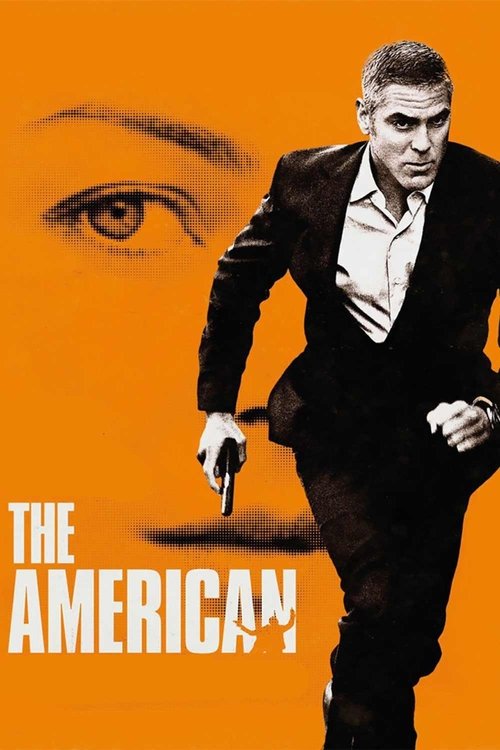
The American
2010 · Anton Corbijn
For a quiet, contemplative night when you want a thriller that simmers instead of explodes — more espresso than adrenaline. Choose it when stillness sounds like a pleasure, not a test.
What it's about
An assassin known as Jack — a craftsman who builds weapons as much as he uses them — hides out in a medieval hill town in Italy's Abruzzo mountains, waiting on orders and assembling a custom rifle for one last job. As he settles into the town's rhythms, he lets a local priest and a woman get closer than a man in his trade should allow, and the double life starts to feel dangerously like a real one.
The experience
Slow, hushed, and coiled — the tension lives in routine, silence, and the sense that any stranger in the piazza could be the end of him. It asks for patience and pays it back in atmosphere and a low, constant hum of dread.
Performances
George Clooney strips away all his usual charm and plays almost everything in silence — a wary, watchful performance built from posture, hands at work, and the rare unguarded glance.
The craft
Anton Corbijn came to film from photography and it shows: rigorously composed frames, stone streets and mountain light treated with the same care Jack gives his gunsmithing. The long wordless stretches of a man machining a weapon become the film's real set pieces. It rewards a big screen and a viewer willing to lean in.
Why it matters
Sold as a Clooney action picture, it startled mainstream audiences with an austere European-style character study — and it confirmed Corbijn as a director whose photographer's eye could carry a feature.
Snapshot
The American is Anton Corbijn's second feature, a deliberately austere thriller in which George Clooney plays Jack — also called Edward, and nicknamed "Mr. Butterfly" — a gunsmith and assassin sent to hide in the mountains of Abruzzo while he builds a custom weapon for one last job. Adapted from Martin Booth's 2004 novel A Very Private Gentleman, the film takes the architecture of the hitman-on-his-final-assignment genre and empties it of momentum, replacing chase and shootout with stillness, routine, and the texture of a medieval Italian hill town. It is a movie about a craftsman made by a director who is, by his first vocation, also a craftsman of images. Marketed by Focus Features as a Clooney action vehicle, it surprised the Labor Day audience that turned out for it — opening at number one in the United States — with its measured European art-cinema rhythm, a mismatch that produced both poor word of mouth among general audiences and a substantial body of admiring criticism. It remains the clearest statement of Corbijn's interest in solitary, watchful men and the cost of their self-enclosure.
Industry & production
The American was a relatively modest, internationally financed production released through Focus Features, the specialty arm of Universal, with Clooney's company Smokehouse Pictures among the producing entities and Clooney himself a producer as well as star. That dual role mattered: a film this unhurried and uncommercial in shape was made possible largely because a major star chose to use his leverage on a small, personal European project rather than a studio tentpole. The shoot took place on location in Italy, principally in the Abruzzo region — the hill towns of Castel del Monte and Castelvecchio Calvisio in the province of L'Aquila, and the city of Sulmona — with an additional early sequence set in wintry Sweden. The decision to shoot in real, narrow, stone-built streets rather than on sets is fundamental to the film's effect; the medieval geometry of the town becomes a character and a trap.
The packaging and reception exposed a familiar friction in specialty distribution: how to sell a contemplative art film carrying a movie star. The trailers leaned on Clooney, guns, and intrigue, promising a brisker thriller than the film delivers. The result was a notably hostile audience grade — The American received a CinemaScore in the D range, among the lowest given to a number-one opener — even as critics responded warmly. This gap between marketed and actual film is part of the work's history and is worth stating plainly rather than smoothing over.
Technology
The film was shot on 35mm photochemical film rather than digitally, a choice consistent with Corbijn's background as a photographer and with the picture's emphasis on grain, available light, and the tonal density of stone, skin, and Italian winter light. The production's "technology" is, in a sense, doubled inside the story: the plot's engine is Jack's machining of a bespoke rifle and suppressor from raw stock and scavenged parts, and the film lingers with documentary patience on lathes, files, drill presses, and the fitting of components. This procedural attention to the manufacture of a weapon is one of the picture's defining textures, and it rhymes deliberately with the precision of the filmmaking itself — both are studies of a solitary expert assembling a dangerous object to exacting tolerances.
Technique
Cinematography
The cinematography, by Martin Ruhe — Corbijn's collaborator on his debut Control — is the film's most discussed achievement. Ruhe and Corbijn favor static or slow compositions, frequently placing Clooney small within wide shots of the town's converging stone walls and stairways, so that the architecture seems to press in on him. The framing is photographic in the literal sense: balanced, frontal, attentive to line and recession, drawing on Corbijn's decades as a portrait and music photographer. The Abruzzo exteriors are rendered in cool, desaturated tones, while interiors — the café, Clara's room — carry warmer, lamplit color. Recurring high-angle and overhead views of the labyrinthine streets reinforce the sense of surveillance and entrapment, turning the picturesque town into a space of sightlines and exposure.
Editing
Andrew Hulme, who also cut Control, edits for duration and withheld information rather than for acceleration. Scenes are allowed to run on past the point a conventional thriller would cut; the rhythm is built from repetition — Jack's exercises, his coffee, his work at the bench, his walks — so that small deviations from routine carry tension. Even the violence is edited tersely and without flourish, often shockingly quick after long stretches of calm. The cutting trusts the audience to read suspense in stillness, which is precisely the contract that the film's marketing failed to prepare general viewers for.
Mise-en-scène / staging
Corbijn stages the film as a series of careful, often symmetrical tableaux. The town's stone corridors, arches, and stairs are used as framing devices and as funnels for action; characters appear at the ends of long views, watched and watching. Props are sparse and meaningful — the partially assembled rifle, a butterfly, a chrome motorcycle, a worn book. The production design keeps Jack's quarters bare and provisional, the room of a man who owns nothing he cannot leave behind. The overall visual control is severe and intentional, occasionally to the point of coldness, a quality central to both the film's admirers and its detractors.
Sound
The sound design is spare and naturalistic — footsteps on stone, the metallic work of the bench, wind, the river, church bells — with long passages nearly free of dialogue. Herbert Grönemeyer's score is used sparingly, low and tense, more atmosphere than melody, leaving silence to do much of the dramatic work. The restraint of the soundtrack is of a piece with the editing and framing: the film repeatedly chooses quiet where genre convention would supply music or noise.
Performance
Clooney gives one of his most withholding performances, stripping away the verbal charm that defines much of his star persona. Jack speaks little, watches constantly, and reveals himself chiefly through wariness — the way he positions himself in a room, checks exits, flinches at attention. It is a performance built on stillness and physical control rather than dialogue. The supporting cast plays in a similarly restrained register: Violante Placido as Clara, the prostitute with whom Jack risks intimacy; Thekla Reuten as Mathilde, the cool client for whom he builds the weapon; Paolo Bonacelli as Father Benedetto, the village priest who reads Jack's guilt; and Johan Leysen as Pavel, his shadowy handler. The ensemble's underplaying sustains the film's atmosphere of suppression and watchfulness.
Narrative & dramatic mode
The narrative is the archetype of the assassin's "last job," but told in a minor, interior key. After a Swedish prologue in which Jack kills attackers and, chillingly, the woman beside him to protect his anonymity, he is dispatched to Italy to lie low and to fabricate a rifle for Mathilde. The drama is less about plot mechanics than about a man tempted toward an ordinary life — through his deepening relationship with Clara and his conversations with the priest — while knowing his trade forbids it. Suspense is generated by ambiguity (who is hunting whom, whether Mathilde's job is in fact aimed at Jack himself) and by the slow encroachment of dread on routine. The mode is contemplative and existential, closer to the European character study than to the action thriller, with a fatalistic shape: the possibility of escape is dangled and then foreclosed.
Genre & cycle
The American belongs to the lineage of the art-house hitman film, a cycle that treats the contract killer not as an action hero but as a figure of alienation, professionalism, and metaphysical solitude. Its closest generic ancestors are Jean-Pierre Melville's portraits of laconic, ritualistic killers and the European-inflected thrillers of the 1970s. It can also be read against the grain of the post-Bourne action thriller dominant in 2010, deliberately refusing that mode's kinetics. The film's foregrounding of the gunsmith's craft connects it to a smaller tradition of procedural attention to weapons and method. Its self-awareness about genre is made explicit in a scene built around Sergio Leone's Once Upon a Time in the West, glimpsed on a screen — a direct nod to the western and to Leone's own operatic patience.
Authorship & method
Anton Corbijn came to filmmaking from photography, having spent decades shooting album covers, portraits, and music videos for artists including Joy Division, U2, and Depeche Mode. His first feature, Control (2007), a black-and-white biography of Joy Division's Ian Curtis, established his interest in withdrawn, self-destructive men and his strikingly composed, photographic image-making. The American is best understood as the work of a photographer-director: its authority lies in the frame, the light, and the held look rather than in dialogue or pace. Corbijn reassembled key Control collaborators — cinematographer Martin Ruhe, editor Andrew Hulme, and composer Herbert Grönemeyer, the German rock musician and actor whose understated score reinforces the film's austerity. The screenplay is by Rowan Joffé, who compresses and externalizes Booth's first-person, highly literary novel; the adaptation necessarily sheds much of the book's interior narration, relocating its reflective qualities into image and behavior. The collaboration is unusually coherent in sensibility — a small team applying a consistent aesthetic of restraint.
Movement / national cinema
The film sits at a crossroads of national cinemas rather than within a single tradition. It is an American-financed, English-language film with a Hollywood star, directed by a Dutch photographer-filmmaker, scored by a German musician, and shot almost entirely on Italian locations with a partly European cast. Its sensibility is consciously European — slow cinema's patience, the existential thriller's chill, the Italian landscape film's attention to place — grafted onto an American genre frame. It is not part of any organized movement, but its affinities lie with the contemplative end of 2000s European art cinema and with an older internationalist tradition of expatriate thrillers set among Mediterranean towns.
Era / period
Released in 2010, The American arrived at a moment when the action thriller was defined by rapid cutting and globe-trotting set pieces, and its refusal of that style is legible as a period statement. It also belongs to a phase of George Clooney's career in which he repeatedly used his stardom to back personal, often somber projects rather than franchise work. The film's chosen setting, by contrast, is nearly timeless: the Abruzzo hill towns are rendered with little signposting of the contemporary world, lending the story an air of suspended, almost mythic present that detaches it from any specific news-cycle moment.
Themes
The film's governing themes are isolation, surveillance, and the impossibility of escaping one's nature. Jack is a man who has made watchfulness a way of life and finds that it has hollowed him out; the central tension is whether intimacy with Clara and confession before Father Benedetto can redeem or merely endanger him. The butterfly motif — Jack's nickname, his tattoo, a creature he photographs and studies — works as the film's emblem: fragile, beautiful, briefly free, and easily crushed, an image of transformation desired and denied. Craft is itself a theme: the loving construction of an instrument of death doubles as a meditation on the self-justifying absorption of expertise. Catholic guilt and the possibility of grace run through the priest's scenes, while the recurring imagery of stone corridors and sightlines literalizes a life lived under constant exposure. Beneath all of it lies a fatalism about violence as a debt that comes due.
Reception, canon & influence
Critical reception was sharply divided but tilted toward admiration for the film's formal control; a significant body of reviewers praised Ruhe's photography, Clooney's restraint, and Corbijn's confidence, while dissenters found the picture cold, slow, and emotionally inert. The split between this critical respect and the openly negative reaction of the opening-weekend audience — reflected in the low CinemaScore — is the most cited fact of its reception and stems largely from the gap between the film's marketing and its actual character. (Precise box-office and polling figures should be verified against contemporary trade sources rather than taken from this account.)
The influences on the film are explicit and acknowledged: Jean-Pierre Melville's austere, ritualized crime films, especially the archetype of the silent professional killer; the deliberate patience and western iconography of Sergio Leone, directly invoked through Once Upon a Time in the West; and the lineage of European art cinema's alienated wanderers, with the figure of a watchful expatriate adrift in a foreign landscape recalling the existential thrillers of the 1970s. Behind all of it stands Corbijn's own photographic practice and his debut Control.
Its forward influence is more modest and harder to document with confidence. The American did not spawn a school, but it stands as a notable, much-referenced example of the "slow" or art-house hitman film, frequently cited in discussions of how to subvert the assassin thriller through stillness, and it consolidated Corbijn's standing as a feature director of serious, image-driven dramas, leading to subsequent work such as A Most Wanted Man (2014). Within the broader culture of the contract-killer film, it is remembered less as a blockbuster than as a deliberate, divisive experiment in turning a genre of motion into a study of waiting.
A Deleuzian reading
Start with the back of his neck.
The full Deleuzian reading of The American →
Reception
Sold as a George Clooney action thriller, it topped the US box office on Labor Day 2010 and promptly infuriated the audiences that bait-and-switch brought in — while critics were far kinder to its slow, European art-house rhythms. It's since been quietly reclaimed as one of Clooney's most underrated films, a favorite of the 'quiet assassin movie' faithful.
How The American was received, from release to now →
Influences: the films it descends from and the films it influenced
- Le Samouraï (1967) — The template for Clooney's near-wordless contract killer — behavioral minimalism and the ritualized solitude of the lone professional, where character is built from gesture and routine rather than dialogue.
- Le Cercle Rouge (1970) — Procedural fetishization of gun-craft and methodical preparation staged in near silence, the model for the film's long wordless sequences of a professional assembling tools and casing space.
- Once Upon a Time in the West (1968) — Literally screened within the film; supplies the Leonean patience of the held wide and the gunfighter's wait, turning stillness and duration before violence into the dramatic event itself.
- The American Friend (1977) — Highsmith-derived study of an alienated craftsman-killer adrift in foreign European cities, the watchful expatriate wandering unfamiliar streets that Corbijn relocates to the Abruzzo.
- The Conformist (1970) — Symmetrical architectural tableaux framing an assassin against European geometry — the composition of a man dwarfed and entrapped by old-town design that Ruhe echoes in the Castel del Monte alleys.
- The Passenger (1975) — Existential expatriate thriller built on long takes and a watchful, evasive protagonist, supplying the slow-cinema dread of surveillance and dissolving identity over genre incident.
- The Day of the Jackal (1973) — The procedural assassin assembling a bespoke weapon; its gunsmithing-as-suspense sequence is directly echoed in Clooney machining a suppressed rifle from parts and proofing it in the woods.
- Control (2007) — Corbijn's own debut and proving ground for the same crew (cinematographer Martin Ruhe, editor Andrew Hulme, composer Herbert Grönemeyer) and the photographer's method of building a withdrawn, self-destructive man entirely through composed image.
- Ghost Dog: The Way of the Samurai (1999) — Melville-descended contemplative hitman governed by a private code and ritual, recasting the contract-killer genre as art-house character study rather than action.
- The Driver (1978) — Minimalist nameless professional defined by craft and silence rather than backstory, an early stripping-down of the genre to terse competence and withheld interiority.
- Thief (1981) — The silent craftsman-assassin defined by ritual gun-assembly procedure and a renunciation arc — Melville-via-Thief minimalism applied to a single expert's tools.
- The Mission (1999) — Sustains a whole film on the locked-frame observation of a craftsman-killer's methodical process, extending the withheld-cut, dialogue-sparse patience The Mission made a viable action mode.
- Only God Forgives (2013) — Extends the static symmetrical tableau and near-wordless dread to an extreme, deploying held frontal compositions and a controlled palette where waiting and image carry the menace.
- A Most Wanted Man (2014) — Corbijn carries the same image-driven restraint and withholding-protagonist method directly forward into the espionage register, the feature The American's reception enabled.
- You Were Never Really Here (2017) — A traumatized, withholding contract killer rendered through elliptical terse violence and sparse, naturalistic sound design, extending the art-house subversion of the assassin thriller.
- The Killer (2023) — Methodical lone-assassin procedural of routine, fabrication, and last-job paranoia, applying cold formal control to the fetishized gun-craft and patient stakeout that The American foregrounded.
- The Limits of Control (2009) — Near-contemporaneous slow-cinema assassin film built on waiting, repetition, and abstracted minimal dialogue, draining the genre of motion in the same key as Corbijn.
- Drive (2011) — Laconic near-silent professional whose restraint is punctured by sudden terse, clipped violence — the same art-house stylization of the genre of motion-into-stillness, released a year later.
- Collateral (2004) — A minimalist neo-noir built on the ascetic, near-silent assassin-as-craftsman, extending the articulate-professional-killer genealogy with the same emphasis on procedure over plot.
- Tinker Tailor Soldier Spy (2011) — Shares the European near-silence, recessive blocking and watchful interiorized restraint, treating the operative as a still, withholding figure rather than an action hero.
Similar films
- The American Friend (1977) — influence & lineage
- A Most Wanted Man (2014) — influence & lineage
- The Passenger (1975) — influence & lineage
- Le Samouraï (1967) — influence & lineage
- No Country for Old Men (2007) — shared sensibility
- Revanche (2008) — shared sensibility
- The Mastermind (2025) — shared sensibility
- A History of Violence (2005) — shared sensibility