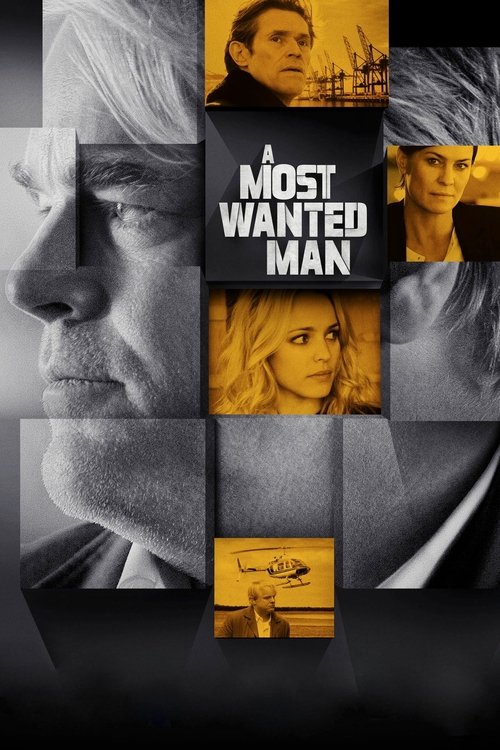
A Most Wanted Man
2014 · Anton Corbijn
For when you want an adult, intelligent thriller to sink into — one that rewards attention and leaves you brooding rather than buzzing. A rainy-night film, deliberately paced by design.
What it's about
A half-Chechen Muslim slips illegally into Hamburg to claim a tainted inheritance, and immediately lands on the watchlists of the city's competing intelligence services. A rumpled German spymaster running a small, off-the-books counterterror unit sees the young man not as a target but as bait — the thread that could unravel a bigger network — if he can keep the Americans and his own superiors from yanking it first. Adapted from John le Carré.
The experience
Slow-burn, gray-skied and quietly gripping — a spy film of surveillance vans, cigarettes and moral compromise rather than chases. It builds patiently to a finish that lands like a punch, and the unease stays with you.
Performances
Philip Seymour Hoffman, in one of his final leading roles, is devastating as the exhausted spymaster — a slumped, chain-smoking man whose intelligence and weariness register in every gesture. It's the kind of complete inhabitation that reminds you what was lost.
The craft
Corbijn, a photographer by origin, gives Hamburg a beautiful, drained melancholy — muted colors, precise frames, a city of glass and suspicion. The screenplay honors le Carré's patience: information is the action, and every conversation is a negotiation.
Why it matters
Remembered as one of Hoffman's last great performances, it stands with the best modern le Carré adaptations — proof there was still an audience for espionage as moral drama in the post-9/11 surveillance era.
Snapshot
A Most Wanted Man is Anton Corbijn's adaptation of John le Carré's 2008 novel, a post-9/11 espionage drama set among the surveillance bureaucracies of Hamburg. It follows Günther Bachmann, a weathered German intelligence officer running a small, off-the-books counter-terror unit, as he attempts to exploit the arrival of Issa Karpov — a tortured, half-Chechen Muslim who slips illegally into the city to claim a tainted inheritance — in order to entrap a respected Islamic philanthropist suspected of laundering money to extremist networks. The film is remembered, inescapably, as one of the last leading performances of Philip Seymour Hoffman, who died in February 2014 shortly after the picture premiered at Sundance. It belongs to the post-Cold War strain of le Carré adaptation in which the moral architecture of the spy genre is reoriented from East-versus-West to the murkier terrain of the war on terror, institutional vanity, and the betrayal of patient intelligence work by political expedience. Corbijn brings to it a photographer's discipline and a chilly, gray-green Northern European palette, producing a slow-burn procedural that withholds catharsis and ends on one of the more bitter notes in recent genre cinema.
Industry & production
The film was produced principally through The Ink Factory, the production company founded by Stephen and Simon Cornwell — le Carré's sons — which would become the central engine for screen adaptations of their father's work (later including the television The Night Manager and The Little Drummer Girl). A Most Wanted Man was an early, formative project for that enterprise, made in partnership with Potboiler Productions, Demarest Films, and with backing from Film4 in the UK, reflecting the customary British-led, internationally financed model of prestige literary adaptation. It was an English-language production shot on location in Hamburg, the city in which the novel is set and where, historically, members of the 9/11 plot had organized — a fact that gives the German setting its specific weight rather than treating it as generic Euro-thriller backdrop.
The picture premiered in the World Cinema Dramatic competition at the Sundance Film Festival in January 2014. In the United States it was distributed by Roadside Attractions in partnership with Lionsgate, the kind of specialty release suited to an adult-skewing, dialogue-driven thriller rather than a wide commercial rollout. The production's defining circumstance, in retrospect, was the death of Philip Seymour Hoffman on February 2, 2014, days after the Sundance screening; the film reached general audiences in mid-2014 already framed by the loss of its star, and much of its press attention and critical framing was shaped accordingly. I do not have reliable figures to cite for the budget or final box-office gross, and will not invent them; it was understood as a modestly budgeted, performance-driven release rather than a tentpole.
Technology
A Most Wanted Man is a conventionally produced digital-era feature with no notable technological innovation at the level of capture or post-production; its interest is wholly in craft rather than apparatus. The aesthetic program is one of restraint and naturalism — available-light realism, location shooting, and a controlled color grade — rather than spectacle or visual-effects work. Surveillance technology is significant within the story (wiretaps, hidden cameras, monitored phones, the apparatus of the modern intelligence state) but the film treats this material soberly and unglamorously, eschewing the kinetic screen-graphics and information-overload montage that the post-Bourne surveillance thriller often deploys. The texture is analog and human: rooms, cars, cafés, and the patient labor of watching. I have no verified specifics on the exact camera systems or lenses used and will not speculate.
Technique
Cinematography
The cinematography is by Benoît Delhomme, whose images give the film its distinctive temperature. Hamburg is rendered in a desaturated register of grays, slate blues, and institutional greens — wet streets, overcast skies, the cold light of office windows and underlit safehouses. The camera is largely composed and observational rather than restless; Corbijn and Delhomme favour stable framings, careful staging in depth, and the patient hold over the jittery handheld idiom common to the genre, which suits a story about watching and waiting. The visual scheme reinforces the film's moral climate: a world drained of warmth, where surveillance flattens human beings into figures observed through glass and across distances.
Editing
The editing is credited to Claire Simpson, an editor of considerable pedigree. The cutting strategy is deliberately measured, prioritizing legibility of process — who is watching whom, who knows what — over momentum. The film accumulates tension through duration and procedural patience rather than through accelerated cross-cutting, reserving sharper rhythmic compression for its operational sequences. The result is a controlled slow burn that asks the audience to invest in the architecture of an intelligence operation, so that the abrupt collapse of that architecture in the finale lands as a genuine rupture.
Mise-en-scène / staging
Corbijn's compositional instincts, formed over decades as a still photographer, are everywhere in the staging. Interiors are organized with painterly precision; characters are placed within frames that emphasize isolation, hierarchy, and the barriers — desks, windows, thresholds — between them. The production design favours the unglamorous bureaucratic real: nondescript offices, anonymous apartments, the back rooms where intelligence is actually conducted. The film's Hamburg is a working port city of immigrants and institutions rather than a tourist's postcard, and the mise-en-scène consistently subordinates the individual to the apparatus that surrounds and observes him.
Sound
The score is by Herbert Grönemeyer, the German musician and a longstanding Corbijn collaborator, whose contribution is restrained and atmospheric, supporting the mood of dread and melancholy without overstatement. The sound design leans toward the naturalistic ambience of the city and the hush of surveillance work — the texture of rooms, traffic, recorded voices. As with much of the film's craft, the aim is sobriety: sound serves tension and realism rather than genre excitement.
Performance
Performance is the film's center of gravity. Philip Seymour Hoffman, working in a German accent, plays Günther Bachmann as a heavy, chain-smoking, perpetually exhausted man whose cynicism is a crust over genuine conviction about how intelligence ought to be done — patiently, humanely, by cultivating sources rather than seizing them. It is a performance of weariness and banked intensity, and its final eruption is among the most discussed moments of his late career. Around him, Rachel McAdams plays the idealistic immigration lawyer Annabel Richter; Willem Dafoe the compromised private banker Tommy Brue; Robin Wright the smooth, duplicitous American intelligence officer; Grigoriy Dobrygin the haunted Issa Karpov; with strong supporting work from Nina Hoss, Daniel Brühl, and Homayoun Ershadi. The ensemble plays in a restrained, naturalistic key consistent with the film's overall sobriety.
Narrative & dramatic mode
The film operates in the procedural-tragic mode characteristic of le Carré: it is structured as the slow construction of an intelligence operation that the audience watches being built piece by piece, only to see it destroyed by forces outside the protagonist's control. The dramatic engine is not action but information and trust — the cultivation of an asset, the leveraging of one suspect to reach a larger target, the negotiation of competing agencies. Suspense derives from process and from the gap between what characters intend and what institutions permit. The mode is essentially tragic: Bachmann is a competent man undone not by his own error but by the impatience and bad faith of allies, and the narrative's deferred, downbeat climax refuses the genre's customary reassurance. Much of the storytelling is interior and conversational, trusting the viewer to follow a dense web of motives.
Genre & cycle
A Most Wanted Man sits within the espionage thriller, and more specifically within the post-9/11, post-Cold War cycle of le Carré adaptations and surveillance dramas concerned with the war on terror. It is a direct relative of Tinker Tailor Soldier Spy (2011), the Tomas Alfredson adaptation that re-established le Carré's cerebral, anti-romantic spy idiom on screen in the 2010s, and it anticipates the Ink Factory's subsequent television work. More broadly it belongs to a strain of grown-up, morally ambivalent thrillers — distinct from the action-forward franchise spy film — that prize ambiguity, institutional critique, and procedural realism. Its subject, the surveillance of Muslim communities in a European city and the ethics of entrapment, places it within the broader post-9/11 cinema of intelligence and its discontents.
Authorship & method
The film is a meeting of two strong authorial sensibilities: le Carré's as source and Corbijn's as director. Anton Corbijn came to feature filmmaking after a celebrated career as a music photographer and video director (Joy Division, U2, Depeche Mode), and his films — Control (2007), his black-and-white account of Ian Curtis; The American (2010) with George Clooney; and later Life (2015) — are marked by visual composure, melancholy, and an interest in solitary, watchful men. A Most Wanted Man extends that authorship: its restraint, its gray palette, and its emphasis on the figure isolated within the frame are continuous with his photographic eye. The screenplay is by Andrew Bovell, the Australian playwright and screenwriter, who distills le Carré's intricate novel into a film that preserves its moral architecture and its bleak conclusion. The key collaborators — cinematographer Benoît Delhomme, editor Claire Simpson, and composer Herbert Grönemeyer, the last a recurring Corbijn partner — execute a unified program of sobriety and atmosphere. Hoffman's performance functions as a third authorial pole, anchoring the film's conscience in his portrait of Bachmann.
Movement / national cinema
The film resists tidy national classification: it is an English-language, British-financed production directed by a Dutch filmmaker, adapted from an English novel, shot in Germany with a multinational cast. This is itself characteristic of contemporary prestige European-Anglo coproduction. Its most meaningful national dimension is its German setting — Hamburg as a real place with a specific post-9/11 history — which the film treats with seriousness rather than as interchangeable backdrop. Corbijn's Northern European sensibility informs the aesthetic, but the picture is best understood as part of a transnational, Anglophone tradition of literary adaptation rather than as an expression of any single national cinema.
Era / period
A Most Wanted Man is firmly a film of the 2010s, the decade in which le Carré's late novels found renewed cinematic and televisual life and in which the surveillance state became a central preoccupation of serious thriller cinema. The novel itself was published in 2008, and the adaptation arrives in a cultural moment shaped by ongoing debates over intelligence overreach, the ethics of detention and rendition, and the treatment of Muslim communities in the West. The film addresses its present directly: it is about how the institutions built after 9/11 actually behave, and about the conflict between the patient, relationship-based intelligence tradition Bachmann embodies and a newer doctrine of seizure and expedience.
Themes
The film's governing theme is the corruption of good intelligence work by impatience, vanity, and political pressure. Bachmann's credo — that you cultivate a source, you take the small fish to land the big fish, you build trust — is set against an institutional appetite for quick, demonstrable results. Closely bound to this is the theme of betrayal, not by enemies but by allies, culminating in the film's devastating reversal. The picture is also about complicity and moral compromise: the banker, the lawyer, the asset are all drawn into an operation whose ethics they cannot fully control. It engages, soberly, the post-9/11 surveillance of Muslims and the danger of mistaking suspicion for guilt; Issa Karpov is a victim refigured as a threat. Underneath runs le Carré's perennial concern with the human cost of statecraft — the way individuals are spent as means by the systems they serve — and a melancholy sense of institutional decay.
Reception, canon & influence
Critical reception was broadly favourable, with particular and near-universal praise directed at Hoffman's performance, which acquired additional poignancy as one of his final leading roles. Reviewers commended the film's intelligence, restraint, and fidelity to le Carré's pessimism, and its refusal of genre consolation; some found its deliberate pace and density demanding, a fair reflection of its procedural ambitions. Rather than cite specific figures or critics' aggregate scores from memory, which I cannot verify precisely, it is accurate to say the consensus regarded it as a thoughtful, well-crafted adult thriller elevated by its lead.
Looking backward, the film's influences are clear: the le Carré tradition above all, with its anti-glamorous, morally ambivalent vision of spycraft, freshly validated on screen by Tinker Tailor Soldier Spy (2011); Corbijn's own prior films and his photographic aesthetic; and the broader post-9/11 cinema of surveillance and the war on terror. Looking forward, its most concrete legacy is institutional: it helped establish The Ink Factory as the principal steward of le Carré adaptations, paving the way for the acclaimed television productions of The Night Manager (2016) and The Little Drummer Girl (2018) and the continued screen life of the author's work. It also stands as a significant entry in the late filmography of Philip Seymour Hoffman, and is frequently revisited in that context. Within Corbijn's career it consolidated his reputation as a director of restrained, atmospheric character studies. It is not a canonical landmark of the genre on the order of the major le Carré adaptations, but it endures as a respected, unusually sober example of the modern espionage film — and as a final showcase for one of his generation's defining actors.
A Deleuzian reading
Watch how often the film puts glass between Günther Bachmann and the thing he wants.
The full Deleuzian reading of A Most Wanted Man →
Reception
At release in 2014 it was impossible to see past Philip Seymour Hoffman's death months earlier — reviews read like eulogies. A decade on it's been quietly upgraded from 'somber swan song' to one of the best le Carré adaptations ever put on screen.
How A Most Wanted Man was received, from release to now →
Influences: the films it descends from and the films it influenced
- Tinker Tailor Soldier Spy (2011) — Established the template Corbijn extends — a hushed, mustard-and-gray le Carré aesthetic where spycraft is rendered as patient clerical labor, the camera holding on faces in static, composed-in-depth interiors rather than cutting for tension.
- The Spy Who Came in from the Cold (1965) — The originating le Carré screen grammar of anti-glamorous tradecraft and the agent as expendable functionary, whose bleak, consolation-refusing ending Bovell's screenplay structurally echoes.
- The Conversation (1974) — Surveillance dramatized through long observational takes and ambient eavesdropping sound design, centered on a solitary watchful man — the exact procedural-of-listening mode Corbijn applies to Bachmann's wiretap operation.
- All the President's Men (1976) — Pakula's bureaucratic realism — fluorescent-lit offices, composition-in-depth staging of paperwork and phone calls — that converts institutional process into suspense without action set-pieces.
- Klute (1971) — Gordon Willis's desaturated, shadow-heavy palette and the device of the protagonist framed as both watcher and watched, a paranoia aesthetic Delhomme's gray Hamburg cinematography inherits.
- Three Days of the Condor (1975) — The 1970s paranoid procedural in which the intelligence apparatus betrays its own — the 'betrayal by allies' architecture culminating in an operative undone by the agency he serves.
- The Lives of Others (2006) — A surveillance state rendered through restrained, static observation and muted color, treating the act of monitoring as a slow moral drama rather than a thriller — the European tonal register Corbijn shares.
- Munich (2005) — Post-terror espionage stripped of heroism, where intelligence work corrodes its agents morally and ends in exhaustion rather than victory — the morally-ambivalent war-on-terror frame the film descends from.
- The American (2010) — Corbijn's prior thriller of a watchful, taciturn professional, built on extended silences, restrained scoring, and figures dwarfed by architecture — the same composure-over-incident method.
- Syriana (2005) — Multi-strand post-9/11 espionage with desaturated handheld realism, depicting intelligence operatives as disposable instruments of policy betrayed by their handlers.
- Carlos (2010) — Extends the post-Carlos espionage proceduralism of cramped geopolitical interiors and surveillance logistics, with Corbijn's post-punk-rooted sensibility echoing the needle-drop ethos.
- The Night Manager (2016) — Direct institutional legacy — the Ink Factory production this film enabled, extending its sober, character-driven le Carré screen idiom and its focus on the lone operative inside intelligence bureaucracy.
- The Little Drummer Girl (2018) — The subsequent Ink Factory le Carré adaptation, continuing the precise, observational staging of recruitment and tradecraft as patient psychological process.
- Eye in the Sky (2015) — A 2010s surveillance-cinema entry dramatizing the war on terror as bureaucratic deliberation — watch-rooms, chains of command, and the ethics of monitoring Muslim suspects rendered as tense procedure.
- Control (2007) — Corbijn's own debut establishes his signature — the solitary, melancholy man isolated within a meticulously composed, near-monochrome frame, an authorial visual program carried directly into Bachmann's portraiture.
- The Constant Gardener (2005) — A contemporaneous le Carré adaptation preserving the author's moral architecture and the structure of an individual crushed by institutional malfeasance, faithful to his political pessimism.
- Bridge of Spies (2015) — A near-contemporaneous sober espionage drama built on negotiation and bureaucratic procedure over action, valuing restraint, dialogue, and moral ambiguity in the cold professional.
- Zero Dark Thirty (2012) — The defining post-9/11 surveillance procedural — slow-burn accumulation of intelligence, naturalistic ambience, and an unglamorous Muslim-world counterterror apparatus that ends without triumph.
- Black Bag (2025) — Corbijn and Philip Seymour Hoffman render Le Carré's tradecraft as exhausted bureaucratic labor; dialogue scenes are shot and cut to let information land without music cues or editorial amplification — the unadorned-dialogue-mix approach to intelligence procedure, where the weight of what is said derives entirely from the actors' controlled delivery and not from the sound mix's commentary on it.
- Relay (2025) — A patient surveillance-procedural of anonymous, evacuated urban spaces and a controlled lead performance under constraint, ending in noir reversal — a close formal sibling to Relay.
Similar films
- Tinker Tailor Soldier Spy (2011) — influence & lineage
- The American (2010) — influence & lineage
- The Lives of Others (2006) — influence & lineage
- Syriana (2005) — influence & lineage
- Bridge of Spies (2015) — influence & lineage
- Black Bag (2025) — shared sensibility
- Revanche (2008) — shared sensibility
- The Berlin File (2013) — shared sensibility