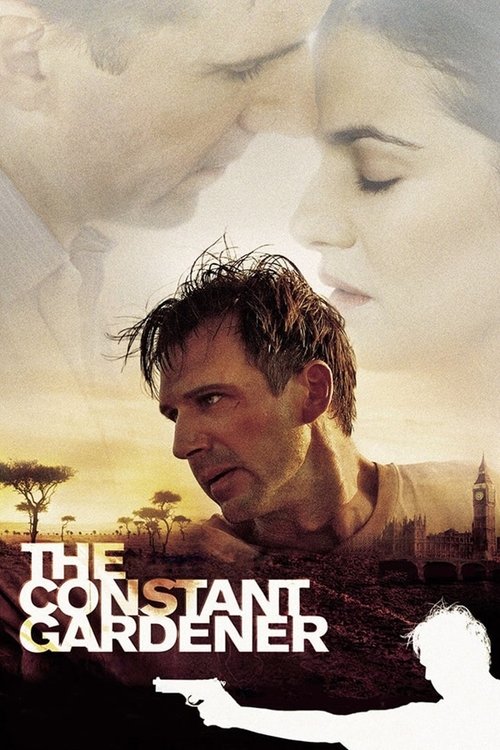
The Constant Gardener
2005 · Fernando Meirelles
For when you want a thriller with a heart and a conscience — something that grips you and then makes you cry. It asks a little patience and pays it back with real emotional weight.
What it's about
A mild, garden-tending British diplomat in Kenya loses his young activist wife — she's found murdered in remote country, and the official explanations don't hold. Retracing her work, he uncovers what she was really investigating: a pharmaceutical company testing drugs on the poor of Nairobi. The deeper he goes into the conspiracy, the more he discovers about the marriage he thought he understood.
The experience
A slow-building thriller wrapped around a love story told in reverse — mournful, urgent, and quietly furious. It's gripping, but what stays with you is the grief: a man falling fully in love with his wife only as he loses her.
Performances
Ralph Fiennes gives one of his most delicate performances, a reserved man cracked open by loss, and Rachel Weisz won the Oscar for making Tessa vivid, prickly, and alive largely in memory — the whole film runs on how much you feel her absence.
The craft
Fernando Meirelles shoots Kenya with restless handheld energy and saturated color, refusing travel-brochure prettiness, and the editing folds past and present together so the marriage and the mystery unspool as one story. Adapted from John le Carré, it keeps his moral anger intact.
Why it matters
It proved Meirelles's City of God breakthrough was no fluke and set the template for the 2000s conscience-driven global thriller, putting real pharmaceutical exploitation in front of a mass audience.
Snapshot
The Constant Gardener is an adaptation of John le Carré's 2001 novel, directed by the Brazilian filmmaker Fernando Meirelles in his first English-language feature following the international breakthrough of City of God (2002). It fuses the conspiracy thriller and the elegiac love story into a single mournful structure: a reticent British diplomat, Justin Quayle (Ralph Fiennes), reconstructs the life and death of his murdered activist wife, Tessa (Rachel Weisz), and in doing so uncovers a pharmaceutical company's lethal drug-testing program among the poor of Kenya. The film is built around a paradox of perspective — a man who learns to love his wife only after she is dead, who comes to know her by retracing the investigation that killed her. Its formal signature is grief rendered as fractured time: a present-tense pursuit constantly interrupted by flashback, so that recollection and detection become the same act. The film earned Weisz the Academy Award for Best Supporting Actress and stands as a landmark of the politically engaged literary thriller in the 2000s.
Industry & production
The project originated with the British producer Simon Channing Williams, long associated with Mike Leigh, working through his Potboiler Productions, and was financed and distributed by Focus Features, the specialty arm of Universal that had become a leading home for prestige adult drama. Le Carré's novel — published in the wake of his own reported research into the conduct of multinational pharmaceutical firms — carried a built-in controversy that made it both attractive and delicate material. The screenplay was written by Jeffrey Caine, who compressed the novel's intricate epistolary and investigative architecture into a more cinematic structure organized around Justin's retrospective discovery.
The decisive production choice was to shoot substantially on location in Kenya, including extensive work in the Kibera settlement in Nairobi and in the Loiyangalani region near Lake Turkana, rather than reconstructing Africa on a set or in a more controllable substitute country. This commitment shaped the film's texture and its ethics: the production engaged with the communities it filmed, and the filmmakers publicly acknowledged the conditions they encountered, with a charitable trust (the Constant Gardener Trust) established afterward to support communities in the areas where filming took place. The casting paired Fiennes — by 2005 an actor strongly identified with repressed, interior Englishmen — with Weisz, whose Tessa needed to register as both a political firebrand and a figure of mystery seen only in fragments. The supporting ensemble was stocked with seasoned British character players (Bill Nighy, Pete Postlethwaite, Danny Huston), lending institutional weight to the film's portrait of diplomatic and corporate complicity.
Technology
The film was shot photochemically on 35mm and finished, characteristically for mid-decade prestige production, through a digital intermediate that allowed the filmmakers to push color and contrast far beyond what conventional photochemical timing would permit. This pipeline is central to the film's look: the African exteriors are rendered in heightened, sun-bleached warmth, while the European and institutional interiors are cooled and desaturated, a deliberate chromatic opposition achieved in the grade. Meirelles and his cinematographer César Charlone favored lightweight, mobile camera bodies and long lenses that allowed them to shoot in dense, uncontrolled real environments — markets, slums, airports — with a documentary nimbleness. The technological approach was in service of immediacy rather than spectacle; the apparatus was kept small enough to move through crowds and respond to events rather than stage them.
Technique
Cinematography
Charlone, Meirelles's collaborator from City of God, gives the film a restless, handheld, often grainy image that treats the camera as a searching human eye. Frames are frequently de-centered, racked, or caught slightly off-balance; focus is sometimes allowed to drift. The color strategy is the most discussed element of the photography: Africa is saturated and golden, almost overexposed with light, while the corridors of British power are leached toward gray-green. This is not naturalism but a moral cartography rendered in light — warmth and life located precisely where the institutional world sees only a testing ground. Charlone received an Academy Award nomination for the cinematography, recognition of a style that married the energy of his Brazilian work to a more sorrowful register. The handheld grammar also serves the narrative's epistemology: because so much is seen through Justin's reconstructive memory, the imagery carries the instability of recollection rather than the authority of an omniscient camera.
Editing
Claire Simpson's editing is arguably the film's defining technical achievement. The narrative is profoundly elliptical, cross-cutting between Justin's present-day investigation and his memories of Tessa, so that past and present bleed into one another and the audience assembles the marriage and the conspiracy simultaneously. Match cuts, sound bridges, and abrupt temporal jumps keep the viewer in a state of active reconstruction that mirrors the protagonist's. The film withholds and then releases information about Tessa in fragments, and the editing controls this drip of revelation with great precision — Justin's understanding deepens at the same rate ours does. The cutting is rhythmically aggressive in the City of God manner but bent toward melancholy: the energy serves grief rather than kinetic excitement.
Mise-en-scène / staging
The staging plays controlled, ordered, hierarchical spaces — embassies, boardrooms, gardens, the diplomatic milieu of polite English restraint — against the teeming, unbounded spaces of Kibera and the Kenyan landscape. Justin's gardening, the title's literal anchor, functions as recurring visual shorthand for his temperament: a man who cultivates a small, controllable plot while remaining oblivious to the larger field. The film stages crowds and real environments with a vérité density, refusing to sanitize or exoticize, and it repeatedly frames Justin as a small figure dwarfed by landscapes and crowds he does not comprehend. Interiors of power are staged with cool formality, emphasizing the smooth, deniable surfaces of complicity.
Sound
Alberto Iglesias's score is built heavily on African vocal and percussive textures woven into a Western orchestral fabric, giving the film a sound that is mournful, propulsive, and rooted in place rather than generically "world-music" decorative. The score carries much of the film's emotional throughline of loss. The sound design layers dense location ambience — the noise of markets, streets, and crowds — to sustain the documentary immersion, contrasted with the muffled hush of diplomatic interiors.
Performance
Fiennes gives a study in repression and gradual awakening: Justin begins as a man of almost pathological politeness and emotional containment, and his performance traces the slow conversion of grief into resolve without ever abandoning the character's fundamental reticence. It is acting built on stillness and small registrations. Weisz's Tessa, by structural necessity, exists largely in fragments and flashback — she is a presence reconstructed rather than continuously inhabited — and Weisz makes her vivid, contradictory, and morally urgent in limited screen time, which is precisely what won her the Best Supporting Actress Oscar. The supporting performances — Nighy's silken bureaucrat, Huston's compromised colleague, Postlethwaite's haunted doctor — fill out a world of graded culpability.
Narrative & dramatic mode
The film's dramatic mode is the investigation-as-mourning: a thriller plot whose true subject is intimacy recovered too late. Structurally it is a flashback mystery, opening near Tessa's death and then moving simultaneously forward (Justin's pursuit of the truth) and backward (the reconstruction of their marriage). This double motion makes detection and grief inseparable — each clue Justin uncovers is also a discovery about who his wife was and how little he knew her. The mode is melodramatic in the precise, non-pejorative sense: it stakes everything on the belated legibility of love. Le Carré's characteristic skepticism toward institutions supplies the political spine, but the adaptation foregrounds the romance, so that the conspiracy functions as the dark medium through which a private relationship is finally understood. The result is a thriller largely emptied of action-genre catharsis; its climax is comprehension and acceptance rather than triumph.
Genre & cycle
The Constant Gardener sits at the intersection of the le Carré adaptation tradition and a mid-2000s cycle of globally conscious "issue" thrillers — films that used genre architecture to dramatize transnational systems of harm (corporate, geopolitical, ecological). It shares territory with the multi-strand globalization dramas and conscience-driven thrillers of its moment, films attentive to the asymmetries between the wealthy North and the exploited South. Within le Carré's own screen history — long defined by Cold War espionage — it marks the author's pivot to post–Cold War targets: multinational capital and the pharmaceutical industry rather than intelligence agencies. As genre, it deliberately frustrates the thriller's promise of decisive resolution, aligning it with a more pessimistic, art-house inflection of the form.
Authorship & method
The film is best understood as a collaboration between le Carré's source sensibility and Meirelles's restless visual method. Meirelles imported from City of God a kinetic, handheld, documentary-inflected style and a willingness to shoot in real, difficult locations — but he redirected that energy from youthful violence toward adult grief, proving the approach was a flexible authorial instrument rather than a one-subject gimmick. His key collaborators are central to any account of the film's authorship: cinematographer César Charlone, whose photographic style is inseparable from Meirelles's; editor Claire Simpson, whose fragmenting structure gives the film its form; composer Alberto Iglesias, whose score supplies its emotional register; and screenwriter Jeffrey Caine, who solved the structural problem of compressing le Carré's novel into a cinematic memory-architecture. Le Carré himself remained an authorial presence through the source material's politics and its acknowledged grounding in real concerns about pharmaceutical conduct in the developing world; the film's end material made clear that, while fictional, it was responding to documented realities — a claim the production was careful to frame as moral rather than literal reportage.
Movement / national cinema
The film is a transnational object that resists single-nation classification. It is a British production with British source material, stars, and milieu, yet its directorial sensibility is Brazilian, its cinematographer Uruguayan, its composer Spanish, and much of its substance Kenyan. It belongs to the broader story of the international circulation of the Latin American "new wave" of the early 2000s — the cohort that brought Meirelles, Alejandro González Iñárritu, Alfonso Cuarón, and Walter Salles to Anglophone production — in which directors trained in vérité, mobile-camera aesthetics were absorbed into prestige English-language cinema and reshaped it. As such it sits less within any one national cinema than at the confluence of British literary filmmaking and the globalized auteur economy of the period.
Era / period
Released in 2005, the film is a document of mid-2000s anxieties: globalization's human costs, corporate impunity, and Western complicity in the suffering of the Global South. It arrived amid intensified public attention to Africa's health crises and to the ethics of how multinational industries operate beyond the reach of accountability. Technologically it belongs to the digital-intermediate era, when color grading became a primary expressive tool, and aesthetically to the moment when documentary-handheld grammar had migrated fully into mainstream narrative film. It also belongs to the era's specialty-distribution ecosystem, in which companies like Focus Features built award-season careers around literate, adult, internationally minded drama.
Themes
The film's central theme is the belated legibility of intimacy — the idea that we may come to know those closest to us only through loss. Around this private core it organizes a set of public concerns: the predation of multinational corporations upon the powerless; the ethics of medical experimentation on populations who cannot consent meaningfully; the quiet machinery of diplomatic and governmental complicity, in which decent men enable atrocity through deniability and inertia. The garden motif threads these together — cultivation versus wildness, the small tended plot versus the vast neglected field — figuring Justin's growth from a man who manages a private order to one who confronts a systemic disorder. Other recurring strands include activism and its costs, the asymmetry between Northern comfort and Southern suffering, and the moral transformation of the passive bystander into a witness who will not look away.
Reception, canon & influence
The film was widely and seriously reviewed on release, with particular praise for Charlone's cinematography, Simpson's editing, and the central performances, and with its political content drawing both admiration for its conscience and the predictable debate over whether a thriller can responsibly dramatize real-world harm. Its most concrete institutional recognition was Rachel Weisz's Academy Award for Best Supporting Actress; the film also drew Oscar nominations including for César Charlone's cinematography, Claire Simpson's editing, and Jeffrey Caine's adapted screenplay, marking it as a strong awards-season presence rather than a niche release. (Readers should treat any specific box-office figures with caution; the film's commercial performance, while solid for a specialty title, is not something I will quantify here without the record in front of me.)
Looking backward, the film draws on several lineages: le Carré's own decades of institutional skepticism; the British tradition of literary adaptation and restrained character drama; and, most visibly, Meirelles's and Charlone's City of God, whose stylistic vocabulary it transplants into new emotional and geographic territory. It also inherits the broader heritage of the conspiracy thriller's interest in the lone individual against an opaque system.
Looking forward, its influence is twofold. Within le Carré's screen afterlife, it helped establish that his post–Cold War novels could be adapted into commercially viable, critically respected cinema, contributing to the sustained appetite for le Carré adaptations in the following decades. Stylistically, it stands as a proof of concept for the absorption of Latin American vérité aesthetics into the politically engaged Anglophone prestige thriller, reinforcing a mode in which globalized injustice is dramatized through fractured, immersive, documentary-inflected form. Within Meirelles's own career it confirmed his viability as an international director working across languages and subjects. The film endures in the canon as one of the most accomplished literary thrillers of its decade and as a touchstone for how political content and personal grief can be fused into a single, formally adventurous structure.
A Deleuzian reading
A man kneels in a flowerbed, hands in the soil.
The full Deleuzian reading of The Constant Gardener →
Reception
A critical hit on release — four Oscar nominations and a win for Rachel Weisz — it has since slid into 'quietly underrated' territory, regularly invoked as Exhibit A of the smart mid-budget adult drama Hollywood stopped making after the 2000s.
How The Constant Gardener was received, from release to now →
Influences: the films it descends from and the films it influenced
- City of God (2002) — Direct parent — Meirelles and Charlone transplant its kinetic handheld camera, bleach-and-saturation color opposition, and on-location vérité grammar wholesale, redirecting youthful-violence energy into adult grief.
- The Insider (1999) — Extends the corporate-whistleblower thriller with long-lens handheld immersion and a double-helix narrative weaving an intimate tragedy through an institutional exposé.
- The Spy Who Came in from the Cold (1965) — Founding template for le Carré on screen — institutional disillusionment dramatized through a worn individual ground down by an opaque system rather than action heroics.
- The Conversation (1974) — Ancestor in the conspiracy-thriller mode where investigation curdles into paranoid mourning and the lone seeker is wounded by what he uncovers about an unseen power.
- Don't Look Now (1973) — Ancestor of the grief-structured edit — fragmented, premonitory cross-cutting where the dead wife saturates the present tense and mystery becomes a form of bereavement.
- Z (1969) — Progenitor of the conscience thriller built on real political atrocity, using investigative momentum and documentary urgency to indict institutional complicity.
- Hiroshima mon amour (1959) — Ancestor of the memory-architecture editing — involuntary flashbacks of the lost beloved intruding on the present as the film's organizing temporal logic.
- Traffic (2000) — Sibling in color-coded geographic storytelling, using distinct grades and handheld textures to separate first-world and developing-world strands of a single transnational injustice.
- Babel (2006) — Sibling in the globalized-injustice mode — fractured cross-cut narrative and immersive on-location vérité linking privileged Westerners to consequences in the Global South.
- Syriana (2005) — Sibling conscience thriller of the same moment, dramatizing opaque corporate-state collusion through deliberately disorienting, elliptical multi-strand construction.
- Blood Diamond (2006) — Descendant applying the Anglophone-prestige-thriller-shot-in-Africa template, fusing star repression with location atrocity in the issue-driven mode Gardener proved viable.
- The Constant Gardener score lineage — Talk to Her (2002) — Sibling through composer Alberto Iglesias, whose mournful, string-and-guitar emotional register supplies the same elegiac interiority he brings to Meirelles's film.
- Tinker Tailor Soldier Spy (2011) — Descendant proving Gardener's thesis that le Carré's institutional cinema is commercially viable, extending its fragmented-flashback investigation and repressed-protagonist craft.
- A Most Wanted Man (2014) — Descendant in the post–Cold War le Carré screen wave Gardener inaugurated, sustaining the anti-cathartic thriller where the conscientious individual is defeated by the system.
Similar films
- Syriana (2005) — influence & lineage
- Tinker Tailor Soldier Spy (2011) — influence & lineage
- Z (1969) — influence & lineage
- City of God (2002) — influence & lineage
- Babel (2006) — influence & lineage
- Black Bag (2025) — same viewing thread
- Hotel Rwanda (2004) — shared sensibility
- Conclave (2024) — shared sensibility
All the films related to The Constant Gardener →
Watch it with: curated runs of related films
- Elegant Betrayals — Watch these back-to-back for couples and beautiful people whose polished surfaces — a London flat, a Riviera villa, a spies' dinner party — hide a betrayal, a surveillance, and a body, each turning intimacy into a crime scene.