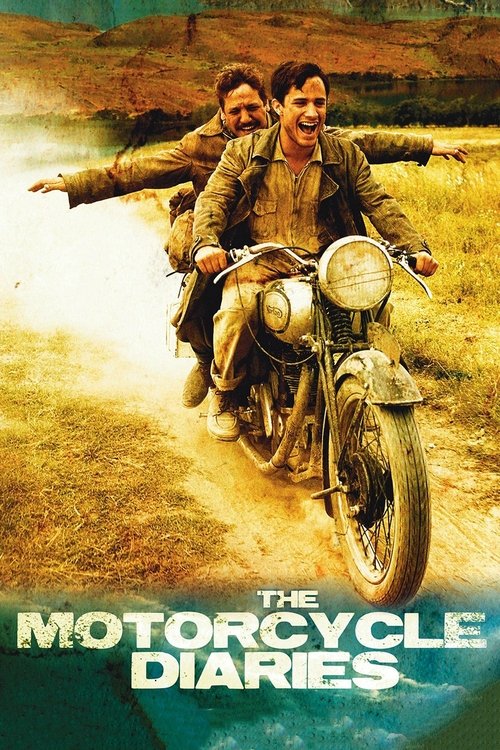
The Motorcycle Diaries
2004 · Walter Salles
I'm Still Here became a Brazilian national catharsis about the dictatorship, won Brazil's first Oscar, and turned Fernanda Torres' campaign into a nationwide event — the biggest Latin American reception story since Roma.
For when you're restless — when you want a film that scratches the travel itch and also leaves you thinking about who you're becoming. Gentle enough for a relaxed evening, substantial enough to stay with you.
What it's about
In 1952, a twenty-three-year-old Argentine medical student and his biochemist friend set out to cross South America on a wheezing old Norton motorcycle — eight thousand kilometers through Argentina, Chile, and Peru. What begins as a lark between two young men becomes something else as the road shows them the continent's poverty and dispossession; the student is Ernesto Guevara, years before the world knew him as Che, and the film watches the person before the icon.
The experience
Warm, funny, and wind-in-your-hair loose in its first stretch, then gradually deeper and quieter as the journey changes the travelers. It's a film about becoming someone, and it lets that happen at the unhurried pace of the road itself.
Performances
Gael García Bernal gives young Ernesto a magnetic mix of charm, stubbornness, and dawning gravity, while Rodrigo de la Serna is irresistible as Alberto, the roguish best friend who keeps the trip — and the film — honest and alive.
The craft
Walter Salles shot largely on location along the real route, and it shows: the Andes, the Atacama, and the Amazon are photographed with a traveler's awe rather than a postcard's gloss. Gustavo Santaolalla's guitar-driven score became instantly iconic, and the episodic structure mirrors the rhythm of a real journey.
Why it matters
An international arthouse hit that won major awards for its music, confirmed Salles as the modern master of the road movie, and pushed Latin American cinema further onto the global stage.
Snapshot
The Motorcycle Diaries (Diarios de motocicleta) is Walter Salles's transnational road movie reconstructing the 1952 journey of two young Argentines — twenty-three-year-old medical student Ernesto Guevara and his older biochemist friend Alberto Granado — across some eight thousand kilometers of South America aboard a sputtering 1939 Norton 500 nicknamed "La Poderosa" ("The Mighty One"). Adapted from Guevara's posthumously published travel journals and Granado's companion memoir, the film deliberately arrests its subject before he becomes "Che": it is an origin story that withholds the icon, tracing instead the slow moral awakening of an asthmatic bourgeois youth into a man radicalized by the poverty, dispossession, and dignity he encounters on the continent's roads. Shot largely on location and in sequence following the actual itinerary, it stands as one of the most internationally successful Latin American films of its decade, winning the Academy Award and BAFTA for Best Original Song ("Al Otro Lado del Río" by Jorge Drexler) and cementing Gael García Bernal's ascent as the face of a resurgent Latin American cinema.
Industry & production
The film exemplifies the polycentric, coproduction-driven model that defined ambitious Latin American filmmaking in the early 2000s. It was assembled from an international patchwork of financing spanning Argentina, the United States, Chile, Peru, Brazil, the United Kingdom, Germany, and France. Robert Redford was a driving force behind the project as producer through his South Fork Pictures, having long been interested in the material; the Sundance apparatus lent both prestige and access. Michael Nozik and Edward Saxon produced, with British broadcaster FilmFour among the financing partners, and Focus Features — the specialty arm of Universal that had become the premier distributor of prestige foreign-language and independent work — handled North American release. Distribution abroad ran through the international specialty circuit that had been enlarged by the crossover successes of Amores perros (2000) and Y tu mamá también (2001).
Production was logistically arduous by design. Rather than shoot on soundstages or fake the geography, Salles's team followed the Guevara–Granado route itself, moving through Argentina, Chile (including the Atacama and the Chuquicamata mining region), Peru (Cusco, Machu Picchu, and the Amazonian leprosarium region near the Peruvian Amazon), and points north, filming across radically varied altitudes, climates, and infrastructures. The San Pablo leper colony sequences, shot on the Amazon, involved real communities and lent the final act its documentary weight. The multinational cast and crew, extended shoot, and physical demands of location work made the film a coproduction in the fullest sense — its very production method mirrored the border-crossing, pan–Latin American consciousness that is the film's theme.
Technology
Technologically the film is conservative by intent, favoring photochemical capture and available-light naturalism over the digital tools then entering the industry. It was shot on 35mm film, and its aesthetic program depends on the grain, latitude, and organic color response of celluloid to register landscape and weathered faces. Salles and cinematographer Éric Gautier embraced lightweight, mobile equipment appropriate to genuine location shooting across difficult terrain — a working method closer to documentary field production than to controlled studio cinematography. The film also incorporates still photography as a motif and a device: Guevara and Granado carry a camera on their journey, and the picture closes with a montage of black-and-white portrait stills of the people encountered along the way, a gesture that fuses the film's fictional apparatus with the documentary impulse and foregrounds the act of looking that the title itself invokes.
Technique
Cinematography
Éric Gautier's photography is the film's signal achievement and its principal argument. A French cinematographer with a background in the naturalist wing of European auteur cinema, Gautier renders the continent as both sublime and social — the Andean altiplano, the salt flats, the Chuquicamata open-pit mine, and the Amazon are photographed with a grandeur that never becomes mere postcard because the human figures are always kept in scale against them. He works extensively with natural light and handheld camera, allowing the frame to breathe and wander; the roving, observational quality binds the fiction to the tradition of ethnographic and documentary looking. Crucially, Gautier modulates register between the picaresque comedy of the early road sequences — sunlit, buoyant, kinetic — and the graver, cooler, more still compositions of the mining and leprosarium passages, so that the visual grammar itself charts Ernesto's deepening seriousness.
Editing
The film was cut by Daniel Rezende, the Brazilian editor who had come to international attention for his propulsive work on City of God (2002). Here he works in a markedly different key, restraining the kinetic maximalism of that film in favor of a patient, accretive rhythm suited to a journey narrative. The picaresque structure — a chain of episodic encounters — is held together by the recurring motif of the road and by Rezende's careful pacing of comic setpieces against the escalating gravity of the later episodes. The interpolation of the still-photograph portraits, especially in the closing sequence, is an editorial decision of real force, converting the accumulated fiction into a memorial document.
Mise-en-scène / staging
Salles's staging privileges authenticity of place and a semi-improvisatory relationship between actors and environment. Non-professional and local performers populate many scenes, and the encounters — with a displaced Communist mining couple in the Atacama, with Indigenous campesinos, with the patients and staff of the San Pablo leprosarium — are staged to feel found rather than composed. Period detail (the Norton, the worn clothing, the makeshift repairs) is handled with restraint, avoiding fetishistic nostalgia. The recurring image of two men on a failing machine, forever pushing and mending it, functions as sustained visual metaphor without being underlined.
Sound
Sound design leans toward naturalism — engine noise, weather, the ambient life of markets, mines, and river settlements. The score by Gustavo Santaolalla is spare and modal, built around guitar and folk-inflected instrumentation that evokes the Andean and pan–Latin American soundscape without descending into ethnographic pastiche; his restraint leaves silence and landscape room to speak. The film's most decorated element is Jorge Drexler's end-credits song "Al Otro Lado del Río," a quiet, intimate composition that won the Academy Award for Best Original Song — the first in Spanish to do so.
Performance
Gael García Bernal's performance is a study in interiority and withholding. He plays Ernesto not as a firebrand but as a reticent, honest, physically fragile young man — the asthma is a constant, humanizing vulnerability — whose radicalization registers in watchfulness rather than rhetoric. The film's ethical seriousness depends on his refusal to telegraph the legend to come. Rodrigo de la Serna, as Alberto Granado, supplies the complementary energy: gregarious, appetitive, opportunistic, and warm, he is the picaresque engine that makes the film's comedy work and throws Ernesto's gathering gravity into relief. The chemistry between the two anchors the picture.
Narrative & dramatic mode
The film operates in the mode of the Bildungsroman fused with the road movie: an episodic, forward-moving structure in which the protagonist is transformed by a sequence of encounters rather than by a single plotted conflict. There is no antagonist and little conventional dramatic causality; the engine is geographic and moral progression. Salles resists biopic teleology — the temptation to read every scene as prophecy of the revolutionary to come. Instead the dramatic arc is one of dawning conscience, punctuated by a few charged setpieces: the night conversation with the persecuted mining couple, the injustice witnessed at Chuquicamata, and the climactic gesture at San Pablo, where Ernesto swims across the river separating the medical staff from the patients — a literal crossing that crystallizes the film's theme of solidarity across imposed divisions. The film's discretion about Guevara's later career is itself a dramatic choice, one that has provoked both admiration and critique.
Genre & cycle
The Motorcycle Diaries sits at the intersection of the road movie, the biographical film, and the coming-of-age drama, and it belongs to two overlapping cycles. Internationally, it is part of the road-movie tradition — the journey as engine of self-discovery — inflected with a specifically Latin American political geography. Within Salles's own body of work it extends the concern with journeys, displacement, and the road that runs through Central Station (1998). More broadly it arrives within the early-2000s wave of Latin American cinema that achieved unprecedented global crossover, sharing personnel and prestige with the Mexican nuevo cine of Cuarón, Iñárritu, and del Toro and with Brazil's City of God — a cohort that revitalized the continent's international standing.
Authorship & method
Walter Salles, a Brazilian director shaped by documentary practice and by the legacy of Cinema Novo, brings to the material a method grounded in location, chronology, and encounter. His decision to shoot along the actual route and, reportedly, in an order tracking the journey, reflects a belief that the landscape and its people should act upon the fiction — that authenticity of place produces authenticity of feeling. His key collaborators are integral to the achievement: cinematographer Éric Gautier, whose mobile, light-sensitive photography realizes the continent as social space; screenwriter José Rivera, the Puerto Rican–American playwright who distilled Guevara's journals and Granado's memoir into a spare, episodic script (work that earned an Academy Award nomination for Adapted Screenplay); editor Daniel Rezende, who gives the picaresque its rhythm; and composer Gustavo Santaolalla, whose restrained folk-modal score, alongside Jorge Drexler's song, provides the film's aural identity. The producing hand of Robert Redford connected the project to Sundance-world resources without imposing a Hollywood idiom.
Movement / national cinema
The film is best understood as a transnational Latin American work rather than the product of a single national cinema. It is emphatically pan-continental in subject — the journey is precisely an argument for a shared Latin American identity beneath national borders — and pan-continental in production. Salles's roots in Brazilian cinema, and the participation of Argentine actors and a France-based cinematographer, make it a genuinely border-crossing enterprise. It belongs to the broader early-2000s renaissance of Latin American cinema on the world stage, and it self-consciously inherits the political and humanist commitments of earlier continental movements — Cinema Novo and the New Latin American Cinema of the 1960s and 1970s — while adopting an accessible, internationally legible form.
Era / period
Set in 1952, the film reconstructs a South America of extreme inequality, extractive industry, displaced labor, and Indigenous dispossession on the eve of the political upheavals of the coming decades. It is precise about the period's textures — the machinery, the mining economy, the leprosaria — without lapsing into sealed nostalgia; the past is presented as continuous with present injustices. Produced and released in 2004, the film also speaks to its own moment: a period of renewed Latin American assertion, both cinematic and political, in which the recovery of a shared continental history carried contemporary resonance. The film's discretion — its portrait of Guevara before the ideology and the violence — allowed it to circulate across a wide political spectrum.
Themes
The governing theme is the awakening of social conscience through direct encounter with injustice — the transformation of abstract privilege into embodied solidarity. Bound to it are the ideas of pan–Latin American identity (the vision of "one mestizo continent" transcending national borders), the dignity of the poor and the dispossessed, and the ethics of the medical vocation, figured through leprosy and healing as metaphors for the barriers societies erect between people. The recurring image of crossing — rivers, mountain passes, borders, the divide at San Pablo — carries the film's moral argument. Mobility, friendship, youth, and the porous line between the personal and the political complete the constellation. The film's deliberate silence about the revolutionary and the executioner Guevara would become is itself a thematic statement, insisting on the innocence and openness of the seeing eye.
Reception, canon & influence
The film was widely acclaimed on the international festival and specialty circuit and became one of the most commercially and critically successful Latin American films of its era, praised for Gautier's cinematography, Bernal's restraint, and Salles's humane, unpolemical touch. Its principal honors include the Academy Award for Best Original Song and an Academy Award nomination for Adapted Screenplay, along with the BAFTA for Best Film Not in the English Language; it accumulated numerous other festival and critics' prizes. Some critics, however, faulted precisely its discretion — arguing that romanticizing the young Ernesto while eliding the later revolutionary violence amounts to a sentimental evasion — and that debate remains part of the film's critical afterlife.
Its influences run backward to the road-movie and coming-of-age traditions, to the humanist documentary impulse, and to the political-cinema legacy of Cinema Novo and New Latin American Cinema, as well as to Salles's own Central Station. The source texts — Guevara's The Motorcycle Diaries and Granado's Traveling with Che Guevara — are its direct wellspring. Forward, the film helped consolidate the international market for Latin American cinema, further elevated Gael García Bernal's global career, and stands as a touchstone example of the biographical road movie that eschews iconographic hagiography in favor of formation and encounter. It endures as both a beloved work of popular art-house cinema and a case study in the ethics of representing a historical figure whose later meaning the film consciously chooses not to depict.
Reception
A Cannes 2004 crowd-pleaser that rode a wave of festival goodwill to an Oscar and arthouse-crossover success; two decades on it's settled in as the definitive wanderlust movie — less debated, more rewatched.
How The Motorcycle Diaries was received, from release to now →
How to watch The Motorcycle Diaries: what to notice on a first viewing
- Watch how small the two riders stay against the landscape. Gautier photographs the altiplano, the salt flats, and the open-pit mine with real grandeur while keeping the human figures in scale. People stay inside the view rather than posing in front of it. The continent registers as a place where people live instead of scenery to be ridden through.
- Watch the light cool down once they reach the mines. The early road scenes are sunlit, buoyant, and kinetic. The Chuquicamata and leprosarium passages are cooler, stiller, and more composed. No line of dialogue marks the change. The visual grammar charts Ernesto's deepening seriousness before he ever says anything about it.
- Watch how often the two of them are pushing the bike. La Poderosa is a 1939 Norton that keeps failing. They mend it, push it, and beg parts for it. The period detail stays worn rather than polished into nostalgia. Two men repairing a dying machine runs under the whole trip without anybody pointing at it.
- Watch how little Ernesto says while someone is telling him something. Bernal plays watchfulness rather than rhetoric, with the asthma as a constant physical vulnerability. He never telegraphs the figure this young man is going to become. The change happens in listening, so track where his attention goes rather than what he declares.
- Watch the encounters with locals and how unrehearsed they look. Salles shot along the real route and filled many scenes with non-professional and local performers. The meetings with a displaced mining couple and with campesinos are staged to feel found. A documentary texture keeps running inside the fiction, and that is where the film's ethics sit.
The whole guide to watching The Motorcycle Diaries, with the keys for a rewatch →
Influences: the films it descends from and the films it influenced
- Bicycle Thieves (1948) — Establishes the neorealist protocol Salles adopts — real locations, nonprofessional local faces, and available natural light making everyday poverty legible as social fact.
- Black God, White Devil (1964) — Cinema Novo's foundational move of shooting the punishing sertão landscape as a political and social field the wanderers physically traverse, which Diaries transposes to the Andes and Amazon.
- The 400 Blows (1959) — Coming-of-age built on a withholding, watchful young performance and an anti-teleological ending that arrests the protagonist mid-formation rather than resolving his fate.
- La Jetée (1962) — Narrative constructed from still photographs — the direct ancestor of the closing black-and-white portrait montage of the real people encountered on the road.
- Easy Rider (1969) — Codifies the motorcycle road movie as generational self-discovery, cutting landscape-in-motion montages against a music track that carries the emotional argument.
- Aguirre, the Wrath of God (1972) — The ethic of dragging a fiction onto the real, punishing South American route so the physical hardship of the location acts directly upon the performances.
- Days of Heaven (1978) — Magic-hour, natural-light photochemical landscape shooting that renders environment as an expressive register, a template Gautier's light-sensitive camera answers.
- Those Who Love Me Can Take the Train (1998) — Éric Gautier's restless, grainy handheld 35mm mobility developed here — the exact roving, light-chasing camera method he carries into Diaries.
- Central Station (1998) — Salles's own prior template: a journey across the national landscape anchored by a nonprofessional local child and a documentary-inflected humanism.
- Y Tu Mamá También (2001) — Contemporaneous Latin American road movie starring the same Gael García Bernal, using digressive asides to make the traversed landscape legible as class and political space.
- Foreign Land (1996) — The mature form of Foreign Land's engine: a border-crossing road journey of self-discovery shot on real locations with documentary attentiveness, landscape steadily transforming the traveler.
- Into the Wild (2007) — Biographical journey shot along the actual real-world route in natural light, treating travel as self-formation and refusing iconographic hagiography — plus a Santaolalla-adjacent folk score.
- On the Road (2012) — Salles reprising his own method on a canonical road text — chronological picaresque shooting along the real itinerary with Gautier's mobile camera.
- Wild (2014) — Solo journey-as-bildungsroman using natural-light handheld travel intercut with fragmentary memory, extending the road film's accretive, episodic pacing.
- Zindagi Na Milegi Dobara (2011) — Shoots a continental journey through real locations so that the itinerary is inseparable from inner transformation — travelogue-as-character-arc, which ZNMD applies to its Spanish route.
- The Son of a Thousand Men (2025) — As editor, Rezende learned to shape an episodic, elliptical journey out of loosely connected encounters, letting performance and rhythm rather than plot mechanics carry the emotional throughline.
- Amores Perros (2000) — Establishes Gustavo Santaolalla's spare folk-modal ronroco-and-guitar scoring as a Latin American sonic signature that Diaries subsequently adopts.
- Machuca (2004) — New Latin American Cinema coming-of-age in which a privileged youth's awakening social conscience is dramatized through encounter rather than polemic.
- Brokeback Mountain (2005) — Deploys Santaolalla's minimal folk-modal guitar over wide natural-light landscape in the same restrained, non-illustrative scoring method.
- The Constant Gardener (2005) — Sibling in Latin-American-vérité aesthetics applied to socially conscious Anglophone-adjacent prestige cinema, using handheld location naturalism to register injustice across the continent.
Similar films
- Y Tu Mamá También (2001) — influence & lineage
- Central Station (1998) — influence & lineage
- Amores Perros (2000) — influence & lineage
- Into the Wild (2007) — influence & lineage
- Black God, White Devil (1964) — influence & lineage
- Brokeback Mountain (2005) — influence & lineage
- Foreign Land (1996) — shared sensibility
- Güeros (2014) — shared sensibility