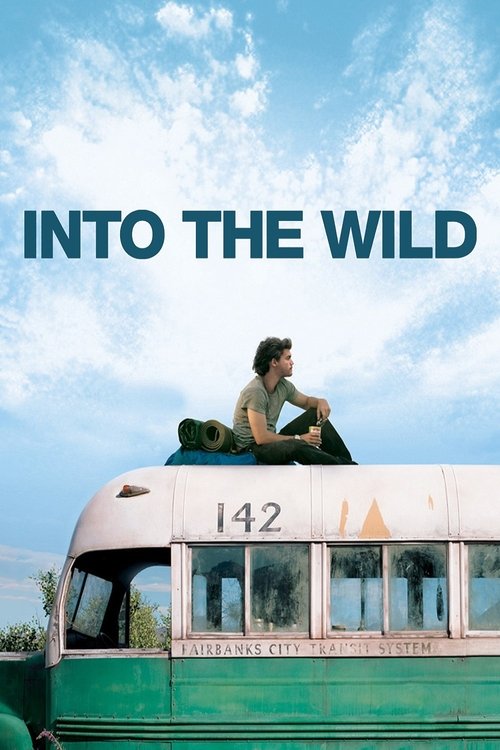
Into the Wild
2007 · Sean Penn
When you want a film to chew on for days — something about freedom, family, and what we owe each other. Not comfort viewing: it's beautiful, but it's headed somewhere heavy, and it earns its tears.
What it's about
The true story of Christopher McCandless, a gifted college graduate who, in 1992, gave his $24,000 savings to charity, cut off his family without a word, and vanished into the American West under the name Alexander Supertramp. The film follows his two years of drifting — river towns, harvest fields, strangers who become makeshift family — on the way to his ultimate goal: living alone off the land in the Alaskan wilderness.
The experience
Rapturous and sorrowful in equal measure — a road movie that keeps opening into huge landscapes while a sense of foreboding gathers underneath. It's long and meditative, and it stays with you; expect to argue afterward about whether he was a seeker or a fool.
Performances
Emile Hirsch is ferociously committed, visibly transforming as the journey wears on, and Hal Holbrook's brief turn as a lonely widower — which earned him an Oscar nomination — delivers the film's most quietly devastating scenes.
The craft
Sean Penn structures it as a mosaic, cross-cutting the Alaskan chapters with the road that led there, and shoots the West with a sweep that begs for a big screen. Eddie Vedder's song cycle isn't background music — it functions as the film's inner voice.
Why it matters
One of the most visible American independent films of 2007, it turned McCandless's story into a lasting cultural argument about wilderness, privilege, and escape — and made the Alaskan bus itself a pilgrimage site.
Snapshot
Into the Wild is Sean Penn's adaptation of Jon Krakauer's 1996 nonfiction bestseller reconstructing the last two years in the life of Christopher McCandless, a well-off Virginia graduate who erased his identity, adopted the name "Alexander Supertramp," and drifted across the American West before starving to death in an abandoned bus on Alaska's Stampede Trail in the summer of 1992. Penn's fourth feature as director, it is at once a road movie, a wilderness survival narrative, and an essay film on renunciation, structured as a non-linear meditation that cross-cuts McCandless's fatal Alaskan idyll with the vagabond odyssey that led him there. The film became one of the most visible American independent releases of 2007, earning Hal Holbrook an Academy Award nomination and generating an Eddie Vedder song cycle that outlived the picture in the wider culture. It endures as a touchstone for debates about self-reliance, transcendentalist idealism, and the thin line between spiritual quest and self-destruction.
Industry & production
The project's defining fact is its long gestation. Penn read Krakauer's book shortly after its 1996 publication and pursued the film rights for roughly a decade, reportedly held back by the reluctance of McCandless's family — particularly his mother, Billie, and father, Walt — to sanction a dramatization of their son's death. Only after the family gave its blessing did the production move forward, and Penn wrote the screenplay himself, drawing on Krakauer's reconstruction (which itself grew out of a 1993 Outside magazine article) and on McCandless's own annotated books, journals, and photographs.
The film was produced through Penn's company alongside partners including River Road Entertainment (Bill Pohlad) and Art Linson, and distributed by Paramount Vantage, the specialty division that was then also behind pictures such as There Will Be Blood and No Country for Old Men. It was made as a mid-budget independent — reported figures cluster around the mid-teens of millions of dollars, though I would treat any single number as approximate rather than authoritative. The shoot was unusually itinerant: Penn moved the production across numerous states to follow McCandless's real route, filming in Alaska, the American Southwest, the Pacific Northwest, California, South Dakota, and elsewhere, and staging the Alaskan sequences over an extended period to capture seasonal change. Commercially the film performed strongly for a specialty release, recouping its budget several times over in worldwide theatrical earnings; I'll flag that precise grosses reported for it vary, so exact totals should be verified rather than asserted.
Technology
Into the Wild was shot photochemically on 35mm film, the standard for prestige location work of the mid-2000s, before digital capture had displaced celluloid on features of this kind. The choice matters thematically: the grain and latitude of film stock serve the picture's reverence for landscape, and cinematographer Eric Gautier exploited natural light and available conditions rather than heavy artificial lighting, in keeping with a naturalistic, location-driven aesthetic. The production leaned on lightweight, mobile shooting to reach remote terrain, and much of the imagery depends on real weather, real rivers, and real wilderness rather than staged or effects-driven substitutes. The film predates the era in which such landscapes would routinely be augmented digitally; its spectacle is largely photographic and geographic. Post-production sound and Michael Brook's score were realized to conventional standards of the period, and Eddie Vedder's songs were recorded as an integrated original soundtrack rather than assembled from licensed catalog tracks.
Technique
Cinematography
Eric Gautier's photography is the film's most celebrated formal element. A French cinematographer best known for Walter Salles's The Motorcycle Diaries (2004) — another youthful road narrative across grand landscape — Gautier brought a restless, hand-held intimacy to the human scenes and an expansive lyricism to the wilderness. He favors wide framings that dwarf McCandless within canyon, river, and tundra, alternating with close, tactile handheld work during encounters with the people he meets. Gautier's palette shifts with geography and season: the golden warmth of the plains and desert against the cold blues and greens of the Alaskan interior. Penn and Gautier also incorporate a repertoire of expressive devices — split-screen, direct-to-camera address, on-screen text, and shifting aspect ratios — that break naturalism to render McCandless's subjectivity and the literary sources animating him.
Editing
Jay Cassidy's editing organizes the film's dual timeline. Rather than a linear chronology, the narrative is divided into titled chapters — using stages of life such as childhood, adolescence, and manhood — that interleave McCandless's terminal months in the Alaskan bus with the two years of wandering that preceded them. This architecture lets the film hold its ending in view from the start, generating dramatic irony and elegiac weight: we watch the exuberant journey knowing the destination. Cassidy's cutting also modulates rhythm sharply, from the propulsive momentum of the road passages to the slowing, attenuating tempo of starvation. The editing earned Cassidy significant recognition within the film's awards profile.
Mise-en-scène / staging
The film's staging is dominated by real environments used as expressive space: the Colorado River rapids, the wheat fields of South Dakota, the Salton Sea's Slab City, and the derelict Fairbanks City Transit bus (number 142) that McCandless called the "Magic Bus." Penn stages the human episodes as a series of way-stations, each populated by a vivid secondary figure — an aging hippie couple, a grain-elevator operator, a Danish tourist, a lonely widower — so that the mise-en-scène of encounter becomes the film's moral texture. Production design keeps McCandless's world spare and improvised: the books, the rifle, the boots, the abandoned bus dressed as a squatter's refuge. The staging consistently opposes the cluttered, affluent interiors of his family home against the emptied-out spaces of his chosen life.
Sound
The soundscape balances the ambient naturalism of wind, water, and wilderness against Michael Brook's score and Eddie Vedder's songs. Vedder, the Pearl Jam frontman, contributed an original suite of songs written for the film — including the widely noted "Guaranteed" and "Society" (the latter a cover reworking) — whose plainspoken, folk-inflected register mirrors McCandless's romantic individualism. The songs function almost as first-person interior monologue, filling the space where a conventional film might use voice-over. The remaining narration is delivered by Jena Malone as McCandless's sister, Carine, whose voice threads the family's grief and bewilderment through the wilderness imagery.
Performance
Emile Hirsch's central performance is a study in physical commitment and shifting register, moving from the buoyant charisma of the young idealist to the emaciated frailty of his final weeks; Hirsch reportedly lost substantial weight to render the starvation. Penn, himself an actor of intensity, directs a deep ensemble in which each supporting figure registers strongly in limited screen time: Hal Holbrook as the widower Ron Franz, whose valedictory offer of grandfatherly love supplies the film's most moving passage; Catherine Keener and Brian Dierker as the itinerant couple; Vince Vaughn as a boisterous farmer; Kristen Stewart as a young singer; and Marcia Gay Harden and William Hurt as McCandless's fracturing parents. Holbrook's work drew the film's principal acting honors.
Narrative & dramatic mode
The film operates in a reflective, elegiac mode rather than a suspenseful one. Because the outcome is known — announced structurally and culturally in advance — the drama lies not in whether McCandless survives but in comprehending why he went, what he sought, and what the film ultimately makes of his ideals. Penn adopts a dialectical structure: the forward drive of the picaresque road narrative set against the enclosed, contracting Alaskan present, with the family's wound bleeding through both. The mode is confessional and literary, saturated with the writers McCandless carried — Thoreau, Tolstoy, Jack London, Boris Pasternak — quoted on screen and in voice. The film's celebrated final movement complicates its own romance: McCandless's dying realization, rendered in the line associated with the film, that "happiness is only real when shared," reframes the whole quest as an argument against the very solitude it has lyricized.
Genre & cycle
Into the Wild sits at the confluence of several traditions. It is a road movie in the American grain, descended from the countercultural wandering of Easy Rider (1969) and the restless mobility of New Hollywood. It is a wilderness/survival narrative in dialogue with the man-against-nature lineage of Jack London and of filmmakers like Werner Herzog. And it belongs to the biographical prestige drama, the mid-2000s cycle of literate, socially observant independent features distributed by specialty divisions. It also participates in a smaller cycle of adaptations of contemporary literary nonfiction about the outdoors and extremity — a vein Krakauer himself helped define with Into Thin Air — and in the enduring American genre of the transcendentalist quest, the individual's flight from society into nature as a form of self-purification.
Authorship & method
As director, Penn approached the film as a deeply personal act of identification, and his authorship is legible in its earnest moral seriousness, its actor-centered ensemble work, and its willingness to sacrifice narrative economy for emotional and thematic fullness. Across his directorial features — The Indian Runner (1991), The Crossing Guard (1995), The Pledge (2001), and this film — Penn returns to fractured families, guilt, masculinity, and mortality, and Into the Wild is the most expansive and least despairing of them. His method here was immersive and location-bound, following McCandless's actual geography and consulting the family and the documentary record.
The film is inseparable from its key collaborators. Eric Gautier's cinematography supplies its visual grandeur and its intimacy; Jay Cassidy's editing supplies its architecture; Michael Brook's score and, above all, Eddie Vedder's original songs supply its inner voice, translating McCandless's idealism into a musical register that reached audiences beyond the film. The screenplay is Penn's own, and its fidelity to Krakauer's reconstruction — including Krakauer's careful, contested investigation into how and why McCandless died — anchors the film in reported fact even as Penn romanticizes his subject.
Movement / national cinema
The film is a work of American independent cinema, but a distinctly transnational one in its craft: a New York and California-rooted American director working with a French cinematographer whose sensibility was formed partly in European auteur cinema and in the Latin American road film. Thematically it is profoundly American — rooted in Emerson and Thoreau's New England transcendentalism, in the frontier myth, and in the national romance of the West as a space of self-invention. It can be read as a late continuation of the New Hollywood impulse, the generation of filmmakers (of which Penn is an inheritor rather than a founder) who fused European art-cinema technique with American subjects and countercultural skepticism toward affluence and conformity.
Era / period
Released in 2007, Into the Wild arrived at a high-water mark for American specialty distribution, the moment of Paramount Vantage, Miramax's late influence, and a robust theatrical market for adult, literate drama that would contract in the following years. Its retrospective setting in 1990–1992 lets it function as a period piece of the early post–Cold War moment, a time of prosperity and disaffected suburban plenty against which McCandless's renunciation reads as a generational protest. The film also spoke to mid-2000s anxieties — about consumerism, environmental reverence, and authenticity — that gave its 1990s story contemporary charge.
Themes
The film's central theme is renunciation: the rejection of money, career, and family in pursuit of an unmediated encounter with nature and truth. It dramatizes transcendentalist self-reliance and the romantic sublime, but subjects them to a searching critique, ultimately suggesting that a life defined by the refusal of human bonds is incomplete — that meaning is relational. Family is a second great theme: McCandless's flight is inseparable from his rage at parental hypocrisy and domestic violence, and the film treats his idealism as both authentic conviction and wounded reaction. Further motifs include materialism and its discontents; the tension between freedom and belonging; mortality and the body's limits; and the seductions and dangers of literature, as McCandless lives by borrowed texts until reality overwhelms them. Penn resists fully endorsing or condemning his subject, holding admiration and grief in suspension.
Reception, canon & influence
Critically, Into the Wild was widely praised, particularly for Gautier's cinematography, the ensemble performances, and Hal Holbrook's supporting turn, though some critics found Penn's treatment of McCandless overly reverent, insufficiently critical of a young man whose death many Alaskans regarded as the avoidable result of hubris and unpreparedness. This tension — hagiography versus cautionary tale — has shadowed the film's reputation and mirrors a real cultural debate that predated and outlived it. In awards terms the film's most durable recognitions were Holbrook's Academy Award nomination for Best Supporting Actor, editing recognition for Jay Cassidy, and honors for Eddie Vedder's music, including a Golden Globe for "Guaranteed"; I'd recommend confirming the specific slate of nominations and wins rather than relying on memory for the full list.
Its influences run backward to transcendentalist literature (Thoreau's Walden, Emerson), to Tolstoy and Jack London, to the American road movie and New Hollywood, and to the naturalist, landscape-reverent cinema associated with Terrence Malick and, in Gautier's own filmography, with The Motorcycle Diaries. Its legacy runs forward in two directions. Culturally, the film — amplified by Vedder's soundtrack — became a durable emblem of wanderlust and anti-consumerist idealism, embraced and parodied in equal measure. Most concretely, it turned the "Magic Bus," Fairbanks City Transit Bus 142, into a pilgrimage site; hikers repeatedly attempted the dangerous crossing to reach it, and after multiple rescues and at least two deaths, Alaskan authorities airlifted the bus out of the backcountry in 2020, relocating it toward institutional preservation at the University of Alaska Museum of the North. Few films of its era can claim so literal a physical afterlife — a case study in how cinema can transform a remote relic into a contested monument, and idealism into a genuine hazard.
Reception
A warmly received awards-season player in 2007 (two Oscar nods, a beloved Eddie Vedder soundtrack), it hardened into THE millennial wanderlust movie — though the reappraisal cuts both ways as the internet grew more skeptical of Chris McCandless worship.
How Into the Wild was received, from release to now →
How to watch Into the Wild: what to notice on a first viewing
- Watch how small Gautier keeps Hirsch inside the landscape. Eric Gautier frames McCandless as a speck in canyon, river and tundra, then switches to close handheld work for every encounter with a person. The wide framings come back whenever he is alone. The camera distance tells you what he went looking for and what it costs him, long before anyone says it.
- Watch for the chapter titles that break the film into stages. Jay Cassidy divides the story into titled chapters named for stages of a life, and cuts between the months in the Alaskan bus and the two years of hitchhiking that led there. The film holds its destination in view from the start, so your attention moves from what happens to why he went.
- Listen for Vedder's songs arriving where a voice-over would be. Penn drops Eddie Vedder's plainspoken folk songs into the road passages instead of narration. Between them, wind, water and road noise carry long stretches with no music at all. The songs give you McCandless's own romantic account of himself, in his register rather than the film's.
- Watch how quickly each new stranger becomes a full person. Penn gives Keener, Dierker, Vaughn, Stewart and Holbrook very little screen time and directs each to register completely. Every way-station holds someone who wants McCandless to stay. The film makes its case for other people through casting and faces, not through speeches.
- Notice the few objects McCandless keeps: books, boots, a rifle. Production design keeps his world spare and improvised, the bus dressed as a squatter's refuge. The affluent family interiors he walked out of stay cluttered by comparison. You can measure what he gave up by counting what is left in the frame.
The whole guide to watching Into the Wild, with the keys for a rewatch →
Influences: the films it descends from and the films it influenced
- Badlands (1973) — Establishes the template Penn and Gautier follow: a young fugitive's inner life narrated in flat first-person voiceover laid over reverent wide framing of the American plains, letting landscape carry emotion the character won't speak.
- Days of Heaven (1978) — Gautier's magic-hour natural-light photography and pastoral wide compositions descend directly from Malick/Almendros's golden-light wheat-field aesthetic, nature shot as a luminous expressive register rather than mere backdrop.
- The Motorcycle Diaries (2004) — Shot by the same DP, Eric Gautier: the sun-drenched, location-bound handheld travelogue of youthful idealism across real geography is Gautier's method transplanted from the Andes to Alaska.
- Easy Rider (1969) — Originates the pop song-cycle as inner voice — a curated rock soundtrack scoring an open-road journey — which Vedder's original songs update into McCandless's musical monologue.
- Five Easy Pieces (1970) — New Hollywood model of the episodic, character-driven drift of a privileged man fleeing his bourgeois family, refusing narrative economy in favor of restless behavioral portraiture.
- Walkabout (1971) — Roeg's elliptical, associative editing that cross-cuts wilderness immersion against images of civilization prefigures Cassidy's chaptered, contrapuntal structure and its critique of consumer society.
- Aguirre, the Wrath of God (1972) — Herzog's practice of shooting in genuinely dangerous, unstaged wilderness so nature registers as indifferent and consuming underwrites the film's real-locations-as-space and its buried cautionary undertow.
- Jeremiah Johnson (1972) — The mountain-man survival narrative of renunciation — a man learning to feed and shelter himself in a beautiful, lethal frontier — supplies the wilderness-competence genre grammar the film both honors and interrogates.
- The Straight Story (1999) — An elegiac American road movie built from real rural locations and reverent, unhurried landscape framing, proving the road-picture could be contemplative and mortality-haunted rather than kinetic.
- 127 Hours (2010) — Takes the wilderness-survival-with-known-outcome structure and pushes the expressive-device toolkit — split screen, subjective flash inserts, a driving song score — to render solitude and physical crisis from inside the body.
- Wild (2014) — Most direct heir: a solo trek whose present-tense trail is intercut with fragmented memory in a nonlinear dual timeline, its inner voice delivered through drifting needle-drop song fragments — the Cassidy/Vedder architecture reprised.
- Tracks (2013) — Reworks the same solo-wanderer-into-the-wilderness scenario, using wide desert landscape framing and physical performance to trace one figure's transcendentalist retreat from society.
- American Honey (2016) — Extends the song-driven road movie of restless American youth — episodic drift, non-professional cast, real-location Americana, and a pop-cue emotional register standing in for interior monologue.
- Leave No Trace (2018) — Carries forward the naturalist, real-location staging of off-grid renunciation, immersing the camera in forest ambient sound to dramatize a principled withdrawal from consumer society.
- The Eight Mountains (2022) — Literary adaptation of a man's retreat from society into the mountains, treating wilderness as a spiritual test and structuring the film around a singer-songwriter score.
- The Secret Life of Walter Mitty (2013) — Figure-in-landscape wilderness cinematography married to a needle-drop score for a self-discovery quest, staging enclosure-versus-openness as the journey's visual grammar.
- Captain Fantastic (2016) — Transcendentalism converted into screen technique: on-screen Thoreau and Emerson as motivation, a bus repurposed as dwelling, and self-reliance dramatized through procedural competence — foraging, butchering, shelter — shot in available light instead of explained in dialogue.
- Grizzly Man (2005) — Contemporary companion piece dramatizing the identical hagiography-versus-hubris tension — an idealist alone in the Alaskan wild whose reverence for nature is also his fatal miscalculation.
- Old Joy (2006) — American-independent wilderness cinema of the same moment, using ambient naturalist sound and unhurried Pacific-Northwest landscape to stage a soft-spoken rejection of consumer life.
Similar films
- Grizzly Man (2005) — influence & lineage
- The Motorcycle Diaries (2004) — influence & lineage
- Paris, Texas (1984) — same viewing thread
- The Emigrants (1971) — same viewing thread
- Train Dreams (2025) — same viewing thread
- Godland (2022) — same viewing thread
- The Straight Story (1999) — influence & lineage · often watched together
- Mystic River (2003) — shared sensibility
All the films related to Into the Wild →
Watch it with: curated runs of related films
- Quiet Lives at the World's Edge — Watch these when you want a life pared down to essentials — someone walking out of society to start from zero, or simply living out their days at the margins.