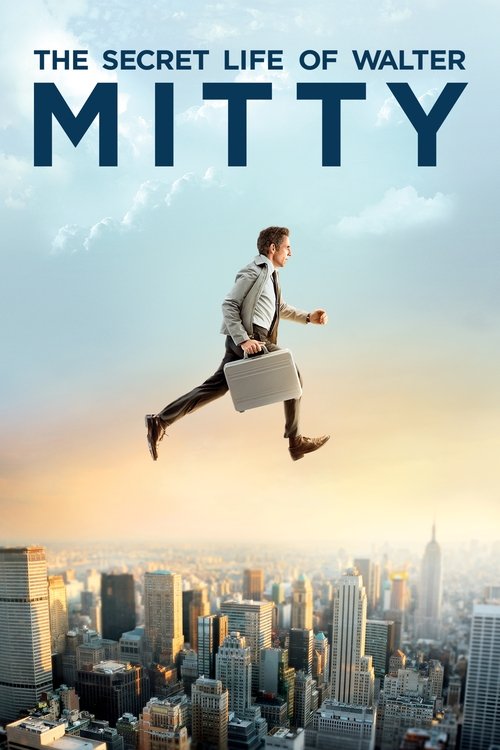
The Secret Life of Walter Mitty
2013 · Ben Stiller
For when you're stuck in a rut and want a film that makes you want to book a flight — feel-good without being empty. A comfort watch with wanderlust built in.
What it's about
Walter Mitty manages the photo negatives at Life magazine, living so cautiously that his only adventures happen in elaborate daydreams. When the negative meant for the magazine's final cover goes missing, he has to actually go — chasing a famously elusive photographer across Greenland, Iceland, and the Himalayas, and discovering the gap between imagining a life and living one.
The experience
Warm, earnest, and visually sweeping — a comedy that keeps trading laughs for awe as the landscapes get bigger. It's the cinematic equivalent of a deep breath before quitting your job.
Performances
Ben Stiller dials his usual comic energy way down to play Walter as gentle and recessive, and the restraint is what makes the transformation land.
The craft
Stiller directs with a picture-book eye: the fantasy sequences erupt out of drab office life with real invention, and the Iceland and Greenland location work delivers genuine widescreen splendor. The needle drops are calibrated for goosebumps — this one earns a big screen and good speakers.
Why it matters
A polarizing gamble at release that found its audience afterward as a sincerity touchstone — the movie people reach for when they talk about films that made them travel.
Snapshot
The Secret Life of Walter Mitty is Ben Stiller's fifth feature as director and his most conspicuous bid for tonal reinvention: a mid-budget studio film that trades the aggressive comic register of Zoolander and Tropic Thunder for earnest, image-driven inspirational fable. Adapted loosely from James Thurber's celebrated 1939 New Yorker short story — and, at a further remove, from the 1947 Danny Kaye vehicle — the film reworks Thurber's henpecked daydreamer into Walter Mitty (Stiller), a "negative asset manager" at Life magazine on the eve of the print edition's shutdown. When a photographic negative earmarked for the final cover goes missing, Walter's habit of "zoning out" into elaborate fantasy gives way to an actual quest across Greenland, Iceland, and the Himalayas. The picture is best understood as a transitional object in Stiller's career and a late example of the wide-release, star-fronted "prestige uplift" film — the kind of glossy, four-quadrant holiday release that grew scarce as studios pivoted to franchises. Released by 20th Century Fox on December 25, 2013, it earned respectful commercial returns and sharply divided reviews, and has since accrued a warmer second life as a comfort film and a showcase for landscape spectacle.
Industry & production
The property had one of the longer development histories in modern Hollywood. Thurber's story, a mere few pages, had been optioned and reoptioned for decades after the Samuel Goldwyn–produced 1947 adaptation; a remake floated through multiple studios and star-director pairings across the 1990s and 2000s. Names publicly attached at various points reportedly included Jim Carrey, Owen Wilson, Mike Myers, and Sacha Baron Cohen as potential Mittys, with directors such as Ron Howard and, earlier, Steven Spielberg circling the material. The exact chronology is muddled in the trade record, and I'd treat any single account of "who was attached when" with caution; what is clear is that the project drifted for years before landing at Fox with Stiller directing and starring and Steve Conrad's screenplay as the shooting draft.
Production was overseen by Samuel Goldwyn Jr. (whose father had produced the 1947 film) among the producing partners, lending an unusual dynastic continuity to the property. Principal photography took place in 2013 across New York, Los Angeles, and — decisively for the film's identity — Iceland, which doubled for Greenland, Iceland proper, and the Afghan/Himalayan high country. The reported budget was in the region of $90 million, and worldwide grosses were reported at roughly $188 million, a result generally read as modestly profitable but short of a breakout given marketing spend. Fox positioned it as counter-programming for the Christmas corridor, betting on Stiller's star wattage and an aspirational, family-safe tone.
The film is also notable as an artifact of integrated brand marketing: Life magazine (a Time Inc. title) is central to the plot, and the production folded in prominent, sometimes discussed-as-intrusive product placements — eHarmony (with Patton Oswalt as an unseen phone representative), Papa John's, and Cinnabon among them. This commercial texture is itself thematically relevant, given a story about corporate downsizing and the death of a great print institution.
Technology
Shot digitally on the Arri Alexa, the film belongs to the moment when high-end digital capture had fully displaced celluloid for large studio productions — a pointed irony for a narrative that mourns the analog photographic negative as a sacred object. The production leaned on visual-effects houses (including work credited to studios such as Look Effects and Method Studios) to stitch fantasy interludes and to extend or composite landscapes, though a substantial portion of the film's impact derives from genuine location capture in Iceland rather than synthetic environments. The daydream sequences — most memorably a superhero-scaled street brawl and a Benjamin Button–parodying romantic aside — deploy CGI as overt spectacle, deliberately legible as fantasy against the naturalism of the "real" journey. The film's technological self-consciousness (negatives, magazine servers migrating to a website, the machinery of image reproduction) makes it a quiet meditation on media transition, arriving precisely as the industries it depicts were being restructured by the same digital forces that made the film itself.
Technique
Cinematography
Stuart Dryburgh — an Oscar nominee for Jane Campion's The Piano — shot the film, and the cinematography is its most consistently praised element. Dryburgh organizes a deliberate visual arc: the New York and office material is cool, boxed, and desaturated, framing Walter within grids of cubicles, elevators, and screens; the travel passages open into widescreen vistas of glacial coastlines, volcanic roads, and mountain approaches rendered with postcard clarity and depth. The compositions frequently isolate a small human figure against vast terrain, literalizing the theme of a diminished man enlarged by experience. Signature images — Walter longboarding down a serpentine Icelandic road, or standing before a Himalayan expanse in search of a snow leopard — are engineered as shareable, iconic beats. Critics who found the film shallow nonetheless tended to concede the beauty of its landscapes.
Editing
Greg Hayden cut the film, and the editing carries much of the movie's conceptual burden: it must yoke together mundane realism and eruptive fantasy without whiplash. The daydream transitions are the key editorial figure — Walter's eyes glaze, the world stalls, and the cut launches into heightened action before snapping back, often to a colleague's bemused "You zoned out again." As the film progresses and Walter's real life becomes adventurous, the fantasy inserts recede, a structural rhyme that the editing tracks by frequency and length. The film also uses graphic-match and on-screen-text flourishes — words from the environment integrated into the frame — to externalize interior states.
Mise-en-scène / staging
The production design draws a hard line between two worlds. The Life offices are a study in institutional dispossession: half-packed boxes, transition-team blandness, and the smug, bearded new-management figure Ted Hendricks (Adam Scott). Against this, the film stages its outdoor sequences for maximal scale and physicality — Walter leaping onto a helicopter, biking through fjords, negotiating a volcanic eruption. The staging consistently contrasts enclosure with openness, passivity with motion, to chart the protagonist's transformation.
Sound
The soundtrack is unusually load-bearing and was marketed almost as a co-author of the film's mood. Its most discussed sequence pairs Walter's decisive leap into adventure with a rendition of David Bowie's "Space Oddity" — sung diegetically-into-fantasy by Cheryl (Kristen Wiig) to spur him on. The curated indie-folk and anthemic-rock palette (including songs by artists such as Of Monsters and Men, José González — who contributed the original "Step Out" — and Arcade Fire) gives the film a mid-2010s emotional-uplift texture. Theodore Shapiro's orchestral score underlays the songs with swelling, sincere cues. Sound design contrasts the muffled hush of the office with the wind and scale of the outdoors.
Performance
Stiller plays Walter with a muted, internalized melancholy quite different from his signature comic personae — a deliberate restraint that some found affecting and others inert. Kristen Wiig underplays as the love interest Cheryl, keeping the romance low-key. Adam Scott's Ted supplies the film's sharpest comic antagonism. Shirley MacLaine (as Walter's mother) and Kathryn Hahn (as his sister) anchor the domestic register, and Sean Penn appears briefly but pivotally as the elusive globe-trotting photographer Sean O'Connell, whose ethos of unhurried presence delivers the film's thesis. Patton Oswalt's voice-only turn threads comic warmth through the film's connective tissue.
Narrative & dramatic mode
Structurally, the film is a quest-shaped bildungsroman for an already-middle-aged man — a "late coming-of-age." The dramatic engine is the gap between fantasy and action: Act One establishes Walter as a man who imagines heroism but cannot approach his crush or assert himself; the missing negative (the mythic "Quintessence of Life," negative 25) supplies a MacGuffin that forces him outward. The daydreams function as expressionist interludes that gradually collapse into a real journey, so that the narrative's own device — the fantasy insert — is thematically consumed as the plot advances. The mode is earnest fable rather than satire; despite comic set pieces, the film commits to sincerity, and its climax turns on a small revelation (the subject of the lost photograph) rather than a large twist.
Genre & cycle
The film is a genre hybrid — adventure, comedy, drama, and light fantasy — that resists neat placement, which partly explains its divided reception. It sits within a recognizable cycle of 2000s–2010s "escape-the-cubicle, live-more" fables (a lineage that runs alongside things like About Schmidt, Up in the Air, or the broader "wanderlust as self-actualization" strain), and within the tradition of the meek-everyman-transformed comedy. It also belongs to the increasingly endangered category of the original-IP, star-driven, mid-budget studio release aimed at all four quadrants — a form that Hollywood was actively abandoning in favor of franchise tentpoles, which lends the film a certain elegiac quality in retrospect, both textually and industrially.
Authorship & method
As director-star, Stiller is the clear author, and the film represents a conscious pivot toward sincerity and visual scale after a run of broad comedies. His method here foregrounds landscape, curated music, and restrained lead performance over gags. Screenwriter Steve Conrad — whose credits include The Weather Man and The Pursuit of Happyness — brings a recurring preoccupation with becalmed men reaching for meaning, and his adaptation departs radically from Thurber, retaining little more than the premise of a daydreamer and the "zoning out" motif. Cinematographer Stuart Dryburgh supplies the prestige visual craft. Composer Theodore Shapiro, a frequent Stiller collaborator (Dodgeball, Tropic Thunder), grounds the pop soundtrack with a sincere orchestral bed. Editor Greg Hayden manages the film's central formal problem of interleaving fantasy and reality. The collaboration is notably music-forward: the soundtrack's curation reads as an authorial statement in its own right.
Movement / national cinema
The film belongs squarely to mainstream American studio cinema and to no formal movement. Its most interesting "national cinema" dimension is geographic and touristic rather than authorial: its extensive Icelandic shooting made it, alongside a cluster of contemporaneous international productions, part of the wave that raised Iceland's profile as a global film location and travel destination. The film effectively functions as landscape cinema for a mass audience, and its imagery contributed to a broader mid-2010s cultural romance with Iceland — though the causal weight of any single film in that phenomenon should not be overstated.
Era / period
Made and set in the early 2010s, the film is acutely of its moment. Its inciting situation — the shuttering of Life's print edition and its migration to a website — captures the post-2008 anxiety of legacy-media collapse, corporate "restructuring," and the digital disruption of image-based industries. Its aesthetic — indie-folk needle-drops, aspirational "authenticity," analog nostalgia (the fetishized negative, the wallet, the vinyl) — is a near-textbook expression of early-2010s middlebrow sensibility, the same cultural climate that produced hipster-craft nostalgia and "live deliberately" lifestyle branding. The film is thus doubly a period piece: about media transition, and unmistakably stamped by the taste culture of the years in which it was made.
Themes
The central theme is the reconciliation of imagination and action — the passage from a life lived vicariously (in daydreams, and pointedly through others' photographs) to one lived directly. Bound up with this are: the dignity of the overlooked functionary and the invisible labor behind cultural artifacts (Walter processes images the world consumes without seeing him); the elegy for analog media and for institutions like Life in an age of digitization and downsizing; presence versus documentation, crystallized in Sean O'Connell's decision, at a climactic moment, not to photograph but simply to look; and a gentle critique of self-mythologizing fantasy in favor of embodied experience. The film's borrowed Life magazine credo — a paean to seeing the world, drawing closer, and feeling — is offered without irony as its moral center.
Reception, canon & influence
Critical reception was decidedly mixed. Reviewers widely admired Dryburgh's photography, the Icelandic landscapes, and Stiller's ambition, but a substantial faction found the film sentimental, tonally uneven, thematically thin, and burdened by conspicuous product placement — the sincerity that admirers prized read to detractors as self-help greeting-card uplift. Aggregate scores landed in mediocre territory (Rotten Tomatoes hovered around the midpoint), and the film was not a major awards presence. Commercially it performed adequately without breaking out.
Its influences run backward to James Thurber's 1939 story (source of the premise and the enduring "Walter Mitty" as shorthand for a fantasist), to the 1947 Danny Kaye adaptation, and, in its earnest-quest DNA and cubicle-escape ethos, to a broader tradition of transformation comedies and Steve Conrad's own melancholic-everyman screenplays. Its music-driven, landscape-forward sincerity also aligns it with the visual and tonal fashions of contemporaneous indie-inflected studio drama.
Its forward legacy is real but modest and diffuse. The film has aged into a genuine comfort-viewing favorite, its inspirational beats and imagery circulating widely — the longboarding sequence, the "Space Oddity" leap, and the recited Life motto have had a durable second life as motivational shorthand online. It stands, in Stiller's filmography, as the fullest expression of his non-comic directorial ambitions. And it functions retrospectively as a marker of an endangered species — the original-story, mid-budget, wide-release studio film — whose relative scarcity has, if anything, softened critical memory of it. Claims of specific, traceable influence on later filmmakers are hard to substantiate, and I'd be honest that the film's most measurable "influence" has been cultural and touristic (its burnishing of Iceland's on-screen allure) rather than a demonstrable mark on subsequent film form.
A Deleuzian reading
A man in an office goes quiet mid-sentence.
The full Deleuzian reading of The Secret Life of Walter Mitty →
Reception
Critics shrugged in 2013 — too sentimental, too glossy, too much product placement — but audiences never agreed, and a decade of streaming and travel-TikTok has turned it into a beloved comfort movie that regularly tops 'critics got it wrong' lists.
How The Secret Life of Walter Mitty was received, from release to now →
How to watch The Secret Life of Walter Mitty: what to notice on a first viewing
- Watch Walter's eyes glaze just before each daydream starts. Greg Hayden builds the same figure every time. Stiller goes still, the room stalls, the cut launches into something enormous, then snaps back to a colleague saying he zoned out again. These inserts carry no past at all. They are an alternative present that runs until it wears itself out.
- Watch Walter boxed inside cubicles, elevator doors, and screens. Stuart Dryburgh shoots the New York material cool and desaturated, with a grid around him in nearly every frame. The office looks like a photocopy of itself. The framing tells you what he is allowed to do before anyone at the magazine says a word to him.
- Count how small Stiller looks against the Icelandic road. Dryburgh keeps setting one tiny figure against enormous terrain: a fjord, a glacial coast, a mountain approach. Then he narrows to a single body on a longboard on a serpentine road. The frame keeps swinging between a huge surrounding and one thin line of action, which is how the film measures him.
- Listen for songs carrying whole stretches where nobody speaks. The curated soundtrack does the narrating. José González's 'Step Out' runs a sequence with no dialogue, and Cheryl sings 'Space Oddity' straight into the moment Walter has to move. Shapiro's score sits underneath. The songs stand in for his inner voice, so you can read his state off whatever is playing.
- Watch how little Stiller's face does in the office scenes. He plays Walter muted and internal, nothing like his comic personae. He absorbs Ted's needling, rehearses lines he never says, and stalls over a dating profile. The stillness is the performance. He is built to receive rather than respond, and that gap is exactly what the rest of the film works on.
The whole guide to watching The Secret Life of Walter Mitty, with the keys for a rewatch →
Influences: the films it descends from and the films it influenced
- The Secret Life of Walter Mitty (1947) — The direct adaptation that codifies the hard cut from drab reality into a saturated, self-cast daydream — the fantasy-insert transition Stiller rebuilds as his central editing device.
- The Weather Man (2005) — Steve Conrad's own screenplay template of the desaturated, becalmed office-bound everyman narrating his way toward meaning — the melancholic-male blueprint he ports directly into Mitty.
- The Pursuit of Happyness (2006) — Conrad again: the earnest striving-everyman quest structure, where dignity is won through persistence rather than plot mechanics, feeding Mitty's sincerity-over-gags scaffolding.
- Amélie (2001) — Whimsy externalized as interior fantasy erupting from an ordinary life, stitched by graphic-match transitions between the imagined and the real that Hayden's editing echoes.
- Big Fish (2003) — The interleaving of a mundane frame narrative with heightened, tall-tale fantasy episodes as a structural engine — reality and daydream cross-cut as equal registers.
- Forrest Gump (1994) — The passive everyman carried through sweeping American landscapes, scored by curated period needle-drops that function as narration rather than underscore.
- Garden State (2004) — The director-star sincerity pivot in which a hand-picked indie-folk soundtrack becomes the primary authorial statement over a restrained, deadpan lead's late coming-of-age.
- Into the Wild (2007) — Figure-in-landscape wilderness cinematography married to a needle-drop score for a self-discovery quest, staging enclosure-versus-openness as the journey's visual grammar.
- Eternal Sunshine of the Spotless Mind (2004) — In-camera, practical-effect transitions that fold a character's interior mental world seamlessly into surrounding physical space rather than segregating it as effects work.
- Lost in Translation (2003) — Recasting a broad-comedy star in a muted, restrained register, using needle-drop song cues to build interior mood in place of dialogue.
- The Fall (2006) — Globe-spanning real-location spectacle deployed as the literal geography of a character's imagination — actual landscape standing in for the interior fantastical.
- Brad's Status (2017) — Stiller again as the becalmed everyman, his comparison-anxiety dramatized through imagined fantasy-insert voiceover sequences — the Mitty daydream device turned inward and satirical.
- Ingrid Goes West (2017) — Extends Mitty's presence-versus-documentation motif — the O'Connell 'don't photograph it' ethos — into the social-media age, where mediated experience becomes the narrative's driving pathology.
- Wild (2014) — A solo figure-in-landscape journey structured around memory-flash inserts and diegetic needle-drops, the walk itself functioning as narrative therapy.
- Chef (2014) — The director-star sincerity pivot away from broad comedy toward a warm road-movie built on a curated needle-drop soundtrack and restrained self-portraiture.
- Hector and the Search for Happiness (2014) — A near-identical whimsical-globe-quest fable in which a becalmed man's daydreams surface as animated fantasy inserts punctuating a self-actualization itinerary.
Similar films
- Into the Wild (2007) — influence & lineage
- Lost in Translation (2003) — influence & lineage
- The Motorcycle Diaries (2004) — shared sensibility
- Interstellar (2014) — shared sensibility
- The Life Aquatic with Steve Zissou (2004) — shared sensibility
- Grizzly Man (2005) — shared sensibility
- The Summit of the Gods (2021) — shared sensibility
- 8½ (1963) — shared sensibility