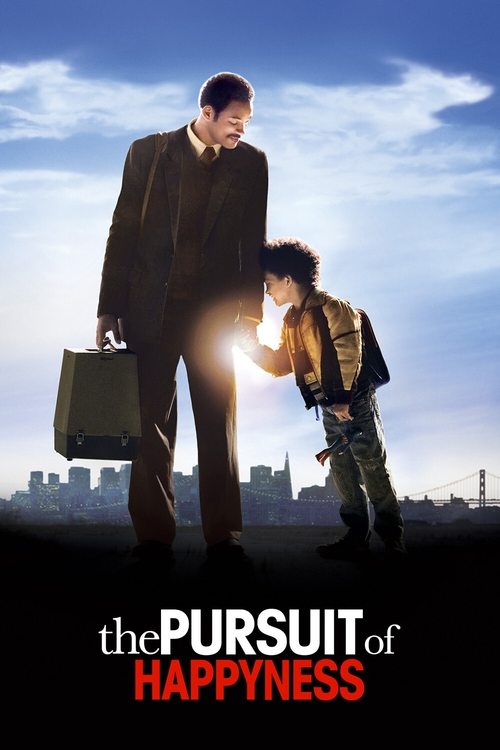
The Pursuit of Happyness
2006 · Gabriele Muccino
For when you need an underdog story that earns its uplift — a motivation movie for a low week, or a father-and-son tearjerker when you want to feel something. Comfort viewing, though the middle stretch is genuinely tough to sit through.
What it's about
San Francisco, the early 1980s. Chris Gardner is a salesman hauling unsellable medical scanners around the city while his finances collapse, until he lands an unpaid stockbroker internship with only a slim chance of a job at the end. He takes it on while raising his young son alone — sometimes without a roof over their heads — in a drama drawn from Gardner's real life.
The experience
An emotional endurance test with a warm center: stressful, tender, and openly sentimental, piling one indignity on another so each small win lands hard. Expect to root loudly and possibly cry.
Performances
Will Smith strips away his star polish for a raw, contained dramatic turn that earned him an Oscar nomination, and playing opposite his real son Jaden gives the father-son scenes an unfakeable ease.
The craft
Gabriele Muccino shoots San Francisco as both dream and obstacle course — buses, BART stations, and church shelters mapped like a daily gauntlet. Steven Conrad's script smartly narrows a year of struggle into concrete, physical problems: a machine to sell, a line to wait in, a place to sleep tonight.
Why it matters
A major box-office hit that proved Will Smith could carry a stripped-down drama, it became the modern reference point for the Hollywood bootstrap story and made Chris Gardner's name a shorthand for against-the-odds persistence.
Snapshot
The Pursuit of Happyness is a based-on-fact American drama that dramatizes roughly a year in the life of Chris Gardner, a struggling San Francisco salesman who, while effectively homeless and raising his young son alone, works his way through an unpaid stockbroker internship at Dean Witter Reynolds toward a permanent position. Directed by the Italian filmmaker Gabriele Muccino in his English-language debut, and built as a star vehicle and passion project for Will Smith and his production company Overbrook Entertainment, the film pairs Smith with his real-life son Jaden Smith in the central father-and-son roles. Adapted by screenwriter Steven Conrad from Gardner's own account of his life, it belongs to the durable Hollywood tradition of the uplift drama — the individual triumphing over adversity by will and endurance — and it became one of the more commercially successful dramas of its year while earning Smith an Academy Award nomination for Best Actor. Its cultural footprint rests less on formal innovation than on its distilled restatement of an American bootstrap myth, a restatement admirers found stirring and skeptics found ideologically loaded.
Industry & production
The film was produced and released by Columbia Pictures (Sony) and assembled through Overbrook Entertainment, the company Smith ran with his producing partner James Lassiter, alongside producers Todd Black, Jason Blumenthal, and Steve Tisch of Escape Artists. The project's engine was Smith's own belief in the material: Gardner's story had circulated in the media — including a widely cited television profile of Gardner's rags-to-riches arc — before it was optioned, and Smith attached himself as both star and producer, which gave the production its financing logic as a mid-budget, awards-oriented star drama rather than a studio tentpole.
The most consequential and unusual production decision was the hiring of Gabriele Muccino, an Italian director with no prior English-language feature, at Smith's insistence. Smith has said in interviews that he wanted an outsider's eye on American aspiration; the choice signaled that the film would be pitched as an emotional melodrama in a European key rather than a conventional Hollywood biopic. The second defining choice was casting Jaden Smith, then a young child and a first-time actor, opposite his father — a decision that fused the film's on-screen father-son bond with a real one and became central to its marketing. The film was shot substantially on location in San Francisco, using the city's actual geography — its financial district, its transit system, and the shelters and single-room settings of Gardner's hardship — as a grounding texture. Precise budget and grosses should be treated with care, but it is well established that the film was a strong commercial performer, grossing in excess of \$300 million worldwide on a modest production budget, an outcome that reinforced Smith's standing as a dramatic lead rather than only an action-comedy star.
Technology
The Pursuit of Happyness was produced with the standard professional apparatus of a mid-2000s studio drama: 35mm photographic origination, anamorphic-era location shooting, and post-production finishing that by this period increasingly ran through a digital intermediate for color grading, though the specific finishing pipeline is not something to overstate without the technical record in hand. The film is not a technology showcase; it deploys no visual effects of note beyond the invisible, corrective kind used to dress period San Francisco to its early-1980s setting and to stage its street-level realism. In that sense the film sits on the conservative side of its moment — the mid-2000s, when digital capture was beginning to enter mainstream production but celluloid remained the default for prestige drama. The relevant "technology" of the film is photochemical and photographic craft in service of naturalism, not spectacle.
Technique
Cinematography
The cinematography is by Phedon Papamichael, a cameraman associated with grounded, character-forward American filmmaking (his collaborations include work with Alexander Payne and James Mangold). His approach here is observational and unshowy: available-feeling light, handheld and shoulder-mounted mobility that follows Gardner through crowded streets and transit corridors, and a palette that leans toward the muted, slightly desaturated register that signaled "seriousness" and documentary truthfulness in 2000s realist drama. The camera privileges Smith's face and body — the physical labor of carrying medical scanners, running to appointments, shepherding a child — and the framing repeatedly isolates the father-son pair against an indifferent urban backdrop. The visual strategy is subordinated to performance and momentum rather than to composed pictorialism.
Editing
The editing is by Hughes Winborne, who shortly before had won the Academy Award for editing Crash (2004). The cutting sustains a propulsive, deadline-driven rhythm appropriate to a story structured around escalating time pressure — rent due, a shrinking bank balance, the daily race to secure a shelter bed, the ticking internship. Winborne's work modulates between this forward drive and held, quieter beats of intimacy between father and son, so that the film's emotional crescendos are earned through contrast. The montage logic tends toward accumulation: the repetition of small setbacks builds the sense of a man running just to stay in place.
Mise-en-scène / staging
The staging trades in the concrete iconography of early-1980s San Francisco and of downward economic mobility: the bulky bone-density scanners Gardner peddles as unsold inventory and literal burden, the borrowed and lost apartments, the subway-station restroom that becomes a shelter, the daily queues outside a church-run refuge. The misspelled word "happyness," which the film foregrounds as graffiti/signage outside the day-care his son attends, functions as its central staged motif — an emblem of institutional neglect that Gardner corrects and, thematically, of a promise imperfectly rendered. The production design keeps period detail legible without tipping into nostalgia.
Sound
The score is by Andrea Guerra, an Italian composer and a frequent Muccino collaborator, whose music supplies the film's emotional through-line with a melodic, string-forward, and generally restrained-to-swelling register characteristic of European scoring for domestic drama. The sound design otherwise emphasizes the din of the city — traffic, transit, crowds — against which the private father-son world is carved out, so that quiet becomes a marker of refuge.
Performance
Performance is the film's true medium. Will Smith delivers what is widely regarded as one of his defining dramatic turns, calibrating charm, exhaustion, shame, and suppressed desperation, and grounding the film's uplift in visible physical and emotional strain; the performance drew his second Academy Award nomination for Best Actor. Jaden Smith's presence supplies unforced naturalism and, by virtue of the real relationship, an authenticity the film leans on heavily. Thandie Newton, as Gardner's wife Linda, plays a woman ground down by poverty into departure — a role sometimes criticized as thinly conceived, functioning more as a pressure than a fully realized character, though Newton invests it with hardness and hurt.
Narrative & dramatic mode
The film operates in the mode of the individual uplift melodrama, organized as a survival narrative with a deferred payoff. Its dramatic engine is relentless subtraction — the systematic stripping-away of Gardner's resources (money, housing, marriage, dignity) — set against a single sustained pursuit (the internship and the job that lies at its end). Structurally it is close to a trial-and-endurance arc rather than a conventional rise-fall-rise; the "rise" is compressed into the final movement and delivered as emotional release. The screenplay by Steven Conrad uses first-person framing devices and a father's address to his son to place fatherhood at the narrative's moral center, so that the economic quest and the parental duty are braided into a single stake. The film is unabashedly sentimental in its dramaturgy, engineering its climax as catharsis, and it is candid about that aim rather than ironic about it.
Genre & cycle
It sits within the American inspirational drama — the "true story of triumph over adversity" — and specifically within the sub-cycle of aspirational, self-made-man narratives that recur throughout Hollywood history. Adjacent reference points include the boxing-underdog and sports-underdog tradition transposed to the arena of finance and family, and the socially attentive hardship drama. It also belongs to a mid-2000s cycle of star-driven prestige dramas designed as awards vehicles for actors better known in other registers. Within these frames the film is notable for locating its struggle in the unglamorous machinery of white-collar precarity — unpaid internships, commissioned sales, the thin margin between solvency and the street.
Authorship & method
The authorship here is genuinely divided between a director-for-hire brought in from another cinema and a star-producer whose vision shaped the project. Gabriele Muccino arrived from Italian popular drama — films such as L'ultimo bacio (The Last Kiss, 2001) and Ricordati di me — where he had developed an emotionally direct, ensemble-driven, feeling-forward style. He brings to the material an unembarrassed embrace of sentiment and a European melodramatic sensibility, treating American aspiration with an outsider's earnestness; the collaboration proved durable enough that he and Smith reunited on Seven Pounds (2008). Will Smith, as star and producer, is the film's other author, and its casting, tone, and market positioning bear his stamp. Steven Conrad (screenwriter) supplies the father-son architecture and the endurance structure. Key craft collaborators — cinematographer Phedon Papamichael, editor Hughes Winborne, and composer Andrea Guerra — align a grounded American realist image and rhythm with a warmly emotive score, the seam along which the film's naturalism and its melodrama meet. The underlying method is fidelity-with-compression: a real life reshaped into a clean, forward-driving arc.
Movement / national cinema
The film is a mainstream Hollywood studio production, but its authorship gives it a transnational character worth naming: an Italian director working within, and slightly against, American genre conventions. Muccino's background connects the film distantly to the emotionally expansive, family-and-relationship-centered strain of contemporary Italian popular cinema rather than to any American independent movement. It is not a film of a "movement" so much as an instance of Hollywood importing a European melodramatic sensibility to reinflect a native myth — a fairly common industrial practice, here made conspicuous by the director's outsider status.
Era / period
Two time frames matter. The film was made in the mid-2000s, within a studio ecology that still funded mid-budget adult dramas as star-and-awards plays. Its story, however, is set in 1981 — a choice that situates Gardner's ascent at the dawn of the Reagan era, amid recession and the ideological ascendancy of market individualism and entrepreneurial self-reliance. That period setting is not incidental: the film's faith in individual effort as the lever of mobility resonates with, and can be read as a product of, the very moment its narrative inhabits. The tension between the early-1980s setting and the mid-2000s of its release — a later era of widening inequality and stagnating mobility — is part of what gives the film its charge and its critics their opening.
Themes
The governing theme is the American Dream reduced to its most personal and strenuous form: happiness as something pursued, promised but not guaranteed, and the misspelled "happyness" as a sign that the promise is imperfectly kept by the institutions that should deliver it. Fatherhood is the film's moral heart — provision, presence, and the transmission of hope from parent to child under conditions designed to break both. Around these cluster themes of dignity under humiliation, the invisibility of the working poor and the newly homeless, and the moral ambiguity of a meritocratic ethic that the film both celebrates and, in its unblinking depiction of Gardner's suffering, quietly indicts. The film's insistence that individual perseverance is the answer is its most debated proposition: it can be read as inspirational testimony or as an ideology that displaces structural causes of poverty onto personal grit.
Reception, canon & influence
Critical reception was broadly positive but not uncritical, and it split along a predictable line. Many reviewers singled out Will Smith's performance as the film's great strength and the anchor of its emotional credibility, and the film was embraced by wide audiences as a genuine crowd-pleaser. A significant strand of criticism, however, found the film manipulative or sentimental and its politics complacent — faulting it for aestheticizing hardship and for endorsing a bootstrap ideology without interrogating it, and for underwriting its wife/mother character. The clearest institutional recognition was Smith's Academy Award nomination for Best Actor, alongside Golden Globe recognition; the film's awards profile centered on him rather than on direction or craft.
Influences on the film (backward): it draws on the long Hollywood lineage of the inspirational true-story and self-made-man narrative, on the underdog-triumph structure familiar from sports drama, and — through Muccino and composer Andrea Guerra — on the emotionally direct melodramatic idiom of contemporary Italian popular cinema. Its deeper source, of course, is the memoir and real biography of Chris Gardner, whose own account supplies the film's incidents and its framing of fatherhood.
Legacy (forward): the film consolidated Will Smith's transition into serious dramatic leading roles and demonstrated the continued commercial viability of the mid-budget inspirational drama, and it directly seeded the Muccino–Smith reunion on Seven Pounds (2008). It became a widely referenced touchstone in popular discourse about ambition and resilience — frequently invoked, and frequently parodied, as shorthand for the tearful bootstrap narrative — and its central father-son image and the "happyness" motif entered the culture's stock of aspirational iconography. Its longer scholarly legacy is as a case study in the ideology of the American Dream on screen: a film debated less for how it was made than for what it argues, and one that continues to be cited in critical conversations about how popular cinema narrates poverty, meritocracy, and mobility. Beyond these well-documented lines, claims of specific, traceable influence on later filmmakers are thin, and the honest account is that the film's real afterlife is cultural and ideological rather than formal.
Reception
A big crowd-pleasing hit in 2006 that earned Will Smith an Oscar nomination; today it's less a critics' darling than a motivational-culture staple, alternately embraced as a sincere tearjerker and side-eyed as bootstraps mythology.
How The Pursuit of Happyness was received, from release to now →
Influences: the films it descends from and the films it influenced
- Bicycle Thieves (1948) — The location-shot neorealist template of a father and his young son trudging a hostile urban economy on foot, the father-son-in-crisis structure Muccino's Italian realism directly descends from.
- L'ultimo bacio (2001) — Muccino's own restless handheld, feeling-forward ensemble style and his scoring partnership with Andrea Guerra, imported wholesale from his Italian cinema into the American project.
- Cinema Paradiso (1988) — The modern popular-Italian idiom of emotionally direct storytelling wedded to a swelling melodic score, the unembarrassed melodramatic sensibility Muccino works within.
- Life Is Beautiful (1997) — The Italian father who shields and inspires his small son through hardship with sentiment foregrounded, the father-son melodrama Muccino extends into an American register.
- Rocky (1976) — The working-class-striver underdog endurance structure resolved by a score-swelled climax — the three-act 'subtraction then triumph' shape Happyness borrows.
- Kramer vs. Kramer (1979) — The intimate single-father domestic melodrama built on a movie star delivering a restrained naturalistic performance opposite a small child.
- Paper Moon (1973) — A parent and child hustling through hard economic times, cast with a real-life parent and child (Ryan and Tatum O'Neal), prefiguring the Will/Jaden Smith real-family casting device.
- It's a Wonderful Life (1946) — The Capraesque populist sentiment that ennobles the striving everyman and pushes the American-dream melodrama openly toward tears.
- The Weather Man (2005) — Screenwriter Steven Conrad's earlier study of a floundering father, the same father-focused endurance architecture he then supplied to Happyness.
- Seven Pounds (2008) — The direct Muccino–Smith reunion, reprising the handheld intimacy, Smith-as-suffering-everyman performance, and Guerra-style emotive scoring.
- Hidden Figures (2016) — The true-story meritocratic-uplift melodrama that dramatizes bootstrap mobility achieved against structural obstacles, forward-driven and score-cued.
- After Earth (2013) — Reuses the real-life Will/Jaden Smith father-son casting as its structuring device, extending the family-casting gambit Happyness introduced.
- King Richard (2021) — Will Smith completing the same striving-Black-father figure in a true-story bootstrap drama — the role that won the Oscar his Happyness nomination pointed toward.
- Playing for Keeps (2012) — Muccino's American fatherhood-and-second-chances mode paired with Andrea Guerra's swelling string cues to cue uplift — the same director/composer sentimental-scoring partnership reused, minus the disciplining central star.
- The Secret Life of Walter Mitty (2013) — Conrad again: the earnest striving-everyman quest structure, where dignity is won through persistence rather than plot mechanics, feeding Mitty's sincerity-over-gags scaffolding.
- Walk the Line (2005) — Phedon Papamichael's grounded, desaturated period-American photography from the prior year, the realist image the film reuses under the same cinematographer.
- Slumdog Millionaire (2008) — Desaturated handheld poverty realism resolved into an aspirational rags-to-triumph melodrama, the same naturalism/uplift seam.
- The Blind Side (2009) — The mid-budget inspirational-true-story underdog built around an Oscar-courting lead performance rather than directorial flourish.
- 12th Fail (2023) — A lead physically embodying grinding day-to-day poverty across a perseverance arc that funnels toward a single qualifying test — the exact body-work Massey performs.
Similar films
- Rocky (1976) — influence & lineage · same viewing thread
- King Richard (2021) — influence & lineage
- Slumdog Millionaire (2008) — influence & lineage
- Creed (2015) — same viewing thread
- Cinderella Man (2005) — same viewing thread
- The Wrestler (2008) — same viewing thread
- Life Is Beautiful (1997) — influence & lineage · often watched together
- Bicycle Thieves (1948) — influence & lineage · often watched together
All the films related to The Pursuit of Happyness →
Watch it with: curated runs of related films
- The Working-Class Long Shot — A run of men whose bodies and grit are their only capital, each grinding toward a single shot at dignity — watch them together and the American bootstrap dream and its bleaker European labor-film shadow start to rhyme.