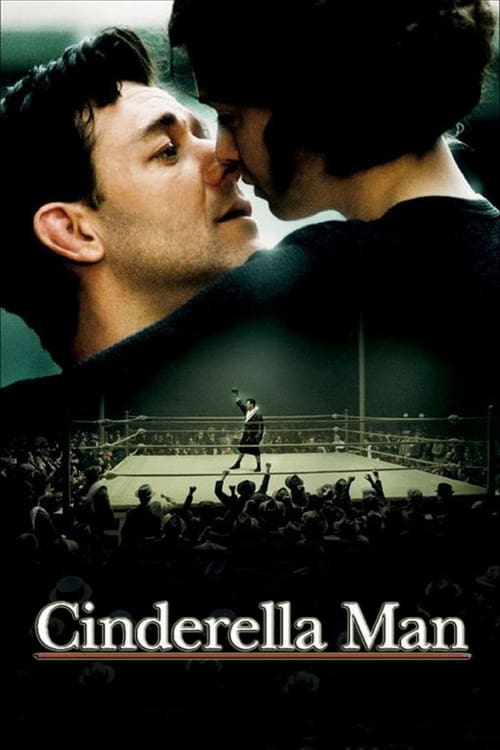
Cinderella Man
2005 · Ron Howard
For when you want an underdog story done straight — a film to root for, cry a little over, and come out of feeling better about people. Comfort with real stakes.
What it's about
The true story of James J. Braddock, a New Jersey boxer whose career collapsed into Depression-era poverty and dock work, leaving him scraping to feed his wife and children. When an unlikely second chance in the ring appears, Braddock's comeback becomes about something plainer than glory: keeping his family together. It builds toward a title shot against the era's most feared heavyweight champion.
The experience
Earnest, old-fashioned, and unabashedly emotional — the fight scenes hit hard, but the film's real weight is in the quiet desperation of a man trying to provide. It's a movie that wants to move you and mostly does.
Performances
Russell Crowe plays Braddock with a gentle, worn decency that makes the fights matter, and Paul Giamatti is terrific as his fast-talking, fiercely loyal manager. The pairing gives the film its pulse.
The craft
Ron Howard's classical, sentiment-forward direction fuses the boxing picture with the Depression survival drama, recreating 1930s New Jersey and the fight game with handsome period detail. The bouts are staged for physical impact — you feel every round.
Why it matters
Reuniting the team behind Howard and Crowe's earlier Oscar-winning collaboration, it earned Academy Award recognition and stands as one of the definitive modern tellings of the Braddock legend. It kept the classical inspirational sports drama alive in a more cynical era.
Snapshot
Cinderella Man dramatizes the improbable comeback of James J. Braddock, a New Jersey light-heavyweight-turned-heavyweight whose career had collapsed into the anonymity of Depression-era dock labor before a string of upset victories carried him, in June 1935, to the world heavyweight title against the feared champion Max Baer. Reuniting the core creative team behind A Beautiful Mind (2001) — director Ron Howard, producer Brian Grazer, star Russell Crowe, and screenwriter Akiva Goldsman — the film is a classical, sentiment-forward biographical drama that fuses the boxing picture with the Depression survival narrative. Its nickname-title, coined for Braddock by the sportswriter Damon Runyon, signals the fairy-tale framing the film embraces without apology. Received respectfully by critics and honored with an Academy Award nomination for Paul Giamatti, it nonetheless underperformed commercially relative to its substantial budget, a shortfall usually attributed to a crowded summer release slot and to Crowe's off-screen legal troubles at the moment of release. It stands today as a well-crafted, unfashionably earnest entry in Howard's cycle of true-story prestige dramas.
Industry & production
The picture was a co-production of Universal Pictures and Miramax Films, developed through Howard and Grazer's Imagine Entertainment. The screenplay originated with Cliff Hollingsworth, whose long-gestating script drew Howard and Crowe; Goldsman, fresh off his Oscar-winning adaptation for A Beautiful Mind, was brought in for revisions, and both writers share screen credit. The project thus extended one of the most productive director-star-producer partnerships of the era: Crowe and Howard coming directly off their A Beautiful Mind collaboration, with Grazer and Goldsman completing the reunion.
The film carried a large budget for a period drama without fantastical spectacle — reported in the industry press as being in the upper tens of millions — and its economics were shaped by two circumstances. First, Universal moved the release from a planned late-2004 awards-season berth into June 2005, positioning an adult Depression drama as summer counter-programming against blockbuster tentpoles, a gamble that did not pay off in ticket sales. Second, and much discussed at the time, Crowe was arrested in New York on the eve of the film's opening in an assault incident, an event that dominated coverage and, by wide contemporary account, undercut the publicity campaign for a film built substantially on his star image. The domestic gross fell short of the production and marketing outlay, and the film is frequently cited as a commercial disappointment despite favorable reviews — a case study in how release timing and star-driven marketing can determine the fate of an otherwise well-received prestige title.
Technology
Cinderella Man was photographed on 35mm film, consistent with the analog-capture norm of major studio production in 2005 and with the period texture the filmmakers sought. Cinematographer Salvatore Totino and Howard pursued a controlled, desaturated palette to evoke the grime and cold of Depression New York, work executed substantially through photochemical and lighting choices rather than the aggressive digital grading that would later become standard. The most technologically demanding component was the staging of the boxing matches, built through multi-camera coverage, choreographed fight action, and extensive editorial construction to convey the physiology of punishment. The film does not foreground digital effects; where computer-generated imagery appears, it is largely invisible period augmentation — crowd extension, set and skyline work — rather than spectacle. I have not seen a detailed, authoritative technical breakdown of specific camera or lens packages, and I will not invent one; the reliable point is that this was a traditional celluloid production whose innovation lay in fight staging and mise-en-scène rather than in novel capture technology.
Technique
Cinematography
Totino's photography divides the film into two visual registers. The domestic and street scenes are shot cold and muted — steel-gray and brown, low-key, the light often hard and directional to model gaunt faces and cramped rooms. Against this, the fight arenas are lit as pockets of harsh, concentrated brilliance, the ring a bright island in surrounding darkness. Within the bouts, the camera moves in close and mobile, favoring subjective proximity — the fighter's-eye disorientation, the blur and snap of impact — over the clean spectator's geometry of the classical boxing film. The visual scheme is legible and purposeful: deprivation rendered in drained color, the ring as the one place where Braddock's world briefly blazes.
Editing
Cutting is by Daniel P. Hanley and Mike Hill, Howard's longtime editorial partners, whose work here earned an Academy Award nomination. Their contribution is most conspicuous in the fights, where the choreographed action is assembled into rhythmic, escalating sequences that alternate visceral impact with cutaways to Mae listening at home and to the ringside faces of Joe Gould and the crowd. The editing calibrates duration and shot scale to build the climactic Baer bout across rounds into a sustained set-piece. In the domestic passages the pace is patient and classical, letting scenes breathe; the film's overall architecture is the familiar three-act rise-fall-rise, and the editing serves that shape cleanly.
Mise-en-scène / staging
The production and costume design reconstruct 1930s New Jersey and New York with prestige-drama thoroughness — tenement interiors, relief lines, the docks, the smoke-filled arenas of Madison Square Garden. Staging repeatedly contrasts scale: the smallness and clutter of the Braddock home against the vast, roaring public space of the arena. Braddock's poverty is dramatized through physical detail — turned-off heat, milk stretched thin, a hand injured and then unexpectedly strengthened by dock work — objects and spaces made to carry the film's meaning. The fight staging itself is a form of mise-en-scène, with Howard emphasizing the bodily cost of boxing rather than its glamour.
Sound
Thomas Newman's score departs from his signature minimalist textures toward a more full-bodied orchestral idiom suited to a period underdog drama, underscoring uplift while attempting to avoid pure bombast. The sound design of the fights is central to their effect: the amplified concussion of blows, the wet and percussive impacts, the roar and hush of the crowd, and the interior muffling that renders a fighter's dazed subjectivity. The alternation between deafening arena and the near-silence of Mae at the radio is one of the film's most effective aural strategies, using sound to bind the two worlds the image keeps apart.
Performance
Performance is the film's anchor. Russell Crowe plays Braddock with a deliberately understated decency — a quiet, dignified reticence rather than showy suffering — grounding the fairy tale in restraint. Renée Zellweger, recently an Academy Award winner for Cold Mountain, plays Mae Braddock as the fearful conscience of the home front; the role is the familiar anxious-wife part, and its limits are as much the script's as the actor's. The standout is Paul Giamatti as manager Joe Gould, whose fast, wounded, loyal energy supplies the film's wit and much of its heart, work recognized with an Oscar nomination. Craig Bierko plays Max Baer as a swaggering menace — a characterization that became the film's chief historical controversy (see Themes and Reception).
Narrative & dramatic mode
The film operates in the mode of the inspirational true-story biopic, structured as a classical fall-and-redemption arc. Its dramatic engine is not suspense about the historical outcome — the title telegraphs triumph — but the moral stakes of survival: whether Braddock can keep his family together and hold his dignity intact. The screenplay externalizes economic catastrophe as personal trial and resolves it through individual grit, a framework that gives the film its emotional clarity and also its ideological simplicity. Antagonism is distributed across an impersonal system (the Depression) and a personified threat (Baer, positioned as a lethal obstacle), the latter concentrating abstract danger into a single climactic bout. The mode is unabashedly sentimental and morally legible — closer to the studio uplift of an earlier Hollywood than to the ironic revisionism of the modern sports drama.
Genre & cycle
Cinderella Man sits at the intersection of two genres: the boxing film and the Depression survival drama. As a boxing picture it belongs to a deep American tradition — Golden Boy, Body and Soul, The Set-Up, Requiem for a Heavyweight, Rocky, and, inescapably, Raging Bull — but it consciously rejects the noir fatalism and self-destruction that define much of that lineage in favor of the redemptive uplift of the Rocky strain. It arrived within a distinct mid-2000s cluster of boxing-adjacent prestige films, released only months after Clint Eastwood's Million Dollar Baby (2004), and is frequently compared to Gary Ross's Seabiscuit (2003) as another handsomely mounted Depression-era true story of an underdog carrying the hopes of the dispossessed. Within Howard's own filmography it belongs to his cycle of fact-based prestige dramas — Apollo 13, A Beautiful Mind, later Frost/Nixon and Rush — films that dramatize real achievement in a polished classical register.
Authorship & method
Ron Howard's authorship is defined less by a radical personal style than by a consistent craft sensibility: clarity, emotional generosity, faith in classical narrative construction, and a humanist investment in competent, decent protagonists tested by extremity. Cinderella Man is a characteristic Howard film in its earnestness and its refusal of irony, qualities that make him unfashionable to some critics and reliable to audiences.
The film's method is fundamentally collaborative and continuous with his established team. Writer Akiva Goldsman, sharing credit with originating screenwriter Cliff Hollingsworth, again shaped a real story into accessible three-act dramaturgy after their A Beautiful Mind success. Cinematographer Salvatore Totino, who became a recurring Howard collaborator (later The Da Vinci Code, Frost/Nixon), supplied the film's two-register visual scheme. Composer Thomas Newman contributed the score. Editors Daniel P. Hanley and Mike Hill — arguably Howard's most durable creative partners, cutting his films across decades — provided the fight construction and overall shaping that earned the film one of its Oscar nominations. The pattern is that of a stable authorial workshop: Howard as the organizing sensibility, surrounded by trusted specialists whose repeated collaboration produces a recognizable house style of polished classical prestige filmmaking.
Movement / national cinema
The film belongs to no avant-garde or self-conscious movement. It is mainstream American studio filmmaking of the mid-2000s in its most classical, prestige-oriented form — the descendant of the Hollywood biographical picture and the Warner Bros. social drama of the 1930s, updated with contemporary production values. If it invokes a national-cinema tradition, it is a deliberately nostalgic and specifically American one: the myth of the common man's endurance and self-reliance during the Depression, a foundational story of national identity that the film retells in reverent rather than critical terms.
Era / period
Two periods matter here. The film is set in the early-to-mid 1930s, at the depth of the Great Depression, and it renders that historical moment — mass unemployment, relief lines, the constant threat of family dissolution — with careful material specificity, using Braddock's fortunes as a synecdoche for a nation's. It was made and released in 2005, within the mid-2000s vogue for handsome, fact-based prestige dramas aimed at adult audiences and awards recognition. The film's underlying appeal — a story of ordinary people surviving economic collapse through perseverance — carried an implicit resonance for contemporary viewers, and its uplift can be read as a reassurance offered from one anxious era looking back to another.
Themes
The film's governing themes are dignity in destitution, the family as the true stake of struggle, and the moral meaning of work. Braddock fights not for glory but to feed his children and keep them under one roof; the film repeatedly ties boxing to labor, framing his comeback as continuous with his hard hours on the docks. A related theme is honor: Braddock's insistence on returning his relief money once he can afford to is presented as the film's ethical keystone. Community solidarity and shared hope thread through the crowd's investment in his rise. The film's most contested thematic choice is its treatment of Max Baer as a near-villain — a swaggering, lethal threat — a characterization that Baer's family and a number of historians publicly disputed, arguing it distorted a more complex and haunted man (the real Baer was genuinely troubled by the deaths of opponents in the ring). This dramatic license, sharpening a real person into an antagonist to serve the underdog structure, is the film's central historical-ethical fault line.
Reception, canon & influence
Critical reception was largely positive: reviewers praised the craftsmanship, the fight sequences, and especially the performances of Crowe and Giamatti, while a dissenting strain found the film emotionally manipulative, overly familiar, and formally conservative — "old-fashioned" deployed as both compliment and complaint. Its formal recognition centered on three Academy Award nominations, for Paul Giamatti (Best Supporting Actor), for Film Editing, and for Makeup; Giamatti's nomination in particular consolidated his standing as one of the era's finest character actors. Commercially, as noted, the film underperformed relative to its budget, a result widely tied to its summer release and to the disruption of its publicity by Crowe's arrest.
The influences on the film run backward to the whole tradition of the American boxing picture and the Depression social drama, and, in its immediate moment, to the underdog-true-story template refined by Seabiscuit; it is best understood as Rocky's redemptive lineage grafted onto a documented historical life. Its influence forward is modest. It did not spawn imitators or shift the genre, and it has not entered the boxing-film canon alongside Raging Bull or Rocky. Its more lasting legacy is threefold: it reintroduced Jim Braddock's largely forgotten story to a mass audience and revived popular interest in his life; it reinforced Ron Howard's brand of polished, humane true-story prestige filmmaking that he would continue in Frost/Nixon and Rush; and, through the Baer controversy, it became a recurring reference point in discussions of the ethics of the biopic — the recurring question of how much a real, defensible human being may be reshaped into a dramatic antagonist in the service of a satisfying story.
A Deleuzian reading
Somewhere in *Cinderella Man* there is a hand.
The full Deleuzian reading of Cinderella Man →
Reception
A well-reviewed prestige picture that famously flopped in summer 2005 — the classic 'adult drama released against blockbusters' cautionary tale — it's since settled into 'underrated' status, regularly cited among Ron Howard's best and rewatched as a great dad movie.
How Cinderella Man was received, from release to now →
Influences: the films it descends from and the films it influenced
- Body and Soul (1947) — James Wong Howe shot inside the ring on roller skates with a handheld camera, inventing the subjective in-fight camera that Cinderella Man's ring POV inherits.
- The Set-Up (1949) — Structured an entire film around one real-time bout with the fighter's-eye staging and ropeside vantages that model Howard's in-ring subjectivity.
- Raging Bull (1980) — Thelma Schoonmaker's expressionist fight montage and the distorted/dropped-out subjective sound (flashbulbs, roars, silence) are the direct source of Cinderella Man's fight-montage and subjective-muffling.
- Rocky (1976) — Supplies the redemptive-underdog three-act template — obscurity, training, title shot — that is grafted here onto Braddock's documented life.
- The Champ (1931) — Establishes the Depression-era boxing melodrama of paternal dignity amid destitution that the film's domestic register revives.
- The Grapes of Wrath (1940) — Gregg Toland's ennobling low-key rendering of Depression poverty is the social-drama visual grammar behind the film's 'dignity in destitution' register.
- On the Waterfront (1954) — Brando's interiorized, understated washed-up-boxer performance is the restraint model Crowe plays against showier fight-film acting.
- Seabiscuit (2003) — The immediate template: a Depression-set true underdog story packaged as inspirational period prestige with archival-styled montage transitions.
- Frost/Nixon (2008) — Extends Howard's polished humane true-story prestige with the same Totino cinematography and Hanley-Hill editing partnership.
- Rush (2013) — Transposes the subjective fight camera into in-cockpit racing POV and reuses the two-combatant scale-contrast staging of rivalry.
- The Fighter (2010) — A boxing biopic built around a scene-stealing supporting turn (Bale's trainer) that echoes Giamatti's Joe Gould as the film's emotional engine.
- Creed (2015) — Extends Rocky's redemptive lineage with a continuous single-take subjective ring camera, the maximalist heir to the in-fight POV tradition.
- Real Steel (2011) — Models the Depression/rust-belt boxing melodrama with clean, spatially legible fight coverage — wide masters that keep both fighters and the geography of the ring readable rather than fragmenting the action.
- Jersey (2019) — Explicitly fused the comeback-fight structure with a father fighting to provide for his family, the exact welding of sport to fatherhood-as-duty that is Jersey's emotional spine.
- A Beautiful Mind (2001) — Same Howard/Goldsman/Hanley-Hill workshop shaping a real life into accessible, uplift-oriented three-act dramaturgy.
- Million Dollar Baby (2004) — Contemporaneous prestige boxing drama using shadowed low-key light and muffled subjective ring sound around an understated lead.
- Road to Perdition (2002) — Depression-era prestige drama scored by Thomas Newman with a desaturated two-register palette, the same warm-interior/cold-exterior scheme Totino uses.
- O Brother, Where Art Thou? (2000) — Roger Deakins' digitally graded sepia Depression palette is a parallel two-register color strategy for evoking the 1930s.
- The Hurricane (1999) — Extends the prestige boxing-biopic of meticulously restaged historic fights as redemptive uplift drama with a star physical transformation.
Similar films
- Creed (2015) — influence & lineage · same viewing thread
- Rocky (1976) — influence & lineage · same viewing thread
- The Fighter (2010) — influence & lineage
- Million Dollar Baby (2004) — influence & lineage
- Raging Bull (1980) — influence & lineage
- Body and Soul (1947) — influence & lineage
- Rush (2013) — influence & lineage
- The Wrestler (2008) — same viewing thread
All the films related to Cinderella Man →
Watch it with: curated runs of related films
- The Working-Class Long Shot — A run of men whose bodies and grit are their only capital, each grinding toward a single shot at dignity — watch them together and the American bootstrap dream and its bleaker European labor-film shadow start to rhyme.