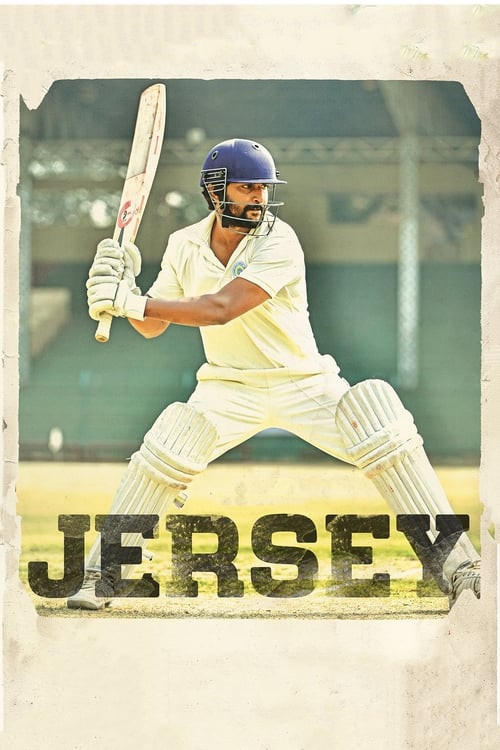
Jersey
2019 · Gowtam Tinnanuri
For when you need a good cry and want to feel earned uplift with it — the underdog film to reach for when life has knocked your own confidence around.
What it's about
Arjun was a gifted batsman whose first-class cricket career stalled in his twenties; now he's in his mid-thirties, out of work, and diminished in his own house. When his young son asks for one thing — an India jersey — he decides to attempt the comeback nobody believes in, not for glory, but to be worth something in his child's eyes again. It's a sports movie welded to a marriage story, and the real scoreboard is at home.
The experience
It builds slowly and then hits very hard — the cricket is rousing, but it's the father-son and husband-wife scenes that do the damage. Bring tissues; this one earns its tears honestly.
Performances
Nani gives one of the defining performances of his career — a proud, wounded man swallowing humiliation daily — and Shraddha Srinath matches him as a wife whose patience has real limits, making the marriage feel lived-in rather than decorative.
The craft
Gowtam Tinnanuri writes the sports drama as domestic melodrama: the match sequences are shot with genuine tension, but the screenplay keeps redirecting the stakes back to a family's dinner table. The restraint is the craft — it withholds the big emotional swings until they count.
Why it matters
One of the most critically esteemed Telugu films of its year, recognized at India's National Film Awards, and successful enough to be remade in Hindi — it helped prove the mid-budget emotional drama could still be an event.
Snapshot
Jersey is a Telugu-language sports drama written and directed by Gowtam Tinnanuri, built around a deceptively simple premise: a gifted batsman whose first-class career stalled in his twenties attempts an improbable comeback in his mid-thirties, less for glory than to buy his young son the one thing the boy has asked for — an India jersey. The film pairs the architecture of the athletic-underdog picture with the intimacy of a domestic melodrama, and its emotional engine is not the scoreboard but a father's wounded pride and his need to be seen by his child. Led by Nani in one of the defining performances of his career and anchored by Shraddha Srinath as his wife, the film became one of the more critically esteemed Telugu releases of its year, earned recognition at the National Film Awards, and was substantial enough as a property that Tinnanuri himself directed a Hindi-language remake in 2022 with Shahid Kapoor. It sits at an interesting hinge in contemporary Telugu cinema: a mid-budget, star-driven film whose ambitions are dramatic and formal rather than spectacular.
Industry & production
Jersey was produced under Sithara Entertainments, with Suryadevara Naga Vamsi among the principal producers — a banner that through the late 2010s positioned itself around content-forward, actor-led projects rather than the large-scale mass entertainers that dominated Telugu box-office conversation. The casting of Nani was central to the film's commercial logic. By 2019 Nani had cultivated a distinctive "natural star" brand: an actor associated with relatable, middle-class protagonists rather than the demigod archetype, which made him an unusually apt vehicle for a story about failure, age, and second chances. That persona is load-bearing here; the film's melancholy depends on an audience willing to accept its lead as an ordinary man rather than an invincible hero.
The production is notable for its cross-industry crew, a growing feature of Telugu filmmaking in this period. The music was composed by Anirudh Ravichander, a Tamil-industry composer, and the cinematography was handled by Sanu John Varughese, whose background reaches into Malayalam and Hindi cinema. This pan-Indian assembly of talent reflected an industry increasingly willing to import craftspeople across language lines to raise production values. Beyond these broad strokes, the granular production record — shooting schedule specifics, exact budget, and precise box-office figures — is not something I can state reliably, and I will not invent numbers; the film is generally described as a commercial success, but I'd treat any specific gross with caution.
Technology
Jersey is a digitally originated feature consistent with standard late-2010s Indian production practice; there is no indication it pursued celluloid or any unusual capture format, and I won't attribute a specific camera system without confirmation. The technological interest lies less in acquisition than in the challenge every cricket film faces: making the sport legible and kinetic on screen. Cricket is a slow, spatially dispersed game, and its cinematic representation depends on the manipulation of speed, angle, and cutting rhythm to compress and dramatize passages of play. The film's match sequences rely on the contemporary toolkit — high-frame-rate capture for slow motion, multiple camera positions to cover the batsman-bowler duel, and digital grading to unify light across sequences shot over many days. The staging of crowds and stadium scale is another technological-logistical problem; where genuine venue footage ends and constructed or augmented crowds begin is not something I can specify precisely, so I'll flag that as a gap rather than guess.
Technique
Cinematography
Sanu John Varughese's photography is one of the film's most consistently praised elements. The register is naturalistic and controlled: warm, slightly desaturated interiors for the domestic scenes that carry the film's grief, and a cleaner, more energized palette on the field. The visual strategy separates two worlds — the cramped, defeated texture of the protagonist's home and workaday life, and the open, charged geometry of the cricket ground where he is briefly himself again. On the pitch, the coverage privileges the physical fact of the batsman: the stance, the timing of a stroke, the isolation of a man at the crease. The camera tends to hold on faces and bodies to locate emotion in performance rather than dissolving action into pure montage. This restraint is deliberate; the film resists the hyper-stylized, gravity-defying sports photography common to the genre in favour of something more grounded, which serves its melodramatic aims.
Editing
Editing is arguably the film's signature craft achievement — Naveen Nooli's work on Jersey was recognized with the National Film Award for Best Editing at the 67th National Film Awards, a rare honor for a Telugu genre film and a meaningful marker of the cutting's quality. The editorial challenge is twofold: sustaining the rhythm of cricket, which requires building tension across deliveries and overs, and managing the film's framing device and time structure, which moves between a present-tense narration and the past it recounts. The match sequences are cut to manufacture suspense from a fundamentally intermittent game, using pace, reaction shots, and the withholding and release of outcomes. Away from the field, the editing modulates a slower, sadder tempo, letting domestic scenes breathe. The award recognition specifically points to how the cutting integrates these two clocks.
Mise-en-scène / staging
The film's production design draws a sharp class and mood distinction between the protagonist's diminished present and the aspirational world of professional cricket. Home spaces are dressed to register strain — the physical evidence of a stalled career and financial pressure — while the cricketing environments are staged as sites of possibility. A recurring motif is the jersey itself: an article of clothing elevated to a symbol of legitimacy, belonging, and a father's promise. Costume and object function here as narrative shorthand, with the son's want of the jersey concretizing an abstract desire for recognition. The staging of the father-son relationship is intimate and physical, built on small gestures rather than declarations.
Sound
Anirudh Ravichander's score and songs are integral to the film's emotional operation. The music leans into swelling, melodic uplift during the comeback beats and turns spare and aching in the domestic register, and the composer's involvement was itself part of the film's cross-industry appeal. Sound design in the match sequences does heavy dramatic work — the crack of bat on ball, the swell and hush of crowd noise, the isolating quiet that can be dropped in to focus a decisive moment. As with the technical crew generally, I can speak to the score's prominence and reception with confidence but would avoid asserting specific mixing or design credits I can't verify.
Performance
Nani's performance is the film's center of gravity and its most discussed feature. He plays age, defeat, and suppressed hope through physical diminishment and reticence rather than histrionics — the comeback is convincing precisely because the actor first makes the failure convincing. The role demanded credible cricketing physicality alongside the emotional arc of a proud man humbled, and the general critical consensus credits Nani with carrying both. Shraddha Srinath, as the wife, provides the film's other axis: her character bears the accumulated frustration of a partner tied to a man who won't relinquish an impossible dream, and the marriage is written and played with more friction and adult complexity than the genre usually allows. The child performer playing the son (Ronit Kamra) supplies the film's affective payload; the relationship between father and son is where the drama ultimately lands.
Narrative & dramatic mode
Jersey operates in a melodramatic mode structured as a retrospective narration — the story is framed as a recounting, which sets up the film for an emotional reversal in its final movement. This framing device is not incidental: it conditions how the audience receives the comeback, seeding a valedictory undertone beneath the ostensibly triumphant sports narrative. Dramatically, the film is a study in masculine pride and belated fatherhood. The protagonist's motivation is pointedly small and personal — a promise to a child — rather than the nation-, team-, or self-glory that typically motivates the sports hero, and this scaling-down is what gives the film its particular pathos. The three-act comeback skeleton is familiar (fall, decision to return, trial and vindication), but the film complicates the standard uplift with a persistent register of loss, so that even its victories feel shadowed. The domestic subplot — a strained marriage, financial precarity, a subplot involving the protagonist's beleaguered working life — grounds the sports fantasy in economic and emotional reality.
Genre & cycle
The film belongs to the Indian sports-drama cycle, a lineage with deep roots and a strong cricketing branch given the sport's cultural centrality on the subcontinent. Landmark reference points include the epic period allegory of Lagaan (2001), the differently-abled underdog story of Iqbal (2005), and the biographical mode of M.S. Dhoni: The Untold Story (2016). Jersey distinguishes itself within this cycle by pursuing the comeback-in-middle-age variant rather than the rise of a young talent, aligning it more with the melancholy, second-chances strain of sports cinema than with youthful triumphalism. It also fuses the sports film with the family melodrama in a way that foregrounds the domestic as much as the athletic. Within specifically Telugu cinema, the film sits in a mid-budget, performance-driven register that runs counter to the industry's high-concept "mass" cycle, marking it as part of a content-cinema tendency gaining traction in the late 2010s.
Authorship & method
Jersey is Gowtam Tinnanuri's second feature, following Malli Raava (2017), and it consolidated his authorial identity around emotionally driven, structurally careful storytelling rather than spectacle. His method here is legible in the film's patience and its reliance on a narrative frame that reorganizes the meaning of everything preceding it — a screenwriter's device as much as a director's. The strongest signal of his authorship is that he was entrusted to direct the film's own Hindi remake, an unusual continuity that speaks to how personally identified the material was with him.
The key collaborators shape the film decisively. Cinematographer Sanu John Varughese brings a restrained naturalism that resists genre flash. Composer Anirudh Ravichander supplies the film's emotional amplification and, as a Tamil-industry figure working in Telugu, exemplifies the pan-Indian craft economy. Editor Naveen Nooli's award-winning cutting is the technical spine that makes both the cricket and the time-structure work. Together this crew produces a film whose craftsmanship is coherent and directed toward feeling rather than display. Where individual creative decisions are concerned beyond these established credits and their reception, I'd rather note the limits of the public record than manufacture intent.
Movement / national cinema
The film is a product of the Telugu film industry ("Tollywood"), one of the largest and most commercially muscular of India's regional cinemas. It arrived during a period when Telugu cinema's national and international profile was rising sharply, and when a parallel appetite for "content films" — mid-budget, story- and performance-led work — was coexisting with the industry's blockbuster spectacle tradition. Jersey belongs to that content tendency. Its cross-industry crew also reflects a broader integration of Indian regional cinemas, with talent, remakes, and dubbed/subtitled distribution flowing more freely across language markets than in earlier decades. The film's subsequent Hindi remake is itself an artifact of this integrated ecosystem, in which a successful regional property is recirculated to the Hindi market.
Era / period
Released in 2019, Jersey sits at the end of a decade that saw Indian cinema's regional industries gain unprecedented reach, aided by the rapid expansion of streaming platforms and the normalization of subtitled cross-regional viewing. It predates the pandemic disruption that would reshape release and consumption patterns almost immediately afterward, and it belongs to a moment when the theatrical mid-budget drama could still find a substantial audience. The film's engagement with cricket also ties it to its era's sporting culture, in which the sport's saturation of Indian public life made the jersey an instantly readable emblem of aspiration.
Themes
The film's central theme is dignity — the desire of a man who has been written off to reclaim his worth in his own eyes and, more urgently, in his son's. Fatherhood is its emotional core: the comeback is finally an act of love and promise-keeping rather than personal vindication, and the film interrogates what a parent owes a child and what a child's simple want can demand of an adult. Failure and age form a second cluster of concerns; Jersey is unusually willing to dwell on the humiliation of unrealized talent and the specific cruelty of coming close and falling short. Economic precarity threads through the domestic story, tethering the sports dream to material stakes. And running beneath the uplift is a meditation on legacy and memory — how a person wishes to be remembered — a theme the film's retrospective narrative frame quietly foregrounds and then detonates.
Reception, canon & influence
Jersey was met with strong critical approval, with particular praise directed at Nani's performance, the emotional weight of the father-son relationship, and the technical craft, especially the editing. Its most concrete canonical marker is recognition at the 67th National Film Awards, where it was honored as a leading Telugu feature of its year and where Naveen Nooli's editing was singled out — a significant institutional endorsement for a genre film. Beyond that, I would characterize its commercial performance as successful without attaching specific figures I cannot verify.
Looking backward, the film's influences are the established Indian sports-drama and cricket-film traditions, the family melodrama, and the international lineage of the middle-aged athletic comeback story, refracted through a distinctly Indian idiom of fatherhood and duty. Looking forward, its clearest legacy is the 2022 Hindi remake — also titled Jersey, also directed by Tinnanuri, and starring Shahid Kapoor with Mrunal Thakur — which transposed the story to a North Indian milieu. That remake was, by general account, far less successful than the original, a divergence often read as evidence that the specific chemistry of the Telugu version — Nani's persona, the tonal control, the craft — was not easily reproduced. In that sense Jersey (2019) stands as both a well-regarded entry in the Telugu content-cinema wave and a cautionary case study in the limits of the cross-language remake, its reputation resting more securely on the original than on its later franchise extension.
Reception
A sleeper hit on release in 2019 that quickly snowballed into 'one of the decade's best Telugu films' status — and when the 2022 Hindi remake underperformed, the discourse sent a whole new wave of viewers back to the original, cementing it further.
How Jersey was received, from release to now →
How to watch Jersey: what to notice on a first viewing
- Notice the difference between the home scenes and the field. Varughese shoots the domestic scenes in warm, desaturated tones that carry the family's strain, then switches to a cleaner, more energized palette once the story reaches the cricket ground. The color tells you which world you're in before any line of dialogue does.
- Watch the camera hold on his stance before he swings. At the crease the coverage isolates the batsman, his stance, the timing of a stroke, rather than dissolving the action into fast montage. The film locates his emotion in his body at the crease, not in slow motion heroics.
- Listen for the score swelling on the field, going quiet at home. Anirudh Ravichander's music leans into melodic uplift during the comeback beats and turns spare and aching in the domestic scenes, matched by a sound design that isolates the crack of bat on ball. The music tells you which register you are in, triumph or strain, before the scene finishes explaining itself.
- Watch how often the film returns to the jersey itself. The jersey the son wants becomes a recurring object, an ordinary piece of clothing carrying the weight of legitimacy, belonging, and a father's promise. One piece of clothing carries everything the father cannot say to his son directly.
- Watch Nani's posture more than his face when he fails. He plays age and defeat through physical diminishment and reticence rather than histrionics, so the failure has to be convincing before the comeback can be. The restraint makes the hope that follows feel earned rather than staged for you.
The whole guide to watching Jersey, with the keys for a rewatch →
Influences: the films it descends from and the films it influenced
- Lagaan: Once Upon a Time in India (2001) — Established the Indian grammar of cricket legibility — making an entire match dramatically readable to a mass audience through ball-by-ball match cutting and crowd-reaction inserts — the editorial vocabulary Naveen Nooli reuses to make Jersey's play emotionally trackable.
- Iqbal (2005) — Built the Indian cricket-underdog drama by isolating bowling/batting mechanics in tight close-up so technique itself carries emotion, a small-scale sports-as-inner-life approach Jersey extends to the batsman's comeback.
- Chak De! India (2007) — Codified the disgraced-athlete-seeking-redemption arc and, crucially, the star subordinating persona to a deglamorized, restrained performance — the template Nani follows in muting his usual charm.
- Rocky (1976) — Fixed the working-class comeback arc whose true stake is dignity rather than the trophy, the value system Jersey inherits by making a jersey, not a championship, the goal.
- Raging Bull (1980) — Modeled the retrospective frame in which an athlete looking back reorganizes the meaning of everything shown, and the choice to shoot sport for interior psychology over spectacle.
- Bicycle Thieves (1948) — Set the neorealist template of a struggling father humiliated before his adoring son, the fatherhood-dignity dynamic and naturalistic restraint Jersey's cinematography deliberately echoes over genre flash.
- Cinderella Man (2005) — Explicitly fused the comeback-fight structure with a father fighting to provide for his family, the exact welding of sport to fatherhood-as-duty that is Jersey's emotional spine.
- Million Dollar Baby (2004) — Pairs the middle-aged comeback with a retrospective voiceover frame that recolors the entire preceding story, plus low-key naturalistic lighting chosen over sports-movie gloss.
- The Wrestler (2008) — Shot the aging athlete's ruined body with handheld naturalistic restraint that refuses glamour, the anti-spectacle register Sanu John Varughese adopts for Jersey's older protagonist.
- Malli Raava (2017) — Tinnanuri's own prior feature that established his signature dual-time, non-linear structure and patient, feeling-first method later consolidated in Jersey's editing architecture.
- Jersey (2022) — The director's own Hindi remake transposing the identical dual-time structure, retrospective frame, and comeback beats to a North Indian milieu with Shahid Kapoor in the Nani role.
- 83 (2021) — Inherits the Lagaan-to-Jersey cricket-legibility grammar, dramatizing real match play through reaction-driven match cutting for a mainstream audience.
- Maidaan (2024) — Extends the Indian sports-comeback figure through restrained, period-naturalist craft that foregrounds a weathered protagonist's dignity over on-field spectacle.
- Slumdog Millionaire (2008) — Deploys a framing device whose late revelation retroactively reorganizes the meaning of every prior scene — the screenwriter's structural gambit Tinnanuri builds Jersey's retrospective frame around.
- Warrior (2011) — Constructs the sports film as family melodrama anchored by a wounded patriarch, prioritizing the domestic bond over the athletic contest the same way Jersey does.
- Pelli Choopulu (2016) — A cornerstone of the same Telugu content-cinema wave that privileges naturalistic, small-scale, character-driven storytelling over star spectacle — the movement Jersey belongs to.
- C/o Kancharapalem (2018) — Telugu content-cinema contemporary that similarly uses withheld structural information as a revelation device and naturalistic restraint over glossy production.
Similar films
- C/o Kancharapalem (2018) — influence & lineage
- Warrior (2011) — influence & lineage
- Lubber Pandhu (2024) — shared sensibility
- Vaaranam Aayiram (2008) — shared sensibility
- Sarpatta Parambarai (2021) — shared sensibility
- Meiyazhagan (2024) — shared sensibility
- Asuran (2019) — shared sensibility
- Bangalore Days (2014) — shared sensibility