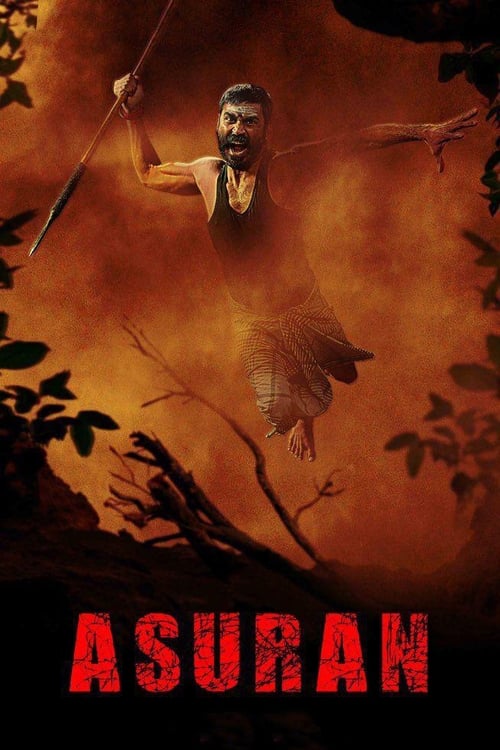
Asuran
2019 · Vetrimaaran
For when you want intensity with weight — a gripping, angry film that earns its action with real grief and leaves you chewing on questions of justice and inheritance. This is a challenge, not comfort viewing.
What it's about
A low-caste farming family in rural southern Tamil Nadu flees into the night after the hot-headed teenage son kills a powerful upper-caste landlord. His father — a meek, hard-drinking toddy-tapper the boy is half-ashamed of — leads the escape, and the chase gradually uncovers who this quiet man used to be, and what it cost him to become so careful. It's a survival story sitting on top of a generations-deep fight over land, caste, and respect.
The experience
Ferocious and emotionally battering — a chase film that keeps tightening while a long look into the past deepens every stake. The violence hits hard because the film mourns it; you come out shaken and moved.
Performances
Dhanush is extraordinary as the father, playing both a stooped, self-erasing older man and the very different man he once was — a dual register that won him a share of India's National Film Award for Best Actor.
The craft
Vetrimaaran adapts an acclaimed Tamil novel into a two-track structure — present-tense flight braided with a long central flashback — that turns a lean chase into something novelistic. The rural landscapes are shot with harsh beauty, and the action is staged for impact rather than spectacle.
Why it matters
A major commercial and critical success that pushed caste and land politics to the center of mainstream Tamil cinema, and cemented its director-star pairing as one of the most vital in Indian film.
Snapshot
Asuran is a Tamil-language rural action-drama that Vetrimaaran adapted from Poomani's acclaimed Tamil novel Vekkai ("The Heat"), transposing the book's spare account of a father and son on the run into a sprawling meditation on caste, land, and the terrible arithmetic of retaliation. The film follows Sivasami, a low-caste toddy-tapping farmer of southern Tamil Nadu, whose family is driven to flight after his younger son kills a dominant-caste landlord in revenge for the murder of the elder son. Structured as a present-tense chase braided with a long central flashback, the film gradually reframes the seemingly meek, alcohol-softened father as a man who has deliberately buried a violent past in order to break the cycle for his children. Dhanush's central performance won him a share of the National Film Award for Best Actor at the 67th National Film Awards, where Asuran was also honored as the Best Tamil feature; the film stands, alongside the work of Pa. Ranjith and Mari Selvaraj, as a landmark of the caste-conscious turn in 2010s Tamil cinema.
Industry & production
Asuran was produced by Kalaipuli S. Thanu under his banner V Creations, a substantial mainstream production house, and this backing matters to how the film reads: it is not a marginal art-house object but a star vehicle for Dhanush, one of Tamil cinema's most bankable and versatile leading men, deployed in the service of unusually confrontational political material. That fusion — a top-tier commercial star, a mass-market producer, and a subject (caste atrocity, agrarian dispossession) more often confined to parallel cinema — is the film's defining industrial fact. Vetrimaaran had by 2019 built a reputation as a director who could smuggle hard social realism into commercially viable packages, and Asuran extended that method to its largest canvas yet. The production drew on the literary prestige of Poomani, a respected figure in modern Tamil letters, which lent the adaptation cultural legitimacy beyond the usual commercial calculus. Precise budget and box-office figures are not something I can state reliably here, so I will not invent them; what is well documented is that the film was a critical and popular success and became one of the more talked-about Tamil releases of its year.
Technology
Asuran was shot digitally, consistent with the standard practice of Tamil feature production by the late 2010s, and its images favor available-light naturalism, deep earth tones, and a grain of physical texture over gloss. I do not have a reliable record of the specific camera system used, so I will not attribute one. What is evident on screen is a technological approach oriented toward realism rather than spectacle: handheld and shoulder-mounted mobility for the chase and fight sequences, low-light interiors that preserve the murk of village huts and toddy shops, and a color palette pushed toward ochre, dust, and the wet green of paddy fields. The digital workflow enabled the film's long, mud-caked outdoor sequences and its capacity to shoot in low light without sacrificing the sense of a real, unglamorous landscape. Sound recording and post-production likewise serve immersion — the film's sonic world is dense with rural ambience — but I cannot verify the specific technical particulars of the mix format beyond what the finished film demonstrates.
Technique
Cinematography
The cinematography — attributed to Velraj, though readers should treat crew attributions as subject to verification — is the film's most immediately expressive instrument. It works in a register of grounded naturalism: the camera stays close to bodies, to soil, to sweat, so that violence lands as physical labor rather than choreography. The rural southern Tamil Nadu landscape is photographed not as scenic backdrop but as contested property — every field, well, and boundary is a stake in the caste conflict, and the framing insistently ties characters to the land they are fighting over. The chase sequences use a restless, ground-level mobility that keeps the fugitives hemmed in by terrain, while the flashback passages carry a subtly different texture, marking the younger, more incendiary Sivasami's world as a separate stratum of memory. Light is handled to preserve the grime of the milieu: interiors are dim and smoky, exteriors harsh and sun-flattened.
Editing
The editing — credited to R. Ramar, again pending verification — is structurally the film's boldest gambit, because Asuran withholds its central revelation through a deliberately delayed flashback architecture. The first movement plunges the viewer into a chase whose stakes are legible but whose deep history is hidden; the long central flashback then rewrites everything the audience has assumed about the father's passivity, and the final movement returns to the present with that knowledge weaponized. The cutting modulates between the propulsive urgency of the manhunt and the slower, more explanatory rhythm of the backstory. Crucially, the edit manages the film's ethical argument: it releases information in an order designed to make the audience first judge Sivasami's meekness and then understand it, so that the structure itself performs the film's thesis about restraint.
Mise-en-scène / staging
Vetrimaaran's staging is committed to the specificity of place and social station. Costume, dwelling, food, drink, and posture all encode caste and class position; the dominant-caste landlords occupy a different physical and spatial world — larger houses, mounted vehicles, retinues — than the fugitive family, and the blocking constantly registers these hierarchies. The toddy shop, the fields, the courtroom, the forest of flight: each set is dressed for social truth rather than picturesqueness. Violence is staged with a bluntness that refuses glamour — killings are sudden, ugly, and consequential — and the film repeatedly stages humiliation and deference as bodily facts, the way lower-caste characters must hold themselves before their oppressors.
Sound
G. V. Prakash Kumar's score and the film's overall sound design lean toward the folk and the elemental rather than the orchestral. The music draws on rural Tamil idioms and percussion, reinforcing the agrarian, southern setting, and it is used sparingly enough that the film's silences and ambient textures — wind over fields, the murmur of a village, the sudden report of violence — carry real weight. The soundscape is a naturalist one, foregrounding environmental noise to keep the drama tethered to its physical world; the score swells at the film's moral and emotional peaks without tipping into the wall-to-wall scoring common in commercial Tamil cinema.
Performance
The film is anchored by Dhanush in a role that requires him to hold two men in one body: the stooped, alcohol-dulled, seemingly cowardly father of the present, and the younger firebrand of the flashback capable of appalling violence. The performance's achievement is that the meekness never reads as mere weakness once the backstory lands — it becomes visible as suppression, a lifetime's discipline. The ensemble is strong around him: Manju Warrier grounds the family as the wife and mother, Pasupathy contributes as a figure from the family's world, and Ken Karunas and Teejay Arunasalam play the sons whose hot-blooded impulses drive the tragedy. The younger performers are essential to the film's generational argument, embodying the very reflex toward retaliation that the father has spent his life trying to unlearn.
Narrative & dramatic mode
Asuran operates in the mode of tragedy folded inside a revenge thriller, and its dramatic power comes from inverting the revenge form. The genre ordinarily rewards escalation; here the film's moral intelligence lies in a father who understands, from bitter experience, that escalation only feeds the machine of caste violence. The narrative's central device is dramatic irony managed across time: by structuring the story so that the audience learns the father's past midway, Vetrimaaran converts what looked like cowardice into hard-won wisdom, and converts the sons' bravery into the naïveté that dooms the family. The film's emotional climax is not a triumphant kill but an argument — the father's insistence, at the story's close, that the one possession the powerful cannot seize from the poor is education, that knowledge is the only inheritance that cannot be taken by force. This reframes the entire action as an argument against the very catharsis the revenge genre promises.
Genre & cycle
The film belongs to the tradition of the rural Tamil action-drama — the caste-and-land vendetta film with roots deep in Tamil cinema — but it participates in that tradition critically rather than celebratorily. Where many rural-revenge films aestheticize masculine retribution, Asuran stages retribution as a trap. It sits squarely within the late-2010s wave of caste-conscious Tamil cinema, a cycle that includes Pa. Ranjith's Kaala (2018), Mari Selvaraj's Pariyerum Perumal (2018), and, shortly after, Selvaraj's Karnan (2021). Within that cycle Vetrimaaran's emphasis is characteristically his own — as attentive to class and land economics as to caste identity, and drawn to the intimate family unit as the site where these forces detonate. The film thus reads simultaneously as commercial star vehicle, agrarian tragedy, and political intervention.
Authorship & method
Vetrimaaran is among the most distinctive auteurs of contemporary Tamil cinema, and Asuran is a definitive statement of his method. Across Polladhavan (2007), the National Award–winning Aadukalam (2011), Visaranai (2015) — India's official Academy Award submission that year, drawn from an account of custodial torture — and the crime epic Vada Chennai (2018), he has pursued a socially engaged realism preoccupied with power, the marginalized, and the machinery of violence. His method combines rigorous location shooting, ensemble naturalism, star performers pushed into deglamorized registers, and narrative structures that complicate easy moral positions. In Asuran his key collaborators extend that project: composer G. V. Prakash Kumar, a frequent presence in Vetrimaaran's cinema, supplies folk-rooted music; the cinematography (attributed to Velraj) and editing (attributed to R. Ramar) serve the director's naturalism and his delayed-revelation structure; and the screenplay's foundation in Poomani's Vekkai gives the film a literary spine. The authorship here is a fusion of a director's political vision with a respected novelist's source material — Vetrimaaran adapting rather than inventing, and using the prestige of the novel to legitimize a mass-audience release.
Movement / national cinema
Asuran is a product of the Tamil film industry ("Kollywood") and, more specifically, of a moment in which Tamil cinema became one of Indian cinema's most vital arenas for anti-caste and class-conscious storytelling. This is distinct from the parallel or "new wave" cinemas of earlier decades; it is a movement inside popular cinema, where directors like Ranjith, Selvaraj, and Vetrimaaran brought Dalit and subaltern perspectives into star-driven commercial films. The film's rootedness in the dialect, geography, and social texture of southern Tamil Nadu is central to its identity as regional cinema — its politics are inseparable from its specificity of place. Within the broader frame of Indian national cinema, Asuran's recognition at the National Film Awards marked an institutional acknowledgment of this regional, politically charged current.
Era / period
Released in 2019, Asuran arrives at a high-water mark of the caste-cinema conversation in Tamil Nadu, when questions of Dalit assertion, land, and historical atrocity had moved from the margins to the commercial center of the industry. The film is a period piece in the sense that its flashback structure reaches into an earlier decade of agrarian caste conflict, but it speaks pointedly to its present: its closing emphasis on education as the instrument of liberation resonates with long-running debates in Tamil political culture about social mobility, reservation, and the unfinished business of caste. The film belongs to the digital-production, star-plus-message era of late-2010s Tamil cinema, when the industry's technical polish and its political ambition were, briefly and productively, aligned.
Themes
The film's governing theme is the cycle of caste violence and the near-impossibility of escaping it. Land is the material engine of the plot — the family's small holding is the object of the dominant caste's covetousness, and dispossession is the film's original sin. Against the reflex of vengeance the film sets an argument for restraint, embodied in a father who knows that answering blood with blood only guarantees more blood. Masculinity is interrogated: the sons' pride and the culture's expectation of retaliatory manhood are shown as forces that consume the very people they claim to protect. And finally there is education as emancipation — the film's closing thesis that the powerful can seize a family's land and money but cannot confiscate knowledge, which becomes the one weapon capable of breaking the cycle across generations. These themes are woven, not stated: the tragedy earns the argument.
Reception, canon & influence
Asuran was widely praised on release, both for Dhanush's performance and for Vetrimaaran's uncompromising treatment of caste, and its critical standing was ratified institutionally when Dhanush won a share of the Best Actor honor (with Manoj Bajpayee for Bhonsle) and the film was recognized as Best Tamil feature at the 67th National Film Awards; I am confident of these awards, while directing readers to verify finer categorical details. Backward, the film draws on Poomani's novel Vekkai as its narrative and moral foundation, on the long tradition of the Tamil rural-vendetta film, and on Vetrimaaran's own prior realist work; it also draws, more broadly, on the historical record of caste atrocity in southern Tamil Nadu. Forward, its most concrete legacy is the Telugu remake Narappa (2021), which transplanted the story into Telugu cinema with Venkatesh in the lead — a direct measure of the original's resonance across Indian language industries. Within its own industry, Asuran helped consolidate the commercial viability of politically charged, caste-conscious storytelling, reinforcing a current that shaped subsequent Tamil cinema. It is now commonly cited among the essential films of the 2010s anti-caste turn in Tamil cinema, and among Dhanush's and Vetrimaaran's most significant achievements — a film that took the machinery of the mass-market revenge drama and turned it, against its own grain, into an argument for laying the weapon down.
A Deleuzian reading
The first thing to watch in *Asuran* is not a face.
The full Deleuzian reading of Asuran →
Reception
A hit and a critical favorite from day one, Asuran skipped the reappraisal phase entirely — the 2021 National Awards (Best Tamil Film, plus Best Actor for Dhanush) simply rubber-stamped what audiences had already decided, and streaming carried it far beyond the Tamil-speaking world.
How Asuran was received, from release to now →
Influences: the films it descends from and the films it influenced
- Visaranai (2015) — Vetrimaaran's documentary-grade location shooting and ensemble of non-star unknowns subjected to the mechanics of custodial/institutional violence set the deglamorized-brutality register Asuran inherits wholesale.
- Aadukalam (2011) — Forged the Vetrimaaran–Dhanush method of pushing the star into a sweat-and-dust, dialect-heavy rural physicality (a National Award performance), the exact deglamorized register Dhanush extends into Asuran's dual role.
- Vada Chennai (2018) — Established Vetrimaaran's braided non-linear architecture that withholds a character's formative past until it recontextualizes the present — the delayed-flashback structure Asuran reuses to reveal the father's hidden history.
- Polladhavan (2007) — Vetrimaaran's debut fixed his object-anchored grounded realism and refusal of heroic gloss, the naturalist grammar that underpins Asuran's staging.
- 16 Vayathinile (1977) — Bharathiraja dragged Tamil cinema out of the studio into real villages shot in available light with regional dialect, founding the location-realist rural lineage Asuran continues.
- Paruthiveeran (2007) — Ameer's raw Madurai-belt vendetta with authentic dialect and unromanticized caste-inflected killing prefigures Asuran's grounded regional texture and matter-of-fact violence.
- Subramaniapuram (2008) — Sasikumar's non-star, period-set gang-vengeance realism with blunt, un-choreographed brutality helped establish the deglamorized Tamil revenge-realism Asuran refines.
- Sholay (1975) — The prototypical mass-market rural-vendetta blockbuster whose crowd-pleasing revenge machinery Asuran deliberately adopts in order to turn it against its own grain.
- Pudhupettai (2006) — Continues Dhanush's de-glamorized, transformation-driven performance mode inside a gritty subaltern milieu governed by social determinism, the actorly legacy Pudhupettai first proved.
- Virumaandi (2004) — Marshals a major star inside a flashback-structured land-and-caste revenge cycle, the exact combination — stardom in service of a difficult social argument told out of chronological order — that Virumaandi proved viable.
- Narappa (2021) — The authorized Telugu remake transposing Asuran's plot, delayed-flashback structure and deglamorized lead performance one-to-one into Telugu cinema with Venkatesh.
- Karnan (2021) — Extends Asuran's fusion of political anti-caste argument with mass-cinema catharsis, using a folk-rooted score and mythic-realist staging of a village uprising.
- Viduthalai Part 1 (2023) — Vetrimaaran's own deepening of state-and-caste violence realism through immersive long-take staging, advancing the method Asuran crystallized.
- Maamannan (2023) — Carries forward Asuran's meek-father / emboldened-son generational arc and its education-and-political-assertion-as-emancipation thread into an electoral anti-caste drama.
- Viduthalai: Part I (2023) — Directly precedes Viduthalai's caste-and-dispossession subject and its method of drawing mythic-restrained performance from an actor cast against physical type, plus R. Velraj-style earthen location image (Velraj shot both).
- Lubber Pandhu (2024) — Fused mainstream commercial pace with caste-violence realism and a bruised-masculinity/dignity arc, proving a wide audience would take pointed caste critique inside genre pleasure — the commercial-realist balance Pachamuthu targets.
- Unforgiven (1992) — A revisionist revenge film that indicts its own genre — the retired killer forced back to the gun — performing the same anti-violence turn on the vengeance drama that Asuran enacts.
- A History of Violence (2005) — Built on the dramatic irony of a mild family man whose concealed capacity for violence surfaces through delayed disclosure, mirroring Asuran's meek-father / buried-past reveal structure.
- Pariyerum Perumal (2018) — A contemporaneous anti-caste Tamil film that makes oppression legible through caste-coded mise-en-scène (footwear, seating, spatial exclusion), the same visual grammar Asuran deploys.
- Kaala (2018) — Ranjith's anti-caste drama makes Dalit land dispossession the literal battleground, the identical theme that drives Asuran's central conflict over contested ground.
- Sarpatta Parambarai (2021) — Shares the physical-transformation lead performance and the dramatization of caste violence as inherited, generational grievance, with a period/rural reconstruction anchoring the drama in a concrete social history.
- Jai Bhim (2021) — Parallel demonstration that a top-billed Tamil star could be physically de-glamorised — gait, teeth, costume, dialect — inside a caste land-violence narrative, from the same Vetrimaaran workshop that trained Jai Bhim's editor.
- Kantara (2022) — Vetrimaaran withholds his protagonist's violence for two acts of studied deference in a land-grab conflict, then detonates it late and retroactively — the delayed-detonation structure Kantara uses on Shiva, where restraint reads as timidity until it is revealed as containment.
Similar films
- Vada Chennai (2018) — influence & lineage · same viewing thread
- Aadukalam (2011) — influence & lineage
- Pariyerum Perumal (2018) — influence & lineage
- Sholay (1975) — influence & lineage · same viewing thread
- Pudhupettai (2006) — same viewing thread
- Nayakan (1987) — same viewing thread
- Vikram Vedha (2017) — same viewing thread
- Mahanadhi (1994) — same viewing thread
All the films related to Asuran →
Watch it with: curated runs of related films
- Blood Feuds and Broken Men — A run of Indian films about ordinary men swallowed by violence, vendetta, and moral compromise — watch these together when you want fate, murky righteousness, and gunpowder sharing the same frame.