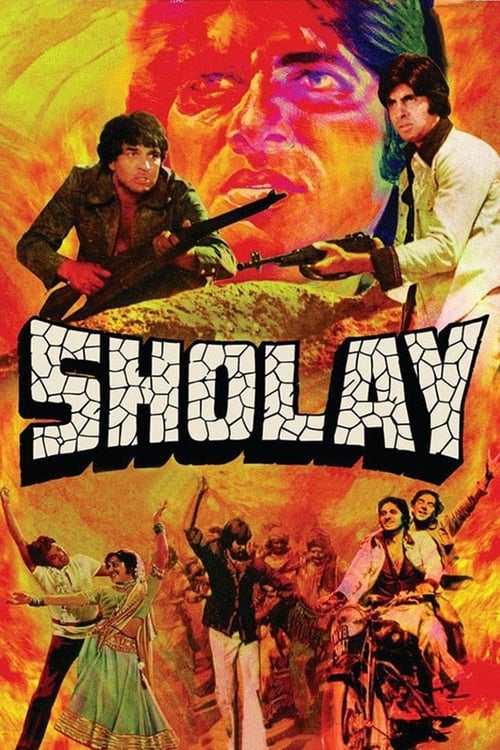
Sholay
1975 · Ramesh Sippy
When you want a full evening's entertainment — the whole buffet, laughter and tears and thunderous showdowns — and you're happy to surrender to a film that wants to give you everything at once.
What it's about
A former police inspector, maimed by the bandit Gabbar Singh and left with nothing after his family is slaughtered, hires two charming petty criminals — Jai and Veeru — to bring the bandit in alive. What starts as a mercenary job becomes something else as the two friends put down roots in the village they're defending, fall in love, and find themselves facing one of cinema's great villains.
The experience
Three hours that fly — it's a campfire epic that swings from comedy to song to romance to genuine menace, built on one of the most beloved friendships ever filmed. Gabbar Singh's scenes still carry a real charge of danger, and the emotional crescendos are played completely straight and completely earned.
Performances
Amitabh Bachchan and Dharmendra have era-defining chemistry as Jai and Veeru, Sanjeev Kumar brings granite dignity to the vengeful Thakur, and Amjad Khan's Gabbar Singh is one of the most quoted, imitated villains in world cinema — playful and terrifying in the same breath.
The craft
Ramesh Sippy shoots the rocky ravines in widescreen like a frontier western while Salim-Javed's screenplay delivers dialogue so quotable that entire scenes entered everyday Indian speech. The songs are woven into the story rather than pasted on, and the action set pieces — a train ambush above all — were on a scale Hindi cinema hadn't attempted. See it big and loud if you ever can.
Why it matters
The definitive Indian blockbuster: after a slow opening it became the longest-running film in Indian history, and its lines, characters, and images saturated the culture so thoroughly that Hindi cinema is often divided into before and after it.
Snapshot
Sholay ("Embers") is the definitive Hindi blockbuster, a three-hour "curry western" that fused the iconography of the American and Italian frontier film with the melodrama, music, and moral architecture of popular Indian cinema. Directed by Ramesh Sippy from a screenplay by the writing team Salim-Javed (Salim Khan and Javed Akhtar), it tells of a maimed former police officer, Thakur Baldev Singh (Sanjeev Kumar), who hires two petty criminals, Jai (Amitabh Bachchan) and Veeru (Dharmendra), to capture the bandit Gabbar Singh (Amjad Khan), who has slaughtered the Thakur's family. Released on 15 August 1975, it opened to tepid business and lukewarm reviews before word of mouth turned it into the longest-running and most culturally saturated film in Indian history. Its dialogue, its villain, and its images entered the vernacular to a degree few films anywhere have matched. It is routinely cited in industry and academic polls as the greatest Indian film ever made.
Industry & production
The film was produced by Ramesh Sippy's father, G.P. Sippy, a leading Bombay producer, under the Sippy Films banner, and it represented an enormous gamble in scale and budget for its era. Production stretched across roughly two and a half years, an unusually long schedule for the industry, and much of it was concentrated on location rather than on studio floors. The now-famous open-country setting was built near Ramanagara, a rocky region outside Bangalore in Karnataka, where the production laid roads, brought in power, and constructed the village of Ramgarh essentially from scratch; the area became so identified with the shoot that it is still popularly associated with the film. Casting reflected an industry in transition: Sanjeev Kumar and Dharmendra were established stars, Hema Malini was a top female lead, while Amitabh Bachchan was still ascending and was reportedly cast partly on the recommendation of colleagues rather than as a guaranteed draw. Amjad Khan, a relative newcomer, was cast as Gabbar Singh after other options fell through, a decision that proved career-defining. The production's ambition—synchronized action set-pieces, a train sequence, large crowd and stunt work—pushed Hindi cinema's technical and logistical envelope.
Technology
Sholay is remembered as a landmark in the technological presentation of Indian film. It was shot on anamorphic widescreen and released in prime metropolitan theaters in 70mm blow-up prints accompanied by stereophonic sound, then a novelty in India and a major part of the film's marketing and roadshow appeal. The wide frame and enlarged format were integral to how the film was experienced: the vast, arid landscapes and the scale of the action were meant to be overwhelming on a large screen, closer to the spectacle of a Hollywood or Italian epic than to the proscenium framing of much contemporaneous Hindi cinema. The stereophonic mix amplified the impact of gunfire, hoofbeats, and the train sequence, and it made the film's sound design—later sold on hugely popular dialogue records—an event in itself. The precise technical particulars of format and print runs should be treated with some caution, since accounts vary; what is firmly established is that the film was promoted and remembered as one of the earliest and most prominent Indian releases to foreground 70mm and stereo sound.
Technique
Cinematography
The cinematography, credited to Dwarka Divecha, is central to the film's identity. Working in widescreen, Divecha treated the Ramanagara terrain—boulder fields, scrub, open horizons—as a character, staging figures against emptiness in a manner clearly indebted to the Italian western's use of landscape. The camera alternates between expansive establishing vistas and tight, held close-ups, a rhythm borrowed from Sergio Leone: Gabbar Singh's introduction, in particular, withholds and then reveals through framing and scale. Action sequences, including the train ambush that opens the Jai-Veeru backstory, are shot with a mobility and coverage unusual for the period. The film's visual grammar—dust, heat, hard light on rock—gave Hindi cinema a frontier aesthetic that had few domestic precedents.
Editing
The editing is credited to M.S. Shinde. The film sustains a long running time by cross-cutting between registers—comedy, romance, action, and revenge tragedy—and by using flashback structure to deliver the Thakur's backstory and the origins of his mutilation as delayed, weighted revelations. The set-piece construction, especially in the action and the climactic confrontation, depends on precise cutting for tension and impact, and the film's most quoted moments are as much products of timing as of dialogue.
Mise-en-scène / staging
Sippy's staging blends spectacle with the tableau conventions of Hindi melodrama. Ramgarh is built as a legible moral space—the temple, the water tower, the Thakur's haveli, the surrounding badlands where Gabbar's gang roams. Gabbar's rocky hideout is staged almost theatrically, a stage for his monologues and cruelties. Set-pieces such as the water-tower sequence, the coin motif associated with Jai, and Gabbar's Russian-roulette torments are staged as self-contained, repeatable "numbers," which is part of why they detached so easily from the film and entered popular memory.
Sound
Beyond the technical achievement of stereo, sound is dramaturgically central. The film's dialogue—clipped, rhythmic, quotable—was written to be performed and savored, and its commercial life on audio records was extraordinary; lines delivered by Gabbar became catchphrases known to people who had never seen the film. R.D. Burman's score and songs, discussed below, are woven into this soundscape, alternating diegetic festivity with tension-building underscore.
Performance
The performances are the film's connective tissue. Amjad Khan's Gabbar Singh is the most celebrated: a giggling, unpredictable, sadistic bandit whose menace is built as much from vocal cadence and pauses as from action, and who broke from the more urbane villains typical of the period. Amitabh Bachchan's Jai—laconic, fatalistic, the quieter half of the duo—crystallized the "angry young man" persona that Salim-Javed and Bachchan were developing across this era, though here it is tempered and interiorized. Dharmendra's Veeru supplies extroverted comedy and romantic energy, Hema Malini's chatterbox Basanti provides the film's comic-romantic engine, and Jaya Bhaduri's near-silent widow Radha carries its most restrained emotional line. Sanjeev Kumar's Thakur anchors the revenge plot with wounded gravity.
Narrative & dramatic mode
The narrative is a revenge tragedy grafted onto a buddy adventure and a village-under-siege story. Its structure is deliberately plural: the central spine—Thakur's contracted vengeance against Gabbar—is braided with the friendship of Jai and Veeru, two romances of contrasting tone, extended comic interludes, and songs. This is the "masala" mode of Hindi cinema, which mixes genres and emotional registers within a single film, and Sholay is often held up as its supreme execution because the tonal shifts feel engineered rather than incidental. The dramatic mode is heightened and moral: sacrifice, honor, revenge, and communal solidarity are foregrounded, and the film builds toward a climax in which private vengeance collides with the demands of law and order.
Genre & cycle
Sholay is the touchstone of the "curry western" or "Dosti [friendship] western," an Indian adaptation of the frontier film. It belongs to a small cycle of early-1970s Hindi films that transplanted western and bandit motifs to rural India—most directly it is often compared to Mera Gaon Mera Desh (1971), also written in part within the Salim-Javed milieu's concerns and likewise pitting villagers and a redeemed outlaw against a dacoit. But Sholay absorbed the cycle and effectively ended it as anything but its own shadow: subsequent dacoit-and-village films were inevitably measured against it. Within the broader masala tradition, it stands as the model of large-scale, multi-star, multi-genre spectacle.
Authorship & method
Authorship of Sholay is genuinely shared. Ramesh Sippy directed with a strong sense of scale, pacing, and star management, and the film's coherence across its sprawling structure is a directorial achievement. The screenwriters Salim Khan and Javed Akhtar—working at the height of their influence, having already shaped the "angry young man" cycle—are widely regarded as co-authors of its power; the screenplay's architecture, characters, and above all its dialogue are inseparable from the film's success, and the writing team's public prominence around this period marked a rare elevation of screenwriters to star status in the industry. Cinematographer Dwarka Divecha translated the western influence into image. Composer R.D. Burman contributed a score and songs that have endured independently, blending folk festivity, romance, and tension. Editor M.S. Shinde shaped the film's rhythm. Producer G.P. Sippy's willingness to fund the scale and long schedule was itself an authorial condition. The result is a film best understood as a convergence of several top talents at a peak moment.
Movement / national cinema
The film belongs to mainstream Bombay cinema—later branded "Bollywood"—as distinct from the parallel-cinema movement of the same decade. It is a commercial, popular-cinema landmark, and much of its historical importance lies in how it defined the ambitions and grammar of that mainstream: the multi-star vehicle, the genre hybrid, the pan-Indian blockbuster designed to play across regions and languages of reception. It is frequently discussed as the moment Hindi popular cinema achieved a new confidence in spectacle and self-conscious craft, and as a defining artifact of Indian national popular culture rather than of any art-cinema tendency.
Era / period
Sholay arrived at a charged moment. It was released in August 1975, in the immediate context of the political Emergency declared that year, and its imagery of lawlessness, vigilante justice, and a state that must ultimately reassert itself has invited political readings—though these should be offered as interpretation rather than authorial intent, since the film's development predated the Emergency. Cinematically, it sits at the crest of the early-1970s shift in Hindi film toward harder-edged action and the "angry young man," a turn away from the romantic and social dramas of the 1950s and 60s. It both culminated that shift and set the template for the blockbuster decade that followed.
Themes
The film's central themes are revenge and its costs; male friendship (dosti) as a bond rivaling romantic and familial love; honor and disgrace, embodied in the Thakur's severed arms and his need to reclaim agency; and the fragility of community against predatory violence. Sacrifice recurs as the moral currency of the plot. The figure of Gabbar dramatizes evil as arbitrary, performative cruelty rather than rational villainy, while the Jai-Veeru pairing romanticizes loyalty among outlaws. The widow Radha's silent grief introduces a theme of suppressed desire and social constraint that runs beneath the film's louder registers. Justice, and the tension between personal vengeance and lawful order, structures the ending.
Reception, canon & influence
Critical and commercial reception was, notoriously, slow at first: early notices were unenthusiastic and initial box office was soft, and there are well-known accounts of anxiety within the production in the opening days. Momentum built through word of mouth over subsequent weeks, and the film became a phenomenon defined above all by longevity—its record-setting continuous run in Bombay is the detail most often cited, and it is frequently described as one of the highest-grossing Indian films of all time, particularly when adjusted for inflation. Precise figures vary between sources and should be treated cautiously, but the film's status as a commercial watershed is not in dispute. Over time critical estimation caught up entirely: Sholay now sits at or near the top of virtually every serious ranking of Hindi and Indian cinema.
The influences on the film are legible and acknowledged in the critical literature. The Italian western, especially the work of Sergio Leone (the landscape-and-close-up grammar, the mythic villain, the extended stand-offs), is the most cited source, alongside the Hollywood tradition of The Magnificent Seven and, behind it, Kurosawa's Seven Samurai (the hired protectors of a besieged village), and the buddy-outlaw dynamic associated with films like Butch Cassidy and the Sundance Kid. Domestically, the dacoit film and specifically Mera Gaon Mera Desh provided a template. A frequently noted production detail is that the original ending, in which the Thakur kills Gabbar, was altered—reportedly at the insistence of the censors—so that Gabbar is handed to the police, a change that redirected the film's stance on private vengeance; the alternate ending has circulated in later years.
The influence of the film is vast. Its dialogue entered everyday Hindi speech; Gabbar Singh became the archetypal Hindi-cinema villain and a merchandising and advertising figure in his own right; and its structure—multi-star, multi-genre, spectacle-driven—became the blueprint for the mainstream blockbuster for decades. It has been endlessly quoted, parodied, and homaged, and it was later revisited in a much-derided 3D remake, Ram Gopal Varma Ki Aag (2007), whose failure only underscored the original's singularity. For scholars and practitioners alike, Sholay functions as the reference point against which Hindi popular cinema measures ambition, and as the clearest case study of how imported genre forms were absorbed and transformed into something distinctively Indian.
A Deleuzian reading
Sippy holds a horizon.
The full Deleuzian reading of Sholay →
Reception
Trade papers wrote it off after a sluggish opening fortnight — some critics dismissed it as a derivative 'curry western' — before word-of-mouth turned it into the biggest blockbuster in Indian film history, running over five straight years at Mumbai's Minerva theater. By 1999 a BBC India poll had crowned it 'Film of the Millennium', and it now routinely tops greatest-Indian-film lists.
How Sholay was received, from release to now →
How to watch Sholay: what to notice on a first viewing
- Watch wide desert vistas cut suddenly to a tight close-up. Divecha alternates expansive boulder-field horizons with held close-ups, a rhythm borrowed from Leone that Sippy runs again and again across three hours. The gap between the two kinds of shot is where the film's tension actually lives.
- Listen to Gabbar's giggle before he decides what to do. Amjad Khan builds Gabbar's menace from cadence and pause rather than motion, a stillness that keeps gathering before it breaks into violence. The menace is in the wait, not in what he actually does.
- Track the coin Jai flips before making a decision. The coin recurs across the film until you read it faster than the characters do, a small object doing the work of a habit. A repeated object trains you to watch how Jai decides, not only what he decides.
- Notice how Ramgarh's dialogue lands with rhythmic, quotable precision. Lines are written to be performed and savored, clipped and timed for maximum effect, which is why entire exchanges became catchphrases off the strength of audio alone. You can hear why people who never saw the film still know its lines by heart.
The whole guide to watching Sholay, with the keys for a rewatch →
Influences: the films it descends from and the films it influenced
- Seven Samurai (1954) — Supplies the core architecture Sholay adapts—outsider fighters hired to defend a besieged rural community against recurring raiders, with the recruitment, training-the-village, and climactic siege beats mapped onto Ramgarh.
- The Magnificent Seven (1960) — Transposes Kurosawa's village-defense plot into gun-and-horse Western idiom, modeling the ensemble-of-hired-protectors framing and the professional-mercenaries-with-a-code tone that Sholay's Jai and Veeru inherit.
- Once Upon a Time in the West (1968) — Source of the vista-to-extreme-closeup grammar and the drawn-out, near-silent standoff staging that Divecha and Sippy replicate—especially the train-arrival and duel geometry echoed in Sholay's opening train sequence.
- The Good, the Bad and the Ugly (1966) — Provides the rhythmic cutting between wide desolate landscape and eyes-only closeups plus the leitmotif-per-character sound design that RD Burman's tension cues and Gabbar's musical entrance imitate.
- For a Few Dollars More (1965) — Establishes the two-bounty-hunter partnership working a reward for cash that Sholay reframes as Jai and Veeru being paid by Thakur, including the mercenary-turns-loyal arc.
- Butch Cassidy and the Sundance Kid (1969) — Model for the wisecracking, mutually-devoted outlaw buddy dynamic—banter under fire, shared petty crime, and a bond ending in sacrificial death—that defines the Jai-Veeru 'Yeh Dosti' friendship.
- Mera Gaon Mera Desh (1971) — The immediate Hindi-cinema template: a reformed criminal recruited to protect a village from a marauding dacoit, giving Sholay its domestic dacoit-film scaffolding and rural-terror stakes.
- Gunga Jumna (1961) — Codified the Hindi dacoit-in-the-ravines milieu and rustic Awadhi/dehati dialogue register that Sholay draws on for Gabbar's speech and its badlands geography.
- Sholay's own model of the masala blockbuster — Amar Akbar Anthony (1977) — Systematizes Sholay's multi-star, multi-register 'self-contained numbers' formula—comedy, romance, action, and song as discrete set-pieces stitched into one three-hour spectacle.
- Shaan (1980) — Sippy and Salim-Javed's direct follow-up reruns the recruited-protagonists-versus-a-theatrical-arch-villain structure, chasing Sholay's scale and lair-bound villain (Shakaal) as an explicit Gabbar successor.
- Mr. India (1987) — Its Mogambo is the clearest heir to Gabbar Singh—the flamboyant, catchphrase-driven, den-dwelling supervillain whose quotable menace (per Salim-Javed's writing) became the Hindi-cinema villain template Sholay set.
- China Gate (1998) — An explicit Bollywood re-run of the Seven Samurai/Sholay village-defense plot, assembling washed-up soldiers to protect a village from a dacoit, consciously working in Sholay's lineage.
- Ram Gopal Varma Ki Aag (2007) — A direct (notoriously failed) remake that recreates Sholay's character grid and Gabbar figure—its collapse measuring exactly how much of the original's craft lived in Sippy's staging and Salim-Javed's dialogue.
- Dabangg (2010) — Revives the Sholay-descended masala mode—self-contained action-comedy-song numbers built around a swaggering hero and a theatrical, quotable villain—confirming the blueprint's endurance into the multiplex era.
- Gabbar Is Back (2015) — Trades on Sholay's iconography at the title level, appropriating the Gabbar name and villain-mythos as cultural shorthand to brand a vigilante-revenge narrative.
- Om Shanti Om (2007) — Supplies the filmi-seventies iconography and the slow-motion hero-entry grammar that OSO recreates as period texture in its recreated golden-age studio world.
- Gangs of Wasseypur - Part 2 (2012) — The masala revenge-western grammar of the iconic dacoit villain, dusty-badlands widescreen, and vengeance-as-genre is directly quoted and subverted, with Definite's swagger a knowing riff on the Bollywood gunslinger.
- RRR (2022) — Defined the Indian 'dosti' two-hero action epic — the male-friendship dyad that betrays and redeems each other, structurally mirrored in Ram and Bheem's bond.
- 3 Idiots (2009) — The masala grammar of a tight male-friendship core carrying abrupt tonal pivots — song, slapstick, romance, tragedy — inside one continuous narrative, which Hirani deploys across the trio's arc.
- Lagaan: Once Upon a Time in India (2001) — Demonstrates the masala fusion of the village-defense ensemble with Leone's widescreen mythic staging on a single ambitious shoot, the immediate Hindi precedent for Lagaan's scale.
- Zanjeer (1973) — The Salim-Javed 'angry young man' prototype that made Amitabh Bachchan's coiled, vengeance-driven persona—directly carried into Jai and the film's revenge-tragedy engine written by the same team.
- Deewaar (1975) — Released the same year from the same Salim-Javed pen, it extends their dialogue-as-star architecture and morally-wounded Bachchan protagonist, the twin pillar of their mid-70s authorship alongside Sholay.
Similar films
- Vikram Vedha (2017) — same viewing thread · often watched together
- Gangs of Wasseypur - Part 1 (2012) — same viewing thread
- Nayakan (1987) — same viewing thread
- Dhurandhar (2025) — same viewing thread
- Pudhupettai (2006) — same viewing thread
- Mahanadhi (1994) — same viewing thread
- Satya (1998) — shared sensibility
- Dilwale Dulhania Le Jayenge (1995) — shared sensibility
All the films related to Sholay →
Watch it with: curated runs of related films
- Blood Feuds and Broken Men — A run of Indian films about ordinary men swallowed by violence, vendetta, and moral compromise — watch these together when you want fate, murky righteousness, and gunpowder sharing the same frame.