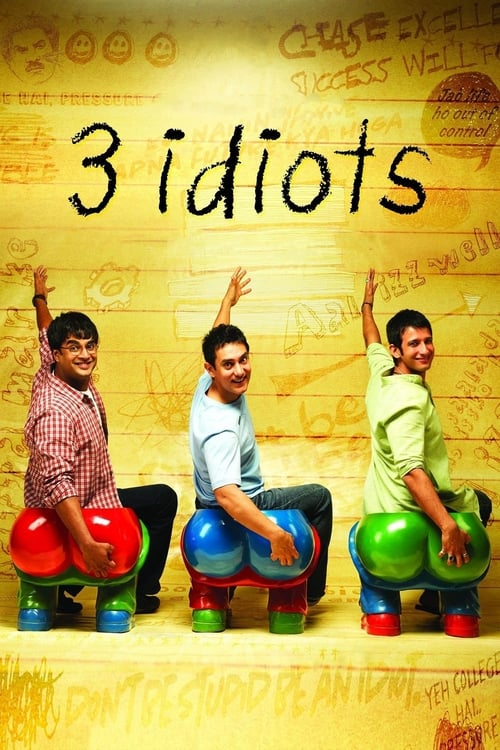
3 Idiots
2009 · Rajkumar Hirani
For when you want to feel good in the fullest sense — a crowd-pleaser to watch with family or friends that leaves you lighter, and maybe a little braver about your own choices. Pure comfort, with a message it actually means.
What it's about
Two middle-aged friends drop everything and race across India to find Rancho, the college roommate who vanished after graduation — the fearless oddball who turned their elite engineering school upside down. In flashbacks, we watch the three of them survive the pressure-cooker campus, its suicidally competitive culture, and a dean nicknamed 'Virus' who believes life is a race. It's a comedy about friendship, and a full-throated argument for studying what you love instead of what you're told.
The experience
Big, warm, and shamelessly entertaining — slapstick, songs, and tearjerker moments all in one nearly three-hour ride that somehow never drags. It makes you laugh hard and then ambushes you with real feeling about parental pressure and fear of failure.
Performances
Aamir Khan is improbably convincing as a college kid decades his junior, radiating mischief and moral clarity, while Boman Irani's blustering dean is a comic creation with genuine menace underneath.
The craft
Rajkumar Hirani's writing is the star: a mystery frame braided with flashbacks, jokes that plant early and pay off an hour later, and tonal swerves from farce to tragedy that most films couldn't survive. The songs are woven into the storytelling rather than pasted on.
Why it matters
It became the biggest Indian box-office hit of its era, sparked a national conversation about the country's brutal education system, and traveled abroad like few Bollywood films before it.
Snapshot
3 Idiots is a Hindi-language campus comedy-drama that became, on release in December 2009, the most commercially successful Indian film to that date and a defining text of mainstream Bollywood's late-2000s maturation. Directed by Rajkumar Hirani and produced by Vidhu Vinod Chopra, it takes the pressure-cooker world of Indian engineering education as the arena for a broader argument about vocation, rote learning, and the fear that drives both. The film is loosely derived from Chetan Bhagat's debut novel Five Point Someone (2004), though Hirani and co-writer Abhijat Joshi transformed the source into something structurally and tonally their own. Built around a mystery-frame — two middle-aged friends racing across India to find their vanished college companion "Rancho" — it braids present-day road comedy with extended flashbacks to their student years. Aamir Khan headlines a company of R. Madhavan, Sharman Joshi, Kareena Kapoor Khan, and Boman Irani, and the picture's fusion of broad slapstick, melodrama, social critique, and a genuinely engineered emotional payoff made it a template that Hindi cinema, and eventually cinemas across Asia, would repeatedly emulate.
Industry & production
The film was a Vidhu Vinod Chopra Productions project, the third Hirani–Chopra collaboration after the Munna Bhai films, and it consolidated a working unit — director, producer, writer Abhijat Joshi, and star Aamir Khan — that had become one of Bollywood's most bankable creative alliances. Aamir Khan by 2009 was already established as an actor-producer who chose projects deliberately and marketed them meticulously; his casting of the college-age "Rancho" while in his forties was a much-discussed choice that the film's costuming, makeup, and his own physical performance work to naturalize. The production drew a portion of its adaptation controversy into the public record: Chetan Bhagat publicly disputed the prominence and framing of his credit relative to the finished screenplay, a dispute that played out in the Indian press around release and remains one of the better-documented author-versus-adaptation conflicts in recent Bollywood history.
Commercially, 3 Idiots was a landmark. It set domestic and worldwide records for a Hindi film on release and performed with unusual strength in overseas and East Asian markets, notably a substantial and durable reception in China where it built a following over subsequent years. Exact figures reported at the time varied across trade sources, so specific gross claims should be treated with the caution any period box-office reporting warrants, but the consensus that it was the highest-grossing Indian film of its moment is firmly established. Its success helped demonstrate the scale of the Chinese market for Indian cinema, a commercial channel that later Aamir Khan vehicles (Dangal, Secret Superstar) would exploit far more fully.
Technology
3 Idiots is a conventionally photographed studio-era-successor production of its time — shot and finished for wide theatrical release without the technological novelty that would define later franchise cinema. It predates the Indian industry's broad move to digital capture and 3D conversion, and there is no strong public record that it experimented with then-emerging tools; its ambitions were dramaturgical and locational rather than technical. What is worth noting is production geography as a kind of technology of scale: the film ranges across Indian locations from institutional campuses standing in for the fictional "Imperial College of Engineering" to the high-altitude landscapes of Ladakh that supply the film's climactic reunion, and the logistical capacity to stage a mainstream comedy across such varied terrain reflects the resources of a top-tier Bollywood production. Its most "technological" set-piece — a comic emergency childbirth conducted over a makeshift video link and a jury-rigged suction device — is a narrative device about improvisation rather than a demonstration of filmmaking hardware.
Technique
Cinematography
Cinematographer C. K. Muraleedharan, Hirani's regular collaborator, shoots in a bright, high-key, legible register suited to broad comedy while reserving a warmer, more saturated palette for the film's emotional and musical passages. The visual strategy is unobtrusive coverage in the classical sense — the camera serves performers and gags — punctuated by expansive location photography, most memorably the Ladakh finale, where the widescreen landscape supplies grandeur the intimate story has earned. The song sequences (notably "Zoobi Doobi" and "All Izz Well") open the visual field into stylized, choreographed space, in keeping with Bollywood convention.
Editing
Hirani, unusually, edits his own films, and 3 Idiots is his most structurally ambitious cut. The screenplay's dual-timeline architecture — a present-tense quest interleaved with a long chronological flashback — depends on editorial control to keep the mystery of Rancho's identity and whereabouts alive without confusing the audience or dissipating comic momentum. The film sustains a nearly three-hour runtime by pacing its tonal swings deliberately: extended comic set-pieces are cut for rhythm and payoff, then yield to melodramatic beats that the editing lets breathe. This authorial command of the cut is central to why Hirani's films land their emotional climaxes as reliably as they do.
Mise-en-scène / staging
The campus is the film's governing space, and its architecture is used thematically: hierarchies of classroom and dormitory, the dean's office as a seat of authority, the hostel as a zone of friendship and rebellion. Boman Irani's "Virus" is staged as a figure of rigid order — his fastidious grooming, his tie-clip, his engineered daily efficiencies — against which Rancho's disorder registers visually. Recurring physical motifs (the "All Izz Well" gesture of a hand to the heart, the ritualized humiliations of ragging) are staged as repeatable, legible business that the film can recall and vary.
Sound
The score and songs are by Shantanu Moitra, with lyrics by Swanand Kirkire; the soundtrack was among the year's most popular and its songs entered wide cultural circulation. "All Izz Well" functions as both diegetic mantra and structural refrain, its melody threaded through the film's emotional architecture. Beyond music, the film's sound design leans into comic amplification — the timing of reactions, the punctuation of physical gags — consistent with the mainstream comedy tradition it works within.
Performance
Performance is where the film's reputation ultimately rests. Aamir Khan's Rancho is a controlled star turn built on restraint amid chaos — the still center around whom the comedy revolves. R. Madhavan and Sharman Joshi, as Farhan and Raju, carry much of the film's emotional weight, Joshi in particular anchoring its most anxious material about family expectation and shame. Boman Irani's Virus is a comic antagonist calibrated to remain human rather than cartoonish, a balance essential to the film's late-act reconciliations. Kareena Kapoor Khan's Pia occupies the more conventionally written romantic role. The ensemble's chemistry — the three leads' fraternal ease — is the film's foundational asset.
Narrative & dramatic mode
The film operates in a hybrid mode characteristic of mainstream Hindi cinema: the masala synthesis of comedy, romance, melodrama, and social message within a single feature. Its distinctive structural choice is the frame-and-flashback mystery. The present-day quest to locate the absent Rancho supplies a forward-driving question, while the flashbacks deliver character, theme, and the bulk of the comedy. A late reveal reframes what the audience has understood about Rancho's identity, converting a coming-of-age narrative into something closer to a parable with a twist. The dramatic engine is not romantic complication but a thesis — that passion should govern vocation and that fear-driven, competitive education deforms the young — dramatized through characters who embody its costs (Raju's paralyzing anxiety, the suicide of a broken student) and its rewards.
Genre & cycle
3 Idiots sits at the intersection of the campus film and the socially-conscious mainstream comedy that Hirani had already pioneered with the Munna Bhai pictures. Those films established his signature cycle: a warm-hearted, comic protagonist who exposes the rigidity of an institution (medicine, then Gandhian ethics, then engineering education) and reforms the people trapped inside it. 3 Idiots is the most fully realized entry in that authorial cycle and arguably the film that fixed its formula. It also belongs to a broader late-2000s wave of Hindi films addressing contemporary middle-class Indian anxieties — careerism, education, generational conflict — in an accessible commercial idiom rather than through art-cinema distance.
Authorship & method
Rajkumar Hirani is the film's decisive authorial intelligence, functioning as director, co-writer, and editor — an unusually integrated command of story, tone, and rhythm. His method, developed with writing partner Abhijat Joshi, is to fold sincere social argument inside reliable crowd-pleasing comedy, so that the message arrives through laughter and earned sentiment rather than lecture. The Joshi–Hirani screenwriting partnership is the throughline of his career. Producer Vidhu Vinod Chopra provided the production architecture and creative stewardship across their long collaboration. Among department heads, cinematographer C. K. Muraleedharan and composer Shantanu Moitra were key recurring collaborators, and Aamir Khan's involvement extended, as it characteristically did, beyond acting into the shaping and marketing of the project. The result is a film whose "voice" is remarkably consistent with Hirani's other work while operating at greater scale and ambition.
Movement / national cinema
The film is a flagship of mainstream Bollywood — the Mumbai-based Hindi commercial industry — at a moment of confident global reach. It is not an art-house or parallel-cinema work; it belongs to the popular tradition of the socially engaged entertainer, a lineage that runs back through decades of Hindi cinema that married mass appeal to moral argument. What distinguishes 3 Idiots within that national cinema is its export success: it became one of the most visible ambassadors of Bollywood abroad, particularly in East Asia, and helped reframe international perceptions of Hindi popular film as capable of both spectacle and substance.
Era / period
Released at the close of the 2000s, 3 Idiots captures a specific moment in India's self-image: a liberalized, aspirational middle class investing heavily in technical education as the path to security, and the psychological toll that pressure exacts on the young. The film's critique of rote learning and its portrait of student stress spoke directly to contemporary Indian debates about educational reform and student mental health — debates that only intensified in the following decade. It arrived, too, as Bollywood was consolidating multiplex-era production values and cultivating overseas markets, and it stands as a high-water mark of that industrial phase.
Themes
The film's central theme is the argument that one should "chase excellence, and success will follow" — that vocation grounded in passion is both more humane and more productive than fear-driven credentialism. Around this it develops a cluster of concerns: the tyranny of rote memorization over understanding; the crushing weight of parental and social expectation; friendship as a form of moral education; and the human cost of a competitive system, made literal in the film's treatment of student despair and suicide. The recurrent mantra "All Izz Well" is the film's thematic emblem — a knowingly naïve coping device that the film treats with affection while acknowledging its limits. Class and mobility run underneath the plot, surfacing fully in the identity reveal that recasts the meaning of learning and merit.
Reception, canon & influence
3 Idiots was both a critical and popular success in India and abroad, praised for its performances, its balance of comedy and feeling, and Hirani's directorial control, while some critics noted its length and its tendency toward sentimental resolution. It won major Indian film honors, including recognition at the Filmfare Awards and National Film Awards, cementing its canonical status within Hindi cinema; readers should consult authoritative awards records for the precise categories, as period listings vary.
Looking backward, the film's influences are legible: Chetan Bhagat's Five Point Someone supplied the setting and premise; Hirani's own Munna Bhai films supplied the reformist-comedy template; and the deep tradition of the socially engaged Hindi entertainer supplied its tonal DNA. Looking forward, its legacy is substantial. It confirmed the commercial viability of message-driven mainstream comedy and shaped the trajectory of both Hirani (whose PK and Sanju extended his method) and Aamir Khan (whose subsequent films leaned further into social themes and Asian markets). It is credited with opening or greatly widening the Chinese theatrical market for Indian film. It generated official remakes in other film industries — including a Tamil version and a widely noted Mexican adaptation — a strong index of a story structure durable enough to travel across cultures. Within India, its critique of educational pressure entered public discourse well beyond the cinema, and "All Izz Well" passed into common speech. Few Indian films of its era can claim so broad a footprint across box office, remake culture, and social conversation.
A Deleuzian reading
A hand goes to the chest.
The full Deleuzian reading of 3 Idiots →
Reception
It arrived as a record-smashing blockbuster — the biggest Bollywood hit ever at the time — with some critics grumbling about the sentimentality; a decade-plus on it's canonized as the definitive Hindi crowd-pleaser and the gateway Bollywood film for a whole generation of international viewers, especially in China, where it became a genuine phenomenon and launched Aamir Khan's superstardom there.
How 3 Idiots was received, from release to now →
How to watch 3 Idiots: what to notice on a first viewing
- Watch how precisely Virus keeps his person and his office arranged. Boman Irani plays the dean through fastidious grooming, a tie clip, and engineered efficiencies in his day. Hirani stages Rancho's mess directly against it, so the argument between them is visible before either speaks. The film's thesis lives in the staging. Order against improvisation, shown as two different ways of occupying a room.
- Watch how still Khan stays while everyone around him panics. Rancho is the calm point in every chaotic scene. Madhavan and Sharman Joshi play anxiety with their whole bodies, and Joshi in particular plays shame about his family. Khan does less, and the comedy organizes around him. Restraint at the center is what lets a three-hour comedy keep its balance. The louder everyone gets, the more Khan's stillness reads.
- Listen for All Izz Well returning as a song and a line. Moitra's tune arrives as a full number and then keeps coming back in fragments, spoken, hummed, or gestured with a hand to the heart. Kirkire's lyric works as a mantra the characters use on themselves. The refrain is a coping device the film treats with affection and also shows the limits of. Saying it does not make it true.
- Track which of the two timelines each scene belongs to. Hirani cuts his own films. He runs a present-day road trip to find a missing friend alongside a long chronological flashback to college. The question of where Rancho went keeps pulling you through three hours of comedy. The frame is the engine. Without the search, the campus material would be episodes rather than a story going somewhere.
- Look at how brightly and evenly the campus scenes are lit. Muraleedharan keeps the comedy high-key and legible, with the camera serving the performers rather than showing off. The palette warms and saturates for the songs and the emotional scenes, so you feel a register change coming. The lighting tells you which mode you are in. A three-hour film that swings between slapstick and grief needs that signal.
The whole guide to watching 3 Idiots, with the keys for a rewatch →
Influences: the films it descends from and the films it influenced
- Munna Bhai M.B.B.S. (2003) — Establishes Hirani's core method — a humane, rule-breaking protagonist who reforms a rigid institution (here a medical college) through empathy and comedy, delivering social argument through laughter rather than lecture.
- Lage Raho Munna Bhai (2006) — Prototype for planting a portable philosophy/slogan ('Gandhigiri') that escapes the film into everyday speech — the exact cultural mechanism 'All Izz Well' would later repeat.
- Anand (1971) — The socially engaged Hindi 'middle cinema' model of oscillating comedy and mortality-driven sentiment, and Hirani's acknowledged template for earning tears without abandoning mainstream warmth.
- Golmaal (1975) — Comedy engineered around a sustained identity deception and a late true-identity reveal — the structural device behind Rancho/Chhote's withheld real name and the film's climactic unmasking.
- Dead Poets Society (1989) — The anti-rote-learning classroom drama pitting a free-thinking mentor against a conformist academic machine, including a student suicide caused by parental/institutional pressure — the tonal and thematic scaffold 3 Idiots reworks.
- Sholay (1975) — The masala grammar of a tight male-friendship core carrying abrupt tonal pivots — song, slapstick, romance, tragedy — inside one continuous narrative, which Hirani deploys across the trio's arc.
- Dil Chahta Hai (2001) — Modernized the three-male-friends ensemble with naturalistic, contemporary urban-youth dialogue and rhythm — the idiom of chemistry among peers that 3 Idiots (and cast member Farhan Akhtar) inherits.
- Rang De Basanti (2006) — An Aamir Khan-led college ensemble organized by a frame/awakening structure, converting campus camaraderie into generational conscience — the ensemble-plus-social-argument blueprint.
- Anbe Sivam (2003) — Wraps a didactic humanist message in a journey/reunion structure and comedy, again casting Madhavan as the anxious conformist foil to a free-spirited idealist.
- Like Stars on Earth (2007) — Aamir Khan-fronted mainstream indictment of rote learning and achievement pressure driving students to breakdown, extending Taare's social critique of the exam-factory school with the same songs-and-catharsis delivery.
- PK (2014) — Extends the Joshi–Hirani method of an innocent outsider whose naive questions satirize a rigid social institution, reusing Aamir and the message-through-comedy engine at larger scale.
- Sanju (2018) — Carries forward Hirani's director-as-editor control over a dual-timeline, frame-and-flashback confession structure, the same interleaved-past architecture that drives 3 Idiots' road-trip reunion.
- Nanban (2012) — An official Tamil remake that transplants the exact story architecture — the missing-friend search frame, the dual timeline, and the anti-rote thesis — into another industry.
- 3 Idiotas (2017) — An official Mexican adaptation proving the durability of the film's story structure, porting its frame-quest and college-pressure critique across an entirely different cultural context.
- Chhichhore (2019) — Rebuilds the engineering-college-reunion frame-and-flashback to confront student suicide and academic pressure head-on — directly extending the student-mental-health thread 3 Idiots seeded into mainstream discourse.
- Dangal (2016) — Continues Aamir Khan's social-message mainstream template and the China theatrical rollout that 3 Idiots pioneered, pairing crowd-pleasing structure with an argument against social convention.
- Super 30 (2019) — A mainstream inspirational education film that turns anti-elitist access to learning into crowd-pleasing entertainment, inheriting 3 Idiots' strategy of arguing educational reform through a star-driven feel-good vehicle.
- Taare Zameen Par (2007) — Shares the precise critique of an exam-and-rank-obsessed education system that crushes creativity, with Aamir positioned as the reformer-figure championing the individual against rote conformity.
- Kai Po Che (2013) — Another Chetan Bhagat adaptation built on a three-male-friends structure, sharing the source author's schema of youthful ambition versus family/societal expectation.
- Zindagi Na Milegi Dobara (2011) — Frames a male-trio reunion journey around a carpe-diem philosophy in which comedy delivers the 'pursue your passion / face your fear' thesis — ZNMD's exact motivational spine in a contemporaneous register.
- 12th Fail (2023) — The exam-pressure-and-education-system critique incubated inside Chopra's own production house; 12th Fail strips its glossy comedy back to the raw coaching-class reality underneath the same theme.
Similar films
- Rang De Basanti (2006) — influence & lineage
- PK (2014) — influence & lineage
- Dangal (2016) — influence & lineage
- Sholay (1975) — influence & lineage
- Like Stars on Earth (2007) — shared sensibility
- 12th Fail (2023) — shared sensibility
- Lagaan: Once Upon a Time in India (2001) — shared sensibility
- Kal Ho Naa Ho (2003) — shared sensibility