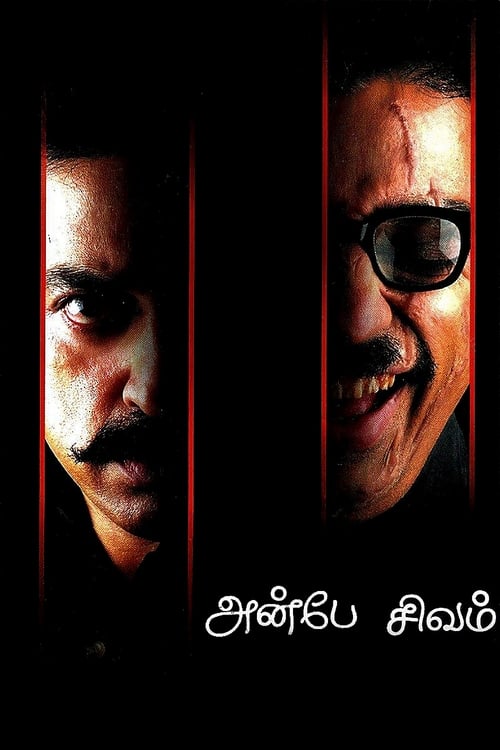
Anbe Sivam
2003 · Sundar C
For when you want a comedy that turns out to have a soul — something funny enough for a group watch that still leaves you sitting quietly through the credits. A generous film for a cynical week.
What it's about
An arrogant young ad executive gets stranded in flood-hit South India with a scarred, limping trade-union activist he can't stand, and the two are forced to make the long journey home together. What starts as a mismatched-travelers comedy keeps opening trapdoors — into the activist's past, into a tragic love story, into a running argument about God, money, and what people owe each other.
The experience
It swings between slapstick, political needling, and sudden grief with startling fluency — you're laughing at a bus-station squabble one minute and blindsided by tenderness the next. Talky, big-hearted, and genuinely moving by the end.
Performances
Kamal Haasan, who also wrote it, gives one of his signature performances — moving between clowning, street-theater fire, and raw grief in a single scene — while a young, preening Madhavan makes the perfect foil.
The craft
This is Kamal Haasan's humanist manifesto in the shape of a road movie: he wrote it and poured his convictions about love, labor, and godless divinity into every detour. The structure hides its depth well — flashbacks bloom out of the comedy, and songs and set pieces keep the sermon airborne.
Why it matters
A flop in 2003 — too talky, too Left for its moment — it was slowly canonized by television reruns until a generation embraced it as one of Tamil cinema's most beloved films.
Nominally directed by Sundar C, this is in every meaningful sense a Kamal Haasan film: he wrote it, stars in it, and poured into it his humanist-Marxist convictions at the height of his powers. The shape is a road comedy — an arrogant young ad executive and a scarred, limping trade-union activist thrown together on a chaotic journey across flood-hit South India, a Tamil cousin to Planes, Trains and Automobiles — but the destination is a meditation on what divinity means when stripped of temples: 'anbe Sivam,' love itself is God. Haasan's performance moves between slapstick, agitprop street theater, and grief with a fluency few actors anywhere could manage, opposite a game, preening Madhavan. The film flopped outright in 2003, too talky and too Left for its moment. Then television reruns did their slow work: a generation that met it on Sunday afternoons argued it into the Tamil canon, and it now sits among the most beloved Indian films of its decade — a commercial failure reversed entirely by affection.
Reception
A box-office flop on its January 2003 release despite good reviews, it was slowly rescued by TV reruns and home video into an undisputed Tamil classic — capped by The Hollywood Reporter India naming it among the 25 best Indian films of the 21st century in 2025.
How Anbe Sivam was received, from release to now →
Influences: the films it descends from and the films it influenced
- Planes, Trains and Automobiles (1987) — The acknowledged template: two temperamentally opposite strangers forced together by cascading transit cancellations, with comedy generated from escalating travel mishaps and enforced cohabitation until grudging affection breaks through.
- The Defiant Ones (1958) — Establishes the message-movie device of literally yoking two antagonists together on a journey so ideological opposites must cooperate, delivering a social sermon through the road structure itself.
- It Happened One Night (1934) — Foundational class-divided road-comedy grammar — cynic and idealist bickering across public transport — plus the Capra populist romance of the ordinary common person that Anbe Sivam's egalitarianism inherits.
- Modern Times (1936) — Kamal Haasan's scarred humanist-clown Nallasivam draws directly on Chaplin's Tramp: physical comedy fused with overt pro-worker political feeling and disarming sentiment.
- Sullivan's Travels (1941) — Supplies the self-aware thesis that comedy and compassion for the poor are morally serious, framed through a privileged man's journey down among the destitute.
- Do Bigha Zamin (1953) — The IPTA-rooted socialist-realist melodrama of class exploitation and the dignity of labor from which Nallasivam's Marxist agitprop politics descend.
- Hirak Rajar Deshe (1980) — Models the traveling agitprop-theater troupe that weaponizes performed verse and street spectacle against a tyrant — the exact street-theater craft Nallasivam practices.
- Mahanadhi (1994) — Kamal-written social-conscience melodrama engineered to indict systemic injustice through one wronged everyman, sharing Anbe Sivam's didactic-through-suffering construction.
- Lage Raho Munna Bhai (2006) — Extends the sermon-through-laughter method: humanist ethics ('Gandhigiri') staged as agitprop-style public street interventions folded inside broad mainstream comedy.
- 3 Idiots (2009) — Wraps a didactic humanist message in a journey/reunion structure and comedy, again casting Madhavan as the anxious conformist foil to a free-spirited idealist.
- PK (2014) — Argues the 'god is human love, not ritual' thesis through an outsider-innocent delivering agitprop social critique, directly extending Anbe Sivam's love-as-god didacticism.
- Peranbu (2018) — Renews the Tamil earnest-humanist journey drama, structuring a father-daughter road of suffering around the literal 'love as the highest divinity' ethos Anbe Sivam preaches.
- Meiyazhagan (2024) — The mismatched-pair journey where a garrulous, open-hearted humanist gradually dismantles a guarded, name-forgetting companion — the same warm-stranger-thaws-the-closed-man dynamic between Karthi and Arvind Swamy.
- Hey Ram (2000) — Kamal's self-scripted auteur cinema foregrounding Gandhian-humanist argument and staging history as personal moral reckoning, the same authored-sermon impulse he brings to Anbe Sivam's screenplay.
- Indian (1996) — Showcases the Kamal-Haasan transformation range (aged patriarch vs. young son) deployed in service of an explicitly political message film, the performance elasticity Anbe Sivam builds around.
- Virumaandi (2004) — Kamal's self-authored humanist thesis (against capital punishment) delivered through Rashomon-style talky, multi-perspective moral debate — the same talk-driven didacticism.
- Alaipayuthey (2000) — Establishes Madhavan's polished urban-yuppie romantic register, which Anbe Sivam casts against type as the callow, materialist ad-man foil to the idealist.
Similar films
- Mahanadhi (1994) — influence & lineage
- Virumaandi (2004) — influence & lineage
- Kadaisi Vivasayi (2022) — shared sensibility
- Michael Madana Kama Rajan (1990) — shared sensibility
- Bangalore Days (2014) — shared sensibility
- Nadodikkattu (1987) — shared sensibility
- Iruvar (1997) — shared sensibility
- Meiyazhagan (2024) — shared sensibility