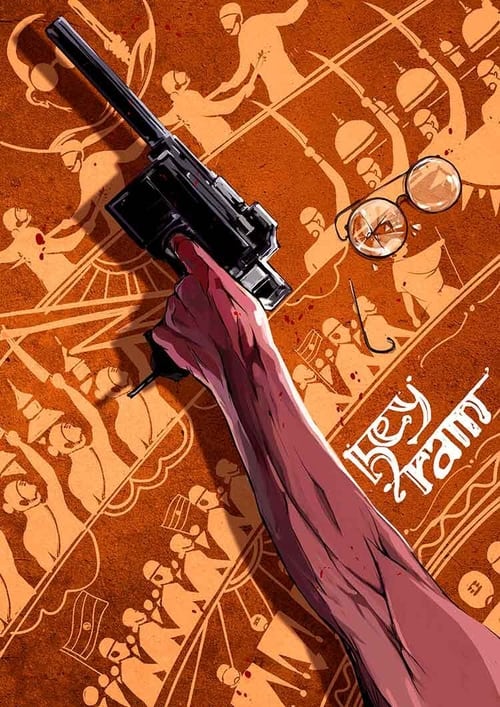
Hey Ram
2000 · Kamal Haasan
For when you want serious historical cinema that wrestles with real moral darkness — a challenge, not a comfort watch, best when you have the emotional room for it.
What it's about
Calcutta, 1946: an archaeologist named Saketh Ram loses his wife to the horrific violence of the Direct Action Day riots, and grief curdles into rage. Convinced that Gandhi's politics are to blame for the bloodshed tearing India apart, he falls in with Hindu-nationalist hardliners and is drawn into a conspiracy to assassinate the Mahatma. Kamal Haasan writes, directs, and stars in this sweeping historical epic that follows one man's radicalization across the last, most volatile years before and after Partition.
The experience
Heavy, haunted, and deliberately uncomfortable — it puts you inside a mind being poisoned by grief and asks you to understand without excusing. The violence lands hard, the guilt lingers, and the film moves with the weight of an epic rather than the rush of a thriller.
Performances
Kamal Haasan carries the film as Saketh Ram, charting a man's descent from cultured archaeologist to would-be assassin with unnerving conviction — a performance of slow transformation rather than big gestures.
The craft
Haasan directs his own script with real ambition, shooting simultaneously in Tamil and Hindi and staging the Partition-era chaos on an epic canvas. The riot sequences have a nightmarish physical force, and the period reconstruction of 1940s Calcutta and beyond rewards a big screen.
Why it matters
One of Indian cinema's most daring reckonings with Partition and Gandhi's assassination, it was controversial on release and has grown in stature as a singular auteur statement — India's official Oscar submission for its year and a defining risk in Kamal Haasan's career.
Snapshot
Hey Ram is Kamal Haasan's ambitious historical epic about the making and unmaking of a would-be assassin. Its fictional protagonist, Saketh Ram, is an archaeologist whose life is shattered when his wife is raped and murdered during the Direct Action Day riots that convulsed Calcutta in August 1946. Radicalized by grief and by Hindu-nationalist agitators, he becomes convinced that Mohandas Gandhi's politics of appeasement have doomed India's Hindus, and he is drawn into a conspiracy to kill the Mahatma — a plot that runs in parallel to, but is ultimately displaced by, the historical assassination carried out by Nathuram Godse. Written, produced, directed by, and starring Haasan, the film was shot simultaneously in Tamil and Hindi and released in February 2000. It sits at the crossroads of the assassination thriller, the partition memoir, and the counterfactual "secret history," using an invented man to interrogate one of modern India's foundational traumas. India selected it as its official submission for the Academy Award for Best Foreign Language Film. It remains one of the most formally daring and politically combustible works in Haasan's filmography.
Industry & production
Hey Ram was produced by Haasan's own banner, Raajkamal Films International, and was among the most expensive Indian productions of its moment — a passion project financed and steered by its auteur-star rather than by a conventional studio system. Making it bilingual (Tamil and Hindi) was both an aesthetic and a commercial decision: it allowed Haasan to reach his southern base while pitching the film to a pan-Indian and prestige audience, since the subject matter — Gandhi, Partition, communal violence — was national in scope. The production was notable for the scale of its period reconstruction, recreating 1940s Calcutta and Madras, the horror of the Great Calcutta Killings, and the milieu of late-colonial India.
Because the film touched Gandhi's assassination and depicted communal rioting in graphic terms, it arrived amid anxiety about censorship and public order; it drew objections from various quarters worried that its sympathetic-then-repentant assassin figure and its unflinching riot sequences might inflame sentiment. The film was cleared and released, but the controversy shadowed its reception. Precise budget and box-office figures circulate in secondary accounts but should be treated cautiously; the reliable claim is that the film was costly, prestige-oriented, and only a moderate commercial performer relative to its ambitions, while accumulating significant critical and institutional recognition.
Technology
Hey Ram was made on 35mm photochemical film, the standard for Indian features of its period, before the industry's digital-intermediate era. Its "technology," in the meaningful sense, is one of controlled artifice: heavy reliance on period art direction, costume, prosthetics, and in-camera color design rather than the digital compositing that would soon dominate. Haasan, who plays Saketh Ram across a span of decades, is aged through prosthetic and makeup work into the elderly man of the film's framing present. The reconstruction of mass riot scenes depends on large-scale physical staging — crowds, set dressing, practical destruction — rather than crowd-replication software. The film's most conspicuous technical signature is its manipulation of the film image itself for temporal and emotional register (discussed under Technique), a choice made through cinematographic and laboratory craft.
Technique
Cinematography
The cinematography is credited to Tirru (R. Thiru), and it is one of the film's defining achievements. The image is stratified by time and memory: the film moves between a desaturated, sepia-and-monochrome-inflected register for the deep past and warmer or more naturalistic tones for other strata, so that color itself becomes a marker of memory, trauma, and historical distance. The Direct Action Day sequence — the film's horrific centerpiece — is staged and shot for maximum visceral impact, the camera pressed into chaos and atrocity. Against these are quieter, more painterly compositions of domestic life and of the conspiratorial interiors where Saketh Ram is groomed for murder. The camera participates in the film's central problem — how memory reconstructs and distorts the past — rather than merely recording events.
Editing
Editing is credited to Renu Saluja, one of the most respected editors in Indian cinema (whose credits include Parinda, Bandit Queen, and Sardar); Hey Ram falls among her final works before her death in 2000. The film's structure is elaborate and non-linear, framed as the recollection of an elderly Saketh Ram and moving between temporal planes. The editing must hold together a frame narrative, an extended flashback of radicalization, and the thriller machinery of an assassination plot, while modulating between the horror of the riots and the intimacy of two marriages. The cutting has to negotiate the film's shifts in color register and its abrupt tonal transitions — atrocity to tenderness, ideological seduction to disillusion — without losing the audience's foothold in time.
Mise-en-scène / staging
Production design is by Sabu Cyril and costume design by Sarika, and the film's material world is meticulously built. The mise-en-scène reconstructs multiple worlds: the archaeological and colonial-scholarly milieu of the protagonist, the bourgeois domestic interiors of his marriages, the charged spaces of Hindu-nationalist organizing, and the catastrophic public space of the riot. Costume and set are used not merely for verisimilitude but as ideological signposts — the visual coding of communal identity, of nationalist iconography, of the boundary between private grief and public politics. Sarika's costuming and Cyril's design were recognized at the National Film Awards, an index of how central the period reconstruction is to the film's meaning.
Sound
The music is by Ilaiyaraaja, whose score threads devotional, folk, and dramatic-orchestral idioms through the film; the recurring invocation "Hey Ram" — Gandhi's traditionally reported dying utterance — is woven into the film's sonic and thematic fabric, turning a phrase of martyrdom into an ironic frame for a film about a man who set out to kill the man who spoke it. Beyond song, the film's sound design carries the weight of its violence: the din of the riot, the quiet of interiors where conspiracy is hatched. Specific mixing and design credits are less consistently documented in accessible sources, and I won't attribute them speculatively.
Performance
Performance is the film's engine. Kamal Haasan carries Saketh Ram across a wide arc — loving husband, shattered widower, ideologically seduced assassin, and finally a repentant old man — and across decades of aging, a role calibrated to the film's counterfactual conceit that this ordinary man might have been the one to kill Gandhi. Around him is an unusually deep ensemble: Shah Rukh Khan as Amjad Ali Khan, the Muslim friend whose bond with Saketh Ram embodies the film's plea for reconciliation; Rani Mukerji as Aparna, the wife whose death detonates the plot; Vasundhara Das as Mythili, his second wife; Atul Kulkarni as the ideologue Sriram Abhyankar, a performance recognized with a National Film Award for Best Supporting Actor; Naseeruddin Shah as Gandhi; and Girish Karnad, Om Puri, Hema Malini and others in supporting roles. The casting of major Hindi and southern stars in a bilingual auteur film was itself a statement of ambition.
Narrative & dramatic mode
The film's dramatic mode is the memory-narrated tragedy grafted onto the assassination thriller. It is organized as recollection: an aged Saketh Ram, near the end of his life in the film's present, reconstructs the events that turned him from grieving husband into political killer. This framing device is not incidental — it makes the whole film an act of confession and reckoning, and it licenses the subjective, color-coded distortions of the imagery. Within the flashback, the film follows a classic radicalization arc: trauma (the riot and Aparna's murder), seduction by an ideology that names an enemy (Gandhi), and recruitment into a plot. The thriller's forward pressure — will he do it? — is complicated by the audience's historical knowledge that Godse, not a fictional archaeologist, killed Gandhi. The film thus builds toward a crisis of conscience rather than a simple assassination climax, resolving the protagonist's arc through disillusion and moral awakening. This yoking of intimate melodrama, ideological thriller, and historical epic is the film's signature and its risk.
Genre & cycle
Hey Ram belongs to several overlapping genres. It is a Partition film, part of the long cinematic reckoning with 1947's communal catastrophe. It is a historical-political epic in the tradition of biographical and nation-building cinema. And it is, structurally, an assassination thriller — a plot to kill a head of the freedom movement — that consciously plays against the audience's foreknowledge of how the real assassination unfolded. Its most distinctive generic move is the counterfactual or "secret history": inserting a wholly invented conspirator into the documented record so that fiction and fact abut one another. Within Indian cinema, it sits alongside other serious treatments of communal violence and national trauma while remaining idiosyncratic in its willingness to make its protagonist a would-be Gandhi-killer and then trace his redemption.
Authorship & method
Hey Ram is an auteur film in the fullest sense: Kamal Haasan wrote, directed, produced, and starred in it, and its formal audacity reflects a single controlling vision. Haasan's method here is maximalist and interrogative — he uses the resources of the star vehicle (his own body across decades, a constellation of guest stars) to stage a genuinely difficult moral and historical argument, rather than to flatter. His key collaborators are integral to the achievement: cinematographer Tirru, whose stratified color scheme externalizes memory; composer Ilaiyaraaja, a decades-long collaborator of Haasan's whose score fuses devotional and dramatic registers; editor Renu Saluja, whose structural command holds the film's fractured time together; production designer Sabu Cyril and costume designer Sarika, whose period world-building carries much of the film's meaning and drew National honors. The film exemplifies a strand of Haasan's career in which he has repeatedly used commercial resources to pursue formally and politically risky material.
Movement / national cinema
The film straddles India's regional and national cinemas. As a bilingual Tamil-Hindi production from a Tamil auteur, it embodies the cross-industry ambition that has periodically bridged the southern and Bombay film worlds. Thematically, it participates in a national cinema of self-examination — films that confront Partition, communalism, and the fragility of the secular-national ideal that Gandhi personified. Made in 2000, it belongs to a moment when Indian cinema was reckoning, directly and obliquely, with resurgent religious nationalism and the memory of communal violence. Its selection as India's Academy Award submission situates it within the state-sanctioned canon of films offered as representative of national cinema abroad, even as its content was domestically contentious.
Era / period
The film is set primarily in the late-colonial and immediately post-Independence years — the Direct Action Day of August 1946, the Partition, and the run-up to Gandhi's assassination on 30 January 1948 — while framed from a much later vantage in the film's present, near the century's end. This double temporality is essential: the film reads the 1940s through the anxieties of the late 1990s, a period marked in India by heightened communal tension. The historical setting is reconstructed with care, but the film's real subject is the persistence of the past into the present — how the wounds and ideologies of 1946–48 continue to structure the national imagination, and how an old man's memory becomes the site where that history is tried.
Themes
At its core the film is about communal violence and the fragility of coexistence, dramatized through the friendship between the Hindu Saketh Ram and the Muslim Amjad Ali Khan. It examines radicalization — how personal catastrophe is metabolized into political hatred, and how grief is exploited by ideologues who supply an enemy. Gandhi, and the "Hey Ram" of his reported last words, becomes the film's contested center: the Mahatma is figured both as the object of the protagonist's murderous rage and, ultimately, as the moral horizon against which that rage is judged. The film interrogates nationalism itself — the difference between a nationalism of inclusion and one of vengeance — and it dwells on memory, guilt, and the possibility of redemption. Its counterfactual structure raises a pointed question: not only who killed Gandhi, but who might have, and what in ordinary men makes them available to such acts. The invocation of Ram — both the deity and Gandhi's dying word — runs as an ironic and unifying motif through a film about a man named for devotion who nearly becomes an assassin.
Reception, canon & influence
Critically, Hey Ram was recognized as a serious, formally ambitious work and was rewarded institutionally: it was named India's official entry for the Academy Award for Best Foreign Language Film, and it won National Film Awards including recognition for Atul Kulkarni's supporting performance and for its costume and art design. At the same time, its reception was polarized. Its unflinching riot imagery and its provocative premise — a sympathetic protagonist bent on killing Gandhi — drew objection and anxiety about communal sensitivities, and its commercial performance was modest relative to its cost and ambition. The result is a film more esteemed than beloved, a prestige object whose reputation has grown as a bold, flawed, singular experiment.
Looking backward, the film's influences are legible: the counterfactual-conspiracy thriller and the tradition of the assassination narrative; the internationally sanctioned mode of the Gandhi biopic (Attenborough's Gandhi being the inescapable reference point for any cinematic Mahatma) against which Haasan works obliquely; and the long lineage of Partition literature and cinema that supplies its trauma and its moral stakes. Its epic period reconstruction aligns it with the ambitions of historical cinema on both national and international scales.
Looking forward, Hey Ram endures chiefly as a landmark of Kamal Haasan's authorship — evidence of his willingness to marshal star power toward difficult, politically charged art — and as a reference point in debates about how Indian cinema may represent Gandhi, communal violence, and the counterfactual. Tracing a precise chain of films it directly "shaped" is difficult, and I won't overstate it; its influence is better understood as tonal and emblematic — a demonstration that a mainstream Indian film could take on the assassination of the nation's most sacred figure through an invented conscience, and survive the attempt as a work of lasting critical interest.
Reception
A commercial flop and political lightning rod in 2000 — protested, trimmed, and argued over — it's since been reappraised as one of the most audacious things a mainstream Indian star has ever made, and now routinely tops 'ahead of its time' lists.
How Hey Ram was received, from release to now →
How to watch Hey Ram: what to notice on a first viewing
- Watch the color shift between scenes set in different time periods. Tirru shoots the deepest past in desaturated sepia and monochrome tones and other periods in warmer, more naturalistic color, so the palette itself marks how far back a scene sits in memory. You can tell how distant or distorted a memory is meant to feel before a single word explains it.
- Listen for the phrase 'Hey Ram' recurring in the score. Ilaiyaraaja weaves Gandhi's reported dying words into the devotional and orchestral music throughout, so the same phrase keeps returning in different musical settings. A phrase of martyrdom keeps sounding through a film about a man who wants to be the one who kills him.
- Notice how costume marks which community a character belongs to. Sarika's costuming and Sabu Cyril's sets use dress and setting as visible markers of communal identity and nationalist iconography, not just period decoration. What a character wears is telling you their politics before they say a word.
- Watch Haasan's posture and bearing age across the decades. He plays the same man as a loving husband, a shattered widower, and an old man near the end of his life, using body and voice rather than makeup alone to mark the years. One actor's physical transformation carries the film's whole span of decades.
The whole guide to watching Hey Ram, with the keys for a rewatch →
Influences: the films it descends from and the films it influenced
- Gandhi (1982) — Established the sanctioned epic Gandhi-biopic mode — prosthetic aging of the Mahatma across decades within meticulous late-colonial period reconstruction — the canonical portrait Haasan reconstructs against by viewing Gandhi through an invented assassin's conscience.
- JFK (1991) — Built the counterfactual-conspiracy assassination thriller out of intercut film stocks and shifting color registers that stratify rumor, memory and 'truth' — the editorial DNA of Tirru's stratified color scheme externalizing memory in Hey Ram.
- The Day of the Jackal (1973) — Supplied the procedural architecture of the assassination thriller — the meticulous, step-by-step mechanics of a plot to kill a real historical figure — that structures Hey Ram's plot against Gandhi.
- The Manchurian Candidate (1962) — Fused the assassination thriller with a study of ideological conditioning, the template for Hey Ram's dramatization of Saket Ram's grief-driven radicalization toward political murder.
- Nayakan (1987) — Kamal Haasan's earlier decades-spanning prosthetic-aging performance set to an Ilaiyaraaja score, establishing the star-vehicle-as-serious-art collaboration Hey Ram inherits wholesale.
- Indian (1996) — Placed Haasan in elaborate prosthetic old-age makeup as an aged freedom-fighter narrating late-colonial nationalism into present violence — the immediate precedent for Hey Ram's aged-survivor frame and its fusion of independence-era memory with communal bloodshed.
- Bandit Queen (1994) — Cut by editor Renu Saluja, whose unflinching structural command over caste and communal atrocity Hey Ram inherits directly through the same editor holding its fractured timeline together.
- Tamas (1988) — Set the benchmark for reconstructing Partition mob violence with sustained, unflinching riot imagery — the mode Hey Ram's Calcutta/Direct Action Day sequences descend from.
- Garm Hava (1973) — Foundational Partition film staging communal displacement and the Muslim experience of the newly divided nation, supplying the moral and historical stakes Hey Ram inherits.
- Reds (1981) — The actor-writer-director-producer marshaling star power and epic period reconstruction toward politically risky historical argument — the auteur-star model Haasan enacts as a single controlling vision.
- Rashomon (1950) — Codified the nonlinear subjective-flashback frame in which contested memory, not chronology, structures the narrative — the formal ancestor of Hey Ram's nonlinear frame and dying-narrator recollection.
- Mahanadhi (1994) — Continues Kamal's against-star authorship — subordinating persona to a bleak, morally serious historical realism with naturalistic staging over spectacle.
- Virumaandi (2004) — Haasan's own directorial follow-through: a Rashomon-structured, multiple-narrator interrogation of violence and justice extending his authored use of fractured testimony for formally risky political material.
- Vishwaroopam (2013) — Haasan again marshals a self-authored star vehicle toward themes of radicalization and terror while courting communal controversy — the direct continuation of the Hey Ram authorial method.
- Gandhi, My Father (2007) — Re-approaches the Mahatma obliquely through a marginal, wounded conscience — his estranged son — extending Hey Ram's strategy of refracting the sacred national figure through an invented or peripheral witness rather than hagiography.
- Sardar Udham (2021) — A nonlinear, memory-fractured assassination biopic of a real political killing rendered in stratified period color — extending Hey Ram's counterfactual/assassination-history mode of building a nation's trauma around a single act of violence.
- 1947 Earth (1998) — Near-contemporary Partition film staging an intimate friend-group ripped apart by sectarian violence with graphic riot reconstruction — a parallel attempt to render communal trauma through personal betrayal.
- Bombay (1995) — Deployed mainstream star melodrama and full-scale riot reconstruction to indict sectarian violence, the same gambit of using popular-cinema resources for communal critique that Hey Ram pursues.
- The Legend of Bhagat Singh (2002) — Dramatizes the freedom-fighter-as-radical wrestling Gandhian nonviolence against revolutionary killing — the exact ideological debate Hey Ram foregrounds through its would-be assassin.
- Anbe Sivam (2003) — Kamal's self-scripted auteur cinema foregrounding Gandhian-humanist argument and staging history as personal moral reckoning, the same authored-sermon impulse he brings to Anbe Sivam's screenplay.
Similar films
- Nayakan (1987) — influence & lineage
- Virumaandi (2004) — influence & lineage
- Sardar Udham (2021) — influence & lineage
- Gandhi (1982) — influence & lineage
- Mahanadhi (1994) — shared sensibility
- RRR (2022) — shared sensibility
- Michael Madana Kama Rajan (1990) — shared sensibility
- Vikram (2022) — shared sensibility