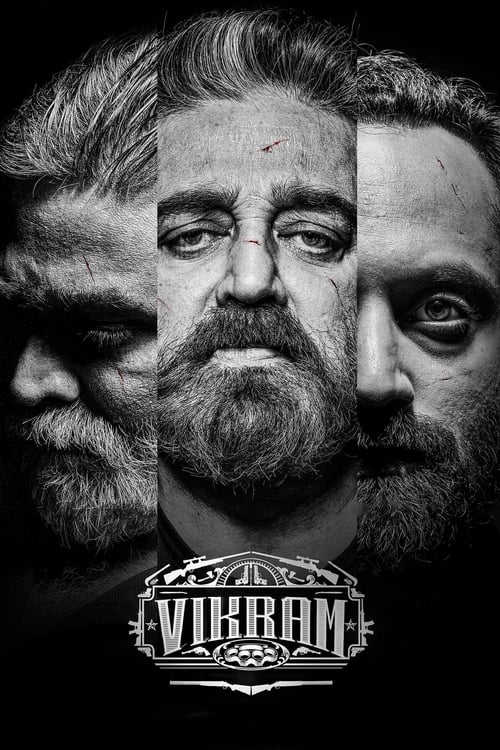
Vikram
2022 · Lokesh Kanagaraj
Built the LCU (Kaithi/Vikram/Leo), the first Indian fan-driven "cinematic universe," and directed Rajinikanth's Coolie — Tamil cinema's fan-theory economy runs on him.
For when you want a loud, clever, maximalist action night — the kind of film you put on with friends and the volume up, not a quiet contemplative evening.
What it's about
Amar, a black-ops investigator, is pulled in to crack a string of masked killings that has everyone rattled. The deeper he digs, the clearer it becomes that the case is a door into something much bigger — a collision course between the police, a shadowy covert squad, and a drug empire — with Kamal Haasan, Vijay Sethupathi, and Fahadh Faasil circling each other at the center of it.
The experience
A dense, propulsive ride that keeps recontextualizing what you thought you were watching, punctuated by big, rowdy action set pieces built for a crowd. It's tense, playful with structure, and engineered for the moment the whole theater erupts.
Performances
Kamal Haasan, Vijay Sethupathi, and Fahadh Faasil sharing a film at this scale is an event in itself — Sethupathi's unpredictable menace and Faasil's live-wire investigator give the legend at the center something real to push against.
The craft
Lokesh Kanagaraj builds the film as a nested puzzle, doling out information so the plot keeps reshaping under you, and stages action with genuine scale and swagger. It's made for the biggest screen and loudest speakers you can find.
Why it matters
A commercial juggernaut of 2022 and the structural keystone of Indian cinema's turn toward interconnected franchise storytelling, cementing the Lokesh Cinematic Universe as a going concern.
Snapshot
Vikram is a Tamil-language action thriller that arrived in June 2022 as both a commercial juggernaut and a structural keystone in Indian popular cinema's turn toward interconnected franchise storytelling. Directed by Lokesh Kanagaraj, it stars Kamal Haasan as the titular agent, Vijay Sethupathi as the drug-syndicate enforcer Sandhanam, and Fahadh Faasil as the black-ops investigator Amar — a marquee assembly of three actors rarely, if ever, seen sharing a frame at this scale. Ostensibly a procedural about a string of masked killings, the film is built as a nested reveal: the investigation that Amar conducts uncovers that the "victim" Karnan is in fact Vikram, a presumed-dead undercover operative, and the plot escalates into a war among police, a covert squad, and a narcotics empire. Its lasting significance is twofold. First, it consolidated the "Lokesh Cinematic Universe" (LCU), tying the film explicitly to Kanagaraj's Kaithi (2019) and seeding characters carried into Leo (2023). Second, it re-established Kamal Haasan — a figure whose screen appearances had grown sparse amid political and other commitments — as a viable, contemporary action lead in his late sixties. The film's title also gestures backward to Haasan's own Vikram (1986), lending the project a layer of star-text self-reference that reviewers widely noted.
Industry & production
The film was produced by Kamal Haasan's own banner, Raaj Kamal Films International, with the star closely involved beyond his acting role — a production arrangement that shaped the film's willingness to treat Haasan as an ensemble anchor rather than a lone hero. Casting Vijay Sethupathi and Fahadh Faasil, both major draws in their own right and both associated with more character-driven or "new wave" registers, was itself an industrial statement: a mainstream mass-movie constructed from actors with pan-Indian critical cachet. Fahadh Faasil, a Malayalam-cinema star, and Sethupathi, a Tamil actor with cross-industry standing, broadened the film's regional reach in a market increasingly oriented toward multi-language releases. Vikram was released theatrically in Tamil with dubbed versions in other Indian languages, riding the post-pandemic reopening of theatrical exhibition when audiences were returning in force to large-canvas event cinema. It was, by consensus reporting, one of the highest-grossing Tamil films of its year; I'll refrain from citing specific box-office figures, as precise, verified numbers vary across sources. The production's most consequential business decision may have been narrative-architectural: designing the film to be readable as a standalone thriller while functioning as connective tissue for an ongoing universe, a strategy borrowed from franchise filmmaking but relatively novel in Tamil cinema at this scale.
Technology
Vikram is a digitally originated, contemporary studio production, and its technological profile is that of high-end Indian action filmmaking of the early 2020s rather than of any single formal experiment. Its most visible technical ambition lies in the staging and capture of large-scale gunfights and a climactic set-piece battle, which depend on coordinated squibs, practical stunt work, and visual-effects augmentation for scale and muzzle detail. The film leans on precise digital color grading to sustain its cool, desaturated night palette and neon-inflected interiors — a look that has become something of a Kanagaraj-Anirudh signature. Beyond this, I would caution against over-specifying the technical pipeline: the detailed record of camera systems, lenses, and VFX vendors is not something I can attest to with confidence, and I won't invent it. What can be said securely is that the film's technology serves an aesthetic of legibility-under-chaos — the ability to hold complex, multi-combatant action in coherent space — rather than spectacle for its own sake.
Technique
Cinematography
Girish Gangadharan's photography is central to the film's identity. The palette runs cool and nocturnal, favoring hard sodium-and-neon sources, silhouettes, and a controlled murkiness that keeps faces emerging from and receding into shadow — visually appropriate for a story about hidden identities and men who are not what they appear. Action is generally staged for spatial clarity, with the camera tracking bodies through architecture rather than dissolving combat into abstraction. The framing repeatedly withholds and then delivers the reveal of Haasan's Vikram, treating the star's face as a dramatic payload; the cinematography is complicit in the screenplay's structure of concealment.
Editing
Philomin Raj's cutting is the film's engine. Vikram is edited as a puzzle that gradually resolves: its first act deliberately misleads, presenting the Vikram/Karnan figure through fragmentary flashback and hearsay before the timeline snaps into clarity. The editing sustains parallel lines of action — investigation, syndicate operations, the covert squad — and accelerates into extended, rhythmically driven action climaxes. Kanagaraj's cinema is frequently praised for momentum, and the editing is the mechanism: information is metered out precisely enough to keep the reversal-heavy plot intelligible while preserving surprise.
Mise-en-scène / staging
The film's world is one of warehouses, safe houses, police stations, and syndicate compounds — functional, contemporary spaces charged by lighting rather than production-design opulence. Kanagaraj stages his large action sequences with attention to geography, letting the audience track who holds which position. Costume and prop work quietly encode allegiance and identity: the recurring masks of the killers, the tactical gear of the squad, the specific iconography that links the film to Kaithi. Staging repeatedly exploits reveals — a body assumed dead, a face behind a mask, an ally who is an enemy — so that blocking itself carries the thriller's logic.
Sound
Anirudh Ravichander's contribution operates as much through sound design and score as through songs. His pulsing, percussive underscore drives the action and has become inseparable from the LCU's sonic brand; the film's theme music functions as a leitmotif of arrival and menace. The mix privileges impact — gunfire, engines, the low-end throb of the score — to lend weight to the physical action. Anirudh's work here is widely regarded as a defining example of how a composer can become a franchise's connective signature.
Performance
The performances are the film's chief pleasure. Kamal Haasan plays Vikram with a weathered, controlled gravity, allowing the role's late reveal to recontextualize earlier restraint; the film is calibrated to reintroduce him as an action star without asking him to perform youth. Fahadh Faasil brings a coiled interiority to Amar, the squad leader whose competence and moral complication carry much of the middle film. Vijay Sethupathi, as Sandhanam, offers a volatile, almost bantering villainy — a drug enforcer who is at once comic, brutal, and pathetic, and whose family entanglements give the antagonist unexpected texture. The interplay among the three registers — Haasan's stillness, Faasil's tension, Sethupathi's volatility — is the film's dramatic core.
Narrative & dramatic mode
Vikram operates in the mode of the reversal-driven action thriller, structured around a central epistemological trick: the audience, like Amar, is invited to misread the situation, and the film's pleasures depend on the staged collapse of that misreading. The dramatic mode fuses procedural investigation with the mythic register of the "mass" hero film — the moment of the hero's revelation is treated with operatic weight. Its narrative is also frankly modular: sequences are engineered both to satisfy in the moment and to plant connective hooks for a larger universe, most famously the late introduction of a still-larger antagonist that reframes the entire conflict as a smaller front in a wider war. This double function — self-contained yet serialized — is the film's most distinctive narrative achievement.
Genre & cycle
The film sits at the confluence of the police-procedural, the undercover-agent thriller, and the Tamil "mass action" tradition, but its most historically notable move is genre-industrial: it belongs to the emerging cycle of connected-universe filmmaking in Indian cinema. Where Hollywood's shared universes had normalized cross-film continuity, Vikram demonstrated that Tamil commercial cinema could execute the same architecture with sophistication, building on Kaithi and extending toward Leo. Within the narcotics-war subgenre, it aligns with a long lineage of Indian crime films about drug empires and the men who police or serve them, but distinguishes itself through its franchise scaffolding and its multi-star, ensemble-of-heavyweights casting.
Authorship & method
Lokesh Kanagaraj is the film's clear author, and Vikram crystallized his method: kinetic, information-dense screenplays that reward attention; a taste for morally shaded protagonists; a fondness for the mid-film reversal; and a deliberate practice of world-building across films. His collaboration with composer Anirudh Ravichander is a defining creative partnership, so consistent that the score has become part of the directorial signature. Cinematographer Girish Gangadharan supplies the shadowed, neon-modern visual grammar; editor Philomin Raj executes the propulsive, reveal-timed structure that Kanagaraj's scripts demand. The action was choreographed by the stunt duo Anbariv (Anbumani and Arivumani), whose work is integral to the film's coherent, large-scale combat. Kanagaraj is credited with the story and screenplay; on the specific division of dialogue-writing credits I would rather not assert details I cannot verify. The animating authorial idea is the marriage of "mass" star spectacle with a genuinely structured, continuity-minded screenplay — and, crucially, the generosity of an auteur willing to let three stars share the load rather than subordinate two to one.
Movement / national cinema
Vikram is a product of Tamil cinema (Kollywood) at a moment of heightened pan-Indian ambition. It reflects a broader early-2020s current in South Indian filmmaking — visible across Telugu and Kannada cinema as well — in which regionally rooted films pursued national and diasporic audiences through dubbing, scale, and event positioning. Within this movement, Kanagaraj represents a younger generation of Tamil directors fluent in global genre grammar and franchise logic while remaining anchored in Tamil star culture and its rituals of hero-introduction. The film also participates in the ongoing dialogue between Tamil and Malayalam cinema, importing Fahadh Faasil's more naturalistic sensibility into a big-canvas Tamil vehicle.
Era / period
The film is a defining artifact of the post-pandemic theatrical resurgence of 2022, when large-format Indian films drove audiences back into cinemas and the "pan-Indian blockbuster" became the dominant commercial aspiration. It also belongs to a specific moment in Kamal Haasan's career — a return to leading-man action after a stretch dominated by political activity and television hosting — which the film consciously exploits, using the star's history (including his 1986 Vikram) as part of its meaning. The period context of franchise-building, multi-star packaging, and cross-language release is legible in nearly every strategic choice the production makes.
Themes
Beneath the action, Vikram is preoccupied with fathers and sons and inherited duty: nearly every principal is defined by a paternal bond, whether protective, vengeful, or broken, and the drug war is repeatedly personalized as a matter of family. It examines identity and concealment — the mask, the presumed-dead man, the agent who is not who he seems — as both plot mechanism and thematic substance. It probes institutional failure and extralegal justice, positing covert squads and vigilante violence as responses to a compromised system. And, self-reflexively, it meditates on legacy — the passing of the hero's mantle across generations, a theme that resonates with Haasan's own star history and with the franchise's ambition to outlive any single film.
Reception, canon & influence
Critical reception was broadly strong, with reviewers praising the film's momentum, its three lead performances, Anirudh's score, and Kanagaraj's confident orchestration of a complex, multi-strand action narrative; some critics noted the density of the plotting and the demands it places on viewers, but the prevailing assessment was that Vikram delivered mainstream spectacle with unusual structural intelligence. It was among the most commercially successful Tamil films of its year, though I've avoided citing exact grosses given the variance in reported figures.
Looking backward, the film draws on the Tamil mass-hero tradition and its rituals of star revelation; on the international undercover-cop and drug-war thriller; and, pointedly, on Kanagaraj's own Kaithi, whose characters and continuity it extends. The title and star invoke Haasan's 1986 Vikram, functioning as a layer of self-referential myth-making rather than a remake. Looking forward, its influence is substantial: it validated the connected-universe model within Tamil cinema, and its explicit hooks — including the late-film introduction of a larger antagonist — set up Leo (2023) and the continued expansion of the Lokesh Cinematic Universe. More broadly, it reinforced the early-2020s pan-Indian blockbuster template and demonstrated that ensemble casts of critically esteemed stars could headline mass entertainers. For a substantial cohort of viewers and filmmakers, Vikram became the reference point for how a Tamil action film could be simultaneously a satisfying standalone and a load-bearing chapter in a larger, still-unfolding cinematic world.
Reception
A day-one blockbuster that instantly rewrote Kamal Haasan's box-office story — his biggest hit in decades after a long dry spell — and it's since settled in as the keystone of the Lokesh Cinematic Universe, the film people rewatch before every new LCU entry.
How Vikram was received, from release to now →
Influences: the films it descends from and the films it influenced
- Kaithi (2019) — Vikram literally continues Kaithi's continuity — reusing the seized-drug MacGuffin and the character Bejoy — and inherits its compressed, real-time single-mission escalation editing where one night's operation snowballs into catastrophe.
- Maanagaram (2017) — Lokesh's debut established his braided-strand architecture: initially disconnected storylines cross-cut in parallel until they collide, the multi-strand convergence editing Vikram scales up to feature ensemble size.
- Vikram (1986) — Supplies the title and Kamal Haasan's 'Agent Vikram' persona as self-referential intertext — Vikram (2022) mythologizes that star-text as a buried layer of identity rather than remaking the film.
- Baashha (1995) — The canonical mass-hero template of a mild/retired man whose violent legendary past is withheld then detonated mid-film — the delayed star-revelation ritual Vikram stages around Kamal's supposedly-dead agent.
- Nayakan (1987) — Fused Kamal Haasan's actorly gravitas with underworld myth-making, founding the Tamil lineage of the serious-actor-as-mass-icon that lets Vikram cast three esteemed leads in a spectacle vehicle.
- Infernal Affairs (2002) — The undercover thriller built on withheld allegiances and a structural reversal — its concealed-identity, reveal-timed screenplay architecture underpins Vikram's own mid-film flip of who is hunting whom.
- Heat (1995) — Model for geographically legible large-scale gunfights — clear spatial staging of cover, sightlines and crossfire — and the professional-cop-versus-professional-criminal ensemble symmetry Anbariv's combat choreography echoes.
- Sicario (2015) — Drug-war thriller whose morally shaded black-ops operatives, tactical nocturnal palette and deliberate withholding of characters' true agendas inform Vikram's neon-noir surveillance and reveal-withholding cinematography.
- The Avengers (2012) — The connected-universe blueprint of a late-film antagonist tease functioning as a franchise hook — the device Vikram imports via the closing Rolex/Suriya reveal to seed a shared cinematic world.
- Leo (2023) — Directly seeded by Vikram's Rolex hook as the next LCU chapter, extending the franchise and building on the hidden-violent-past reveal structure (here adapting Cronenberg's A History of Violence).
- Salaar: Part 1 (2023) — An explicit multi-film connected-universe attempt in Telugu/Kannada that follows Vikram's validation of serialized world-building within Indian mass cinema.
- Aavesham (2024) — Codifies contemporary mass-hero star-elevation cutting — slow-build entrance, sound-design punch on the reveal — that Aavesham deploys (and gently parodies) for Ranga's introduction.
- Master (2021) — Lokesh's prior mass vehicle sharing the morally-compromised antagonist, Anirudh's leitmotif scoring and reveal-timed set-pieces, later retroactively annexed into the same LCU continuity.
- KGF: Chapter 2 (2022) — Same-era pan-Indian blockbuster deploying elevated mass-hero mythology with saturated, high-contrast nocturnal grammar and slow-motion elevation shots — the parallel visual template Vikram works within.
- Jailer (2023) — Tamil mass vehicle extending the multi-star cameo ensemble and universe-hook approach — headlining an esteemed star while dangling cross-film cameos and franchise expansion as Vikram did.
- Pushpa: The Rise (2021) — Contemporary pan-Indian blockbuster foregrounding a smuggling-syndicate underworld and elevated star iconography, reinforcing the same post-pandemic template of mythic mass-hero spectacle.
- Jigarthanda DoubleX (2023) — A parallel model for the crowd-pleasing-yet-reflexive mass film, extracting a cast-against-type turn from a legacy star and folding fan-service into a self-aware gangster architecture.
Similar films
- Nayakan (1987) — influence & lineage · same viewing thread
- Kaithi (2019) — influence & lineage
- Vikram Vedha (2017) — same viewing thread
- Aavesham (2024) — same viewing thread
- Viduthalai: Part I (2023) — same viewing thread
- Maharaja (2024) — same viewing thread
- Jigarthanda DoubleX (2023) — same viewing thread
- Super Deluxe (2019) — same viewing thread
All the films related to Vikram →
Watch it with: curated runs of related films
- Blood Feuds and Broken Men — A run of Indian films about ordinary men swallowed by violence, vendetta, and moral compromise — watch these together when you want fate, murky righteousness, and gunpowder sharing the same frame.
- First Day, First Show — A run of maximalist, movie-drunk crowd cinema best taken loud and communal — spectacle, folk myth, gangster swagger, and lads-on-a-trip mayhem that all believe in the front row.