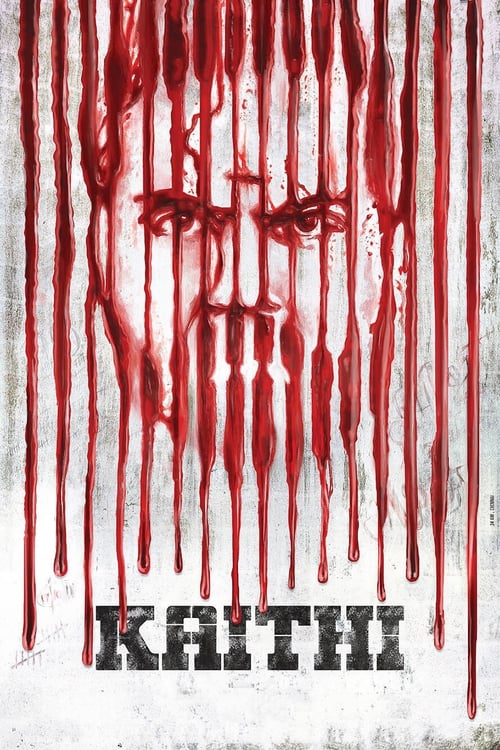
Kaithi
2019 · Lokesh Kanagaraj
Built the LCU (Kaithi/Vikram/Leo), the first Indian fan-driven "cinematic universe," and directed Rajinikanth's Coolie — Tamil cinema's fan-theory economy runs on him.
For an adrenaline night when you want to be pinned to the couch — tense, propulsive, no filler. Reach for it when a slow burn won't do and you need a film that grabs you in the first ten minutes.
What it's about
Dilli, a convict granted a single day of parole, wants one thing: to meet the daughter he has never seen. Instead a massive drug bust goes sideways, poisoned officers need a driver, and Dilli ends up hauling a truck of dying policemen through a gauntlet of gangsters across one long night — his reunion receding with every roadblock.
The experience
Relentless — a ticking-clock siege thriller that keeps tightening for its whole runtime, with action that feels heavy, physical, and consequential. The emotional stakes of a father's one chance give the mayhem a pulse.
Performances
Karthi carries the film with a weathered, coiled stillness — a hardened man visibly holding grief and hope in check between fights.
The craft
Lokesh Kanagaraj strips the mainstream Tamil template to the bone: one continuous night, no songs, lean cross-cutting between the truck, a besieged station, and the ticking clock. The night-time cinematography and thudding sound design make it a film for good speakers and a dark room.
Why it matters
A sleeper Diwali release that became a phenomenon, it launched the Lokesh Cinematic Universe and helped push Tamil action cinema toward leaner, night-set genre filmmaking.
Snapshot
Kaithi ("Prisoner") is a Tamil-language action thriller written and directed by Lokesh Kanagaraj, released to coincide with Diwali in October 2019. It stars Karthi as Dilli, a convict released on a single day's parole who wants only to meet the daughter he has never seen, and who is instead swept into a night-long defensive siege on behalf of a decimated police force. The film's most conspicuous formal decision is its self-imposed austerity: it unfolds across roughly one continuous night, contains no song-and-dance numbers, and has effectively no female lead — three departures from the default grammar of mainstream Tamil cinema that together define its character. Built as a lean genre exercise, it also became the load-bearing first entry in what fans and the filmmakers came to call the Lokesh Cinematic Universe (LCU), a shared continuity that the director would extend through Vikram (2022) and beyond. As a film, Kaithi is notable less for narrative novelty than for the discipline of its execution — a small cast, a compressed timeframe, and a chase-and-hold structure pursued with unusual formal rigor for a commercial star vehicle.
Industry & production
Kaithi was produced by Dream Warrior Pictures, the company of S.R. Prabhu and S.R. Prakashbabu, a mid-tier Tamil production house that had backed the director's debut Maanagaram (2017) and positioned itself around content-forward genre projects rather than pure star spectacle. Casting Karthi — an established lead but not a "mass hero" in the mold of the industry's biggest names — allowed the production to sell a concept picture rather than a personality. The decision to strip out songs and a romantic subplot was commercially counterintuitive in a market where those elements are near-mandatory for wide appeal, and the film's greenlighting reflects a growing early-2020s appetite in Tamil cinema for tightly genre-bound, "single-thread" narratives.
The film was a Diwali release, one of the most competitive windows in the Tamil calendar, and it performed strongly enough commercially to be treated as a breakout for its director and a validation of the lean-thriller model. Precise box-office figures reported for Indian films vary widely across trade outlets and are not consistently verifiable, so I will not assert specific numbers here; what is well established is that the film was received as a commercial success and materially raised Kanagaraj's standing. Its afterlife as the seed of a franchise — with a sequel long announced — belongs to the production history as much as the reception, since it converted a standalone thriller into a foundational studio asset.
Technology
Kaithi is a digitally originated film shot for the standard multiplex-and-single-screen exhibition ecosystem of late-2010s Indian cinema. Its defining technical constraint is diegetic: the story takes place almost entirely at night, much of it in darkness lit by practical and vehicular sources, which places the film squarely within the low-light capabilities of contemporary digital cinema cameras. Detailed, independently verifiable specifications of the exact camera and lens packages are not something I can confirm without risk of invention, so I will characterize the technology at the level the film's images make legible: sensitive digital capture used to hold detail in near-dark interiors, road exteriors lit by headlamps, and the sodium-and-shadow palette of a besieged police station. The truck sequences depend on rigging for vehicle-mounted and moving-camera work, and the film's action is built for practical staging — bodies, vehicles, and environments — rather than heavy digital augmentation, with visual effects used to extend and clean rather than to generate spectacle.
Technique
Cinematography
The cinematography, by Sathyan Sooryan, is the film's signature achievement and the clearest expression of its ambition. Working almost entirely at night, Sooryan builds an image system out of restricted light: pools of practical illumination, headlamp beams cutting through dust and dark, and the cold institutional light of the police station interior. The near-monochromatic, blue-and-amber nocturnal palette does double duty — it enforces visual unity across a story that could have felt episodic, and it keeps the audience in the same perceptual condition as the characters, straining to read a threat in the dark. The camera favors mobility and proximity during action, staying close to Dilli inside the cab of the truck and moving with the defenders inside the station, which sustains the film's claustrophobic, real-time pressure. This is craft that reads as authored rather than merely competent: the lighting scheme is a thesis about how to make a low-light siege legible without cheating it into daylight clarity.
Editing
Cut by Philomin Raj, the film's editing is organized around a compressed, near-continuous timeline. The structure braids two spatial situations — Dilli on the road driving a truckload of incapacitated officers, and the skeleton crew holding the police station — and the cutting maintains a tightening rhythm across both without letting the parallel lines slacken. The film's real-time pressure depends on editorial restraint: withholding relief, denying the narrative the release valve of a song break, and pacing the escalation so that the single night feels genuinely continuous. The action is assembled to preserve geography and cause-and-effect rather than to dazzle through fragmentation, which keeps the violence intelligible.
Mise-en-scène / staging
Kaithi's spatial imagination is central. The film essentially rests on two contained arenas — the moving truck and the fortified-but-vulnerable police station — and it extracts sustained tension from the finite properties of each. The station siege in particular is staged as a problem of thresholds, corridors, and sightlines: who controls the door, the roof, the armory, the lockup. This concentration on a defensible interior under nocturnal assault places the film in a long lineage of siege staging. The truck functions as a mobile pressure cooker, its cab a confessional space and its cargo a moral weight Dilli literally carries. The production design keeps the world grimy, functional, and unglamorous, in keeping with the film's rejection of ornament.
Sound
The score is by Sam C.S., whose muscular, percussive background music is one of the film's most discussed elements and a large part of its propulsive feel. In a film with no songs, the score bears an unusual share of the emotional and rhythmic load, punctuating the siege and elevating Dilli's recurring motif. The sound design leans into the mechanical and the martial — engines, blows, the ambient dread of the dark perimeter — to sustain tension in the frequent absence of dialogue. The absence of musical numbers is itself a sonic decision: it keeps the film inside a single continuous acoustic reality rather than periodically stepping outside it.
Performance
Karthi's Dilli anchors the film through physical performance and restraint rather than dialogue-driven heroics; the character is defined by a want (to see his daughter) that runs orthogonal to the plot's demands, and Karthi plays the tension between reluctance and capability. The ensemble is genuinely functional to the design: Narain as the narcotics officer Bejoy provides the film's procedural spine, and Napoleon as the station's officer figure lends institutional gravity. The antagonists are played broad enough to register as menace without tipping into the operatic. Because the film denies itself romance and songs, performance is concentrated on situation-driven behavior — fear, calculation, endurance — which suits its naturalistic register.
Narrative & dramatic mode
The film operates in a compressed, unity-of-time dramatic mode: one night, a small set of locations, an escalating siege. Its dramatic engine is a classic ironic structure — a man who wants nothing to do with the fight is the only one capable of winning it, and his private goal (a daughter) is perpetually deferred by the public emergency (the poisoned officers, the drug cartel's counterattack). This withholding of the personal payoff is the film's chief source of pathos and keeps an action premise emotionally grounded. The mode is propulsive and forward-driving rather than mysterious; the audience largely knows the stakes and the geography, and suspense derives from execution and survival rather than from concealed information.
Genre & cycle
Kaithi sits at the intersection of the siege thriller, the crime-and-narcotics procedural, and the reluctant-hero action film. Its most direct generic kinship is with the fortified-outpost-under-attack tradition — a lineage most often traced to John Carpenter's Assault on Precinct 13 (1976), itself in dialogue with the Western — in which a heterogeneous, undermanned group must hold a building against a numerically superior force. The film belongs to a late-2010s cycle in Tamil cinema of genre-forward, "content" thrillers that consciously trimmed the traditional commercial apparatus (songs, romance, comedy track) in favor of tightly bounded premises. Its single-night, single-objective construction aligns it with the international real-time or near-real-time action mode.
Authorship & method
The film is a director's statement. Lokesh Kanagaraj, following the interlocking-narrative structure of his debut Maanagaram (2017), here demonstrates a facility for genre architecture — clean premises, hard constraints, and escalation — that would define his subsequent career. His method in Kaithi is subtractive: remove the elements a Tamil commercial film is "supposed" to have and see what discipline the remaining structure imposes. His most consequential authorial decision extends beyond the frame: the film plants continuity seeds that he would later harvest into a shared universe, revealing a producer-director sensibility oriented toward world-building.
The authorship is genuinely collaborative in the areas that matter most to the film's identity. Cinematographer Sathyan Sooryan's low-light image system, composer Sam C.S.'s score, and editor Philomin Raj's compression are not decorative contributions but constitutive of the film's effect; in a work this stripped-down, craft is the text. Karthi, as star, submits to the concept, playing a role built around endurance and reticence rather than heroics-on-demand. This alignment of a star's willingness with a director's austerity is itself part of the film's method.
Movement / national cinema
Kaithi is a product of the Tamil film industry (colloquially "Kollywood"), one of the major regional cinemas of India, and it participates in a broader early-2020s reappraisal of what a mainstream South Indian film could be. It arrived during a period in which Tamil, Telugu, Malayalam, and Kannada cinemas were increasingly exporting genre confidence to a pan-Indian audience, and in which the "hero film" was being renegotiated against tighter, more Western-influenced genre templates. The film's rejection of the song sequence — a defining feature of Indian popular cinema for generations — is legible only against that national-cinema backdrop; the omission means something precisely because the convention is so strong.
Era / period
Released in 2019, Kaithi belongs to the immediate pre-pandemic moment of Indian commercial cinema, when theatrical genre experimentation was ascendant and the "cinematic universe" model — imported from Hollywood's franchise era — was beginning to appeal to Indian producers. It reflects the late-2010s convergence of digital low-light capture, an appetite for compressed genre storytelling, and a star system newly willing to subordinate itself to concept. Its period identity is also transitional: made as a standalone, it was retroactively positioned as an origin point once the shared-universe strategy proved viable.
Themes
The film's central theme is fatherhood as a moral compass: Dilli's entire arc is organized around a daughter he has never met, and the siege becomes a test of whether a man defined by criminality and violence can be redeemed by care. Adjacent to this is a theme of institutional fragility — the police, poisoned and reduced to a skeleton, must be saved by the very kind of person they imprison, which inverts the usual relationship between criminal and state. The film also meditates on duty performed reluctantly: heroism here is not aspiration but obligation, taken up because no one else can. Class and the carceral system hover at the edges — the "prisoner" of the title is both a literal convict and a figure of larger social confinement — though the film keeps these implications subordinate to its immediate genre mechanics rather than developing them into overt argument.
Reception, canon & influence
Critically and popularly, Kaithi was received as a taut, well-crafted thriller and a marker of Lokesh Kanagaraj's arrival as a distinctive genre director; praise concentrated on its cinematography, score, pacing, and the confidence of its stripped-down design. I will not attach specific ratings or grosses that I cannot verify, but the consensus that the film represented a formal step forward for mainstream Tamil action is well established.
Looking backward, its influences are legible: the fortified-outpost siege descends from the Assault on Precinct 13 / Western tradition, its nocturnal chase-and-hold shape echoes the vehicular-siege logic of films like Mad Max: Fury Road (2015) in spirit if not in scale, and its no-songs, real-time discipline aligns it with international genre minimalism more than with domestic convention.
Looking forward, Kaithi's influence is unusually concrete for a single genre film. It became the cornerstone of the Lokesh Cinematic Universe, with narrative and character threads later connected to Vikram (2022), and a sequel was announced and long anticipated, extending Dilli's story. Its commercial and critical success also helped legitimize the lean, song-free Tamil action thriller as a viable model, encouraging further genre-forward experimentation in the industry. Within the director's own filmography it functions as a proof of concept whose structural and world-building lessons carried directly into his subsequent, larger-scale work. In that dual capacity — as a self-contained achievement and as the first stone of a franchise — Kaithi occupies a distinctive place in recent Tamil cinema.
Reception
Released on Diwali 2019 directly opposite Vijay's Bigil, it was the underdog that won the word-of-mouth war and turned sleeper hit; now it's canonized as the founding stone of the Lokesh Cinematic Universe and the film that announced Lokesh Kanagaraj as Tamil cinema's next big thing.
How Kaithi was received, from release to now →
How to watch Kaithi: what to notice on a first viewing
- Watch for pools of light cutting through darkness and dust. Sathyan Sooryan lights nearly every scene with restricted, practical sources, headlamps, single bulbs, so your eye has to work as hard as the characters' do. You're kept in the same dark, straining perception as the people on screen.
- Notice there's no song breaking up the tension. Unlike most Tamil commercial films, Kaithi never cuts to a musical number, so Sam C.S.'s percussive score is the only music carrying the film's rhythm. Withholding the usual release valve keeps the pressure building instead of letting it vent.
- Track how the editing keeps cutting between the truck and the station. Philomin Raj braids two spatial situations, Dilli on the road and the skeleton crew holding the police station, tightening the rhythm across both at once. Two separate fights are made to feel like one continuous emergency.
- Watch how the film uses doorways, corridors, and the roof. The station siege is staged as a problem of thresholds and sightlines, who controls the door, the roof, the armory, every space treated as contested ground. The geography of the building is doing as much work as any weapon.
- Watch Dilli's face for reluctance rather than heroics. Karthi plays Dilli through physical restraint and hesitation, a man pulled into a fight he keeps visibly wishing he weren't part of. His hesitation is what makes the violence feel like a cost, not a thrill.
The whole guide to watching Kaithi, with the keys for a rewatch →
Influences: the films it descends from and the films it influenced
- Rio Bravo (1959) — Establishes the jail-siege template Kaithi inherits — a small, mismatched band holding a lockup against a surrounding gang until relief arrives, with a compromised ally earning redemption through the defense.
- Assault on Precinct 13 (1976) — The explicit structural model (named in the dossier): a near-derelict police station besieged by a faceless swarm, forcing cops and a prisoner into alliance, held together by a spare synth-percussion pulse rather than dialogue.
- Night of the Living Dead (1968) — Codifies the board-up-the-building nocturnal siege of overwhelming numbers — barricaded entrances, dwindling defenders, attrition tension — that governs Kaithi's station-under-siege geometry.
- The Wages of Fear (1953) — Origin of the volatile-cargo truck-run suspense; Kaithi transposes it to a lorry of poisoned, dying cops as fragile freight that must reach the hospital or be lost en route.
- Duel (1971) — Turns the truck cab into a confined pressure chamber and sustains menace through a single nocturnal vehicular pursuit — the confined-vehicle staging and highway-jeopardy grammar Kaithi runs on.
- Sorcerer (1977) — Grimy, kinetic night-driving of a doomed cargo scored to engine drone and percussion — the sweat-and-machinery realism Kaithi's truck sequences echo over glamour.
- The Road Warrior (1981) — Reconceives the vehicle as a moving fortress defended against pursuers, converting the static siege into a rolling one — the mobile-siege logic of Dilli's lorry.
- Die Hard (1988) — The single-location, near-real-time siege carried by one reluctant, out-gunned everyman picking off a superior force across one night — Kaithi's unity-of-time and reluctant-hero irony.
- The Warriors (1979) — A group must cross hostile night-city terrain besieged by faceless gangs to reach safety by dawn — the nocturnal-gauntlet-against-the-clock shape Kaithi adopts.
- Heat (1995) — Codifies the cool-blue nocturnal urban palette and procedural cop craft that underwrite Sathyan Sooryan's blue-amber, low-light image system.
- Collateral (2004) — Digital low-light capture of a city across one continuous night, a driver and a dangerous passenger locked in a car — the direct low-light-nocturnal cinematography debt for Kaithi's look.
- 16 Blocks (2006) — A burnt-out cop must escort a vulnerable charge across the city while besieged by corrupt colleagues in compressed time — the reluctant-protector-transporting-a-charge spine of Dilli's arc.
- Master (2021) — Carries forward Kaithi's constraint-driven genre architecture and the star-submits-to-concept method — a marquee lead bent to a director's austere premise rather than heroics-on-demand.
- Vikram (2022) — Harvests the continuity seeds Kaithi planted (the drug consignment, Dilli's world) into the Lokesh Cinematic Universe — the payoff of Kaithi's producer-director world-building method.
- The Raid: Redemption (2011) — Single-building siege stripped of romance and musical interludes, wall-to-wall percussive action as pure structure — the international lean-genre minimalism Kaithi's no-songs discipline sits beside.
- Mad Max: Fury Road (2015) — The dossier's cited spirit-kin: a relentless nocturnal chase-and-hold built on percussive scoring and vehicular-siege momentum with dialogue pared to a minimum.
- Vikram Vedha (2017) — A Tamil action thriller prized for real-time, geographically legible action choreography and cop/criminal moral inversion, carrying forward VV's legible-action-geography craft.
- Kill (2024) — The Indian proof-of-concept for Kill's structural bet: one night, no songs, no heroine, action confined to a vehicle in transit, with practical source lighting (headlamps, cabin bulbs) doing all the work a song sequence would otherwise do.
Similar films
- Vikram (2022) — influence & lineage
- Vikram Vedha (2017) — shared sensibility
- Kill (2024) — shared sensibility
- Pudhupettai (2006) — shared sensibility
- Super Deluxe (2019) — shared sensibility
- Ghilli (2004) — shared sensibility
- Aaranya Kaandam (2011) — shared sensibility
- Chithha (2023) — shared sensibility