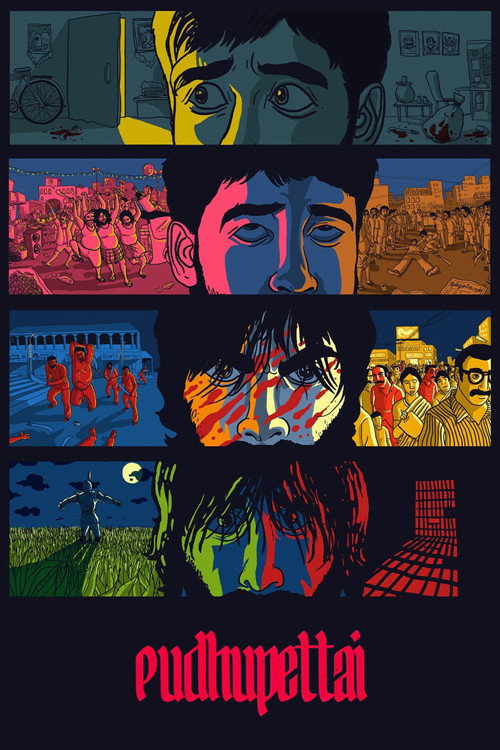
Pudhupettai
2006 · Selvaraghavan
For when you want the hard stuff — a dark, intense crime epic that refuses to romanticize its antihero. Challenge, not comfort; save it for a night you can handle it.
What it's about
Kokki Kumar is a carefree teenager in a Chennai slum until his mother's murder blows his life apart. He runs, gets absorbed into a street gang, and climbs — from errand boy to enforcer to the feared right hand of a dirty politician — in a rise that costs him everything a rise is supposed to buy. It's a gangster saga told from the gutter up, with no glamour and no exits.
The experience
Raw, feral, and genuinely unsettling — this isn't the fun kind of gangster movie. It moves with a nervy, unpredictable energy, and it makes you complicit in Kumar's ascent before showing you exactly what he's become.
Performances
Dhanush, still early in his career, is astonishing as Kokki Kumar — twitchy, pathetic, terrifying, sometimes all in one scene. It remains one of the great transformative performances in Tamil cinema.
The craft
Selvaraghavan directs with deliberate ugliness and experimental nerve — grimy textures, jagged rhythms, and musical numbers that curdle rather than celebrate, with a score that gets under your skin. It was conceived as a bleak character chronicle rather than a star vehicle, and every choice serves that.
Why it matters
A commercial disappointment on release that grew into one of Tamil cinema's defining cult films — now routinely cited among the great Indian gangster pictures and a touchstone of the Selvaraghavan–Dhanush collaboration.
Snapshot
Pudhupettai ("New Town," the name of a Chennai locality) is a Tamil-language crime saga written and directed by Selvaraghavan and released on 26 May 2006. It charts the ascent of Kokki Kumar (Dhanush), a slum adolescent who flees home after witnessing his mother's murder, is absorbed into a street gang, and metastasizes into the ruthless enforcer — and eventual boss — of a criminal-political machine. Conceived as a bleak coming-of-age-through-violence chronicle rather than a conventional star vehicle, the film paired one of Kollywood's most temperamentally experimental directors with an actor, Dhanush, still early in a career the two had already begun to build together. Commercially it underperformed on release; over the following decade it accrued a substantial cult reputation and is now routinely cited among the defining Tamil gangster films of its era and a landmark in Dhanush's filmography. It is a work best understood as a deliberate act of de-heroization, using the grammar of the underworld epic to strip the gangster of glamour.
Industry & production
The film was produced under the Kollywood studio system of the mid-2000s, financed by K. Muralidharan, V. Swaminathan and G. Venugopal — the Lakshmi Movie Makers / Gemini axis of producers active in Tamil cinema at the time. It arrived at a moment when the Tamil industry was negotiating a widening gap between mass-market star spectacle and a self-consciously "realist," youth-oriented strand of filmmaking to which Selvaraghavan belonged. The director came to the project fresh off Kaadhal Kondein (2003) and 7G Rainbow Colony (2004), both of which had established him and Dhanush as a distinctive author-actor unit trading in psychological damage and social marginality.
The production leaned into difficulty rather than away from it: an unglamorous milieu, an anti-heroic protagonist, coarse dialogue, and an unusually long, novelistic structure. The precise budget and box-office figures are not reliably documented in the public record, and the specifics of the shoot are thinly recorded; what is consistently reported is that the film opened to only average commercial returns and was regarded on release as a financial disappointment before its later critical rehabilitation. Its dialogue was written by the veteran novelist Balakumaran, a frequent and important collaborator in Tamil cinema, whose contribution shaped the film's much-discussed vernacular register.
Technology
Pudhupettai was made in the mid-2000s transitional window, and it should be treated as a photochemical (35mm) production of that period rather than a digital-native film; detailed technical documentation of its capture and finishing workflow is not part of the reliable public record, and this dossier will not invent one. What is stylistically evident on screen is a preference for available-feeling, low-key lighting, handheld mobility, and a desaturated, grainy palette that reads as a rejection of the glossy, high-key look then dominant in commercial Tamil cinema. The film's texture — shadowed interiors, murky slum exteriors, a general suppression of "prettiness" — is the product of aesthetic choice as much as any particular apparatus, and it is on that level of technique, rather than tooling, that its interest lies.
Technique
Cinematography
Photographed by Arvind Krishna, the film cultivates a grimy, close-pressed visual field. The camera favors handheld intimacy and unstable framings that keep the viewer inside Kumar's disorientation, alongside a muted, near-monochrome color grade that drains the underworld of romance. Night and interior scenes sit in heavy shadow; the slum is rendered as a warren rather than a picturesque location. This is imagery that works against the conventional gangster film's fondness for iconic, statuesque compositions of its hero — where the genre often ennobles, Selvaraghavan and Arvind Krishna diminish and entrap.
Editing
Edited by Kola Bhaskar, Pudhupettai is structured as a non-linear, retrospective narration. Kumar recounts his own rise, and the cutting moves associatively across his biography rather than in strict chronology, folding the story back on itself as memoir and confession. The film is long and episodic by design, accumulating incident the way a novel accumulates chapters — a shape consonant with Balakumaran's literary sensibility. The editing also carries the film's tonal violence: abrupt transitions and elliptical compressions of time mirror the arbitrariness of the world it depicts.
Mise-en-scène / staging
The staging is committed to squalor and claustrophobia. Costuming, décor and location work refuse aspirational polish; characters inhabit cramped rooms, alleys and functional political-office spaces. Violence is staged as ugly, sudden and consequential rather than choreographed for spectacle. A recurring device is direct address — Kumar's narration and, at moments, his engagement of the camera — which implicates the audience in his account and foregrounds the film's interest in self-mythologizing. The overall production design translates the sociology of the title neighborhood into physical texture.
Sound
Yuvan Shankar Raja's contribution is central to the film's identity, and the soundscape is as important as any image. The score fuses driving rhythm, chant-like vocal textures and an aggressive, at times dissonant sensibility that matches the narrative's descent; the songs (among them the widely remembered "Oru Naalil") function less as interludes than as expressive extensions of Kumar's psychology. Yuvan's work here is frequently singled out as a career highlight and as a key reason the film's atmosphere has aged so well. The dialogue track, in the raw Chennai idiom crafted by Balakumaran, is itself a sonic signature — the film's language, blunt and profane, was among its most commented-upon features.
Performance
Dhanush's performance as Kokki Kumar is the film's engine and the basis of much of its later reputation. He tracks a single figure across a long moral arc — from frightened, orphaned adolescent to numbed, calculating, finally near-monstrous power broker — without softening the character into likability. The physical transformation (posture, voice, the hardening of affect) is calibrated to the non-linear structure, so that the same actor must credibly embody several psychological ages of one man. The supporting cast, including Sonia Agarwal and Sneha in significant female roles and Azhagam Perumal as a gang elder, is deployed to chart Kumar's shifting relationships to loyalty, desire and betrayal; the film's world is populated so as to isolate him further with each ascent.
Narrative & dramatic mode
The dominant mode is tragic and ironic rather than celebratory. Pudhupettai is a first-person crime memoir, narrated in retrospect by a protagonist who is neither reliable nor redeemed. Its dramatic engine is the classic rise-and-corruption curve of the gangster tradition, but Selvaraghavan withholds catharsis: Kumar's power brings no transcendence, only deeper entrapment and moral evacuation. The film's coming-of-age spine — a boy shaped by grief, poverty and violence — is fused to an underworld chronicle so that social determinism and individual pathology become inseparable. The direct-address framing lends the story a quality of testimony, even self-indictment, and the episodic, novelistic accumulation of events resists the tidy three-act shaping of mainstream commercial cinema. It is, in tone, closer to fatalistic naturalism than to heroic melodrama.
Genre & cycle
The film sits squarely in the gangster / underworld-crime genre, but it belongs specifically to a strand of Tamil cinema that sought grit and moral ambiguity over the mass-hero idiom. Where much popular Kollywood crime cinema of the period elevated its protagonists into figures of righteous or charismatic power, Pudhupettai pursues degradation. Its coordinates are recognizably those of the international rise-and-fall crime picture — the slum-to-syndicate ascent, the corrupting embrace of politics, the accumulation of women, wealth and enemies — inflected through a distinctly local politics of caste, poverty and electoral machinery. Commentary on the film has consistently framed it as part of a broader conversation about "evolving gangster tropes" in Tamil cinema, positioning its stylized violence, guttural dialogue and refusal of sanitized heroism as a template for a more unsparing register.
Authorship & method
Pudhupettai is a strongly authored film, and Selvaraghavan is its controlling intelligence as both writer and director. His body of work is defined by psychological darkness, socially marginal protagonists, tonal risk and an appetite for narrative and structural experiment that often placed him at odds with commercial expectation — qualities that here reach their fullest and harshest expression. His creative partnership with Dhanush (whom Selvaraghavan, as his elder brother, also worked with across several formative films) is essential to understanding the film's conception: it is built around an actor willing to disappear into an unsympathetic role.
The authorship is genuinely collaborative in its key departments. Balakumaran's dialogue supplied the vernacular texture and much of the film's confrontational verbal identity. Yuvan Shankar Raja's score and songs gave it a sonic personality that has proven durable and influential. Arvind Krishna's cinematography established the desaturated, handheld visual grammar, and Kola Bhaskar's editing realized the retrospective, non-linear architecture. The film's distinctiveness emerges from the alignment of these choices — writing, music, image and cut all pulling toward the same anti-glamorous end.
Movement / national cinema
The film is a product of Tamil cinema (Kollywood), a major regional industry within Indian film, and specifically of a mid-2000s current that pushed toward realism, youth alienation and de-heroized protagonists. It should not be flattened into "Bollywood": its language, milieu, political texture (caste, local electoral corruption, slum geography) and star culture are specifically Tamil. Within that national-regional frame, Selvaraghavan represents an auteurist, risk-taking pole — closer in spirit to a filmmaker's cinema than to formula — and Pudhupettai stands as one of the more uncompromising statements to emerge from that tendency in the period.
Era / period
Released in 2006, the film belongs to a moment when Tamil cinema was actively diversifying: mass-hero spectacle continued to dominate the box office, while a parallel wave of directors pursued darker, more socially grounded material aimed at a younger, more cine-literate audience. Pudhupettai is very much a film of this transitional moment — ambitious, formally restless, commercially uneasy. Its initial underperformance and later canonization together tell a period story about the gap between what the mid-2000s market rewarded and what a portion of the audience came to prize in retrospect.
Themes
Several interlocking themes organize the film. Determinism and the manufacture of the criminal: Kumar is shown as produced by grief, poverty and a social order with no exits, complicating any simple moral judgment even as the film refuses to excuse him. Power as corruption: each rung of ascent hollows the protagonist further, so that success and dehumanization advance together. The nexus of crime and politics: the underworld is not autonomous but entangled with electoral power, corruption and patronage. Masculinity, desire and control: Kumar's relationships with women register his shifting appetites for possession and dominance rather than intimacy. Self-mythology and narration: the retrospective, direct-address structure makes the telling of a life a theme in itself — the gangster authoring his own legend. Underlying all of these is a fatalism that treats violence as cyclical and inescapable rather than resolvable.
Reception, canon & influence
On release, Pudhupettai drew strong critical notice — particularly for Dhanush's performance, Selvaraghavan's direction and Yuvan Shankar Raja's music — while performing only modestly at the box office and being widely regarded at the time as a commercial disappointment. In the years since, its standing has inverted: it is now commonly discussed as a cult classic and one of the touchstone films of both Dhanush's and Selvaraghavan's careers, its anniversaries marked by fan and press attention. (Precise contemporaneous box-office and budget figures are not reliably documented in the public record and are not asserted here.)
Influences on the film (backward): Pudhupettai draws on the long international lineage of the rise-and-fall gangster picture — the slum-to-power trajectory, the fusion of crime and politics, the tragic corruption arc that the genre has carried from Hollywood through world cinema. Comparisons to that broader tradition of the underworld epic recur in critical writing about it. Domestically, it extends and darkens the Tamil crime film while carrying forward Selvaraghavan's own preoccupations with damaged, marginal protagonists established in his earlier work, and it bears the literary imprint of Balakumaran's dialogue.
Legacy (forward): The film's most durable influence lies in its demonstration that a Tamil crime film could reject heroic glamour in favor of moral ugliness, raw language and formal experiment — and be embraced for it over time. It is frequently credited in later discourse with helping shift the register of the Tamil gangster film toward grittier, more ambiguous portraiture, and its aesthetic and tonal choices are cited as a reference point for subsequent, more "authentic" underworld cinema. For Dhanush, it remains a defining early demonstration of dramatic range; for Selvaraghavan, a high-water mark of his auteurist ambition; and for Yuvan Shankar Raja, one of the scores most closely bound to his reputation. Its trajectory — commercial neglect followed by canonization — has itself become part of how the film is discussed, a case study in the cult afterlife of an ambitious work that arrived slightly ahead of its audience.
Reception
Met with mixed reviews and underwhelming box office in 2006, it's since been fully canonized as one of Tamil cinema's greatest gangster films — a 4K remastered re-release hit Tamil Nadu theaters in July 2025 to a hero's welcome.
How Pudhupettai was received, from release to now →
How to watch Pudhupettai: what to notice on a first viewing
- Notice how drained of color the world stays throughout. Arvind Krishna shoots in a muted, near-monochrome grade with heavy shadow at night, refusing the glossy, colorful look gangster films usually give the underworld. The drained color keeps the film from making any of this look like something to want.
- Watch how unsteady the camera gets during violence. The camera stays handheld and close, tilting and jostling rather than holding the composed, statuesque shots gangster films usually reserve for their heroes. The instability keeps you disoriented right alongside Kumar instead of admiring him from a stable distance.
- Notice Kumar occasionally speaking straight into the camera. His own narration runs across the film, and at moments he directly addresses the lens, turning his rise into something he is telling you himself. You are watching a man author his own legend, not a neutral account of what happened to him.
- Listen for chant-like vocals pushing under the dialogue. Yuvan Shankar Raja's score leans on driving rhythm and dissonant, chant-like textures, and the songs function less as breaks from the story than as extensions of Kumar's state of mind. The music is not a pause from the story. It is another way of telling you what Kumar feels.
The whole guide to watching Pudhupettai, with the keys for a rewatch →
Influences: the films it descends from and the films it influenced
- Nayakan (1987) — Established the Tamil slum-to-don epic with PC Sreeram's low-key chiaroscuro underworld imagery, the exact chiaroscuro grammar Pudhupettai inherits while inverting Nayakan's mournful dignity into moral ugliness.
- Goodfellas (1990) — Its retrospective first-person voiceover that narrates a criminal ascent as episodic memoir rather than plotted drama is the structural template for Pudhupettai's novelistic, unreliable retrospective narration.
- City of God (2002) — Desaturated handheld slum realism narrated by a youth rising through a gang hierarchy across nonlinear chapters — the direct debt for Arvind Krishna's visual grammar and Kola Bhaskar's episodic cut.
- Satya (1998) — Pioneered de-glamorized Indian underworld realism built on vernacular street dialogue and the ordinary-man-into-killer arc, the domestic precedent for stripping heroic glamour from the crime film.
- Company (2002) — Rendered the crime-politics nexus as cold organizational machinery, supplying the syndicate-meets-electoral-power thread that structures Guru's later ascent.
- Scarface (1983) — The underclass rise-and-fall of hubris and self-destruction — protagonist propelled from nothing to a paranoid violent apex — is the genre skeleton Pudhupettai darkens.
- Kaadhal Kondein (2003) — Selvaraghavan's own earlier film that forged the director-Dhanush collaboration around a psychologically damaged, socially marginal protagonist, the method that reaches its harshest form here.
- Mean Streets (1973) — Handheld immersion in a source-lit low-life milieu — the claustrophobic, grimy staging of petty criminals in tight spaces that Pudhupettai's squalor-claustrophobia inherits.
- Deewaar (1975) — Codified the Indian slum-to-smuggler ascent of an aggrieved underclass figure, the rise-arc template Pudhupettai retains while deliberately refusing its heroic pathos.
- Subramaniapuram (2008) — Extends Pudhupettai's register shift into vernacular Tamil crime realism where small-time youths are consumed by the crime-politics nexus, shot with de-heroized period grit.
- Aaranya Kaandam (2011) — Tamil neo-noir formal experiment that builds on Pudhupettai's permission to de-glamorize and structurally play with the gangster film rather than heroize it.
- Vada Chennai (2018) — The fullest heir: a nonlinear retrospective north-Chennai gangster epic where a reluctant youth is dragged into a crime-politics underworld, directly extending Pudhupettai's structure and milieu.
- Jigarthanda (2014) — A meta-gangster film that foregrounds the ugly authenticity of the real underworld against filmi glamour, carrying forward Pudhupettai's de-heroization as explicit subject.
- Asuran (2019) — Continues Dhanush's de-glamorized, transformation-driven performance mode inside a gritty subaltern milieu governed by social determinism, the actorly legacy Pudhupettai first proved.
- Amores Perros (2000) — Contemporary exemplar of desaturated, grain-heavy handheld urban realism cut into interlocking nonlinear strands — the same turn-of-decade aesthetic register Pudhupettai works in.
- Gangs of Wasseypur (2012) — Sprawling multi-decade nonlinear gangster saga fusing crime and politics through vernacular vulgarity and a folk-inflected score — a parallel in novelistic-episodic ambition and anti-glamour.
- Kattradhu Thamizh (2007) — Contemporary Chennai descent narrative scored by Yuvan Shankar Raja, framing a deglamorized star lead's fall through non-chronological confession — the same composer, the same star-turned-wreck deglamorization, and the same frame-narrated ruin, made one year prior.
Similar films
- Vada Chennai (2018) — influence & lineage · same viewing thread
- Asuran (2019) — influence & lineage · same viewing thread
- Nayakan (1987) — influence & lineage · same viewing thread
- Aaranya Kaandam (2011) — influence & lineage · same viewing thread
- Jigarthanda (2014) — influence & lineage
- Satya (1998) — influence & lineage
- Vikram Vedha (2017) — same viewing thread
- Mahanadhi (1994) — same viewing thread
All the films related to Pudhupettai →
Watch it with: curated runs of related films
- Blood Feuds and Broken Men — A run of Indian films about ordinary men swallowed by violence, vendetta, and moral compromise — watch these together when you want fate, murky righteousness, and gunpowder sharing the same frame.