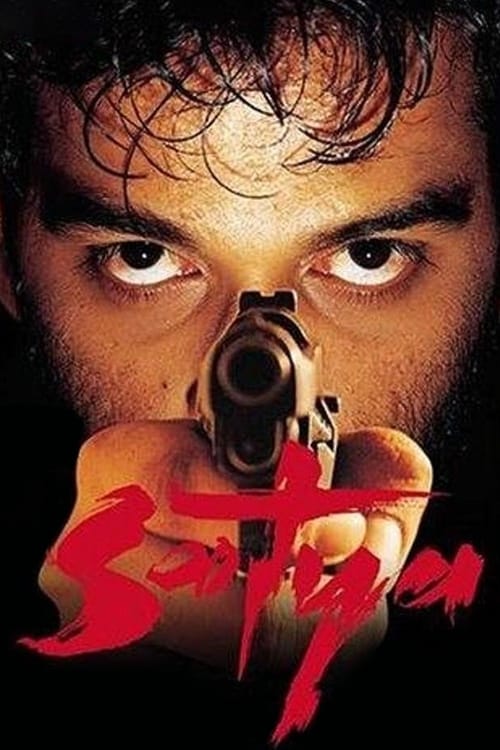
Satya
1998 · Ram Gopal Varma
For when you want a serious, gripping crime saga that earns its violence — a film to give your full attention on a night you're in the mood for something intense and real, not escapist.
What it's about
A quiet young migrant named Satya arrives in Mumbai with no past and no connections, looking only for work. A stint in jail on a false charge throws him together with Bhiku Mhatre, a volatile, magnetic gang boss, and Satya is pulled into the city's underworld — a world of cramped chawls, police pressure, shifting loyalties, and sudden violence, where friendship and doom grow from the same soil.
The experience
Gritty and immersive, with an undertow of dread — it feels less like watching a gangster movie than being embedded in one. The texture is raw and street-level, but the emotions run operatic: loyalty, brotherhood, and the sense that the city will collect its debt.
Performances
Manoj Bajpayee's Bhiku Mhatre is one of the great gangster performances — explosive, funny, childlike and terrifying by turns — a star-making turn that steals the film from its own title character, with J.D. Chakravarthy's stillness as the perfect foil.
The craft
Ram Gopal Varma shot it in real Mumbai locations with a documentary-inflected roughness that was radical for Hindi cinema in 1998, and the script by then-unknowns Anurag Kashyap and Saurabh Shukla gives the underworld a lived-in vernacular crackle. The city itself — monsoon streets, rooftops, crowded lanes — becomes the film's real set.
Why it matters
Widely credited with inventing 'Mumbai noir,' it reset the template for the Hindi gangster film, launched Bajpayee, Kashyap, and a generation of grittier Indian filmmaking in its wake.
Snapshot
Satya is the film most often credited with reinventing the Hindi gangster picture and inaugurating what critics would later call "Mumbai noir." Released in mid-1998, it follows a nameless, near-anonymous migrant — Satya (J.D. Chakravarthy) — who arrives in Bombay, is drawn almost by gravity into the city's underworld, and rises alongside the volatile gang boss Bhiku Mhatre (Manoj Bajpayee) before the machinery of crime, police, and betrayal grinds them both down. Directed by Ram Gopal Varma at a moment when he was consciously breaking from mainstream Bollywood convention, and written by the then-unknown pair of Anurag Kashyap and Saurabh Shukla, the film fused documentary-inflected location shooting with an operatic sense of loyalty and doom. Its cultural footprint is outsized: it made a star of Bajpayee, launched a generation of writers and technicians, and set the template for two decades of Indian crime cinema. It is routinely placed on lists of the greatest Hindi films ever made.
Industry & production
Satya was produced under Varma's own banner during a period when he was positioning himself as a maverick within the Bombay industry. Varma had already had commercial and critical success — the Telugu thriller Shiva (1989), the horror film Raat, and the Hindi hits Rangeela (1995) and Daud — and he leveraged that standing to make a film that deliberately rejected the star-driven, song-and-romance formula then dominant. Rather than casting established leading men, he built the ensemble largely from theater actors and relative unknowns: Chakravarthy (a Telugu-cinema actor Varma had worked with), Bajpayee (a struggling Delhi-theatre-trained actor with only bit parts behind him), Saurabh Shukla, Aditya Srivastava, Makarand Deshpande, Shefali Shah, and Sushant Singh. Urmila Matondkar, coming off Rangeela, was the one recognizable marquee name, and she was cast against glamour type as the ordinary neighborhood woman Vidya.
The production leaned on real Bombay locations — chawls, cramped tenements, bars, the seafront rocks — rather than studio sets, which lowered costs and heightened realism. The film's development is itself part of its legend: the screenplay emerged from Varma's collaboration with Kashyap and Shukla, both of whom were early in their careers, with Shukla also acting (as Kallu Mama) in the film. Precise budget and box-office figures for Satya are not consistently documented in the reliable record, and I will not invent them; what is agreed is that the film was a commercial success relative to its modest cost and became a decisive critical and industry event.
Technology
Satya was shot on 35mm film in the late-1990s, before the digital transition, and its technological signature lies less in equipment novelty than in method: handheld and available-light-inflected shooting on real streets. The production embraced the roughness that location work imposed — practical light sources, ambient city noise, cramped interiors — and made that texture an aesthetic virtue rather than a limitation. This grounded, quasi-documentary approach stood in contrast to the polished, controlled studio image of mainstream Hindi cinema. The record on specific cameras and stocks is thin, so I will not overstate the technical particulars; the salient point is the deployment of relatively mobile, unfussy technique to capture Bombay as a lived-in environment.
Technique
Cinematography
The film's photography is credited to Gerard Hooper and Mazhar Kamran, who gave Satya its distinctive visual grammar of intimacy and unease. The camera works close to the actors, often handheld, favouring tight interiors, cluttered frames, and the compressed geography of chawls and lanes. Bombay is shot not as spectacle but as pressure — a city of narrow spaces, rain, neon, and shadow. The seafront rock where Bhiku Mhatre stands and roars his defiance became one of Hindi cinema's iconic images precisely because the cinematography treats such moments as eruptions against an otherwise grimy, enclosed world. The visual style consciously borrows from a realist, noir-adjacent tradition rather than the high-key gloss of contemporaneous Bollywood.
Editing
Editing is credited to Apurva Asrani (with Bhanodaya). The cutting is central to the film's tension: it alternates between long, breathing passages of ensemble life and abrupt, jolting bursts of violence, so that killings arrive suddenly and without the choreographed build-up of masala action. This rhythm — the ordinary interrupted by the brutal — is one of the film's defining formal achievements and a key reason its violence reads as shocking rather than balletic. The editing also manages a large ensemble and multiple strands (the gang, the police, the political-underworld nexus, the domestic) without losing the propulsive downward arc of Satya's story.
Mise-en-scène / staging
The staging privileges density and authenticity: crowded rooms, shared meals, card games, cramped domestic quarters, the constant proximity of bodies. Gang life is shown as a social world — men eating, joking, quarreling — before it is shown as a criminal enterprise, which makes the eventual violence land as a rupture of a recognizable community. The production design and location choices foreground the working-class Bombay milieu, and the blocking often keeps several characters alive within a single frame, reinforcing the theme of the gang as a surrogate family. This is naturalistic staging in the service of tragedy.
Sound
Sound is one of Satya's underrated strengths. The film uses the ambient noise of the city as a near-constant bed, and the background score by Sandeep Chowta drives much of the film's dread and momentum. The songs — composed by Vishal Bhardwaj with lyrics by Gulzar — are integrated with unusual discipline for a Hindi film of the period: numbers such as "Goli Maar Bheje Mein," "Sapne Mein Milti Hai," and "Badalon Se Kaat Kaat Ke" function as extensions of mood and milieu rather than decorative interludes. The interplay of a restrained, functional song presence with an aggressive score was itself a departure from convention.
Performance
The acting is the film's beating heart, and it is dominated by Manoj Bajpayee's Bhiku Mhatre — a performance of raw charisma, volatility, and wounded loyalty that made him a star and remains a touchstone of Hindi screen acting. His seafront cry — the "Mumbai ka king kaun?" moment — became instantly canonical. J.D. Chakravarthy plays Satya with a watchful, interiorized reserve that anchors the ensemble; his relative blankness lets the world around him supply the drama. The supporting cast is uniformly strong: Saurabh Shukla's Kallu Mama, Shefali Shah as Bhiku's wife Pyaari, Aditya Srivastava, Makarand Deshpande, Sushant Singh, and Urmila Matondkar as Vidya all contribute to an ensemble realism in which no character reads as a type. The naturalistic, theater-trained performance style was a deliberate rejection of Bollywood's presentational norms.
Narrative & dramatic mode
Satya operates as a tragedy of assimilation. Its protagonist has almost no backstory — he arrives with no name-recognition, no explained past, no clear motive — and this deliberate opacity turns him into a vessel through which the audience enters the underworld. The narrative mode is realist and observational, accumulating the textures of gang life before it tightens into inexorable doom. Rather than a hero's journey, it traces a descent in which love (Satya and Vidya) and friendship (Satya and Bhiku) cannot survive the logic of the world the characters inhabit. Violence is presented as consequence rather than spectacle, and the film withholds moral consolation: institutions (police, politics) are as compromised as the criminals. The dramatic engine is loyalty and its betrayal, and the ending delivers tragedy rather than resolution.
Genre & cycle
The film is a crime drama / gangster film, but its importance is that it redefined the genre in Hindi cinema. Earlier Bombay crime films — from the "angry young man" cycle of the 1970s through the stylized dons of the 1980s and 1990s — tended toward myth, melodrama, and larger-than-life heroism. Satya replaced that with a grounded, morally ambiguous, ensemble-driven realism. It became the founding text of what is often labeled "Mumbai noir" or the Bombay underworld realist cycle, and it stands as the first film in Varma's loosely conceived gangster trilogy, later continued in Company (2002) and D (2005). It arrived amid, and helped catalyze, a wave of late-1990s/2000s crime films that treated the underworld sociologically.
Authorship & method
Satya is inseparable from Ram Gopal Varma's authorial project of the late 1990s: an insistence on realism, atmosphere, and technique over stardom and formula, and a habit of recruiting and empowering young talent. Varma's method here — real locations, unknown actors, integrated craft, a script developed with new writers — became a model, and he functioned as much as an incubator as an auteur.
The key collaborators are central to the film's authorship:
- Writers Anurag Kashyap and Saurabh Shukla supplied the screenplay and dialogue, grounding the underworld in credible speech and social texture; both would become major figures (Kashyap as one of Indian cinema's most influential directors, Shukla as a leading actor-writer).
- Cinematographers Gerard Hooper and Mazhar Kamran built the film's intimate, noir-inflected visual language.
- Editor Apurva Asrani shaped its distinctive rhythm of the mundane interrupted by the violent.
- Composer Vishal Bhardwaj (with lyricist Gulzar) wrote songs that served mood and milieu; Sandeep Chowta provided the propulsive background score. Bhardwaj, like Kashyap, would go on to a major directorial career.
The concentration of future first-rank talent on a single mid-budget crime film is itself a defining fact of Satya's authorship.
Movement / national cinema
Within Indian national cinema, Satya sits at a hinge point. It is mainstream Hindi (Bollywood) cinema, made for theatrical release with songs, yet it imported the realist sensibility more associated with parallel/art cinema and married it to genre energy. In doing so it helped open a middle path — commercially viable but artistically serious crime cinema — that would define a significant strand of 2000s Hindi filmmaking. It is frequently discussed as the wellspring of a new realist current in Bombay cinema, and its personnel (Kashyap, Bhardwaj, and others) went on to lead that current. It also reflects the specifically Bombay-centric preoccupation with the city's real 1990s underworld and its entanglement with police and politics.
Era / period
The film is a document of late-1990s Bombay, made in the shadow of the real-world dominance of organized crime syndicates in the city during that decade and the widely reported nexus of the underworld with politics, business, and the film industry itself. It was released in 1998, on the cusp of the city's official renaming to Mumbai, and it registers the anxieties of that era: migration, informal economies, urban precarity, and the porousness between crime and everyday life. As an artifact of the pre-digital, pre-multiplex Hindi industry, it also captures a transitional moment just before the economic and technological shifts that would reshape Indian cinema in the 2000s.
Themes
Several themes recur and interlock:
- The migrant and the city: Satya's anonymity dramatizes Bombay as a machine that absorbs the rootless and remakes them.
- The gang as family: Loyalty, brotherhood, and belonging are the film's emotional core, which makes betrayal its central catastrophe.
- Love against violence: The tender Satya–Vidya relationship is continuously threatened by the world Satya cannot escape.
- Institutional rot: Police and political power are shown as complicit, collapsing any clean line between law and crime.
- Fate and doom: The narrative moves with tragic inevitability; escape is imagined but never permitted.
- Ordinary violence: By embedding brutality in the mundane, the film insists on the banality — and cost — of the underworld.
Reception, canon & influence
Satya was met with strong critical acclaim and quickly acquired the status of a landmark. It was recognized in major Indian awards circuits — including National Film Award and Filmfare recognition, with particular attention to Bajpayee's performance and to the film's craft — though I will not enumerate specific award categories where my recollection is not certain. Over the following decades it has been repeatedly canonized: it appears frequently on critics' and industry lists of the greatest Hindi and Indian films, and it is treated as the defining modern gangster film of the subcontinent.
Influences on the film (backward): Satya draws on the international gangster and crime-film tradition — the operatic loyalty-and-betrayal structures associated with films like The Godfather, and the gritty urban energy of world crime cinema — filtered through Varma's own realist instincts and the lived reality of 1990s Bombay. It also reacts against the preceding Hindi crime tradition (the mythic dons and the angry-young-man archetype), defining itself by its rejection of that mode's melodrama.
Legacy (forward): The film's influence is difficult to overstate. It made Manoj Bajpayee a star and validated a naturalistic school of Hindi screen acting. It launched or accelerated the careers of Anurag Kashyap and Vishal Bhardwaj, both of whom became defining directors of a realist, genre-literate strand of Indian cinema — a lineage that runs through films like Kashyap's Gangs of Wasseypur. It established Varma's gangster trilogy and set the template for "Mumbai noir," influencing a long cycle of underworld films in the 2000s and beyond. Its formal innovations — location realism, ensemble casting, integrated music, violence as rupture — became a shared vocabulary for the industry. As both a commercial success and an artistic watershed, Satya is the film to which subsequent Indian crime cinema is most often traced back.
A Deleuzian reading
A man stands on the rocks at the edge of Bombay with the sea behind him, and he shouts at the city.
The full Deleuzian reading of Satya →
Reception
A low-budget sleeper hit in 1998 that critics embraced immediately, it has only grown in stature since — now routinely ranked among the greatest Hindi films ever made and treated as the big bang of 'Mumbai noir'. Every Hindi gangster film since gets measured against it.
How Satya was received, from release to now →
How to watch Satya: what to notice on a first viewing
- Watch how close and unsteady the camera stays in cramped interiors. Hooper and Kamran shoot handheld in tight chawls and lanes, compressing Bombay into pressure rather than spectacle. The camera puts you inside the crowding instead of showing it to you from a safe distance.
- Notice how suddenly violence arrives inside otherwise ordinary scenes. Apurva Asrani cuts between long stretches of everyday gang life, meals and card games, and abrupt bursts of killing with almost no buildup. The suddenness is the point: violence here reads as rupture, not choreography.
- Watch how many gang members share the frame at meals. Varma stages the gang as a crowded social world, bodies constantly close, before he ever stages it as a criminal enterprise. The density makes the gang feel like a family before it ever feels like a crime.
- Listen for the city noise that never fully drops out. A constant ambient bed of traffic and street sound sits under Sandeep Chowta's score, and the songs stay tied to mood rather than becoming interludes. Bombay itself becomes a pressure you hear as much as you see.
- Watch Bhiku Mhatre's volatility against Satya's stillness. Bajpayee plays Bhiku as loud, charismatic, and unstable while Chakravarthy keeps Satya watchful and withheld, letting the world around him supply the drama. The contrast is the film's engine: one man performs the underworld, the other absorbs it.
The whole guide to watching Satya, with the keys for a rewatch →
Influences: the films it descends from and the films it influenced
- The Godfather (1972) — Supplies the operatic loyalty-and-betrayal architecture and the ritual framing of the syndicate as domestic family — meals, weddings, brotherhood — that Satya reworks so violence erupts from within intimate settings.
- Mean Streets (1973) — Model for handheld, location-shot immersion among low-level hoods and the volatile hothead friend (Johnny Boy → Bhiku Mhatre) whose unpredictability sets the film's rhythm rather than plot mechanics.
- Bicycle Thieves (1948) — The neorealist doctrine of real locations and unknown/non-star faces as an ethical method — the source of Varma's insistence on texture over glamour that underwrites the whole film.
- Salaam Bombay! (1988) — Establishes the documentary-textured street casting and city-underbelly geography of Bombay realism that Satya inherits and turns to the gangster genre.
- Parinda (1989) — The first modern realist Bombay gangster film — the chawl/mill milieu and the innocent drawn into the underworld, shot on location, that Satya intensifies into pure milieu-driven tragedy.
- Nayakan (1987) — Indianizes the Godfather template by mapping the don's rise onto a specific city's slum geography with naturalist lead performance, proving the transplant Satya then strips of grandeur.
- Ardh Satya (1983) — Parallel-cinema naturalism and the institutional-rot theme, with Om Puri's unglamorous interiorized performance serving as the acting template Bajpayee's Bhiku extends.
- Deewaar (1975) — The mythic 'angry young man' smuggler archetype and melodramatic don that Satya defines itself against — a negative-influence ancestor whose romantic underworld it deliberately deglamorizes.
- The Middleman (1976) — Transposes the etiquette of favors and moral surrender for advancement into an urban milieu, using restless handheld location realism to trace an ordinary man's incremental accommodation to a corrupt economy.
- Company (2002) — Varma's own direct continuation of the gangster trilogy, extending Satya's handheld intimacy, ambient-city sound bed and opaque-protagonist opacity into the mechanics of the syndicate itself.
- Maqbool (2003) — Satya's composer turned director grafts Macbeth onto the Mumbai underworld, carrying forward the gang-as-family framing and the naturalistic ensemble he first scored under Varma.
- Black Friday (2004) — Satya's co-writer applies its dialogue-grounded social realism to a docu-procedural of the 1993 blasts — handheld sprawl through real locations, mundane detail punctured by sudden violence.
- Sarkar (2005) — Varma makes the Godfather debt explicit within his own house style, reprising Satya's low-key noir lighting and integrated craft while foregrounding the patriarch-as-institution.
- Ab Tak Chhappan (2004) — A Varma-produced encounter-cop procedural extending Satya's institutional-rot theme and its refusal of heroics, built on the same restrained, naturalistic performance register.
- Gangs of Wasseypur (2012) — The fullest heir — Satya's writer expands its method into a generational epic: milieu-dense staging, diegetically integrated songs as commentary, and violence staged as abrupt rupture of the everyday.
- Sacred Games (2018) — Extends Satya's opaque-migrant-in-the-city protagonist and gang-as-family tragedy into long-form, preserving the ambient Bombay sound bed and dialect-grounded speech Kashyap first honed on it.
- Gangs of Wasseypur - Part 2 (2012) — Kashyap co-wrote this film's grimy, on-location Mumbai-underworld realism, and its refusal of star-glamour for grubby vernacular crime is the naturalist mode he brings back to Wasseypur.
- Pudhupettai (2006) — Pioneered de-glamorized Indian underworld realism built on vernacular street dialogue and the ordinary-man-into-killer arc, the domestic precedent for stripping heroic glamour from the crime film.
- Aaranya Kaandam (2011) — Legitimized the desaturated, available-light Indian neo-noir idiom — grimy interiors, morally ambiguous gangsters, on-location realism — that P.S. Vinod's cold imaging inherits and localizes to Tamil streets.
- Gangs of Wasseypur - Part 1 (2012) — Pioneered the vernacular Indian underworld realism that casts theater-trained character actors over stars and grounds gangsterism in grimy, dialect-specific local texture.
- Vikram Vedha (2017) — Grounded Indian gangster cinema in gritty neo-noir realism centered on the criminal's interiority and moral ambiguity, the noir-realist lineage VV's gray-zone justice descends from.
- Vaastav: The Reality (1999) — Emerges in the same late-'90s cycle with the identical narrative of an ordinary man's tragic assimilation into gangdom, sharing the naturalistic ensemble and lived Mumbai-street texture.
Similar films
- Nayakan (1987) — influence & lineage
- Salaam Bombay! (1988) — influence & lineage
- Sholay (1975) — shared sensibility
- Gangs of Wasseypur - Part 1 (2012) — shared sensibility
- Pudhupettai (2006) — shared sensibility
- Thalapathi (1991) — shared sensibility
- Kill (2024) — shared sensibility
- Vada Chennai (2018) — shared sensibility