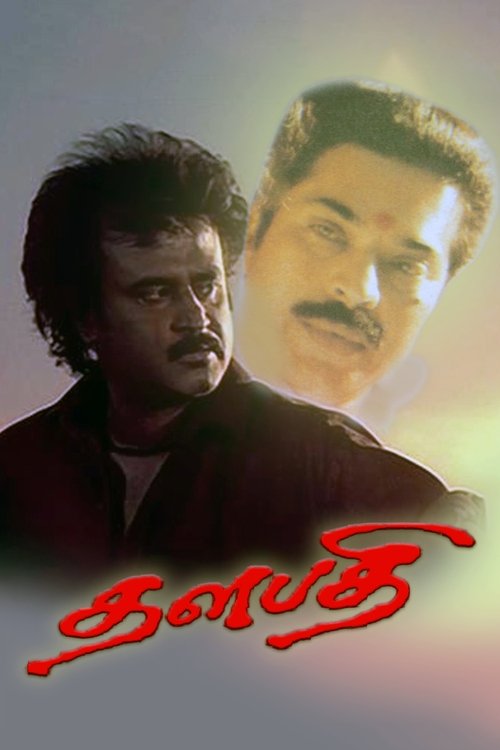
Thalapathi
1991 · Mani Ratnam
When you want a big, sweeping mythic drama — male friendship, mother-love, destiny — and you're ready to be wrung out by the end. Emotional heavy weather, gladly entered.
What it's about
An abandoned baby grows into Surya, a ferocious protector of his slum neighborhood who answers injustice with his fists. When a local strongman named Deva recognizes his fire and makes him his commander, Surya gains the brother he never had — and a place inside an outlaw order that a principled new district official has sworn to dismantle. Underneath the gangster plot runs an older story: a mother, a lost son, and loyalties that pull in opposite directions.
The experience
Operatic and full-blooded — this is a film of thunderclap confrontations, smoldering silences, and songs that hit like monsoon rain. It builds a slow, aching weight of fate; you feel the tragedy coming and can't look away.
Performances
Rajinikanth gives one of his most soulful performances, trading superstar swagger for wounded ferocity, and Mammootty matches him with quiet, immovable authority — watching two titans of Indian cinema share the frame is the event. Srividya is devastating as the mother carrying a lifelong secret.
The craft
Mani Ratnam stages the story like myth — shafts of light, smoke, rain, and silhouette turn slum alleys into an epic landscape, with Santosh Sivan's cinematography doing painterly work. Ilaiyaraaja's score and songs are legendary in their own right, carrying whole stretches of emotion. Made for a big screen and good speakers.
Why it matters
A landmark pairing of two of Indian cinema's biggest stars and a high-water mark of the Tamil gangster drama, it's endlessly rewatched, quoted, and ranked among Mani Ratnam's and Rajinikanth's finest work.
Snapshot
Thalapathi ("The Commander") is Mani Ratnam's mythologically-underwritten gangster drama, a Tamil-language film that transplants the friendship of Karna and Duryodhana from the Mahabharata into the slums and back-alleys of a modern south Indian town. Its engine is a bond between two men: Surya (Rajinikanth), an abandoned foundling raised in poverty who becomes a fierce protector of the powerless, and Deva (Mammootty), a local strongman who recognizes Surya's ferocity, embraces him, and makes him his commander. Around this axis Ratnam builds a tragedy of blood and belonging — Surya is the illegitimate, cast-off son of a woman (Srividya) whose legitimate son grows up to be the district collector (Arvind Swamy) sworn to break the very outlaw brotherhood Surya serves. The pairing of two of Indian cinema's biggest stars — Rajinikanth, then the reigning Tamil superstar, and Mammootty, the Malayalam icon — was itself an event. The result is one of Ratnam's most emotionally direct films and one of composer Ilaiyaraaja's most celebrated scores.
Industry & production
Thalapathi arrived at a high point in Mani Ratnam's ascent through 1980s and early-1990s Tamil cinema. It followed Mouna Ragam (1986), the gangster landmark Nayakan (1987), Agni Natchathiram (1988), and the children's drama Anjali (1990), and immediately preceded Roja (1992), the film that would make Ratnam a pan-Indian name. By 1991 Ratnam was recognized as the most formally ambitious mainstream filmmaker in the Tamil industry, a director who could work with superstars while resisting the broadest conventions of the masala film.
The production is associated with producer G. Venkateswaran, a frequent Ratnam collaborator of the period, and the film was made in Tamil and released in dubbed versions for other-language markets (a Hindi dub circulated under the title Dalapathi). Much of the film was shot away from the studio in and around Mysore, and its slum and settlement environments were substantially built or dressed rather than merely found — the density and texture of these spaces are central to the film's look. Precise budget and box-office figures are not something I can state reliably here, so I will not; the film is generally remembered as a strong commercial and critical success, and its songs became enduring hits, but exact grosses belong to a documentary record I cannot verify.
The casting coup was the top-lining of Rajinikanth and Mammootty together — a Tamil and a Malayalam superstar sharing the screen as near-equal leads, a rare arrangement that gave the film unusual marquee weight across south Indian markets. The film is also frequently cited as the feature debut of Arvind Swamy, who would reunite with Ratnam on Roja.
Technology
Thalapathi is a conventionally photochemical production of its era — 35mm color, optically finished, with sound built in post to the standard practice of Indian commercial cinema at the time, including dubbed dialogue and songs pre-recorded in studio and picturized to playback. There is no exotic technical apparatus here; the film's distinction lies in craft rather than novel technology. What is worth noting is that the film sits on the cusp of a generational shift in Tamil cinematography — its images announce a new, more painterly sensibility (see below) that would define the following decade — without depending on any new machinery to do so. The "technology" that matters most is the lighting and lensing intelligence brought to ordinary anamorphic-era tools.
Technique
Cinematography
The film was photographed by Santosh Sivan, and it is one of the works that established him as a major cinematographer before Roja and the art films (The Terrorist, Iruvar) that made his international reputation. Sivan's Thalapathi is built on warm, earthen, often backlit imagery: dust, smoke, low sun, silhouettes against bright grounds, and a palette of ochres and golds that lends the slum world a burnished, almost mythic glow rather than social-realist grime. Faces are frequently rim-lit or thrown into partial shadow; crowds and processions are staged so that light rakes through them. This is not documentary observation but a heightened, pictorial vision — appropriate to a film that treats its outlaws as figures out of epic. The visual grammar of Thalapathi — the halation, the backlight, the saturated warmth — proved influential on the texture of 1990s Tamil cinema.
Editing
The film was cut by Suresh Urs, a long-standing Ratnam collaborator. The editing reflects Ratnam's characteristic balance: extended, patiently held dramatic scenes — the meetings between Surya and Deva, the mother-son confrontations — set against more kinetic passages of violence and the rhythmic, montage-driven construction of the songs. Ratnam's cinema of this period is notable for withholding the exaggerated cutting of standard action fare in favour of a smoother, more classical continuity that lets performance and staging carry weight.
Mise-en-scène / staging
Ratnam stages Thalapathi as a world of thresholds and territories: the slum as a self-governing community, the marketplace, the rail lines and industrial edges of the town, the ordered interiors of officialdom. The recurring image is of Surya standing between worlds — belonging fully to none. Ratnam repeatedly composes the two leads in tableaux of loyalty: seated together, flanked by followers, framed as a court around Deva. The film's iconography deliberately evokes kingship and retinue, translating the Karna-as-crowned-vassal motif into the visual language of the gang.
Sound
As is standard for the tradition, dialogue is post-dubbed and songs are playback numbers picturized to pre-recorded tracks. The dominant sonic element is Ilaiyaraaja's score (discussed under Authorship). The film's sound design serves the melodrama and the songs rather than pursuing naturalism; the emotional register is carried far more by music than by ambient realism.
Performance
Rajinikanth gives one of his most controlled and internalized star performances as Surya — the film asks him to be less the flamboyant showman of his commercial vehicles and more a wounded, principled figure of banked rage and loyalty, and he answers with real gravity. Mammootty's Deva is his counterweight: watchful, magnanimous, quietly commanding, a don whose power is expressed through stillness. The chemistry between the two stars — mutual regard rather than rivalry — is the film's emotional foundation. Srividya, as the mother who abandoned Surya, anchors the film's tragic core in a few charged scenes, and Arvind Swamy makes an assured debut as the upright collector who is also, unknowingly, Surya's half-brother. Shobana and Bhanupriya lead the female roles.
Narrative & dramatic mode
The dramatic mode is tragedy in a melodramatic key — a mode Ratnam handles with restraint. The narrative turns on dramatic irony the audience feels long before the characters: we understand, or come to understand, that Surya and the collector are brothers, that the woman Surya reveres and resents is his own mother, and that the loyalties binding him to Deva will force him into collision with his own blood. The engine is not plot mechanics but the slow, agonizing pressure of identity revealed too late. The film's most powerful scenes are recognition scenes — the discovery of parentage, the impossibility of choosing between the brother who is family by blood and the brother who is family by choice. This is the ancient tragic structure of the abandoned child returned, and Thalapathi plays it for its full pathos.
Genre & cycle
Thalapathi belongs to the Indian gangster / "friendship" film, and specifically to the lineage Ratnam himself had shaped with Nayakan — the crime film reconceived as moral and familial tragedy rather than as pure action spectacle. It sits within the broader Tamil tradition of the outlaw-hero who dispenses justice the state cannot, and within the enduring genre of male friendship (nadpu) as a supreme value. But Thalapathi is distinguished within these cycles by its overt mythic scaffolding: it is a gangster film that is also a conscious retelling of an epic. Compared with the sprawling rise-and-fall biography of Nayakan, Thalapathi is tighter and more fable-like, less concerned with the sociology of crime than with the tragic logic of destiny and loyalty.
Authorship & method
The film is a signature Mani Ratnam work in its fusion of star cinema with authorial control, its literate reworking of source material, and its collaboration with a stable of major craftspeople. Ratnam has openly connected the film to the Mahabharata's Karna — the great warrior born to Kunti, abandoned at birth, raised outside his royal lineage, and bound by gratitude and love to Duryodhana, who alone honored him. Surya is Karna; Deva is Duryodhana, the friend who elevates the outcast and commands his undying loyalty; the mother is Kunti; and the righteous collector-brother stands in the position of the Pandavas. This is the film's method in miniature: myth as psychological blueprint, not as costume.
The key collaborators are essential to the film's identity. Composer Ilaiyaraaja delivered a score widely regarded as among his finest — both the songs ("Rakkamma Kaiya Thattu," "Yamunai Aatrile," "Sundari Kannaal," "Chinna Thaayavaal," "Kaatukuyilu") and a background score whose main theme is celebrated in its own right; the songs became standards of Tamil film music. (The oft-repeated claim that "Rakkamma Kaiya Thattu" was named in a BBC global-song poll circulates widely; I cannot verify the exact provenance of that honor and flag it as an unconfirmed piece of popular memory.) Cinematographer Santosh Sivan supplied the film's luminous visual signature. Editor Suresh Urs shaped its rhythm. Together they represent the collaborative ensemble through which Ratnam's authorship operates.
Movement / national cinema
Thalapathi is a landmark of Tamil-language commercial cinema and, more broadly, of the wave of technically sophisticated south Indian filmmaking that Ratnam and his collaborators drove in the late 1980s and early 1990s. It belongs to no formal movement but exemplifies a distinct tendency: the elevation of mainstream Tamil cinema's production values and formal ambition — in cinematography, music, and dramatic construction — while retaining stars and songs. The Ratnam–Sivan–Ilaiyaraaja axis of this period is often understood as a decisive modernization of the south Indian popular film's visual and aural language, one that would soon reach a national audience through Roja.
Era / period
The film is a product of the very early 1990s, on the eve of India's economic liberalization and just before the nationalist and terrorism-themed cinema that Roja would inaugurate for Ratnam himself. It is essentially outward from politics: its concerns are personal, familial, and mythic rather than topical. It captures a moment when Tamil commercial cinema's craft ceiling was rising sharply, and when a director could still command two superstars for a chamber-scaled tragedy dressed as a gangster picture.
Themes
The film's governing themes are loyalty and chosen family — the idea that the bond one elects (Surya to Deva) may run deeper than the bond of blood — set against the countervailing pull of maternal abandonment and inherited identity. Surrounding these are: justice outside the law, embodied in Surya the outlaw-protector versus the collector's institutional order; the stigma of illegitimacy and the wound of the cast-off child; the moral ambiguity of violence committed in a good cause; and fate as an inescapable structure, the tragic recognition that comes too late to change anything. By routing all of this through the Karna myth, Ratnam frames his gangster's loyalty as a species of nobility, and his tragedy as something older than the modern city it inhabits.
Reception, canon & influence
Thalapathi was received as a major work of its moment and has grown in stature since, and it is now widely regarded as one of Mani Ratnam's finest films and a high point for both of its stars — often singled out as one of Rajinikanth's most restrained and respected performances and as a landmark example of the Rajinikanth–Mammootty pairing. Ilaiyaraaja's score is consistently ranked among his greatest achievements, and Santosh Sivan's cinematography is credited as an early demonstration of the visual sensibility that would define his career.
Influences on the film (backward): the decisive source is the Mahabharata, and specifically the Karna–Duryodhana friendship, which supplies the film's entire tragic architecture. Within Ratnam's own filmography, Nayakan is the immediate precursor — the template of the crime film reimagined as familial tragedy — and the wider Tamil traditions of the righteous-outlaw hero and the sacred value of male friendship feed directly into it.
Legacy / what it shaped (forward): the film reinforced a durable strain in Tamil and Indian cinema — the mythologically inflected gangster-friendship drama — and its craft, particularly Sivan's warm, backlit, painterly imagery and Ilaiyaraaja's score, exerted a felt influence on the look and sound of 1990s Tamil filmmaking. It also served as a launching point in its collaborators' trajectories: the Ratnam–Sivan partnership continued into celebrated later work, and Arvind Swamy's debut here led directly to his lead in Roja. Where precise citations of awards, poll placements, or box-office standings are concerned, the popular record around Thalapathi is fuller than what I can responsibly confirm in specifics; what is not in doubt is its standing as a canonical Ratnam film and a lasting touchstone of the modern Tamil gangster tragedy.
A Deleuzian reading
Start with a silhouette.
The full Deleuzian reading of Thalapathi →
Reception
A hit on release in 1991, it has since climbed into the Tamil canon — now routinely cited as the film where Rajinikanth the actor outshone Rajinikanth the superstar, and as one of Mani Ratnam's finest.
How Thalapathi was received, from release to now →
How to watch Thalapathi: what to notice on a first viewing
- Watch dust and smoke catch backlight throughout the slum scenes. Santosh Sivan shoots in warm, earthen, often backlit imagery, low sun and silhouettes against bright grounds, giving the slum world a burnished glow rather than social-realist grime. The world looks mythic on purpose, not like a documentary of poverty.
- Notice how often Deva's followers arrange themselves around him. Ratnam repeatedly composes Deva and his men in tableaux of loyalty, seated together and flanked by followers, framed like a court around a king. The staging borrows the visual language of royalty for a gang of outlaws.
- Listen for the score carrying more feeling than the dialogue. Ilaiyaraaja's music, both songs and background score, is the dominant emotional register throughout, with the sound design built to serve the melodrama rather than naturalism. The music is not decoration here. It is doing the primary emotional work.
- Watch Rajinikanth play banked rage instead of showmanship. Rajinikanth performs Surya with real restraint, wounded and principled rather than flamboyant, a deliberate departure from the commercial star vehicle version of himself. You are watching an actor known for spectacle choose stillness instead, on purpose.
- Notice how often Surya stands literally between two spaces. Ratnam stages the slum, the marketplace, and the ordered interiors of officialdom as separate territories, and repeatedly frames Surya standing at the threshold between them. He belongs fully to no single world you see him occupy.
The whole guide to watching Thalapathi, with the keys for a rewatch →
Influences: the films it descends from and the films it influenced
- Nayakan (1987) — Ratnam's immediate self-precursor — the crime epic re-engineered as familial tragedy with the outlaw as tragic patriarch, the exact template (star don, restrained central turn, dockside-underworld staging) Thalapathi inherits and re-tunes to the Karna myth.
- The Godfather (1972) — Supplies the gangster-as-parallel-sovereign staged in dark, warm interiors and Gordon Willis's chiaroscuro backlighting — the operatic 'kingship retinue tableaux' and low-key golden light Thalapathi restages around Deva's court.
- Deewaar (1975) — The template of two brothers split across the law — one smuggler, one lawman — pivoting on a mother as moral fulcrum, directly reworked in Thalapathi's Surya-vs-collector-brother axis and the deferred maternal recognition.
- Ganga Jamuna (1961) — The foundational Indian recognition-tragedy of an outlaw brother destroyed by his lawman brother, giving Thalapathi its dramatic-irony architecture of kin unknowingly ranged against kin.
- Mother India (1957) — Establishes the mother who upholds the law against her own transgressive son as the melodrama's tragic keystone — the Kunti-position that Thalapathi's abandoning mother occupies.
- Baashha (1995) — Extends the restrained-Rajinikanth gangster with a buried righteous identity — the quiet-menace don who dispenses justice outside the law that Thalapathi crystallized for his star persona.
- Roja (1992) — Direct continuation of the Ratnam–Santosh Sivan partnership and the launch of Arvind Swamy from his Thalapathi debut into a lead, carrying forward the warm, painterly golden-hour palette.
- Iruvar (1997) — The peak of Ratnam–Sivan collaboration — golden backlight, rim-lit close-ups, and processional kingship tableaux — refining the luminous star-portraiture Thalapathi first demonstrated for Sivan.
- Dil Se.. (1998) — Sivan's silhouette-and-backlight lyricism (train-roof song, sunlit haze) is the mature flowering of the rim-lighting and golden-hour vocabulary he prototyped on Thalapathi.
- Raavanan (2010) — The clearest inheritor of Thalapathi's authorial method — an epic myth (Ramayana) mapped onto a crime story as psychological blueprint, again shot by Santosh Sivan, extending 'myth not as costume.'
- Kaala (2018) — Rebuilds the mythologically-inflected Rajinikanth gangster-patriarch dispensing justice outside the state, inverting the Ramayana (Ravana as hero) the way Thalapathi channeled Karna through its star.
- Gangs of Wasseypur (2012) — Scales the gangster saga to a generational, myth-sized genealogy of loyalty and vengeance, carrying forward Thalapathi's fusion of underworld melodrama with epic-tragic inevitability.
- Karnan (2021) — Makes explicit the Karna archetype latent in Thalapathi — the abandoned warrior-hero elevated into an outlaw of righteous defiance — reactivating the same Mahabharata figure as social-justice tragedy.
- Aaranya Kaandam (2011) — Tamil neo-noir that titles its gangster ensemble after an epic 'kanda,' inheriting Thalapathi's habit of reading the underworld through a mythic frame while modernizing its formal register.
- Agni Natchathiram (1988) — Ratnam's earlier experiment in stylized backlit/silhouette star cinema (with PC Sreeram) built on half-brother rivalry — the visual and fraternal-conflict laboratory whose lighting logic Sivan carries into Thalapathi.
- Thevar Magan (1992) — Contemporaneous myth-inflected honor tragedy where a modern son is pulled into ancestral clan violence, matching Thalapathi's method of staging classical fatality through a restrained star turn rather than costume.
Similar films
- Nayakan (1987) — influence & lineage
- Iruvar (1997) — influence & lineage
- Aaranya Kaandam (2011) — influence & lineage
- Kannathil Muthamittal (2002) — shared sensibility
- Pudhupettai (2006) — shared sensibility
- RRR (2022) — shared sensibility
- Mahanadhi (1994) — shared sensibility
- Vaaranam Aayiram (2008) — shared sensibility