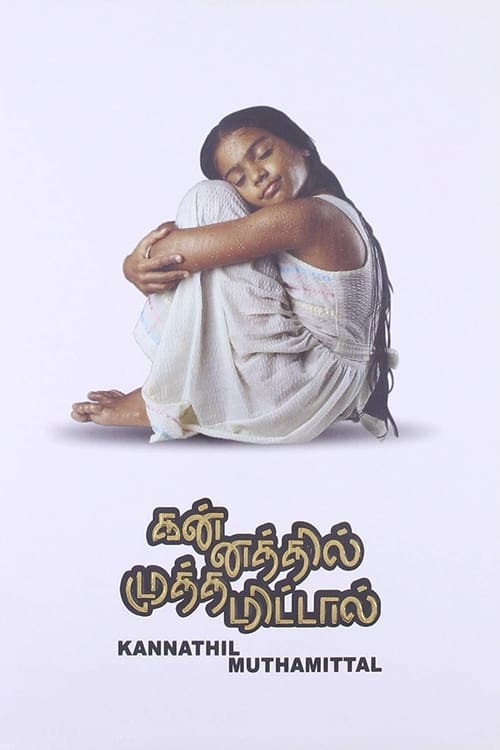
Kannathil Muthamittal
2002 · Mani Ratnam
When you want a film that makes you feel the full weight of family — good for a night when you're ready to cry and don't mind a story that takes you somewhere hard to go.
What it's about
On her ninth birthday, Amudha learns from her parents — a writer father and a loving mother in Chennai — that she was adopted as an infant, born to a Tamil refugee. Her fixation on finding her birth mother pulls the whole family out of their comfortable life and across the water into Sri Lanka, where a civil war is grinding on and the militant Tamil Tigers control the territory they must cross. A child's private question becomes a journey through a war zone.
The experience
Tender and wrenching by turns — it moves like a family drama with songs and warmth, then drops you into the raw fear of a country at war. The emotional register is big and unembarrassed; it earns its tears through the girl's stubborn, funny, wounded point of view.
Performances
Young P.S. Keerthana carries the film as Amudha with startling directness, and Madhavan and Simran give the adoptive parents real ache — people trying to love a child through a question they can't answer.
The craft
Mani Ratnam frames the war through domestic intimacy rather than battle scenes, with lush cinematography and an A.R. Rahman score that threads longing through the whole picture. The songs aren't interruptions; they carry the film's emotional argument.
Why it matters
One of the most acclaimed Tamil films of its era and a landmark in Ratnam's run of political dramas — proof that mainstream Indian cinema could hold a child's story and a civil war in the same frame.
Snapshot
Kannathil Muthamittal ("A Peck on the Cheek") is Mani Ratnam's most intimate war film — a chamber drama about an adopted nine-year-old's search for her birth mother that folds outward into the Sri Lankan civil war. The premise is deceptively domestic: on her birthday, Amudha is told by her writer-father Thiruchelvan and her mother Indra that she was born to a Tamil refugee and adopted as an infant. Her fixation on that origin turns a middle-class Chennai family's holiday into a passage across the Palk Strait into LTTE-held territory. Ratnam uses the child's private longing as a lens on statelessness, ethnic war, and the fragility of the constructed family. Released through his own Madras Talkies banner, the film is widely regarded as the fourth panel in his loose sequence of political romances (after Roja, Bombay, and Dil Se), and it is his most explicit engagement with the Eelam conflict that shadows Tamil cinema. Commercially it was among his more muted performers, but critically it was embraced as one of his finest, and it was decorated heavily at the national level.
Industry & production
The film was produced by Mani Ratnam under Madras Talkies, the Chennai production house through which he had by 2002 established himself as the dominant auteur-producer of Tamil "parallel-mainstream" cinema — films with star casts and A.R. Rahman scores that nonetheless pursued serious political and formal ambitions. By this point Ratnam commanded the resources to shoot on location, mount elaborate song sequences, and retain the top-tier technical collaborators (Rahman, cinematographer Ravi K. Chandran, editor A. Sreekar Prasad) who defined the prestige tier of South Indian filmmaking.
The subject matter — the Sri Lankan civil war and the Liberation Tigers of Tamil Eelam — was politically charged in Tamil Nadu, where the Eelam cause carried deep sympathy but also the scar of Rajiv Gandhi's 1991 assassination by an LTTE suicide bomber. Ratnam had already been a lightning rod: Bombay (1995) drew protests and a bomb attack on his home. Kannathil Muthamittal handled the Eelam material with deliberate ambivalence, neither endorsing nor demonizing the Tigers, which shaped both its production caution and its reception. Precise budget and box-office figures are not something I can state reliably; the consensus in accounts of Ratnam's career is that the film underperformed commercially relative to his hits while accruing unusually strong critical capital. The film's distribution was aided by its festival profile and its National Film Award sweep, which extended its life well beyond its theatrical run.
Technology
The film was shot and finished on 35mm in the standard analogue-photochemical workflow of early-2000s Indian cinema, before digital intermediate grading became routine in the industry. Its technological signature lies less in novel apparatus than in the deployment of mature tools: location shooting with sensitive coverage of low-light and interior scenes, and an ambitious sound design built around Rahman's score. Rahman's music was recorded in his Chennai studio (Panchathan Record Inn) using the dense multi-layered production that had made him the defining film composer of the era, blending sampled and live instrumentation. I don't have reliable specifics on any unusual camera or lab technology unique to this production, and I won't invent them; the film's craft achievement is one of refinement within a conventional format rather than technical first.
Technique
Cinematography
Ravi K. Chandran's photography is central to the film's emotional register. He works in a warm, softly diffused palette for the domestic Chennai passages — golden interiors, tactile close-ups of the child's face — and shifts toward a harder, more desaturated and unstable idiom as the family crosses into the war zone, where handheld coverage and available-light textures replace the composed lyricism of the earlier reels. The song sequences, by contrast, are shot with the lush, controlled grandeur typical of Ratnam–Rahman set pieces, using landscape (lush greenery, waterfalls, coastline) as expressive counterpoint. Chandran's framing repeatedly isolates Amudha against adult conversations she is trying to decode, using the child's eyeline and scale within the frame to make her interiority the organizing perspective.
Editing
A. Sreekar Prasad's cutting shapes the film's dual movement between the buried past and the present. The screenplay withholds and then discloses backstory — how Amudha came to be adopted, the circumstances of her birth mother's flight — and Prasad handles these revelations through flashback interpolation and elliptical transitions rather than exposition. His editing was singled out at the national awards. The rhythm is patient in the domestic scenes and grows more fractured and percussive once the war intrudes, mirroring the collapse of the family's controlled world.
Mise-en-scène / staging
Ratnam stages the film around thresholds: doorways, birthday tableaux, the deck of a boat, checkpoints. The adoptive household is rendered as a warm, book-lined, articulate space — Thiruchelvan is a novelist, and the family's fluency in language and affection is part of the point, because the child's origin lies in a world of displacement that has no such stability. As the geography shifts to Sri Lanka, the staging becomes sparser and more exposed, bodies dwarfed by ruined or contested landscape. The contrast between the two milieus — bourgeois interiority versus stateless exposure — is built into the physical world of the film.
Sound
Sound is arguably the film's most celebrated dimension. A.R. Rahman's score and songs — with lyrics by Vairamuthu — carry the emotional and political argument. The soundtrack ranges from tender lullaby registers to the overtly nationalist "Vidai Kodu Engal Naade," a song of Eelam farewell/defiance whose lyrics were honored at the national awards. Beyond songs, the film's audiography — the layering of ambient war sound, silence, and the child's voice — was recognized as part of its craft achievement. Rahman's music does not merely decorate scenes; it functions as the film's inner voice, especially in passages where Amudha's longing exceeds what dialogue can express.
Performance
The performances are pitched toward restraint. R. Madhavan (Thiruchelvan) and Simran (Indra) play the adoptive parents with a warmth deliberately shadowed by anxiety about their claim on the child. The film's fulcrum is the child performer P.S. Keerthana as Amudha, whose work — alternating precocious articulacy with raw, inconsolable need — was widely praised and honored with a national award for a child artist. Nandita Das, as the birth mother Shyama caught inside the conflict, brings a spare, haunted gravity to a role defined largely by absence and loss. Supporting turns, including Prakash Raj, anchor the adult world around the child's quest. The ensemble's discipline keeps a story that risks sentimentality tethered to observed behavior.
Narrative & dramatic mode
The film's dramatic mode is the quest-melodrama refracted through political tragedy. Its engine is a child's simple, unanswerable demand — I want to see the woman who gave birth to me — and the narrative treats that demand as both irreducibly personal and impossible to satisfy in a world torn by war. Structurally, the film braids a domestic present (the loving but destabilized Chennai family) with a withheld past (the mother's story) and an increasingly dangerous journey. Ratnam refuses a clean resolution: the reunion the film builds toward is not a redemptive closure but an encounter shaped by the mother's entanglement in the militancy and by the gulf between the child's fantasy and reality. The melodramatic address — heightened music, emotional avowal — coexists with a documentary-inflected sobriety about the war, producing a tonal doubleness characteristic of Ratnam's political films.
Genre & cycle
Kannathil Muthamittal sits at the intersection of the family drama and the war film, and within Ratnam's own oeuvre it belongs to his cycle of films that stage private love against the backdrop of political violence — Roja (Kashmir insurgency), Bombay (communal riots), and Dil Se (Northeast insurgency and suicide bombing). Critics frequently group these as a loose "terrorism trilogy" and read Kannathil Muthamittal as its coda, distinguished by placing a child rather than a romantic couple at the center. Against the broader field of Tamil cinema, the film is an art-inflected entry in the commercial mainstream: it retains songs, stars, and gloss but subordinates them to a serious inquiry into ethnicity, belonging, and war.
Authorship & method
The film is a signature Mani Ratnam work in its fusion of glossy mainstream form with sober political theme, its use of children and family as the moral center, and its trust in music and image over exposition. Ratnam directed and shaped the screenplay; the story is developed from source material by the Tamil writer Sujatha (Sujatha Rangarajan), a frequent Ratnam collaborator whose literary sensibility informs the film's articulate, writerly household. The core creative partnership is with A.R. Rahman, whose score is inseparable from the film's meaning, and lyricist Vairamuthu, whose words give the Eelam material its poetic charge. Cinematographer Ravi K. Chandran and editor A. Sreekar Prasad complete the authorial team, both delivering award-recognized work. Ratnam's method here — a small human question opening onto a vast political catastrophe, rendered through location shooting, a child's perspective, and Rahman's music — is the mature distillation of the approach he had been refining across the previous decade.
Movement / national cinema
The film is a landmark of Tamil cinema and, more broadly, of the strand of Indian filmmaking that pursues political seriousness inside popular form. It belongs to no formal "movement" in the manner of a new wave, but it exemplifies the Ratnam-led modernization of South Indian mainstream cinema in the 1990s–2000s: technically polished, star-driven, yet willing to engage divisive subjects. Its specifically Tamil identity matters — the Eelam conflict is a Tamil diasporic wound, and the film speaks from within that community's ambivalence, neither propagandizing for the LTTE nor disowning the refugees the war produced. In that sense it is national cinema doing transnational work, addressing a conflict across the strait that binds Tamil Nadu and Sri Lanka.
Era / period
Kannathil Muthamittal is a product of the early-2000s high-water mark of the Ratnam–Rahman collaboration, a period when Tamil cinema's production values, music, and global reach were rising sharply. It arrived while the Sri Lankan civil war was still active — years before the LTTE's military defeat in 2009 — which lends its portrait of the conflict the charge of the contemporary rather than the historical. The film thus captures a moment when the Eelam struggle was an open, unresolved presence in Tamil public life, and when Indian cinema was gaining confidence to treat such subjects with ambiguity rather than melodramatic certainty.
Themes
The film's central theme is the constructed nature of family and the tension between biological origin and lived belonging: Amudha is wholly loved yet cannot rest until she confronts the woman who bore her, and the film refuses to rank the two mothers. Around this sits a cluster of related concerns — statelessness and refugeehood, the way war orphans identity itself; the ethics of adoption and truth-telling to children; and the incommensurability between a child's clean moral demands and the compromised adult world of political violence. Language and articulacy recur as motifs (the father is a writer; the family talks its way through feeling), set against the muteness of trauma embodied by the birth mother. Underlying all of it is Ratnam's persistent theme: the collision of private love with public catastrophe, and the question of whether tenderness can survive history.
Reception, canon & influence
Critically, Kannathil Muthamittal was received as one of Mani Ratnam's finest and most emotionally mature films, admired for its restraint, its child's-eye perspective on war, and the Rahman score. It was honored heavily at the national level: it is widely reported to have won six National Film Awards at the 50th National Film Awards, including recognition for Ratnam's direction, Vairamuthu's lyrics for "Vidai Kodu Engal Naade," Sreekar Prasad's editing, and the young Keerthana's performance, among others. (I'd flag that the exact roster of six categories is sometimes reported inconsistently, so the specific list should be verified against the official citation rather than taken from memory.) The film also traveled to international festivals, extending Ratnam's global art-house reputation.
Looking backward, the film draws on Ratnam's own established template of political romance and on Tamil literary sensibility via Sujatha, as well as on a longer tradition of Indian melodrama that uses the family as a microcosm of the nation. Its handling of insurgency and its refusal of easy villainy extend the ambivalent politics of Roja, Bombay, and Dil Se. Looking forward, its legacy lies less in imitators than in consolidating the model of the serious-minded, technically lavish, socially engaged Tamil film — and in demonstrating that a child's interiority could anchor a war narrative without collapsing into sentimentality. It remains a reference point in discussions of how Indian cinema has represented the Sri Lankan conflict and the Tamil diaspora, and a touchstone in the critical account of Ratnam's authorship. Where the empirical record is thin — precise financials, the full technical crew, the exact award citations — I've flagged the uncertainty rather than filled it in.
Reception
Critics adored it in 2002 but Tamil Nadu audiences largely stayed away, making it a box-office disappointment — two decades on it's routinely called one of Mani Ratnam's very best, and it swept festival awards abroad while it was 'flopping' at home.
How Kannathil Muthamittal was received, from release to now →
How to watch Kannathil Muthamittal: what to notice on a first viewing
- Watch the golden warmth fade once the family crosses into Sri Lanka. Ravi K. Chandran shoots the Chennai scenes in a warm, softly diffused golden palette, then shifts to a harder, desaturated, handheld look once the family enters the war zone. The image itself tells you the family has left safety behind before anything dangerous happens on screen.
- Watch Amudha framed small against adult conversations she can't follow. Chandran repeatedly isolates the nine-year-old within the frame relative to the adults around her, using her eyeline and scale to make her confusion the organizing point of view. You keep experiencing adult conversations the way she does, as something half-overheard and half-understood.
- Listen for Rahman's score arrive exactly where words run out. A.R. Rahman's music functions as the film's inner voice, entering hardest in passages where Amudha's longing for her birth mother exceeds anything dialogue could say. The music is doing the emotional work the script deliberately leaves unsaid.
- Watch doorways, birthday tables, and checkpoints frame the family. Ratnam stages the film around literal thresholds, doorways, a birthday tableau, a boat deck, a checkpoint, each one marking a passage the family can't easily undo. Every threshold the family crosses is a small point of no return, staged as an actual piece of architecture.
- Watch Amudha swing between grown-up words and raw need. P.S. Keerthana plays Amudha alternating precocious articulacy with inconsolable, childlike want, never letting one register cancel out the other. She sounds like an adult and needs like a nine-year-old, often in the very same scene.
The whole guide to watching Kannathil Muthamittal, with the keys for a rewatch →
Influences: the films it descends from and the films it influenced
- Roja (1992) — Establishes the Ratnam–Rahman method of routing a national catastrophe (Kashmiri insurgency) through one intimate domestic quest, with Rahman's debut score carrying the emotional argument the dialogue withholds — the exact template Kannathil Muthamittal inherits.
- Bombay (1995) — Ratnam's device of placing children as uncomprehending moral witnesses at the center of communal violence, using the family as a microcosm of the nation to humanize an intractable political conflict.
- Dil Se.. (1998) — Treats a female insurgent with refused villainy and an unresolved, tragic ending, directly prefiguring the sympathetic Eelam militant mother and the refusal-of-resolution structure of the seed film.
- Mouna Ragam (1986) — Ratnam's early mastery of withheld-flashback melodrama — a present relationship gradually excavated through a concealed past — and of ensemble restraint over histrionics.
- Pather Panchali (1955) — The foundational Indian model of the child's-eye view of poverty and loss rendered through observational restraint rather than melodramatic underlining — the realist lineage of the child-eyeline perspective.
- Jeux interdits (Forbidden Games) (1952) — Refracts war through a child's uncomprehending play and gaze, originating the template of the war film organized entirely around a child's limited, non-heroic point of view.
- Come and See (1985) — Apprehends war through a youth's subjective sensory experience and the held human face, refusing heroic framing — the extreme case of war-as-child's-interiority the seed film tempers into melodrama.
- Aayutha Ezhuthu (2004) — Extends Ratnam's interwoven personal-political narrative and location-driven realism with Rahman, applying the same music-and-image-over-exposition method to youth politics.
- Madras Cafe (2013) — Takes up the same Sri Lankan Eelam conflict and Indian entanglement with a journalistic restraint and a refused, tragic resolution, continuing the model of the serious-minded, ambivalent Indian film on that war.
- Kadal (2013) — Continues the Ratnam–Rahman collaboration and the structure of moral innocence tested amid violence, with location shooting and Rahman's score again functioning as inner voice.
- Black (2005) — Carries cinematographer Ravi K. Chandran's expressive, high-contrast, memory-inflected lighting and a child-perspective interiority from the seed film into Hindi cinema.
- Raavanan (2010) — Extends Ratnam's technically lavish location shooting and refusal of easy villainy — the sympathetic-outlaw ambivalence first honed in the Eelam-militant portrait of the seed film.
- Kattradhu Thamizh (2007) — An earlier A. Sreekar Prasad collaboration where his editing braids a fractured, memory-driven timeline into coherence over a socially-conscious subject — the precise cutting method Prasad brings to Kattradhu Thamizh's nonlinear flashback structure.
- My Name Is Khan (2010) — Chandran again: shoulder-level handheld tied to a single consciousness, with sound design foregrounded over dialogue so that a political atrocity is routed entirely through one person's sensorium — the direct technical parent of Rizwan's sensory-overload POV passages.
- Alaipayuthey (2000) — Immediate predecessor pairing Ratnam with Rahman and editor A. Sreekar Prasad, its non-linear memory-driven cross-cutting between timelines being the editorial grammar the seed film refines.
- Iruvar (1997) — Ratnam's fullest trust in image and Rahman's music over expository dialogue, staging political history as stylized tableau — the authorial confidence carried directly into the seed film.
- The Terrorist (1998) — Anchors the same LTTE/Eelam suicide-bomber subject in an intimate, near-silent close-up study of a young woman's face, sharing the restraint-over-spectacle craft of the child's-interiority war film.
- Grave of the Fireflies (1988) — Centers war's cost on children severed from family and a quest to survive, staging the loss of the parent-figure without letting the horror resolve into consolation.
- Where Is the Friend's House? (1987) — Drives its narrative through a small moral errand shot at child eyeline with non-sentimental realism, the same child-quest structure that lets interiority, not plot mechanics, carry the film.
Similar films
- Iruvar (1997) — influence & lineage
- Thalapathi (1991) — shared sensibility
- Vaaranam Aayiram (2008) — shared sensibility
- Nayakan (1987) — shared sensibility
- Thanmathra (2005) — shared sensibility
- Chithha (2023) — shared sensibility
- Pudhupettai (2006) — shared sensibility
- Aadukalam (2011) — shared sensibility