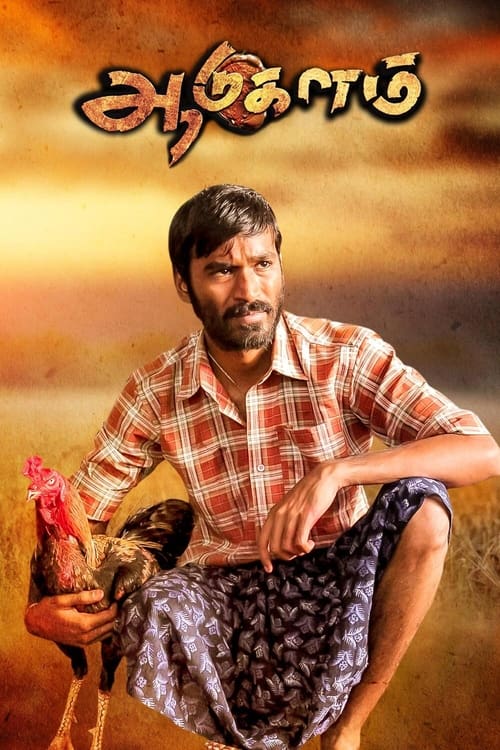
Aadukalam
2011 · Vetrimaaran
For when you want a gripping, grounded drama with real stakes and real texture — something intense that earns its emotions rather than a light watch. Lean in, don't unwind.
What it's about
In the rooster-fighting arenas of Madurai, the aging master Pettaikaaran has never lost — and Karuppu, his devoted young aide, is the best fighter-handler he's ever trained. When a single fight goes against the old man's word, mentor and protégé become rivals, and pride, loyalty, and betrayal play out across the cockpits, streets, and love affairs of the town.
The experience
Earthy and electric — the cockfight sequences are heart-in-mouth tense, and the human rivalry underneath keeps tightening until the film turns genuinely tragic. It's vivid, raw, and emotionally bruising in the best way.
Performances
Dhanush won the National Award for Best Actor as Karuppu, and you can see why: he plays guileless devotion curdling into hurt with complete conviction. The film's portrait of the old master is just as vivid — wounded pride made flesh.
The craft
Vetrimaaran shoots the Madurai rooster-fighting world with near-documentary specificity — the arenas, the wagers, the codes of respect all feel lived-in rather than researched. The fight sequences are cut for maximum tension, and the milieu itself becomes the story's engine. It swept six National Film Awards, including Best Direction.
Why it matters
A landmark of the realist wave in 2010s Tamil cinema that confirmed Vetrimaaran as one of its leading voices and marked Dhanush's arrival as a major dramatic actor.
Snapshot
Aadukalam ("the arena") is Vetrimaaran's second feature, a Tamil-language tragedy set in the rooster-fighting subculture of Madurai. On its surface a story of cockfights, wagers and small-town rivalry, it is more precisely a study of ego, mentorship and fate, in which an old master's pride curdles into betrayal against the young protégé who surpasses him. The film was a landmark for its makers and for the actor Dhanush, and it is best remembered for sweeping the 58th National Film Awards, where it won six prizes including Best Direction and Best Actor. It consolidated Vetrimaaran's reputation, established after Polladhavan (2007), as one of the leading voices of a socially grounded, realist strain of Tamil cinema, and it stands as an early demonstration of his signature method: genre-adjacent material excavated for its human and social undercurrents rather than its spectacle.
Industry & production
The film was produced within the Tamil (Kollywood) industry and released in January 2011. It emerged from the same production milieu as Vetrimaaran's debut, and its casting reflected a filmmaker still working with mid-budget resources and an actor, Dhanush, who by this point was an established star but not yet the pan-Indian figure he would later become. The picture also marked the Tamil-cinema debut of Taapsee Pannu, who plays Irene, the Anglo-Indian girl at the center of the romantic subplot; the film thus functions in industry memory as a launch point for her southern career. Beyond these facts the granular production record — precise budget, shooting schedule, financing arrangements — is not richly documented in reliable English-language sources, and I will not invent figures. What is clear is that the project was pitched at the scale of a serious commercial drama rather than a large event film, and that its subsequent awards recognition lifted it well above its origins in the marketplace.
Technology
Aadukalam was made at a moment when Tamil cinema was transitioning between celluloid and digital acquisition, and I do not have a reliably sourced confirmation of the exact capture format, so I will not assert one. What the finished film demonstrates, regardless of format, is a commitment to available-light and location-driven image-making rather than studio polish. The cockfight sequences — crowds pressed into dust arenas, birds in violent motion, money changing hands — demanded fast, reactive coverage, and the film's technical achievement lies in marrying that documentary immediacy to a controlled dramatic architecture. The National Award for cinematography that the film received signals that its technical craft was judged exceptional by the standards of its year.
Technique
Cinematography
The photography, by Velraj, is the film's most celebrated formal element and was honored with the National Film Award for Best Cinematography. Its strategy is one of embedded realism: the camera lives inside the crowds and courtyards of Madurai, favouring handheld mobility, natural light and a palette of dust, sweat and earth tones over glamour. In the fight sequences the coverage is close and kinetic, cutting the human faces of gamblers and trainers against the blur of the birds, so that the spectacle is always refracted through the people who stake themselves on it. Velraj's work here established a template — grounded, textured, regionally specific — that would recur across Vetrimaaran's collaborations and across the wider realist turn in Tamil cinema.
Editing
Kishore Te's cutting, also a National Award winner for the film, is central to its tension. The rooster fights are constructed as set pieces of accelerating rhythm, but the editing's more consequential work is structural: it braids the arena action, the romance, and the slow-tightening web of manipulation into a build toward tragic reversal. The film withholds and reveals the mentor's true motives across its length, and the editing manages that flow of information so that betrayal lands as both shock and grim inevitability.
Mise-en-scène / staging
Vetrimaaran stages the film in the specific social geography of Madurai — its streets, its Christian and Hindu communities, its hierarchies of loyalty and debt. The cockpit arena is the recurring theater, a literal aadukalam that doubles as a metaphor for the human contest around it: the birds fight by instinct, the men fight by ego. Staging repeatedly places the young Karuppu and the aging Pettaikaaran in configurations of deference and challenge, mapping the generational struggle onto physical blocking. The Anglo-Indian household, and the cross-community romance it frames, extends the film's social canvas beyond the male world of the fights.
Sound
The soundscape is grounded in the din of crowds, birds and wagering, and G.V. Prakash Kumar's score threads folk-inflected textures through the drama. The song "Otha Sollala" became the film's breakout musical moment and a lasting hit, its earthy melody consonant with the film's rooted world. I do not have a verified attribution for a separate audiography award and will not claim one; what is secure is that the film's aural design serves its realism rather than decorating it.
Performance
Dhanush's performance as Karuppu won the National Film Award for Best Actor and remains the film's human center. He plays a young man of instinct and pride — loyal, hot-blooded, and ultimately caught in a betrayal he cannot see coming — and the performance modulates cockiness into vulnerability as the trap closes. The role is often cited as a turning point in his standing as a serious actor. Opposite him, the veteran playing Pettaikaaran gives the film its tragic engine, a mentor whose warmth is inseparable from his vanity. Kishore, as the antagonistic police figure, and Naren, as the fellow protégé Durai, supply the surrounding pressures, while Taapsee Pannu's Irene anchors the romance. The ensemble's naturalism — non-glamorous, regionally specific in speech and manner — is essential to the film's texture.
Narrative & dramatic mode
The dramatic mode is tragedy in a near-classical sense: a story of hubris, in which a revered figure's pride and jealousy destroy the very bonds he presides over. The narrative uses the cockfight not merely as setting but as structuring device — each fight raises the stakes of the human contest — and it turns on a moral inversion, in which the mentor the audience trusts is revealed as the author of the catastrophe. Karuppu's error, going against Pettaikaaran's word in a fight, is the pebble that starts the avalanche of enmity described in the premise; from there the plot tightens through manipulation, misdirected blame and betrayal toward a downbeat resolution. The romance operates as counterpoint, a strand of tenderness and social friction (the cross-community coupling) set against the male world of ego and violence.
Genre & cycle
Nominally an action-drama-thriller, Aadukalam belongs less to the register of the Tamil "mass" film than to the realist, rooted regional drama that gained force in Tamil cinema around the late 2000s and early 2010s. It shares a family resemblance with films that mined specific rural and small-town subcultures — their trades, sports and social codes — for dramatic material. Within that current, Aadukalam is distinguished by its subject: the sport of rooster fighting, a milieu rarely centered on screen. It is best read as part of the cycle of grounded, place-specific Tamil dramas that pushed against the industry's dominant star-vehicle idiom, a cycle to which Vetrimaaran himself would become a defining contributor.
Authorship & method
Vetrimaaran directed and is credited with the film's story and screenplay, and Aadukalam is a clear statement of his authorial method. That method takes genre-legible material — here a fighting-sport milieu — and hollows it out to reveal social structure and human weakness: ego, loyalty, betrayal, the way communities police their own. His cinema is characterized by regional specificity of place and dialect, non-glamorous casting, morally unresolved endings, and an interest in power and its abuses that would sharpen into overtly political work in later films. The key collaborators on Aadukalam form an early version of the team and sensibility that recur across his career: cinematographer Velraj, whose embedded realism won the film a National Award and who would himself become a director; editor Kishore Te, likewise a National Award winner here; and composer G.V. Prakash Kumar, whose folk-grounded score and the hit "Otha Sollala" gave the film its musical identity. The confluence of these crafts — direction, camera and cutting all nationally honored — is what lifts the film from strong genre drama to award-sweeping cinema.
Movement / national cinema
The film is a work of Tamil cinema and, more broadly, of the Indian regional-realist tendency that gathered momentum in the 2000s and 2010s. Within Tamil cinema specifically, Vetrimaaran is frequently grouped with a generation of filmmakers who foregrounded caste, class and regional life with unusual directness, moving the industry's center of gravity away from purely escapist forms. Aadukalam participates in that movement by taking a marginal subculture seriously on its own terms, and its recognition at the National Awards — India's state honors, which draw from across the country's language cinemas — marked the arrival of this Tamil realist current on the national stage.
Era / period
Released in 2011, Aadukalam sits at an inflection point for Tamil cinema, as digital technology, younger directors and a taste for grounded storytelling were reshaping the industry. It is contemporary in setting, portraying present-day Madurai rather than a historical past, and its concerns — economic precarity, community boundaries, the persistence of local hierarchies — are those of its immediate moment. In career terms it belongs to the early, formative phase of Vetrimaaran's filmography, after Polladhavan and before the more explicitly political Visaranai (2015) and Vada Chennai (2018).
Themes
The film's governing theme is ego and its costs — the way pride, in both the young protégé and the old master, corrodes trust and destroys community. Closely bound to this is the theme of mentorship and its betrayal: the surrogate father who cannot bear to be surpassed. Fate and instinct run throughout, mirrored in the birds whose blind courage is the men's own; the arena becomes a figure for a world in which people, like roosters, are set against one another for others' gain. The romance introduces themes of social and communal boundary-crossing, and the wider fabric of the film is attentive to class, debt and the economies of a marginal sport. Underlying all of it is a bleak moral vision in which loyalty is fragile and manipulation wins — a vision consistent with Vetrimaaran's later work.
Reception, canon & influence
Critically, Aadukalam was received as a major achievement, an assessment ratified most concretely by its six National Film Awards at the 58th ceremony — among them Best Direction for Vetrimaaran, Best Actor for Dhanush, Best Cinematography for Velraj and Best Editing for Kishore Te, with additional honors (including choreography) rounding out the tally. That sweep is the central fact of the film's reception and canonization; I note that I am confident of the total and of these specific craft categories, and will not fabricate the full enumeration where my recall is less certain. The Best Actor win is frequently cited as a defining moment in Dhanush's career and among the notable young Best Actor recipients in the award's history.
Looking backward, the film draws on the long tradition of tragedy built around hubris and on the realist, location-rooted tendencies already present in Vetrimaaran's Polladhavan and in the broader Tamil turn toward grounded regional drama. Looking forward, its influence is twofold. Within Vetrimaaran's own filmography it is a foundational text, prefiguring the social realism and moral bleakness of Visaranai, Vada Chennai and Asuran. Within the industry, its awards success helped legitimize the grounded, subculture-specific drama as prestige cinema and reinforced Dhanush's standing as an actor of range as well as a star. Its craft team — Velraj as cinematographer-turned-director, Kishore Te as editor, G.V. Prakash Kumar as composer — carried its sensibility into subsequent Tamil films. The precise reach of that influence is difficult to quantify from the historical record, but Aadukalam's place as an early keystone of the modern Tamil realist movement is secure.
A Deleuzian reading
Watch where Velraj's camera goes during a cockfight.
The full Deleuzian reading of Aadukalam →
Reception
Released Pongal 2011 in the shadow of Vijay's Kaavalan, it did respectable rather than blockbuster business — then swept six National Film Awards, the most of any Indian film that year, and got retroactively crowned. Fifteen years on it's a fixture on best-Tamil-films-of-the-2010s lists and the film people point to as the start of the Vetrimaaran–Dhanush prestige run.
How Aadukalam was received, from release to now →
Influences: the films it descends from and the films it influenced
- Polladhavan (2007) — Vetrimaaran's debut established the handheld, location-rooted realism and the non-glamorous Dhanush-as-everyman casting that Aadukalam refines into award-sweeping form.
- Subramaniapuram (2008) — Its dialect-specific Madurai realism and a plot of male-fraternity loyalty curdling into betrayal and tragedy are the direct regional-grit template Aadukalam builds on.
- 16 Vayathinile (1977) — Pioneered shooting Tamil rural drama outdoors in natural light, freeing the industry from studio sets — the location/natural-light lineage Velraj's National-Award camera extends.
- Mullum Malarum (1978) — Replaced melodramatic acting and expository dialogue with restrained performance naturalism and silence, the acting register Dhanush inhabits here.
- Nayakan (1987) — Model for the morally unresolved Tamil realist tragedy of rise-and-downfall grounded in specific place and community codes.
- Raging Bull (1980) — Turns the fighting arena into an externalization of a man's ego and self-destruction, cutting kinetic, accelerating combat set-pieces to interior psychology — the arena-as-metaphor method Aadukalam applies to the rooster pit.
- Fat City (1972) — Naturalist blood-sport milieu structured around mentorship and the fraught torch-passing between an aging fighter and a younger one, undone by ego and fate.
- Amores Perros (2000) — Uses a dogfighting arena and embedded handheld camerawork inside a blood-sport subculture as a lens onto class and violence.
- Virumaandi (2004) — Builds its drama from a rural agrarian milieu (cockfighting sub-culture) and an honor-and-betrayal cycle staged with the layered crowd-and-conflict soundscapes Virumaandi pioneered locally.
- Visaranai (2015) — Extends Aadukalam's naturalist ensemble and moral bleakness into overtly political social realism, keeping the withheld, escalating structure of dread.
- Vada Chennai (2018) — Reuses the arena-as-metaphor (carrom board / gang turf) and the withheld-revelation nonlinear editing, again anchored by a naturalistic Dhanush.
- Asuran (2019) — Sharpens the ego-and-fate tragedy and Dhanush's non-glamorous naturalism into explicit caste politics — the maturation of the same authorial method.
- Madras (2014) — Neighbourhood-specific Tamil realism in which a contested communal space becomes the arena of loyalty and betrayal, inheriting Aadukalam's subculture-as-structure approach.
- Pariyerum Perumal (2018) — Grounded, location-rooted caste realism with a morally unresolved ending, extending the prestige-realist mode Aadukalam's National-Award sweep helped legitimize.
- Karnan (2021) — Folk-inflected score and an arena-as-metaphor confrontation (village versus authority) staged as tragedy of ego and fate.
- Velaiyilla Pattathari (2014) — Dhanush's National Award-winning lived-in, class-inflected naturalism under Vetrimaaran is the performance register VIP borrows and sands down into a crowd-pleaser.
- Viduthalai: Part I (2023) — Vetrimaaran's early template for dense-ensemble staging and deferred confrontation — building tension across a large peripheral cast so the reckoning is withheld to the last act.
- Lubber Pandhu (2024) — Direct precedent for the mentor/veteran-versus-protégé betrayal built around wounded male ego, staged in a granular rural sporting subculture (rooster-fighting) shot with gritty realism instead of glamour.
- The Wrestler (2008) — Tails a fighter's body with embedded handheld camera through a working-class fighting subculture in natural light, sport-as-fate rendered documentary-close.
- Angamaly Diaries (2017) — Ensemble, dialect-rooted regional realism whose accelerating, densely choreographed set-pieces build to a chaotic climactic melee — the same escalating-set-piece editing logic.
- Jallikattu (2019) — Makes an animal-arena the engine of social metaphor, driven by folk-percussive diegetic sound and the mob rendered as protagonist.
- Kattradhu Thamizh (2007) — Milieu-driven Tamil realism in which the protagonist is undone by the codes of his own social world, built on granular location authenticity and deglamorized ensemble performance.
Similar films
- Asuran (2019) — influence & lineage
- Vada Chennai (2018) — influence & lineage
- Pariyerum Perumal (2018) — influence & lineage
- Nayakan (1987) — influence & lineage
- Pudhupettai (2006) — shared sensibility
- Vikram Vedha (2017) — shared sensibility
- Visaranai (2016) — shared sensibility
- Viduthalai: Part I (2023) — shared sensibility