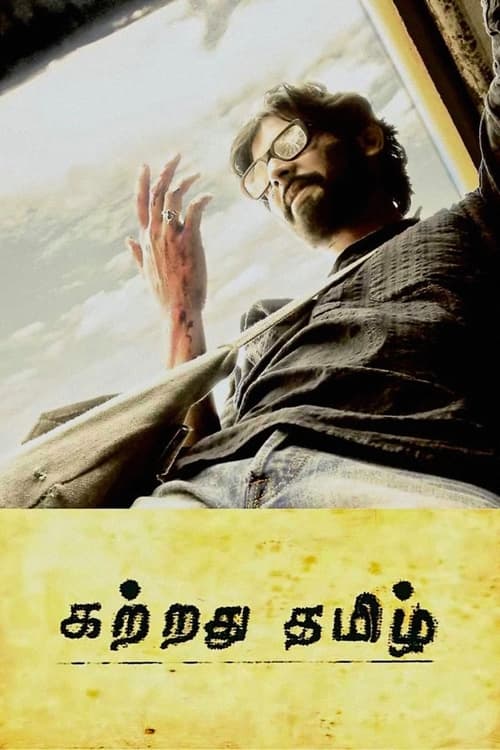
Kattradhu Thamizh
2007 · Ram
For when you want cinema that confronts rather than comforts — a film to argue with, sit with, and carry around for days. Absolutely not a light evening; reach for it when you're ready to be unsettled.
What it's about
Prabhakar holds a postgraduate degree in Tamil literature and teaches school in a Chennai that has stopped caring about either. As the city reorganizes itself around IT money and English, everything he studied — and the language his whole self is built on — loses its market value, and the film watches this quiet, educated man come slowly, frighteningly apart. It's the story of what happens when a society tells someone his learning, and by extension his life, is worthless.
The experience
Bleak, seething, and deliberately uncomfortable — less a thriller than a slow-burning howl of rage that keeps tightening its grip. It gets under your skin and stays there; you come out shaken more than entertained.
Performances
Jiiva goes all in as Prabhakar, tracking the shift from wounded idealism to something much darker with a rawness that made the role a landmark of his career.
The craft
Director Ram's debut is fearless in structure and tone, telling its story in fractured flashback from a present where its hero is already lost, and letting anger and tenderness sit side by side. The filmmaking is rough-edged by design — the grime of the city is the point, not a backdrop.
Why it matters
A cult touchstone of 2000s Tamil cinema, it announced Ram as a major dissenting voice and proved a mainstream industry could carry an openly furious film about language, class, and what an economy discards.
Snapshot
Kattradhu Thamizh — the title translates loosely as "the Tamil one has learned," with a bitter double edge implying learning that the world no longer rewards — is the debut feature of the director known simply as Ram. It is a psychological drama-thriller built around Prabhakar (Jiiva), a postgraduate in Tamil literature who works as a schoolteacher and finds his education, and the language it is grounded in, rendered worthless by a city reorganizing itself around information-technology capital and English. Told largely in flashback from a present in which Prabhakar is already unraveled — the framing narration has him claiming responsibility for more than twenty deaths — the film charts a slow psychic collapse rather than a criminal spree, ending in a joint suicide with his childhood love, Anandhi. Released on 6 October 2007, it underperformed commercially but hardened over the following decade into one of the most cited cult objects of 2000s Tamil cinema, valued precisely for the qualities that made it uncommercial: its bleakness, its refusal of catharsis, and its diagnosis of a social order that treats humanistic learning as obsolete.
Industry & production
The film was produced within the mid-2000s Tamil (Kodambakkam) industry at a moment of rapid commercial escalation, and it sits deliberately athwart the prevailing star-hero economics of that market. It was mounted as a producer-backed debut — credited to Salmara Mohammad Sharief — rather than a major-studio vehicle, which is consistent with its modest theatrical footprint and its willingness to gamble on unglamorous material. Its casting logic reinforces the point: Jiiva, then a rising lead, was pushed toward physical and psychological deglamorization, and the female lead went to Anjali in what marked her Tamil-language debut, later carrying her to a Best Debut Actress win at the 2nd Vijay Awards.
One well-documented production detail illuminates the industry context: the picture was developed under the title Tamil M.A. and renamed Kattradhu Thamizh to qualify for the tax exemptions then extended to films bearing Tamil-language titles — a policy incentive that materially shaped nomenclature across the industry in this period. Production was geographically dispersed, with shooting reported across Maharashtra, Andhra Pradesh, Kerala and Chennai over a stretch approaching a year, an unusually protracted schedule for a film of its scale and a sign of the director's insistence on control over texture and location. Beyond these verified facts, granular records of budget and day-to-day production are thin, and specific financial figures should not be asserted.
Technology
Kattradhu Thamizh was made at the tail end of Tamil cinema's photochemical era, before the wholesale migration to digital acquisition that reshaped the industry in the 2010s; it is, in its finish and grain, a film-originated work, and its imagery carries the tonal density associated with celluloid capture and a desaturated, controlled palette. Its most significant technological dimension, however, is thematic rather than instrumental: the film is about a technological transformation — the IT boom that remade Chennai's economy, real estate and status hierarchies in the 2000s. The multiplex, the call-center-adjacent professional class, and the glass-and-concrete corporate city are treated as an encroaching machine-order against which the protagonist's manual, textual, language-bound vocation cannot compete. In that sense the film's engagement with technology is critical and elegiac: it stages the human cost of a modernization it neither celebrates nor pretends to reverse.
Technique
Cinematography
The photography is credited to S. R. Kathir, and it is one of the film's defining achievements. Kathir works in a restrained, low-key register — muted color, hard urban surfaces, and a Chennai rendered less as a picturesque backdrop than as a hostile environment of construction sites, cramped interiors and indifferent streets. The camera tends to hold on Jiiva's deteriorating face and body, using framing and dead space to externalize isolation rather than relying on expressionist flourish. The visual scheme is disciplined enough that the film's mood reads as environmental and inevitable: the city looks like something closing in. Detailed accounts of specific lenses, stocks or lighting setups are not part of the reliable public record and are not invented here.
Editing
A. Sreekar Prasad, among the most decorated editors in Indian cinema, cut the film, which runs to roughly 147 minutes. His work is central to the film's dramatic mode, because the story is delivered through a fractured, flashback-driven structure that withholds the full shape of Prabhakar's descent until late. The editing must sustain dread across a nonlinear timeline, modulating between the ruined present and the receding past without letting the mechanism become schematic. Prasad's contribution was recognized with a Best Editor award at the Vijay Awards, an unusual honor for a film so far outside the commercial mainstream and a marker of how much of its effect is achieved in the cut.
Mise-en-scène / staging
The film's staging is organized around contrast and diminishment. Prabhakar is repeatedly placed within spaces that dwarf or exclude him — the corporate city, the transactional urban crowd — and the production design privileges lived-in shabbiness over gloss. Costume and physical transformation do heavy staging work: Jiiva's unkempt hair and beard, his gaunt bearing, function as continuous visual signals of a self coming apart. The film stages social humiliation with a documentary flatness that refuses to sentimentalize its hero, which is part of why its violence, when it arrives, feels like symptom rather than spectacle.
Sound
Yuvan Shankar Raja's score and songs form the film's emotional spine, and the soundtrack was received as one of its standout elements — five tracks that critics of the day treated as a significant musical statement. The most notable single fact of the film's sound design is generational and symbolic: Yuvan's father, the composer Ilaiyaraaja, performed one of the songs, an intergenerational gesture that also reads as a benediction upon a film preoccupied with Tamil cultural inheritance. Beyond the songs, the film uses music and silence to sustain its depressive, interior atmosphere rather than to punctuate action.
Performance
Jiiva's performance as Prabhakar is the reason the film survives as a reference point. He undertook a visible physical transformation — growing a full beard, altering his bearing — and, by his own later accounts, found the role emotionally punishing enough to require help disengaging from it afterward. The performance is built on collapse: intelligence curdling into resentment, tenderness into obsession, articulacy into breakdown. It is a genuinely uncommercial piece of screen acting for a leading man of his moment, and it reframed his range. Anjali, as Anandhi, grounds the film's memory-strand and its final tragedy; her debut here was strong enough to be awarded. Karunas and Azhagam Perumal appear in support, the former known primarily as a comic actor and here deployed against that grain.
Narrative & dramatic mode
The film's dramatic mode is confessional, retrospective and tragic. Its architecture is a frame narrative: a present-tense Prabhakar, already destroyed and speaking from beyond the point of no return, delivers the story of how he arrived there, so that the film is less a question of what will happen than of how it happened — a structure that converts suspense into fatalism. The romance with Anandhi supplies the film's only warmth and its ultimate devastation, culminating in a shared suicide by train that seals the tragic form. This is a character study before it is a thriller; the "sociopath" of the marketing synopsis is, in the film's own logic, a man produced by systematic social negation rather than a figure of innate pathology. The narration's claim of many deaths sits ambiguously against what the film actually dramatizes, and that ambiguity — between literal body count and the delusional self-mythology of a broken mind — is part of the work's design.
Genre & cycle
Nominally a psychological drama-thriller, Kattradhu Thamizh is best understood as a work of social realism inflected toward tragedy and, at its edges, horror-of-the-everyday. It belongs to a discernible strain of 2000s Tamil cinema that used the crime or thriller frame to carry serious social critique rather than genre pleasure. Within Ram's own subsequent body of work it reads as the opening statement of a consistent authorial cycle — films centered on marginalized, socially wounded protagonists and on the human damage of inequality (his later Thanga Meenkal and Peranbu extend the same humanist-realist preoccupation, though in gentler registers). Situated against the mainstream Tamil hero film of its year, Kattradhu Thamizh is deliberately anti-generic: it withholds triumph, punishment-as-justice, and redemptive closure.
Authorship & method
The film is a strong auteurist debut, written and directed by Ram, and it establishes the thematic signature that has defined his career: an ethical fixation on the socially excluded and a refusal of consolation. His method here is patient and immersive — a near-year of dispersed shooting, an insistence on deglamorized performance, and a willingness to build a film around collapse rather than arc.
That vision was realized through an exceptionally strong band of collaborators, and the film is a case study in the director-as-assembler. Cinematographer S. R. Kathir supplied the oppressive, low-key visual world; editor A. Sreekar Prasad, a national-caliber craftsman, gave the fractured timeline its coherence and won an award for doing so; composer Yuvan Shankar Raja provided the melancholic sonic identity that carried much of the film's afterlife, with Ilaiyaraaja's guest vocal as a symbolic seal. Jiiva's total commitment as lead completes the picture — the authorship is Ram's, but its force depends on this specific convergence of technicians and actors willing to follow a first-time director into uncommercial territory.
Movement / national cinema
Kattradhu Thamizh is a Tamil-language film rooted in the specific cultural politics of Tamil Nadu, where the Tamil language carries a charged identitarian and historical weight — the film's grief over the devaluation of Tamil learning is legible within a regional tradition in which language is inseparable from dignity and selfhood. It participates in the broader current of socially engaged Indian regional cinema, and within Tamil cinema specifically it aligns with a post-2000 turn toward realist, issue-driven filmmaking that ran parallel to, and often against, the industry's commercial star system. Its concern with the human wreckage of neoliberal urban transformation gives it kinship with a pan-Indian art-adjacent cinema of the period without diluting its distinctly Tamil address.
Era / period
The film is precisely of its moment: mid-to-late-2000s Chennai during the IT and real-estate boom, a period of conspicuous economic acceleration that generated new professional elites while stranding those outside the new economy. Kattradhu Thamizh reads that boom from its underside. Where much of the surrounding culture narrated the era as arrival and aspiration, the film narrates it as displacement — the story of what and who the boom left behind. It is also an artifact of Tamil cinema's late-celluloid, pre-digital-saturation craft period, and of a specific window in which a mainstream lead could still be routed into a role this austere.
Themes
The governing theme is the obsolescence of humanistic learning under market modernization: a man defined by mastery of Tamil literature discovers that his knowledge commands neither income nor respect in a city that prices English, code and capital. From this flow the film's linked concerns — the psychological toll of gentrification and social exclusion; poverty and class humiliation; the erosion of cultural and linguistic inheritance; and the transformation of thwarted love and thwarted vocation into obsession, delusion and self-destruction. Crucially, the film frames Prabhakar's disintegration as socially produced, indicting a system rather than pathologizing an individual. Its tragic ending refuses the reassurance that such damage can be redeemed or contained.
Reception, canon & influence
On release the film was not a commercial success, but critical response recognized its ambition — reviewers described it as hard-hitting and singled out the lead performance, the editing, the cinematography and Yuvan Shankar Raja's score. Institutional recognition followed at the Vijay Awards, where Anjali was honored as Best Debut Actress and A. Sreekar Prasad as Best Editor. Over the years its reputation inverted the way cult films' reputations often do: initial box-office indifference gave way to a durable status as a landmark of serious 2000s Tamil cinema, frequently invoked in discussions of the industry's realist and socially critical strain.
Looking backward, the film's lines of influence run through the tradition of socially conscious Indian regional cinema and the tragic character study — the anti-hero destroyed by his milieu rather than his flaws alone — and through Tamil Nadu's particular reverence for language as identity, which supplies both the film's subject and its emotional charge. Looking forward, its most concrete legacy is as the founding work of Ram's authorship: the concern with the wounded and marginal that defines Thanga Meenkal and, most acclaimed, Peranbu begins here. More diffusely, it stands as a touchstone for a generation of Tamil filmmakers and cinephiles who cite it as proof that a mainstream lead vehicle could be turned toward uncompromising social tragedy. The precise extent of its influence on specific later films is not exhaustively documented and is better described as an enduring reference point than as a traceable school; where the record is thin on direct lineage, that limitation should be acknowledged rather than filled in.
Reception
Hailed by critics on release in 2007 but a box-office failure, it slowly hardened into one of Tamil cinema's definitive cult classics — the film people now cite when they say Tamil cinema was ahead of its time in the 2000s.
How Kattradhu Thamizh was received, from release to now →
Influences: the films it descends from and the films it influenced
- Bicycle Thieves (1948) — Supplies the neorealist template of a decent man ground into ruin by economic obsolescence rather than personal flaw, structured as accumulating collapse instead of dramatic arc — the exact anti-melodramatic tragedy shape Ram builds his unemployed Tamil teacher around.
- Pather Panchali (1955) — Founds the Indian-regional humanist realism of observing poverty and marginality patiently and without pity, the socially-conscious documentary texture Kattradhu Thamizh inherits over its dispersed, near-year location shoot.
- Taxi Driver (1976) — Models the subjective character study that locks the camera and voice-over to a deteriorating urban loner's mind, letting an unreliable narrator's alienation curdle into violence produced by the city — the frame-narration-of-a-breaking-man device Ram adopts.
- Raging Bull (1980) — Sets the precedent of a lead's total, self-punishing physical deglamorization in service of an unlovable protagonist — the De Niro-style bodily commitment that Jiiva's degraded transformation directly extends.
- Nayakan (1987) — The Ilaiyaraaja-scored Tamil tragic character study whose anti-hero is forged and finally destroyed by his milieu, shot in P. C. Sreeram's low-key shadow palette — the sonic and visual grammar Kattradhu Thamizh descends from, sealed by Ilaiyaraaja's own guest vocal.
- Kannathil Muthamittal (2002) — An earlier A. Sreekar Prasad collaboration where his editing braids a fractured, memory-driven timeline into coherence over a socially-conscious subject — the precise cutting method Prasad brings to Kattradhu Thamizh's nonlinear flashback structure.
- Thanga Meenkal (2013) — Ram's own follow-through on the founded cycle: the same ethical fixation on a wounded, socially-excluded figure, deglamorized performance, and melancholic score, refusing consolation exactly as the debut did.
- Visaranai (2015) — Carries the film's uncompromising social-realist tragedy to its bleakest institutional extreme — powerless men ground down by systems, deglamorized ensemble, and a total refusal of relief that Kattradhu Thamizh made viable for mainstream Tamil cinema.
- Taramani (2017) — Extends Ram's IT-boom-Chennai milieu study and frame-narration device, continuing the authorial concern with characters malformed by the era's economic and social pressures introduced in the debut.
- Peranbu (2018) — The fullest realization of Ram's method seeded here — patient, immersive attention to a marginalized caregiver, a deglamorized lead following the director into uncommercial terrain, and a structure of endurance over arc.
- Vada Chennai (2018) — Deploys nonlinear, flashback-braided editing across a socially-embedded Chennai underclass saga, extending the fractured-timeline realist grammar and location-rooted deglamorization the earlier film helped legitimize.
- Pudhupettai (2006) — Contemporary Chennai descent narrative scored by Yuvan Shankar Raja, framing a deglamorized star lead's fall through non-chronological confession — the same composer, the same star-turned-wreck deglamorization, and the same frame-narrated ruin, made one year prior.
- Paruthiveeran (2007) — Same-year exemplar of the Tamil realist wave's raw location texture and refusal of a redemptive ending, driving toward uncompromising tragedy with non-glamorous performance rather than heroic arc.
- Subramaniapuram (2008) — Extends the period-authentic, deglamorized Tamil realism where characters are annihilated by their social world, using location fidelity and non-star faces as the same authenticity strategy Ram pursues.
- Angadi Theru (2010) — Turns the same 2000s-Chennai economy toward its working-class retail underclass — the exploited flip-side of the IT boom — with physical deglamorization and immersive social critique paralleling Kattradhu Thamizh's obsolescence theme.
- Aadukalam (2011) — Milieu-driven Tamil realism in which the protagonist is undone by the codes of his own social world, built on granular location authenticity and deglamorized ensemble performance.
Similar films
- Pudhupettai (2006) — influence & lineage
- Nayakan (1987) — influence & lineage
- Vada Chennai (2018) — influence & lineage
- Kannathil Muthamittal (2002) — influence & lineage
- Aadukalam (2011) — influence & lineage
- Iruvar (1997) — shared sensibility
- Mahanadhi (1994) — shared sensibility
- Thaniyavarthanam (1987) — shared sensibility