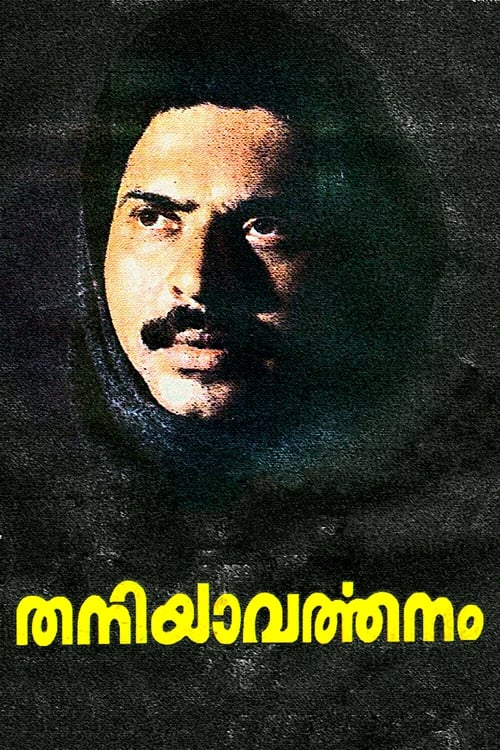
Thaniyavarthanam
1987 · Sibi Malayil
For when you want serious, heartbreaking drama that makes you think about how communities create the very things they fear — closer to a Greek tragedy than a weepie. Definitely a challenge; bring your full attention and maybe a stiff drink after.
What it's about
Balan is a gentle, respected schoolteacher in a Kerala village whose family carries a grim legend: every generation, it's said, must produce a madman. When his mentally unstable uncle dies, the village quietly decides Balan is next in line. What follows is the slow tightening of communal suspicion — the sidelong looks, the gossip, the small exclusions — around a completely sane man, and around the family that starts to believe the whispers too.
The experience
A slow-burning tragedy that works like a vice — quiet, restrained, and increasingly unbearable as you watch decency get ground down by rumor. It's devastating without ever raising its voice, and it stays with you as a kind of ache.
Performances
Mammootty, as Balan, gives one of the great performances of Malayalam cinema — a portrait of a man's dignity eroding by degrees, played with such restraint that every small crack registers like a landslide.
The craft
A. K. Lohithadas's debut screenplay is the engine: a mechanism of social pressure built so precisely that the outcome feels both avoidable and inevitable, launching one of Malayalam cinema's great director-writer partnerships with Sibi Malayil. The horror here is entirely social — no ghosts, no curse, just belief doing its slow work — and the film's power comes from how patiently it documents that.
Why it matters
A landmark of the golden age of Malayalam cinema and the film that announced the Malayil–Lohithadas partnership, which went on to shape the region's serious mainstream drama for a generation.
Snapshot
Thaniyavarthanam is a Malayalam social tragedy directed by Sibi Malayil from a screenplay by A. K. Lohithadas — by most accounts Lohithadas's debut as a credited screenwriter, and the first collaboration in what became one of the most consequential director-writer partnerships of Malayalam cinema. It stars Mammootty as Balan Master, a mild, respected schoolteacher in a Kerala village shadowed by a hereditary belief: that the family is fated always to harbor a "madman," one in each generation. When Balan's mentally unstable uncle dies, the village's collective conviction fixes on Balan as the next vessel of the curse. The film's terrible engine is that this belief is not supernatural but social — the community's suspicion, gossip, and slow ostracism become a self-fulfilling prophecy that grinds a sane man toward the breakdown everyone has already assigned him. The title itself carries the theme: thani avarthanam is the extended percussion solo in a Carnatic concert, a repeating rhythmic cycle that circles back on itself — an apt figure for a curse that recurs, generation upon generation, until the pattern seems inescapable.
Industry & production
The film belongs to the "middle cinema" of late-1980s Malayalam production — commercially released, star-driven works that nonetheless carried the serious social and psychological ambitions usually reserved for the parallel-cinema wing of Adoor Gopalakrishnan or G. Aravindan. Detailed English-language documentation of the film's budget, shooting schedule, and studio arrangements is genuinely thin, as it is for most regional Indian features of the period; what can be said with confidence is structural. By 1987 Mammootty was one of the two reigning superstars of Malayalam cinema (alongside Mohanlal), and his participation is what allowed a bleak, uncommercial subject — the psychological destruction of an ordinary man — to reach a wide theatrical audience. The production sits at the intersection of star capital and authorial ambition that defined the Malayalam industry's late-1980s golden age, when Kerala's cinema was producing a remarkable run of humanist dramas that were at once popular and artistically respected.
Technology
Like effectively all Indian regional features of 1987, Thaniyavarthanam was shot on 35mm film using color stock, and — following standard Indian practice of the era — its dialogue was almost certainly recorded not as location sync sound but dubbed in post-production, with music and effects built onto the track afterward. This post-dubbing regime shaped performance and editing rhythm across Indian cinema and would have governed this film as well. Specifics of the exact stock, cameras, and laboratory work are not part of the reliable public record and I will not invent them. What matters technologically is that the film uses an entirely conventional, unshowy toolkit; its intensity is achieved through staging, performance, and writing rather than through any technical novelty.
Technique
Cinematography
The identity of the director of photography is not something I can confirm from memory, and I will not attribute it falsely. What can be described is the film's visual mode, which is consistent with the naturalist idiom of Malayalam middle cinema: available-feeling light, domestic and village interiors, an unglamorous rendering of a small Kerala community. The camera serves the drama of faces and the pressure of watching eyes — the film is, thematically, about being looked at and judged, and its coverage tends to register the gaze of the community as much as the plight of its victim.
Editing
The specific editor is likewise not something I can reliably name. Structurally, the film's cutting follows the accretive logic of tragedy rather than of incident: it builds through the slow accumulation of small humiliations and suspicions, each scene tightening the social net around Balan, so that the film's momentum is psychological pressure rather than plot mechanics. The tragic architecture — a stable, respected man methodically stripped of standing until the community's prophecy is fulfilled — is the film's real editorial rhythm.
Mise-en-scène / staging
The staging is rooted in the textures of rural Kerala: the schoolhouse, the family home, the courtyard and village lanes where reputation is made and unmade. Lohithadas's writing and Sibi Malayil's direction are attentive to the social geography of a village where privacy does not exist and where a family's standing is a fragile, collectively enforced thing. The recurring dramatic unit is the small public scene — the whispered aside, the wary glance, the withdrawal of neighborly warmth — through which stigma is transmitted. The "madness" motif is staged less as spectacle than as social fact: the film is interested in how a community decides a man is mad and then makes it so.
Sound
Concrete detail on the sound design and the composer is not something I can state with certainty, and I flag that honestly rather than guess. Sibi Malayil's films of this era are strongly associated with the composer Johnson, whose scores defined the emotional register of Malayalam middle cinema, but I cannot confirm his specific involvement here and will not assert it. Whatever the attribution, the film belongs to a tradition in which a restrained melodic score underlines domestic tragedy without tipping into bombast.
Performance
The film is, above all, a performance vehicle in the most serious sense. Mammootty's Balan is a study in restraint and interiority — a departure from the heroic registers that defined his star image. The role demands that he play sanity under siege: a decent man who must absorb a community's projected fear while trying not to become what they insist he is, and whose eventual unraveling must feel less like an actor's showcase than like the inevitable collapse of a real person under unbearable pressure. It is widely regarded as one of Mammootty's finest and most controlled performances, precisely because its power comes from suppression rather than display. The surrounding ensemble — drawn from the deep bench of Malayalam character actors who populated Lohithadas and Sibi Malayil's films — carries the communal weight of the drama, though I will refrain from naming specific supporting players I cannot confirm.
Narrative & dramatic mode
The dramatic mode is pure tragedy, and of a particularly pitiless kind: the audience understands from early on that Balan is sane, which makes every subsequent scene an exercise in dread. The narrative is a machine of inevitability. Where a conventional melodrama might offer rescue or vindication, Thaniyavarthanam refuses it; the community's belief functions like fate in classical tragedy, except that here "fate" is entirely man-made — the sum of ignorance, superstition, and social cruelty. The film's structure is that of the self-fulfilling prophecy: the label precedes the condition and produces it. This gives the film a terrible irony, since the very people who "protect" the family against its curse are the ones who enact it. The dramatic experience is one of mounting helplessness rather than suspense — the question is not whether Balan will be destroyed but how completely.
Genre & cycle
The film sits within the social-problem drama and the humanist family tragedy — the dominant serious genre of Malayalam middle cinema in the late 1980s. Its particular subject, mental illness and the stigma surrounding it, connects it to a wider strand of Indian cinema concerned with the treatment of the "mad" and the socially outcast, but Thaniyavarthanam is distinctive in locating the true pathology not in the afflicted individual but in the community's superstition. Within the Lohithadas–Sibi Malayil cycle that followed, it functions as an origin point: the template of the ordinary, essentially good protagonist destroyed by forces of society, family, and circumstance recurs across their subsequent work.
Authorship & method
The decisive authorial fact of Thaniyavarthanam is the meeting of director Sibi Malayil and writer A. K. Lohithadas. Sibi Malayil, active as a director from the mid-1980s, specialized in emotionally intense, character-driven dramas pitched to a mainstream audience but built on serious dramatic bones. Lohithadas, for whom this film marks the beginning of a celebrated screenwriting career, would become one of the most revered writers in the language — a dramatist of rural Kerala's families, poverty, honor, and the wounds inflicted by community and circumstance. The pairing produced a sustained run of landmark films across the late 1980s and early 1990s, of which Thaniyavarthanam is the first and, in many accounts, the foundational statement of their shared sensibility: tragic, humanist, socially observant, and unafraid of unhappy endings. On the specific contributions of the cinematographer, editor, and composer, the reliable record available to me is thin, and I have flagged that rather than fabricate credits; the film's authorship, as it is remembered, is overwhelmingly a matter of writer, director, and star.
Movement / national cinema
The film is a product of Malayalam cinema's late-1980s golden age, one of the richest moments in Indian film history. Kerala's industry in this period was unusual in sustaining a genuine "middle cinema" — films that were neither the austere art cinema of Adoor Gopalakrishnan and Aravindan nor purely commercial entertainment, but a viable third stream that fused popular stars with literate, socially engaged writing. Thaniyavarthanam is a representative and superior example of that stream. It also reflects the broader vitality of regional Indian cinema in the 1980s, when Malayalam, Bengali, and other language industries produced work of an ambition that the mainstream Hindi cinema of the decade often did not match. Its rootedness in the specific social fabric of rural Kerala — caste, family reputation, village surveillance, and folk belief — is inseparable from its meaning; this is a national cinema speaking in a deeply local voice.
Era / period
1987 places the film at the threshold of the Malayalam industry's most celebrated years and within the larger transition of Indian cinema toward the home-video and television era. Theatrical release remained the primary channel, but the period's films increasingly found second lives through video and later satellite television, which is a substantial part of how a serious drama like this one built its long reputation. The film's concerns — superstition versus rational understanding of mental illness — also mark it as a work of a modernizing society examining its own persisting folk beliefs, a characteristic preoccupation of Kerala's socially conscious cinema in these years.
Themes
The film's central theme is the destructive power of superstition and social stigma, dramatized through the idea of hereditary "madness" as a family curse. Its deepest insight is essentially sociological: it is a portrait of labeling and the self-fulfilling prophecy, in which a community's collective belief manufactures the very reality it fears. Around this core cluster several others — the cruelty of the group toward the individual; the tyranny of family honor and reputation in a face-to-face society; the helplessness of reason against inherited belief; and the fragility of sanity itself under relentless social pressure. Mental illness is treated less as a medical subject than as a social one: the film indicts not the condition but the community's response to it. The title's musical metaphor — the repeating percussion cycle — reinforces the theme of recurrence and inescapability, of a pattern that turns back on itself generation after generation. It is, finally, a humanist protest: a demand that we see the person the community has agreed to stop seeing.
Reception, canon & influence
Within Malayalam film culture, Thaniyavarthanam is remembered as a classic and as a milestone on several counts: as the debut of A. K. Lohithadas, one of the language's greatest screenwriters; as the first Sibi Malayil–Lohithadas collaboration; and as one of Mammootty's most admired dramatic performances. I want to be careful about awards: the film is frequently cited among the significant works of its moment, but I cannot confirm specific award citations, box-office figures, or contemporary review texts from reliable memory, and I will not invent them. Its critical standing rests on its writing and Mammootty's restraint, and on the unflinching bleakness that set it apart from more consoling melodramas.
Looking backward, the film draws on a long tradition of humanist social realism in Indian and specifically Kerala cinema and literature — the village tragedy, the socially conscious drama attentive to caste, poverty, and belief — as well as on the broader theatrical inheritance of tragedy as inevitability. Its treatment of the outcast and the "mad" participates in a wider Indian cinematic concern with those society casts out.
Looking forward, its influence is best understood through the Sibi Malayil–Lohithadas partnership it inaugurated, which went on to produce a defining body of emotionally devastating humanist tragedies in the late 1980s and early 1990s — works built on the same foundation of the ordinary, decent protagonist crushed by family, society, and fate. Thaniyavarthanam established that template, and Lohithadas's subsequent career as the pre-eminent screenwriter of Malayalam middle cinema can be read as an elaboration of the concerns first stated here. For Mammootty, the film is a touchstone of his range beyond stardom. In the longer view, it endures as one of the strongest arguments for what Malayalam cinema's golden age could do: take a popular star and a mainstream release and turn them into a merciless, compassionate examination of how a community destroys one of its own.
Reception
Acclaimed on release as a landmark of Malayalam cinema's late-80s golden age, and its stock has only risen — today it's routinely cited as one of the era's great tragedies and a film that was ahead of its time in taking on superstition and mental illness.
How Thaniyavarthanam was received, from release to now →
Influences: the films it descends from and the films it influenced
- Chemmeen (1965) — Establishes the Kerala model of a community belief operating as a self-fulfilling prophecy that grinds individuals down — the same fate-as-social-verdict engine Thaniyavarthanam inherits, mapped onto village social geography.
- Nirmalyam (1973) — The protagonist destroyed by the community's faith and gaze, sustaining decency until a final unhinged collapse — a direct model for the ordinary man broken by collective belief and stigma.
- Elippathayam (1981) — Perfects the accretive, entrapment structure and the observational 'gaze of community' — slow naturalist watching as a form of judgment — that Thaniyavarthanam adopts for its tragedy of inevitability.
- Kodiyettam (1977) — Bharath Gopy's ordinary, unheroic man rendered in a plain naturalist idiom of everyday Kerala life — the anti-star realism that licenses casting a matinee idol as a crushed common man.
- Thakara (1979) — Centers the village's tolerated-then-destroyed outsider/'mad' figure, giving the Malayalam middle cinema its template for labeling-and-ostracism as a communal mechanism.
- Pather Panchali (1955) — Founding Indian humanist realism whose tragedy is assembled from small domestic increments rather than melodramatic peaks — the accretive-tragedy editing logic Thaniyavarthanam works in.
- Do Bigha Zamin (1953) — The social-problem-drama blueprint of a decent, poor protagonist ground down by structural forces, importing Italian neorealist naturalism into mainstream Indian narrative.
- Bicycle Thieves (1948) — Neorealism's ordinary man losing dignity step by step, shot on location with post-dubbed sound and non-expressionist framing — the naturalist idiom Malayalam middle cinema domesticated.
- Kireedam (1989) — The purest Sibi–Lohithadas restatement of the seed: one incident plus social labeling forces a good young man to become the criminal fate assigns him — the self-fulfilling-prophecy machine rebuilt around Mohanlal.
- Bhoothakkannadi (1997) — Lohithadas's own directorial elaboration of the seed's mental-illness-and-stigma strand, tracing a decent man's paranoid disintegration under the community's suspicion.
- Vasanthiyum Lakshmiyum Pinne Njaanum (1999) — Extends the naturalist, non-sentimental treatment of mental illness and social ostracism first stated here into a full-length portrait of a stigmatized, ridiculed man.
- Thanmatra (2005) — Later Malayalam humanist tragedy of a good man losing his mind before a watching family and community, carrying forward the seed's fusion of clinical decline, social gaze, and lead-actor restraint.
- Amaram (1991) — Lohithadas script placing a proud fisherman (Mammootty) inside a mesh of village gossip and honor that destroys him — the 'gaze of community' and coastal social geography extended into another star tragedy.
- Bharatham (1991) — Same partnership building the tragedy from familial duty and honor crushing the protagonist — Lohithadas's ordinary-decent-man-versus-family-and-fate structure elaborated for Mohanlal.
- Kamaladalam (1992) — Sibi–Lohithadas turn the crushing gaze on an artist consumed by grief and drink, extending the humanist tragedy of a gifted man undone by circumstance and community judgment.
- Sadayam (1992) — Continues the partnership's commitment to the merciful-yet-merciless portrait of a condemned good man, sustained by star restraint rather than melodramatic pitch.
- Mathilukal (1990) — Contemporary proof of Mammootty's restraint register — interiorized, star-suppressing performance in an austere naturalist frame — the same actorly method Thaniyavarthanam draws from him.
Similar films
- Mathilukal (1990) — influence & lineage
- Kireedam (1989) — influence & lineage
- Thanmathra (2005) — shared sensibility
- Mahanadhi (1994) — shared sensibility
- Manichitrathazhu (1993) — shared sensibility
- Tumbbad (2018) — shared sensibility
- Kishkindha Kaandam (2024) — shared sensibility
- Nayakan (1987) — shared sensibility