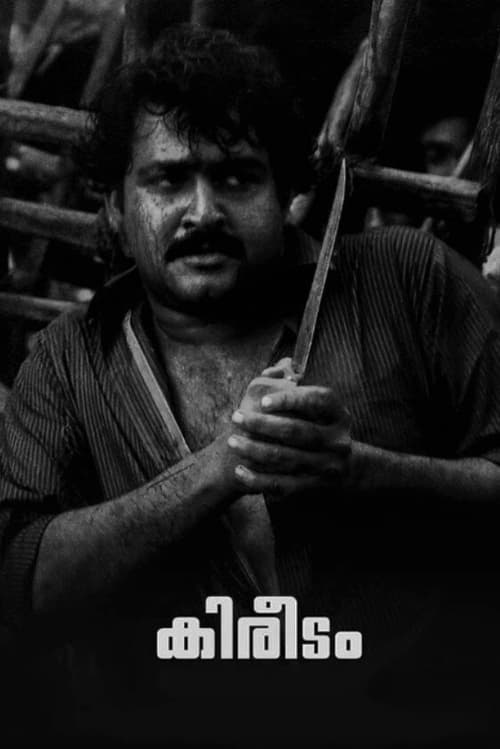
Kireedam
1989 · Sibi Malayil
For when you want serious, wrenching drama — a film to sit with when you're ready to feel the unfairness of the world and think about how little control we have over who people decide we are. Challenge, not comfort.
What it's about
Sethu is the dutiful eldest son of an aging police constable, days away from fulfilling his father's lifelong dream of seeing him in uniform. Then he steps into a street confrontation to save his father from a feared local strongman, and that single reflexive act of protection rebrands him overnight — in his town's eyes he is no longer an aspirant but a rowdy. The film follows a decent man fighting a reputation that hardens around him like a cage.
The experience
A slow, crushing tragedy that works by inevitability rather than surprise — you watch a good man's options close off one by one, and the fight scenes hurt because you know what each one costs him. It leaves a bruise.
Performances
Mohanlal's Sethu is a landmark of Malayalam acting — the anguish of a man watching his own life happen to him, played almost entirely in the eyes and the slump of the shoulders between bursts of violence.
The craft
Sibi Malayil directs with restraint that makes the violence land harder: the film is less about the fights than the silences afterward, the father's face, the neighbors' changed looks. The screenplay's cruel symmetry — heroism and ruin as the same gesture — gives it the shape of classical tragedy.
Why it matters
A touchstone of Malayalam cinema's late-eighties golden run and one of the defining performances of Mohanlal's career, it has been remade and referenced across Indian cinema as the archetypal accidental-rowdy tragedy.
Snapshot
Kireedam is a Malayalam tragedy about a young man who becomes, against his will and his every intention, the thing he most feared. Sethumadhavan — "Sethu" — is the eldest son of an aging police constable, and he carries his father's deferred dream: to wear the uniform, to redeem the family's modest standing through respectable service. On the eve of that future, he intervenes in a street confrontation to protect his father from a feared local strongman, and in a single reflexive act of violence he is transfigured in the eyes of his town from aspirant to rowdy. The film's cruelty is that Sethu's heroism and his ruin are the same gesture. What begins as filial devotion hardens into a criminal identity he cannot shed, and the "crown" of the title — kireedam — becomes bitterly ironic: not the honor he sought but the reputation of a thug that is forced onto his head. Built around a career-defining performance by Mohanlal and a screenplay by A. K. Lohithadas that has entered the canon of Malayalam writing, the film is one of the signal works of Kerala cinema's late-1980s golden age, and a rare popular tragedy that refuses the consolation of redemption.
Industry & production
Kireedam emerged from the most fertile creative period of Malayalam commercial cinema, a moment when a small regional industry sustained an unusually literate, screenwriter-driven middle cinema alongside its star vehicles. The film is a product of the partnership between director Sibi Malayil and screenwriter A. K. Lohithadas, one of the defining writer-director teams of the era, and it pairs them with Mohanlal at the height of his powers. Kerala's industry in this period operated on modest budgets and fast schedules, releasing a high annual volume of films to a devoted domestic audience whose appetite for serious drama coexisted with mass entertainment. Within that ecosystem, Kireedam is a mid-budget star-and-story film: it leverages Mohanlal's box-office standing to underwrite a fundamentally uncommercial narrative shape — a tragedy with no reprieve. Precise production particulars such as the producing banner, shooting schedule, and budget are not richly documented in the widely available English-language record, and I will not invent them; what is secure is the authorship of its key craft roles and its standing as a critically and popularly successful release that generated a direct sequel, Chenkol (1993), reuniting the same director, writer, and star.
Technology
The film was made with the standard production technology of Malayalam cinema at the close of the 1980s: 35mm color photography, conventional optical and mono sound recording, and the near-universal Indian practice of post-synchronized dialogue rather than live location sound. This dubbing convention shaped performance and editing rhythm across the industry, allowing controlled, theatrically weighted vocal delivery to be layered over image. Music and effects were mixed to a monophonic optical track for release prints. None of this was novel — Kireedam is not a film of technological experiment — but the competent, unshowy deployment of ordinary tools is itself part of its aesthetic: the technology is made invisible so that performance and situation can carry the weight.
Technique
Cinematography
The photography works in the observational, character-centered register typical of Kerala's middle cinema: a small-town world rendered in unglamorous, legible interiors and streets, with the camera generally serving the actors rather than announcing itself. The visual grammar favors medium shots and sustained framings that keep Sethu inside his social environment — the family home, the police-station milieu, the public spaces where reputation is made and unmade — so that the audience registers how relentlessly the town watches him. As his fate darkens, the imagery leans on the expressive possibilities of the human face in close-up, particularly in the film's confrontations and its devastating final movements. (The cinematography credit is not something I can attribute with full certainty from memory, and I will not guess at the name; the style, however, is clearly that of the era's restrained realist school.)
Editing
Kireedam is cut for dramatic clarity and accumulation rather than for kinetic effect. Its structure is essentially a downward spiral: each sequence tightens the noose, and the editing's task is to let consequence follow cause with a sense of tragic inevitability. Action beats — the pivotal street fight, later violent encounters — are staged and cut to be readable and brutal rather than balletic, in keeping with a film whose violence is meant to appall rather than thrill. The rhythm slows markedly in the emotional set pieces, giving performances room to breathe and holding on reactions long enough for grief and shame to register. The specific editor's credit is not something I can reliably name.
Mise-en-scène / staging
The staging is rooted in a recognizable lower-middle-class Kerala milieu, and much of the film's power comes from the ordinariness of its spaces. The Achuthan Nair household — respectable but precarious, organized around the father's uniform and the family's hopes — is the moral center against which Sethu's degradation is measured. Public staging is crucial: because the film is about reputation, Sibi Malayil repeatedly places Sethu before onlookers, so that private acts acquire public meaning. The recurring motif of the crowd — the town as chorus and jury — is a staging idea, not merely a plot device.
Sound
Johnson, one of Malayalam cinema's most esteemed composers and a frequent Sibi Malayil collaborator, provides the score, and his contribution is central to the film's emotional architecture. His writing here is characteristically restrained and melodic, using theme to underline pathos without overwhelming it — the music mourns Sethu even as he still hopes. Dialogue, delivered in post-dubbed clarity, carries much of the drama's weight, and the sound design foregrounds the spoken word in the manner of a script-driven cinema. The interplay of Lohithadas's dialogue and Johnson's score is one of the film's most distinctive sensory signatures.
Performance
Performance is the film's supreme achievement. Mohanlal's Sethu is a landmark of Indian screen acting: he charts, with extraordinary modulation, the arc from a soft, deferential, almost boyish young man into a figure hollowed out by rage, shame, and despair. The transformation is legible not as a single break but as a slow erosion, and Mohanlal renders the intermediate states — the disbelief, the futile attempts to reclaim normal life, the eventual surrender to his imposed identity — with painful precision. His work here is routinely cited among the finest performances in Malayalam cinema, and it earned him national recognition (a Special Jury/Special Mention honor at the National Film Awards for his 1989 work). Thilakan, as the father, delivers a performance of equal gravity: his constable is a man whose dignity is bound up in his son's future, and Thilakan makes the father's helpless witness to that future's collapse almost unbearable. The antagonist — the feared local strongman, a role that became career-defining for its actor, popularly identified thereafter with the character's name (Keerikkadan Jose) — supplies a menace concrete enough to make Sethu's fate feel like a trap rather than a contrivance.
Narrative & dramatic mode
Kireedam is a tragedy in the full, classical sense, and its distinction lies in importing that mode into a popular star vehicle. Its dramatic engine is irony: the protagonist's defining virtue — loyalty to his father — is precisely what destroys him, and his moment of courage is the moment of his fall. The narrative obeys a logic of inexorable consequence: once Sethu is branded, each subsequent event forecloses another exit, until the possibility of return has vanished. Crucially, the film withholds the redemptive turn that popular cinema conditions audiences to expect; there is no rescue of the dream, no restoration of order. This refusal is the source of its lasting force. The mode is realist in texture but tragic in shape — a domestic, socially grounded story elevated to the register of fate.
Genre & cycle
The film sits at the intersection of family drama, social realism, and the action idiom, but it subverts each. It uses the vocabulary of the "action hero" — the street fight, the confrontation with a local don — only to invert its meaning: here the ability to fight is a curse, not a superpower, and each display of strength deepens the hero's damnation. It belongs to the broader cycle of screenwriter-driven Malayalam melodrama of the late 1980s and early 1990s that took ordinary Kerala lives seriously as tragic material, a cycle in which the Lohithadas–Sibi Malayil films are central. Within that cycle Kireedam is distinguished by the totality of its pessimism, extended and confirmed by its sequel Chenkol, which continues Sethu's story without granting him deliverance.
Authorship & method
The film is best understood as a dual authorship. A. K. Lohithadas, for whom Kireedam was among the works that established him as the pre-eminent Malayalam screenwriter of his generation, supplies its conception: the tragic structure, the ironic mechanism, the socially exact dialogue, and the moral seriousness that treats a small-town rowdy's life as worthy of tragedy. Sibi Malayil's direction is self-effacing in the best sense — he subordinates visual flourish to performance and situation, trusting the script and his actors, and calibrating tone so that a melodramatic premise never tips into sentimentality. The collaboration with composer Johnson, a fixture of Malayalam middle cinema, completes the film's emotional design. The method, in short, is one of restraint in service of a script: a director and craftsmen placing their gifts at the disposal of a great screenplay and a great actor, rather than competing with them.
Movement / national cinema
Kireedam is a defining artifact of Malayalam cinema's golden age, the roughly late-1970s-to-early-1990s efflorescence in which Kerala's film culture — nourished by a highly literate audience, a strong tradition of literary and theatrical writing, and a robust film-society movement — produced a commercially viable middle cinema of unusual seriousness. It is not part of the more austere art-cinema wing associated with figures such as Adoor Gopalakrishnan; rather, it exemplifies the popular-yet-substantial strand that carried social and psychological weight to a mass audience through major stars. In the broader landscape of Indian national cinema, it stands as an example of a regional industry sustaining forms — the popular tragedy chief among them — that the larger Hindi mainstream of the period rarely attempted.
Era / period
The film is stamped by the specific social world of late-1980s Kerala: the aspirational anxieties of the lower middle class, the weight of family honor and paternal expectation, the moral economy of a small town where reputation is destiny, and the era's ambient culture of local strongmen and street power. Made at the close of the 1980s, it belongs to a moment when the industry's writer-driven realism was at its peak and its major stars were willing to take on genuinely tragic, unflattering roles. That willingness — a star of Mohanlal's magnitude accepting a hero who is defeated and degraded rather than triumphant — is itself characteristic of the period's creative confidence.
Themes
The film's governing theme is the tyranny of circumstance over character: the terror that a single act, rightly motivated, can determine an entire life. Closely bound to this is the theme of reputation as fate — the way a community's naming of a person can overwrite that person's own will and self-understanding. It is also a study of fathers and sons, of inherited dreams and the guilt of failing them, with the father's uniform standing as the emblem of a respectability the son cannot secure. Masculinity is interrogated rather than celebrated: physical strength, the conventional currency of the action hero, becomes here the instrument of self-destruction. Underlying all of these is a bleak meditation on the irreversibility of consequence and the impossibility, in this social world, of a second chance.
Reception, canon & influence
Kireedam was received as both a popular success and a work of serious artistic weight, and it has since become firmly canonical in Malayalam cinema — routinely cited among the essential films of Kerala's golden age and, above all, as one of the definitive performances of Mohanlal's career, an actor already regarded as among India's finest. National recognition for that performance (a Special Jury/Special Mention honor for his 1989 work) confirmed its standing at the time. Its influences run backward to the tradition of literary tragedy and to the socially grounded, script-first realism that Malayalam middle cinema had been cultivating through the 1980s; Lohithadas's writing is the crucial mediating force here, translating a tragic sensibility into the idiom of popular film. Forward, its legacy is substantial: it consolidated the Lohithadas–Sibi Malayil partnership as a benchmark for Malayalam screenwriting-directing collaboration; it directly generated the sequel Chenkol (1993); and it demonstrated the commercial viability of the uncompromising popular tragedy, encouraging a strand of star-driven serious drama in Kerala cinema. Its reach beyond Malayalam is evident in its remake for other Indian-language markets — most prominently the Tamil Kireedam (2007) — a measure of how durable and transportable its central tragic conceit proved to be. Where the granular reception record (contemporary reviews, precise commercial figures) is thin in the widely available English-language sources, I have refrained from inventing detail; what is beyond dispute is the film's enduring canonical status and the singular place of its central performance.
Reception
A hit and an instant prestige piece in 1989, it's only grown — now sitting near the top of every 'greatest Malayalam films' list and treated as the gold standard of the Sibi Malayil–Lohithadas–Mohanlal collaboration.
How Kireedam was received, from release to now →
How to watch Kireedam: what to notice on a first viewing
- Watch for bystanders and onlookers whenever Sethu is in public. Sibi Malayil keeps staging him in front of a crowd, at the tea stall, on the street, at the station, so a private act keeps becoming a public spectacle. The town is always watching, and what it decides it saw will matter more than what actually happened.
- Notice the camera moving closer to Sethu's face as the film continues. Early scenes favor medium shots that keep him inside his family and neighborhood. As events narrow his options, the framing tightens toward his face alone. The close-ups isolate him from the world that used to hold him, right as that world turns against him.
- Listen for the score's mournful tone under Sethu's hopeful early scenes. Johnson's music stays restrained and melodic throughout, but its sadness is already present in scenes where Sethu still believes his future is intact. The music grieves for him before the story catches up, so you feel the cost early.
- Notice the father's police uniform hanging or laid out at home. The uniform recurs as a physical object in the household, the family's hope for respectability folded into one piece of clothing that is not yet Sethu's to wear. One garment carries the whole family's ambition, which is why every scene near it feels weighted.
- Watch Mohanlal's posture and voice in the earliest scenes with his father. He plays Sethu soft-spoken and almost boyish at the start, deferential around his father and shy around the neighborhood. Track how much of that softness survives as the film continues. The performance gives you a baseline gentleness to measure every later change against.
The whole guide to watching Kireedam, with the keys for a rewatch →
Influences: the films it descends from and the films it influenced
- Peruvazhiyambalam (1979) — Establishes the exact 'reputation-as-fate' mechanism Kireedam inherits — an ordinary youth transformed by the community's collective gaze into a feared killer after a single act of violence he never sought.
- Thakara (1980) — Codifies Malayalam middle cinema's realist medium-shot grammar and its sympathetic doomed-outsider protagonist, rendered through situation rather than melodramatic underlining — the tonal restraint Sibi Malayil adopts.
- Thaniyavartanam (1987) — The same Lohithadas–Sibi engine perfected one film earlier: a small town's rumor and superstition staged as a chorus that mechanically grinds an innocent man toward ruin.
- Sanmanassullavarkku Samadhanam (1986) — Pairs Johnson's understated realist scoring with Mohanlal's everyman register in a lived-in Kerala town, the sonic-performance idiom Kireedam turns tragic.
- Rajavinte Makan (1986) — Built the charismatic urban-tough Mohanlal star-image that Kireedam deliberately inverts — the invincible rowdy fantasy recast as a boy who never wanted the reputation.
- On the Waterfront (1954) — Model for the Method-inflected expressive close-up of inarticulate wounded working-class masculinity and a son crushed by an authority he cannot escape — the performance register of Mohanlal's breakdown.
- Thaniyavarthanam (1987) — The purest Sibi–Lohithadas restatement of the seed: one incident plus social labeling forces a good young man to become the criminal fate assigns him — the self-fulfilling-prophecy machine rebuilt around Mohanlal.
- Chenkol (1993) — Direct sequel by the same authorial team, extending Sethumadhavan's post-prison downward spiral into a bitter second act built on accumulated tragic irony.
- Spadikam (1995) — Extends the fathers-and-sons masculinity critique explicitly — a good son (Mohanlal) turned violent by a rigid patriarch, with Thilakan reprising the destructive-father archetype.
- Bhoothakkannadi (1997) — Lohithadas directing his own writing carries the Kireedam DNA forward — a modest man's guilt-driven psychological unraveling built on tragic irony and social exactness.
- Kireedam (2007) — Tamil remake transporting the exact tragic conceit intact — an aspiring police aspirant's son becomes a stabber and forfeits his future — proving the mechanism's transportability across industries.
- Nayakan (1987) — Contemporaneous Indian popular-tragedy structure: a sympathetic man's slide into violence traced with tragic irony so the audience mourns rather than condemns him.
- Amaram (1991) — Lohithadas screenplay applying the identical downward-spiral tragedy and father-child sacrifice to a coastal fisherman, scored by Johnson in the same restrained key.
- Bharatham (1991) — The Lohithadas–Sibi–Mohanlal–Johnson quartet reassembled, structuring tragedy around paternal/fraternal duty and a man destroyed by circumstance and reputation.
- Sadayam (1992) — Same team's tragic Mohanlal vehicle driven by 'dramatic accumulation' — small inevitabilities compounding until doom, with the director subordinating style to performance.
- Kamaladalam (1992) — Sibi's self-effacing direction again placed entirely at the disposal of a bravura Mohanlal performance charting a gifted man's self-destruction.
- Thevar Magan (1992) — Kamal Haasan's tragedy of a peaceable man dragged into inherited violence — the reluctant-masculinity critique in which becoming the enforcer is the fall, not the triumph.
Similar films
- Nayakan (1987) — influence & lineage · same viewing thread
- Mahanadhi (1994) — same viewing thread
- Pudhupettai (2006) — same viewing thread
- Asuran (2019) — same viewing thread
- Vikram Vedha (2017) — same viewing thread
- Aaranya Kaandam (2011) — same viewing thread
- Drishyam (2013) — shared sensibility
- Thanmathra (2005) — shared sensibility
All the films related to Kireedam →
Watch it with: curated runs of related films
- Blood Feuds and Broken Men — A run of Indian films about ordinary men swallowed by violence, vendetta, and moral compromise — watch these together when you want fate, murky righteousness, and gunpowder sharing the same frame.