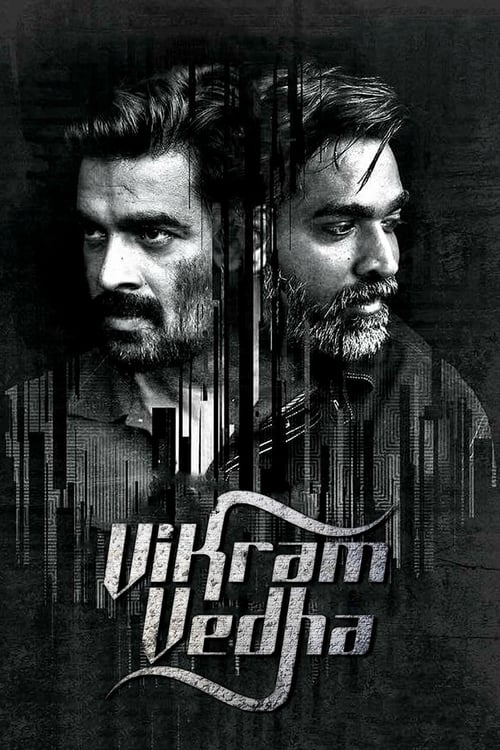
Vikram Vedha
2017 · Pushkar
For when you want a slick crime thriller with an actual brain — something with mass-movie swagger that still leaves you debating right and wrong on the drive home.
What it's about
Vikram is a decorated police 'encounter specialist' — an officer comfortable with extrajudicial kills, certain he's on the right side. Vedha is the notorious North Chennai gangster he's hunting. Then Vedha simply walks into the station and surrenders — and starts telling Vikram stories from his life, each one ending in a riddle designed to crack the cop's certainty about who is good and who is evil.
The experience
A taut, swaggering cat-and-mouse thriller that keeps flipping the board on you — every time you think you've picked a side, a new story lands and the ground shifts. Punchy, propulsive, and smarter than its genre needs it to be.
Performances
R. Madhavan and Vijay Sethupathi are a genuine double act — Madhavan all coiled righteousness, Sethupathi loose, sly, and magnetic as the gangster who's always three moves ahead. Their interrogation scenes crackle.
The craft
Writer-directors Pushkar and Gayathri rework a centuries-old folktale — a king carrying a riddling spirit — into modern Chennai pulp, and the structure is the star: three nested stories, each a trap. The action is muscular, but the real craft is in the screenplay's symmetry and the way every riddle pays off.
Why it matters
A commercial and critical hit that became modern Tamil cinema's benchmark for the smart mass thriller, spawning a high-profile Hindi remake and turning its two leads' pairing into legend.
Snapshot
Vikram Vedha is a Tamil-language action thriller that reworks a centuries-old Indian folktale into a taut, morally destabilizing cat-and-mouse drama. Its ostensible engine is simple: Vikram (R. Madhavan), a decorated police "encounter specialist" — an officer accustomed to extrajudicial killings — hunts Vedha (Vijay Sethupathi), a notorious North Chennai gangster. The twist is that Vedha surrenders of his own accord and then proceeds to interrogate his interrogator, telling three life-stories, each ending in a riddle that forces Vikram to question his certainty about who is good and who is evil. The film's lasting reputation rests less on its action than on this architecture: it takes the pulp scaffolding of the police-versus-gangster picture and turns it into a sustained argument about moral relativism, systemic corruption, and the impossibility of clean judgment. Directed by the husband-and-wife team Pushkar–Gayathri (credited here in shorthand as "Pushkar"), it became one of the defining Tamil films of the late 2010s and, five years later, the source of a high-profile Hindi remake by the same directors.
Industry & production
The film was produced by Y NOT Studios, the Chennai company headed by S. Sashikanth, in partnership with Reliance Entertainment for wider distribution — a pairing typical of the mid-2010s Tamil industry, where a boutique production house supplied creative ambition and a national studio supplied reach. Y NOT had already built a reputation for backing writer-driven, genre-literate projects, and Vikram Vedha fit that profile: a mid-budget star vehicle whose selling point was its screenplay rather than spectacle.
Casting was central to the film's design. R. Madhavan, a star of the 2000s returning to Tamil leading roles, was set against Vijay Sethupathi, then in the ascendant as Tamil cinema's most compelling "anti-hero" character actor. The deliberate contrast — Madhavan's clipped, upright authority versus Sethupathi's slouching, grinning menace — is itself a production decision that the whole film exploits. Shraddha Srinath plays Priya, a criminal defense lawyer married to Vikram, a role that sharpens the film's thematic tensions by placing the machinery of legal defense inside the protagonist's own household.
Precise budget and box-office figures are not something I can cite reliably here, and I will not invent them; what is well established is that the film performed strongly enough, critically and commercially, to become a franchise-defining property and to justify a lavish Hindi remake.
Technology
By 2017 Tamil feature production had almost entirely migrated to digital capture, and Vikram Vedha belongs to that norm — a digitally shot, digitally finished urban thriller. I do not have a firmly documented record of the specific camera system or the exact post-production pipeline used, and rather than guess at model numbers I will flag that gap directly. What can be said with confidence is that the film's look is that of contemporary digital cinematography: controlled low-light interiors, night exteriors in Chennai handled with the latitude that modern sensors allow, and a color grade that leans into cool, desaturated urban tones for the "present-day" manhunt while warming and saturating the flashback stories. The film's technological signature is aesthetic restraint rather than novelty — it uses the standard toolkit of its moment cleanly.
Technique
Cinematography
P. S. Vinod's photography is organized around the film's central dialectic of certainty versus doubt. The framing device — Vedha narrating in a police interrogation space — is shot with a stillness and hard, contained light that suits the film's talky, theatrical core, while the embedded flashback "riddles" open up into the textured, lived-in geography of North Chennai. Vinod handles action with clarity rather than kinetic overload; the film generally favors legible geography over the fragmented cutting fashionable in commercial action of the period. Night work and interiors carry much of the mood, with pools of practical light and shadow doing the noir work of suggesting that no character stands wholly in the light.
Editing
The editing (I'll note the specific editor credit is not something I can confirm with certainty and won't misattribute) is the film's most structurally ambitious element, because Vikram Vedha is fundamentally a nested-narrative machine. The cutting must repeatedly hand the film off between the frame (Vikram and Vedha in the room) and the tales (Vedha's past), and each return to the frame is timed to land a moral reversal. The rhythm is deliberately withholding: information is released in the exact order needed to invert the audience's sympathies, so the editing is less about pace than about the choreography of revelation. The recurring "story — riddle — return" beat gives the film an almost musical, stanza-like construction.
Mise-en-scène / staging
Much of the film's power comes from staging that is close to chamber drama. The interrogation-room confrontations are essentially two-hander theater, and the direction trusts the actors and the writing to hold long dialogue exchanges. Against that confinement, the flashbacks stage the gangster underworld with grounded specificity — cramped homes, back-alley violence, the social realism of a working-class Chennai milieu. The contrast between the sealed, abstract "present" (a moral courtroom without walls) and the crowded, physical "past" is a deliberate spatial strategy.
Sound
Sam C. S.'s score and the sound design are integral to the film's identity. His background score drives the manhunt with propulsive, percussive energy, while the song "Tasakku Tasakku" and the romantic "Yaanji" became widely known in their own right. The score's function is dramatic rather than decorative — it underlines the film's swagger and its tension, and it helped establish Sam C. S. as a distinctive new voice in Tamil film music. Sound also serves the folktale conceit: the transitions into Vedha's stories are treated as invocations, marking the shift from interrogation to legend.
Performance
Performance is where Vikram Vedha is most celebrated. Vijay Sethupathi's Vedha is the fulcrum — a gangster whose relaxed, teasing charisma makes moral argument feel like play, and whose folksy narration (each riddle delivered almost as a game) recasts a killer as a Socratic provocateur. R. Madhavan's Vikram is the necessary counterweight: rigid, self-assured, and slowly cracking as his black-and-white worldview is dismantled. The film's meaning lives in the space between these two registers. Shraddha Srinath grounds the domestic and ethical stakes, embodying the legal-system counter-argument to encounter policing.
Narrative & dramatic mode
The film's defining feature is its frame-tale, riddle-driven structure. This is not an incidental flourish but the whole design: Vikram Vedha is a nested narrative in which the antagonist controls the storytelling. Each of Vedha's three tales presents a scenario that initially confirms Vikram's (and the audience's) moral assumptions, then twists to expose a hidden context that reverses the judgment — and each ends with a direct question posed to Vikram. The dramatic mode is therefore dialectical and interrogative rather than simply propulsive: the "action thriller" is repeatedly paused for what amounts to moral philosophy staged as suspense. The effect is that the viewer is positioned exactly as Vikram is — confident, then unsettled, then forced to concede that the categories of "criminal" and "lawman" don't map cleanly onto "evil" and "good."
Genre & cycle
The film sits at the intersection of the gangster picture, the police procedural, and the neo-noir moral thriller, all filtered through the machinery of a mythic riddle-tale. It belongs to a broader 2010s cycle of Tamil films that took genre seriously as a vehicle for authorial ideas — crime and thriller cinema that was slick, structurally clever, and star-driven while remaining thematically pointed. Within that cycle, Vikram Vedha is notable for foregrounding the figure of the "encounter cop," making the extrajudicial-killing thriller not a celebration of tough policing but an examination of it.
Authorship & method
The film is the work of Pushkar–Gayathri, a directing and writing partnership who conceive their films as tightly engineered screenplays first. Their signature is structural: an appetite for genre reinvention, nested storytelling, and moral inversion, executed with mainstream polish rather than art-house austerity. Vikram Vedha is their clearest statement of this method — a commercial thriller whose real subject is the instability of moral judgment.
Their key collaborators shape the result decisively. Cinematographer P. S. Vinod supplies the noir-inflected urban look and the visual distinction between frame and tale. Composer Sam C. S. delivers both the hit songs and a driving score that became one of the film's calling cards and a launchpad for his career. The editing organizes the elaborate flashback architecture, though I'll again note I can't confirm the individual editor's name with certainty and won't guess. Above all, the writing — the folktale adaptation and the riddle structure — is inseparable from the direction, since Pushkar–Gayathri are the authors of both.
Movement / national cinema
Vikram Vedha is a product of the post-2010 Tamil "new wave," a period in which Kollywood produced a generation of writer-directors — figures such as Vetrimaaran, Karthik Subbaraj, and others — who blended genre fluency, technical sophistication, and socially grounded storytelling. Vijay Sethupathi's stardom is itself emblematic of this movement: an unconventional leading man whose success signaled a shift in what Tamil audiences would accept in a hero. The film also reflects Tamil cinema's deep engagement with regional, class-specific settings (here, North Chennai) as more than backdrop.
Era / period
Released in 2017, the film captures a confident, ambitious moment in Tamil commercial cinema: high production values, national-studio distribution, and a willingness to build a mass entertainer around an intellectually provocative premise. It also speaks to its Indian sociopolitical moment, in which "encounter killings" by police were a live and contested public issue — the film's choice to interrogate rather than glorify the encounter specialist gives it a distinctly of-its-time charge.
Themes
The film's governing theme is moral relativism — the collapse of the clean binary between good and evil. Its riddle structure is a machine for demonstrating that judgment depends on context, and that the man with the badge and the man with the gun may be mirror images. Adjacent themes run throughout: the ethics of state violence and extrajudicial killing; institutional corruption that implicates the "lawful" side as much as the criminal; loyalty, family, and revenge within the underworld; and the tension between law (embodied by Priya's defense practice) and order (embodied by Vikram's policing). The recurring invocation of the Vikram-Betaal legend frames all of this as an ancient problem: the ruler who thinks he can judge, forced by a storyteller to confront the limits of his own certainty.
Reception, canon & influence
Critically, Vikram Vedha was strongly praised, with particular acclaim for its screenplay and for Vijay Sethupathi's performance, and it is widely regarded as one of the standout Tamil films of its year and of the late-2010s more broadly. It has entered the informal canon of modern Tamil thrillers frequently cited for narrative craft.
Influences on the film (backward): Its foundational source is the Indian folktale cycle of Vikram and Betaal (the Baital Pachisi / Vetala tales), in which King Vikramaditya carries a spirit who tells riddle-stories that trap the listener into moral judgment — a structure the film adapts almost directly, down to the names Vikram and Vedha. More broadly it draws on the global tradition of the morally ambiguous gangster-versus-cop thriller and on neo-noir's interest in gray-zone justice.
Legacy (forward): The film cemented Pushkar–Gayathri as major Indian filmmakers and contributed to Vijay Sethupathi's and Sam C. S.'s rising profiles. Its most conspicuous legacy is the 2022 Hindi-language remake, also directed by Pushkar–Gayathri, with Hrithik Roshan and Saif Ali Khan in the lead roles — a rare case of the original creators re-mounting their own work for a national audience, which testifies to the strength of the underlying screenplay. Its enduring influence lies less in imitation than in demonstrating, to a mass audience, that a folktale's riddle structure could power a modern commercial thriller — that moral philosophy and mass entertainment need not be opposed.
Reception
A sleeper hit in summer 2017 that critics and audiences embraced immediately, it's since hardened into consensus canon — routinely topping 'best Tamil films of the 2010s' lists and serving as many outsiders' gateway drug into Tamil cinema.
How Vikram Vedha was received, from release to now →
How to watch Vikram Vedha: what to notice on a first viewing
- Watch the interrogation room stay still and contained. The frame scenes between Vikram and Vedha are staged as sealed, near-static chamber drama, sharply different from the crowded, physical streets of the flashbacks. The stillness of the room is what lets the two men's argument carry the whole scene.
- Notice pools of light and shadow in the night scenes. Vinod lights interiors and night exteriors with practical pools of light against shadow, so no single character ever stands fully lit. The lighting itself is arguing that nobody here is simply good or simply bad.
- Track the pattern of story, then riddle, then return. Each of Vedha's tales follows the same beat, a story, a riddle posed to Vikram, then a cut back to the interrogation room, almost like the stanza of a song. Recognizing the pattern is what lets you feel each return land as a fresh reversal.
- Watch Vedha's grin while he tells each story. Sethupathi plays Vedha with a relaxed, teasing charisma that turns each account into something closer to play than confession, against Madhavan's rigid, upright control as Vikram. The contrast in how relaxed each man is tells you who actually holds power in the room.
- Listen for the score shift when a story begins. Sam C. S.'s music treats the move into each of Vedha's tales almost like an invocation, marking the shift from interrogation into legend with its own sound. The score tells your ear a legend is starting before the story itself has begun.
The whole guide to watching Vikram Vedha, with the keys for a rewatch →
Influences: the films it descends from and the films it influenced
- Rashomon (1950) — Pioneered the nested retold-testimony frame in which competing narrated accounts dissolve any single moral truth and implicate the listener as judge — the exact trap Vedha's riddle-stories spring on Vikram.
- The Saragossa Manuscript (1965) — A pure stories-within-stories architecture where each embedded tale opens another, modeling the recursive frame-tale nesting VV inherits from the Vikram–Betaal cycle.
- Sholay (1975) — Codified the masala convention of a charismatic outlaw (Gabbar) dominating a cop-versus-bandit standoff, handing the villain the film's magnetic center — the structural weight VV gives Vedha over its nominal hero.
- Nayakan (1987) — Established the sympathetic Tamil don as a moral-gray protagonist adapted from the Godfather template, the anti-hero register Vijay Sethupathi's Vedha directly extends.
- Pulp Fiction (1994) — Chaptered, out-of-order crime storytelling in which flashback editing and criminal vernacular reassemble a moral fabric — the nonlinear cutting logic VV applies to its embedded tales.
- The Usual Suspects (1995) — A captured storyteller narrates flashbacks that manipulate his interrogator so the tale reframes the teller — the precise interrogation-frame engine driving VV's cop-and-suspect chamber scenes.
- Heat (1995) — Built cop and criminal as mirror doubles who meet face-to-face, paired with geographically legible action staging — the mirrored-antagonists design and readable action VV adopts.
- Satya (1998) — Grounded Indian gangster cinema in gritty neo-noir realism centered on the criminal's interiority and moral ambiguity, the noir-realist lineage VV's gray-zone justice descends from.
- Ab Tak Chhappan (2004) — Dramatized the 'encounter specialist' cop and extrajudicial police killing as subject matter, the state-violence and encounter-killing milieu VV's cop Vikram inhabits.
- Aaranya Kaandam (2011) — The founding Tamil New Wave neo-noir, using nonlinear interlocking gangster plotting and black-comic moral relativism that opened the aesthetic space VV works in.
- Vikram Vedha (2022) — The creators' own Hindi self-remount, transposing the identical riddle-structured screenplay to Hrithik Roshan and Saif Ali Khan for a national audience — a direct re-mounting of the same authored architecture.
- The Dark Knight (2008) — An antagonist who poses moral-dilemma 'riddles' forcing the hero into impossible choices, destabilizing the cop/criminal moral binary exactly as Vedha's questions do to Vikram.
- Jigarthanda (2014) — A Tamil neo-noir pairing a director-outsider with a gangster played by Vijay Sethupathi in contrasting comic-menacing registers — the same anti-hero performance calibration Sethupathi brings to Vedha.
- Vada Chennai (2018) — A nonlinear Tamil gangster epic built on nested flashback chronology and legible turf geography, extending the same nested-narrative editing and mapped-space staging as VV.
- Andhadhun (2018) — A mainstream moral-relativist thriller whose riddle-and-twist architecture converts ethical instability into commercial entertainment — VV's exact proof that moral philosophy can power a mass thriller.
- Super Deluxe (2019) — Braids interlocking nested storylines (again featuring Sethupathi) engineered so moral ambiguity accumulates across the frame boundaries, the Tamil New Wave's most elaborate extension of nested storytelling.
- Kaithi (2019) — A Tamil action thriller prized for real-time, geographically legible action choreography and cop/criminal moral inversion, carrying forward VV's legible-action-geography craft.
- Maharaja (2024) — Structures a Tamil thriller through nested flashbacks that repeatedly reorganize the viewer's moral perspective, sharing Maharaja's use of sequence-withholding to control sympathy.
Similar films
- Vada Chennai (2018) — influence & lineage · same viewing thread
- Super Deluxe (2019) — influence & lineage · same viewing thread
- Nayakan (1987) — influence & lineage · same viewing thread
- Aaranya Kaandam (2011) — influence & lineage · same viewing thread
- Jigarthanda (2014) — influence & lineage
- Kaithi (2019) — influence & lineage
- Andhadhun (2018) — influence & lineage
- Sholay (1975) — influence & lineage · same viewing thread · often watched together
All the films related to Vikram Vedha →
Watch it with: curated runs of related films
- Blood Feuds and Broken Men — A run of Indian films about ordinary men swallowed by violence, vendetta, and moral compromise — watch these together when you want fate, murky righteousness, and gunpowder sharing the same frame.