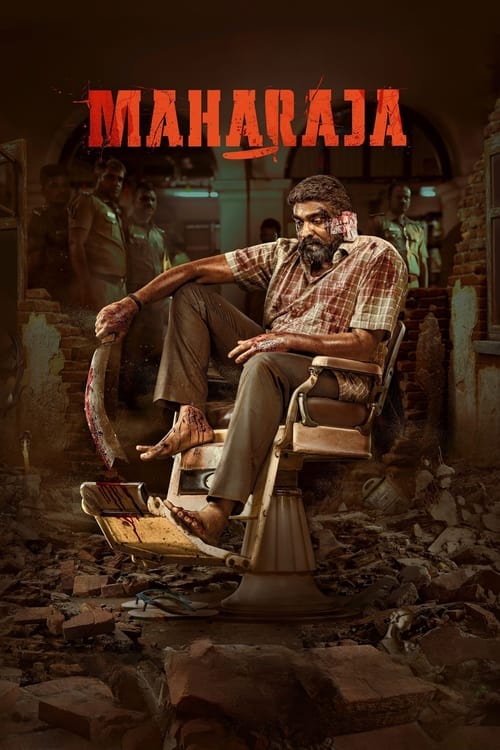
Maharaja
2024 · Nithilan Saminathan
When you want a film to chew on for days — a twisty thriller you watch with full attention and immediately want to argue about. A challenge watch, and hugely satisfying if you commit.
What it's about
A mild-mannered Chennai barber walks into a police station to report that his beloved 'Lakshmi' has been taken in a burglary — and refuses to say whether Lakshmi is a woman, a child, a pet, or a thing. The officers mock him; the mockery curdles when they learn what he's really after. Told out of chronological order, it's a revenge story that keeps rearranging what you think you know about this quiet man and his loss.
The experience
Starts almost playful, then tightens into something methodical and brutal — the nonlinear structure keeps you leaning forward, reassembling the timeline, until the pieces snap together late with real force. Expect hard violence alongside the puzzle-box pleasure.
Performances
Vijay Sethupathi, in his fiftieth film as a lead, plays the barber with a deceptive stillness that makes the mystery work — you can never quite settle on who this man is until the film wants you to.
The craft
Writer-director Nithilan Saminathan builds the whole film as a chronology trick, hiding its central revelation in plain sight until the final act — the screenplay's construction is the star. It rewards a spoiler-free first viewing and practically demands a second one to see how it was done.
Why it matters
One of the most discussed Tamil releases of 2024, it pushed the Tamil revenge thriller toward intricate, puzzle-driven screenwriting and traveled far beyond its home audience.
Snapshot
Maharaja is a Tamil-language revenge thriller that disguises a brutal, methodical procedural inside a deceptively whimsical premise: a mild-mannered Chennai barber walks into a police station to report that his beloved "Lakshmi" has been stolen, refusing at first to clarify whether Lakshmi is a woman, a pet, or an object. The officers ridicule him — until they discover that Lakshmi is a battered metal dustbin, and that the man reporting its theft has an altogether darker purpose. Directed by Nithilan Saminathan in only his second feature, and built around a nonlinear structure whose central trick is withheld until the final act, the film became one of the most discussed Tamil releases of 2024. It marked Vijay Sethupathi's fiftieth outing as a lead actor and featured, in a striking piece of casting, the Hindi-cinema director Anurag Kashyap as its antagonist. Commercially it outperformed expectations at home and, unusually for a Tamil thriller, achieved a substantial theatrical run in China; its Netflix availability broadened its reach further. The film exemplifies a strain of contemporary Tamil cinema in which formal ingenuity — twist architecture, timeline manipulation — is fused with socially charged subject matter.
Industry & production
Maharaja was produced by Sudhan Sundaram and Jagadish Palanisamy under The Route and Passion Studios, mid-budget outfits operating in the crowded Tamil theatrical market. Reported figures place the budget in the region of ₹20 crore against worldwide earnings estimated near ₹190 crore, though such trade figures should be treated as approximate; South Indian box-office reporting is notoriously inconsistent and not independently audited. The salient production fact is the casting coup: securing Vijay Sethupathi — by 2024 one of Tamil cinema's most bankable and critically respected stars — for a role that inverts his frequent screen persona, and pairing him with Anurag Kashyap, a filmmaker of national reputation making a rare and prominent acting appearance in a Tamil film. That cross-industry casting generated significant pre-release attention and signaled the production's ambition to travel beyond the regional market.
The film opened theatrically on 14 June 2024 with a runtime of roughly 140 minutes. Its later performance in the Chinese market — where it was positioned as an art-thriller crossover and became, by trade accounts, the highest-grossing South Indian film in China — is the production's most distinctive commercial footnote, evidence of a growing appetite in that market for Indian films sold on narrative craft rather than spectacle.
Technology
Maharaja is a digitally originated production shot on contemporary cinema cameras and finished through a standard digital-intermediate pipeline; the film does not foreground any novel imaging technology, and the record does not indicate bespoke technical innovation at the capture stage. Its most consequential "technology" is instead structural and post-production–based: the film's effect depends heavily on editorial and sound-design engineering to sustain a concealed timeline. This is a work whose technical achievement lies less in the camera than in the cutting room and the mix, where the withholding and eventual release of information is precisely calibrated. In that sense it belongs to a lineage of "puzzle" thrillers whose technology is dramaturgical rather than photographic.
Technique
Cinematography
Dinesh Purushothaman's photography favors a controlled, unshowy naturalism appropriate to a story that must keep its cards hidden. Much of the film unfolds in confined, functional interiors — the barbershop, the police station, cramped domestic spaces — lit to feel lived-in rather than expressionistic. This restraint is strategic: a more flamboyant visual scheme would risk tipping the film's hand, whereas the deliberately ordinary surfaces allow the narrative's concealed architecture to pass unnoticed on first viewing. The violence, when it arrives, is shot with a blunt physicality that contrasts with the earlier compositional calm.
Editing
Editing is the film's signature discipline, and Philomin Raj's work is central to its identity. Maharaja intercuts strands that a first-time viewer naturally reads as concurrent, only to reveal that they are separated in time — the film's crucial sleight of hand. The cut governs what the audience is permitted to infer, using the ordinary grammar of parallel montage to plant a false assumption about simultaneity. When the reveal comes, it works retroactively: scenes already witnessed acquire a second meaning. This is editing as the primary engine of suspense and of the twist, and it places the film squarely within the tradition of thrillers whose structure is their argument.
Mise-en-scène / staging
The staging draws sustained tension from the gap between surface and substance. The recurring image of the barber's chair and the shop's mundane routine establishes a register of the everyday that the film systematically undermines. The dustbin "Lakshmi" — a dented, unremarkable object treated with reverence — is the film's controlling piece of production design, an emblem hiding in plain sight whose true significance is deferred. Police-station scenes are staged around institutional skepticism and bureaucratic friction, spatially dramatizing the obstacles the protagonist must maneuver around.
Sound
B. Ajaneesh Loknath — a composer associated primarily with Kannada cinema, notably the Kantara and KGF-adjacent Sandalwood ecosystem — supplies a score that modulates between restraint and eruption, withholding emotional cues in service of the film's concealments and then amplifying the late revelations. The sound design participates in the film's misdirection, and the score's crossover pedigree is itself notable: a Kannada composer scoring a Tamil hit reflects the increasingly pan-South-Indian nature of the industry's craft labor.
Performance
Vijay Sethupathi anchors the film with calculated underplaying. Known for naturalistic, often warm or roguish characters, he here builds Maharaja from stillness and opacity — a man whose blankness is a mask, and whose interiority the film deliberately withholds so that the audience misreads him along with the police. The performance's power is cumulative, legible fully only in retrospect. Opposite him, Anurag Kashyap plays Selvam as a figure of casual, self-satisfied menace; the novelty of a celebrated director appearing as a Tamil-film villain is matched by the effectiveness of the turn. Sachana Namidass, as the daughter Jothi, carries the emotional stakes on which the plot's cruelty finally rests. Supporting players fill out the police-station ensemble; specific secondary-role attributions I would not assert beyond the principals without firmer confirmation.
Narrative & dramatic mode
The film's dramatic mode is the concealed-information thriller — a revenge narrative told out of order so that its true subject is hidden until late. Its ostensible engine, the theft of a dustbin, is a pretext: Maharaja fabricates the complaint to bypass the bureaucratic and social obstacles that surround the reporting of sexual assault, using the absurdity of the "Lakshmi" case to force the police into an investigation that serves his real, unspoken aim of hunting the men who attacked his daughter. The structure runs two temporal strands that appear simultaneous but are in fact separated by roughly a decade, and the climactic reversal reveals that Jothi is the biological daughter of the antagonist Selvam — orphaned in a road accident that also killed Maharaja's wife, then adopted and renamed by Maharaja. Selvam thus discovers he has brutalized his own child. The dramatic architecture is therefore one of tragic irony delivered through withheld structure: the villain is destroyed not by the hero but by knowledge.
Genre & cycle
Maharaja sits at the intersection of the action-thriller and the "puzzle-box" mystery, and it belongs to a recognizable contemporary Tamil cycle in which nonlinear or twist-driven construction is applied to hard-edged crime material. This cycle has produced widely admired films built on structural gambits and late reversals, and Maharaja is a conspicuous, commercially successful entry in it. It also participates in the broader Indian revenge-thriller tradition — the wronged father as avenger — while distinguishing itself through formal concealment rather than escalating spectacle. Its restraint in star-vehicle terms (a subdued lead performance, no interest in conventional heroic uplift) marks it as a genre film consciously working against genre expectation.
Authorship & method
Nithilan Saminathan wrote and directed the film, sharing screenplay credit with Raam Murali; the story and its structural conceit are Nithilan's. His debut, Kurangu Bommai (2017), was likewise an intricately plotted thriller organized around an object passing between characters, which establishes a clear authorial through-line: Nithilan is a filmmaker of engineered plots, interested in structure as the primary vehicle of meaning and in ordinary objects as narrative pivots. The dustbin "Lakshmi" in Maharaja rhymes conceptually with the MacGuffin-like object of his first film. His method is patient and architectural, prioritizing the withholding and controlled release of information over momentum for its own sake.
The key collaborators reinforce this authorial signature. Cinematographer Dinesh Purushothaman supplies the naturalistic surface that makes concealment possible; editor Philomin Raj executes the intercutting on which the central deception depends — arguably the most decisive craft contribution after the screenplay itself; and composer B. Ajaneesh Loknath scores the film's shifts between restraint and revelation. The collaboration of talents drawn across South Indian industries (a Kannada-associated composer on a Tamil film) and across national cinema (a Hindi-cinema director as lead antagonist) is itself characteristic of the film's method: assembling craft where it best serves the design rather than within a single regional silo.
Movement / national cinema
The film is a product of Tamil cinema (Kollywood), the Chennai-based Tamil-language industry, and specifically of its 2010s–2020s wave of writer-director-driven thrillers that pair mainstream stars with formally ambitious scripts. This wave has reshaped commercial Tamil filmmaking by demonstrating that structural sophistication and socially conscious subject matter can be commercially viable within a star system. Maharaja's cross-industry casting and its later success in China also position it within a larger, ongoing story about pan-Indian and international circulation, in which regional-language films increasingly travel on the strength of craft and word of mouth rather than language-specific stardom.
Era / period
Maharaja is very much a film of the mid-2020s streaming-and-crossover moment in Indian cinema. It arrived when Tamil thrillers were being consumed globally through platforms like Netflix, when the boundaries between India's regional industries had grown porous, and when audiences — trained by a decade of twist-driven storytelling — were receptive to, and even expectant of, structural misdirection. Its road to a substantial theatrical run in China reflects a period in which Indian films began to find non-diaspora foreign markets on the basis of narrative appeal. The film's confidence that a mainstream audience will accept a withheld, retroactively reorganizing structure is itself a marker of its era.
Themes
At its core the film is about vengeance, fatherhood, and the moral architecture of protection. The dustbin "Lakshmi" — literally the object that shielded an infant during a fatal accident, and named for the goddess of fortune — functions as a sustained metaphor for guardianship and for the sacredness a survivor may invest in an ordinary thing. The film examines how institutions fail victims of sexual violence, dramatizing the bureaucratic and social barriers that drive its protagonist to an elaborate ruse simply to compel an investigation. Its final reversal turns on a bleak of dramatic irony into tragedy: the antagonist's destruction of his own child indicts cycles of violence in which perpetrators unknowingly consume their own. Themes of concealed identity, chosen versus biological kinship, and the gap between how a man appears and who he is run throughout, mirrored formally by a structure that itself conceals its true shape.
Reception, canon & influence
Critical reception was strongly favorable, with particular praise for the screenplay's construction, for Sethupathi's restraint, and for the audacity and effectiveness of Kashyap's casting; reviewers frequently singled out the film's nonlinear architecture and its late reversal as its defining achievements. Commercially it was among the notable Tamil successes of 2024 and achieved a rare crossover run in China, where trade accounts describe it as the highest-grossing South Indian release; as with all such figures, precise numbers should be read as trade estimates rather than audited totals.
Looking backward, the film's influences are the modern twist-driven thriller tradition — the broad international lineage of structurally concealed, retroactively reorganizing narratives — filtered through Nithilan Saminathan's own prior work, whose object-centered plotting Maharaja extends. The revenge-of-the-wronged-father archetype it draws on is deeply embedded in Indian popular cinema.
Looking forward, Maharaja's legacy is still consolidating, and any claim about films it has directly shaped would be premature. What can be said is that its success reinforced the commercial case within Tamil cinema for structurally ambitious, star-anchored thrillers that trust audiences with concealed architecture, and that its cross-industry casting and Chinese theatrical performance served as a proof of concept for the international circulation of craft-driven Tamil films. Its most likely enduring influence lies in that demonstration — that formal daring and social seriousness can coexist with mainstream success — rather than in any single stylistic imitation traceable so far.
Sources: Wikipedia — Maharaja (2024 film)), TMDB — Maharaja cast & crew, Malay Mail — Maharaja China box office
Reception
A word-of-mouth sleeper in June 2024 that just kept snowballing — first a Netflix obsession across India, then a shock second life that December when it topped the Chinese box office and overtook Baahubali 2 as the highest-grossing South Indian film ever released in China.
How Maharaja was received, from release to now →
How to watch Maharaja: what to notice on a first viewing
- Watch how ordinary and lived-in every interior looks. Dinesh Purushothaman shoots the barbershop, the police station, and the cramped domestic spaces with a controlled, unshowy naturalism. The plainness grounds the film in ordinary rooms and ordinary people.
- Notice how carefully the film handles an ordinary dented dustbin. The object called Lakshmi is dented and unremarkable, yet the staging treats it with a reverence usually reserved for a person, an emblem hiding in plain sight. An object this ordinary is clearly carrying more weight than the police in the scene are willing to give it.
- Watch how little Maharaja's face reveals while he's being questioned. Vijay Sethupathi builds the character from stillness and blankness rather than his usual warmth, so what he wants stays hard to read. You are left reading him the way the police do, from very little.
- Watch how relaxed and unbothered Selvam seems in every scene. Anurag Kashyap plays him with a casual, self-satisfied ease rather than open aggression, menace delivered through comfort instead of threat. His ease is the first thing the film shows you about him.
- Listen for the score pulling back right before a scene turns. B. Ajaneesh Loknath's music stays withheld and restrained through most scenes, then erupts sharply at specific moments, refusing to cue your emotions in advance. The music is concealing as much as it reveals, matching a story that is doing the same thing to you.
The whole guide to watching Maharaja, with the keys for a rewatch →
Influences: the films it descends from and the films it influenced
- Kurangu Bommai (2017) — Nithilan's own debut engineers its entire plot around an ordinary object (a decoy bag/idol) passing between strangers, the same object-as-narrative-pivot method the dustbin 'Lakshmi' extends.
- The Prestige (2006) — Uses parallel crosscutting to make the audience assume two strands are simultaneous when they are not, the precise editing deception behind Maharaja's concealed time-gap between the two robberies.
- Dunkirk (2017) — Intercuts three timelines of different durations as if concurrent, converging only at the climax — the structural sleight-of-hand of presenting non-simultaneous events in braided montage that Maharaja weaponizes for its reveal.
- The Usual Suspects (1995) — Its terminal reveal retroactively reorganizes every prior scene, teaching the withhold-then-recontextualize architecture where the final image forces the viewer to re-read the whole film.
- Memento (2000) — Treats scrambled chronology itself as the vehicle of meaning, releasing information in a deliberately non-linear order so comprehension arrives only in retrospect — Maharaja's core structural ethos.
- Oldboy (2003) — Recasts an entire revenge arc through a late kinship reversal, revealing the vengeance was meticulously engineered by another party — the same retroactive 'who is really avenging whom' inversion Maharaja lands.
- The Sixth Sense (1999) — Plants the decisive clue in plain sight and reserves a single final revelation that reinterprets earlier scenes, the object-in-plain-sight / retroactive-reveal grammar Maharaja adopts.
- Pulp Fiction (1994) — Popularized intercut, out-of-order chronology where scenes gain meaning from their withheld temporal position, normalizing the audience's trust in reordered narrative that Maharaja assumes.
- Drishyam (2013) — Builds Indian everyman suspense on an object hidden in plain sight and information withheld from both investigators and audience, the concealment-through-ordinariness Maharaja inherits and complicates.
- Pizza (2012) — Established the modern Tamil twist-thriller template where a final reversal reframes the entire preceding narrative, opening the commercial space Maharaja operates in.
- Memories of Murder (2003) — Grounds a crime narrative in naturalistic restraint and calculated underplaying rather than momentum, letting dread accrue through ordinary detail — the tonal control Maharaja uses to mask its design.
- Ratsasan (2018) — A Tamil procedural driven by dramatic irony around a concealed antagonist, using naturalistic restraint to keep the threat hidden in the everyday texture of the frame, like Maharaja's calm surface.
- Vikram Vedha (2017) — Structures a Tamil thriller through nested flashbacks that repeatedly reorganize the viewer's moral perspective, sharing Maharaja's use of sequence-withholding to control sympathy.
- Super Deluxe (2019) — Interweaves separate Tamil narrative strands with Vijay Sethupathi anchoring calibrated underplaying, and modulates between restraint and eruption exactly as Maharaja's sound and performance design do.
- Andhadhun (2018) — A contemporary Indian puzzle-box thriller propelled by an object/deception and cascading moral reversals, trusting the audience with concealed architecture in the same register as Maharaja.
- Jigarthanda DoubleX (2023) — Deploys against-type and cross-industry casting plus a patient, architecturally withheld structure in Tamil cinema, paralleling Maharaja's Kashyap-as-antagonist gambit and engineered-plot method.
Similar films
- Vikram Vedha (2017) — influence & lineage · same viewing thread
- Super Deluxe (2019) — influence & lineage · same viewing thread
- Jigarthanda DoubleX (2023) — influence & lineage
- Drishyam (2013) — influence & lineage
- Andhadhun (2018) — influence & lineage
- Aaranya Kaandam (2011) — same viewing thread
- Vada Chennai (2018) — same viewing thread
- Vikram (2022) — same viewing thread
All the films related to Maharaja →
Watch it with: curated runs of related films
- Blood Feuds and Broken Men — A run of Indian films about ordinary men swallowed by violence, vendetta, and moral compromise — watch these together when you want fate, murky righteousness, and gunpowder sharing the same frame.