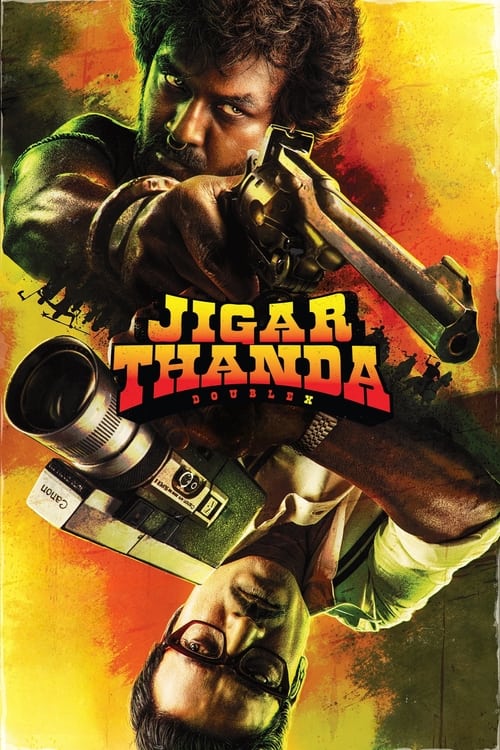
Jigarthanda DoubleX
2023 · Karthik Subbaraj
For when you want a big, brash, unpredictable crime saga that turns out to have a beating heart — the kind of film you start for the swagger and finish a little choked up. Best with your full attention and a free evening.
What it's about
Late-1970s Tamil Nadu. Caesar, a feared Madurai-region gangster, dreams of becoming a Clint Eastwood–style movie hero — and a sharpshooter with orders to kill him poses as a film director to get close. The fake production becomes a real one, and what began as a con spirals somewhere neither man imagined: into the forests, into caste politics and tribal land, and into a strange, sincere love letter to what a camera can do.
The experience
A wild tonal ride — swaggering gangster comedy for the first stretch, then a slow-building emotional epic that sneaks up on you and hits surprisingly hard. It's long and maximalist in the grand Tamil tradition, and the last act pays off everything.
Performances
S.J. Suryah is ferociously alive as Caesar, all volatile ego and unexpected tenderness, and Raghava Lawrence — cast against his mass-market horror-comedy image — matches him with real gravity as the assassin-turned-director.
The craft
Karthik Subbaraj builds a period fable around the machinery of moviemaking itself — a film within a film where the camera literally changes who's holding it and who's in front of it. The 1970s staging, the forest and elephant sequences, and the genre swerves from western to gangster picture to political drama make it a feast on a big screen.
Why it matters
A standout of the 2020s Tamil crime wave, it reworked the director's own breakout premise into something more political — a mainstream entertainment that puts caste violence and tribal dispossession at its center.
Snapshot
Jigarthanda DoubleX is a Tamil-language crime epic written and directed by Karthik Subbaraj, released in late 2023. It carries the name of Subbaraj's own 2014 breakout Jigarthanda but is not a sequel; it is better understood as a thematic re-imagining that takes the earlier film's central conceit — an aspiring filmmaker entangling himself with a real-life gangster in order to make a movie — and reworks it into a period fable set largely in the late 1970s. The film pairs Raghava Lawrence, an actor-choreographer better known for mass-market horror-comedy, against S.J. Suryah as a feared Madurai-region strongman named Caesar who dreams of becoming a Clint Eastwood–style screen hero. What begins as a con — a sharpshooter posing as a director to get close enough to kill his target — curdles into a meditation on cinema itself as a moral and revolutionary instrument, folding in a subplot about forest-dwelling communities, elephant poaching, and Gandhian nonviolence. It stands as one of Subbaraj's most ambitious works: a genre picture openly in love with the movies, and an argument that the camera can do what the gun cannot.
Industry & production
The film was produced within the Tamil (Kollywood) industry, part of the broader South Indian cinema whose commercial and creative confidence had risen sharply through the 2010s. Subbaraj by 2023 was an established brand-name director — his commercial peak had come with the Rajinikanth vehicle Petta (2019) — which gave a project like DoubleX the leverage to be mounted on a substantial scale with period reconstruction, a large ensemble, and effects-supported action. The casting itself was a production statement: placing Raghava Lawrence, associated with the Kanchana/Muni franchise and with dance, in a restrained dramatic register, and elevating S.J. Suryah — a director-turned-actor who had reinvented himself as a flamboyant character player — into a co-lead of near-mythic dimension. I do not have reliable, verifiable figures for the film's budget or box-office gross, and I will not invent them; contemporaneous coverage treated it as a mid-to-large budget release that performed respectably rather than as a blockbuster on the scale of Petta. The precise theatrical release date and distribution particulars are details I can gesture at only loosely (a late-2023 release), and I flag that as a limit of what I can state with confidence.
Technology
Jigarthanda DoubleX is a digitally originated and finished film, consistent with standard Tamil-industry practice by the early 2020s: capture on digital cinema cameras, a full digital-intermediate color pipeline, and computer-generated and composited effects work. The technological interest of the film lies less in its own toolset than in its subject: it is a movie about the technology of cinema. Its 1970s setting motivates depictions of celluloid filmmaking — the physical camera, the reel, the mechanics of shooting and projecting — and the narrative repeatedly foregrounds the apparatus of moviemaking as something almost sacred. The production accordingly had to reconstruct period film equipment and image-making practice as diegetic objects. Beyond that, I would be speculating to name specific camera systems or post-production vendors, so I leave those unstated rather than guess.
Technique
Cinematography
The photography is one of the film's most discussed strengths. The cinematography (attributed to S. Tirru, whom I believe to be the credited director of photography, though I flag a small residual uncertainty on the exact credit) leans into a warm, saturated, sun-baked palette appropriate to its rural Tamil Nadu and forest locations, and to the western movies it venerates. The compositions consciously borrow the grammar of the American and Italian western — wide vistas, low horizons, isolated figures framed against landscape, and the standoff geometry of the spaghetti western that Caesar idolizes. This visual quotation is thematically motivated rather than decorative: because the plot concerns a man who wants to live inside a cowboy film, the camera periodically adopts that film's look. The forest sequences shift the register toward something more elemental and green-shadowed, setting the natural world against the dusty theatricality of the gangster milieu.
Editing
The editing manages an unusually layered structure — a story about the making of a film, containing a film-within-a-film, and toggling between con, melodrama, action, and comedy. The cut has to keep the meta-cinematic frame legible while sustaining momentum across a long runtime. Match-cutting and montage tie the "real" events to their filmed re-enactments, so that the seam between life and movie becomes a deliberate expressive device rather than a problem to be hidden. I am not fully certain of the credited editor's name and will not assert one incorrectly; Subbaraj has worked with a consistent editorial team across his career, and the film bears his characteristic taste for tonal gear-changes.
Mise-en-scène / staging
Production design is central: the film reconstructs a 1970s Madurai-adjacent world of cinema halls, gangster dens, police stations, and forest settlements, and it stages its story amid the paraphernalia of period filmmaking. The staging repeatedly frames performance-within-the-frame — actors being directed, a gangster rehearsing heroism, a camera crew at work — so that the mise-en-scène itself dramatizes the theme that everyone is, in some sense, performing for a camera. The western iconography extends into costume and prop: the cowboy hat, the poncho-like silhouette, the gunslinger's stance become recurring visual motifs attached to Caesar.
Sound
The score and sound design are by Santhosh Narayanan, Subbaraj's most important and longest-standing musical collaborator, whose work has shaped the identity of nearly all the director's films. Narayanan's contribution fuses driving percussion and folk-inflected Tamil sonorities with pastiche of western-movie scoring — the twanging, whistling, brass-and-guitar language associated with Ennio Morricone's work for Sergio Leone — again motivated by Caesar's cinephilia. The soundtrack functions both as crowd-pleasing "mass" scoring for the action-hero beats and as ironic commentary, underscoring the gap between a small-time rowdy and the mythic gunslinger he imagines himself to be.
Performance
Performance is where the film's reputation largely rests. S.J. Suryah's Caesar is a large, operatic creation — comic, menacing, childlike in his movie-worship, and finally tragic — and the role gave him one of the showcase parts of his acting career. Raghava Lawrence, cast against type, plays the more interior, morally compromised figure of the man sent to manipulate and destroy Caesar, and much of the film's emotional torque comes from the shift in that relationship from predation to something like kinship. The ensemble around them fills out the period world with the broad character work typical of Tamil commercial cinema.
Narrative & dramatic mode
The dramatic mode is a hybrid characteristic of Subbaraj: a crime narrative braided with black comedy, melodrama, and, in its final movement, earnest social-message cinema. The spine is a con-and-betrayal plot — a killer embedded as a filmmaker — which is a machine for suspense and for meta-cinematic irony. Over the course of the film that machinery is redirected: the fake film becomes a real one, and the act of filming becomes the plot's moral engine. The narrative is reflexive throughout, built on nested layers of representation (the film we watch, the film being shot inside it, the movies the characters worship), and it uses that nesting to argue a thesis about cinema's power. The tonal range is wide and deliberately so, swinging from slapstick to bloodshed to sincere pathos, which is both the film's signature pleasure and, for some viewers, its principal risk.
Genre & cycle
The film sits at the intersection of the Tamil "gangster" film, the meta-cinema film, and the western homage. It belongs to a distinctly South Indian cycle of movies about movies and about the near-religious status of cinema and its stars in Tamil culture — a culture where film and politics have long been intertwined. Simultaneously it is a self-aware entry in the global lineage of films that pay tribute to the western, and specifically to the Leone–Eastwood spaghetti western and to Clint Eastwood as an icon of screen masculinity. Within Subbaraj's own body of work it extends a personal cycle of reflexive crime films that began with Pizza and the original Jigarthanda.
Authorship & method
Karthik Subbaraj is the film's clear author: writer-director, and by 2023 a recognizable stylist whose recurring preoccupations — crime worlds, cinephilia, tonal whiplash, morally ambiguous protagonists, and a fascination with performance and identity — are all present here. His method is one of genre synthesis, taking mass-cinema conventions and bending them toward reflexive and political ends. The most consequential collaboration is with composer Santhosh Narayanan, whose scores have been integral to Subbaraj's authorial voice since early in the director's career. On the image side, the credited cinematographer (I believe S. Tirru) delivers the western-inflected look the material demands. Subbaraj also functions as a curator of performers, here mining a career-defining turn from S.J. Suryah and a reinvention from Raghava Lawrence. Where I am unsure of specific technical credits — notably the editor — I have said so rather than attribute falsely.
Movement / national cinema
The film is a product of contemporary Tamil cinema and, more broadly, of the wave of South Indian filmmaking that reshaped the Indian film landscape in the 2010s–2020s, when directors from the Tamil, Telugu, Kannada, and Malayalam industries pushed regional cinema to national and pan-Indian prominence. It is not an art-cinema "movement" film; rather it exemplifies a strand of ambitious commercial auteurism within Tamil cinema, in which a director working inside the star-and-genre system nonetheless pursues formally reflexive and thematically serious aims. Its deep engagement with the specifically Tamil relationship between cinema, fandom, and public life roots it firmly in that national-cinema context.
Era / period
The film was made in the early-2020s present but is set predominantly in the 1970s, and its period identity is doubled. Diegetically, the 1970s setting lets it stage a mythologized moment of cinema and of regional strongman culture, and to root its western-worship in the era when Eastwood and the spaghetti western loomed largest. As a production, it belongs to the post-Baahubali, post-Petta moment of South Indian confidence, when scale, period reconstruction, and pan-regional ambition were newly available to Tamil directors. The interplay between the nostalgic 1970s frame and the contemporary craft is part of the film's texture.
Themes
The film's governing theme is the power of cinema — its capacity to transform a person, to mobilize a community, and to stand in for, or supersede, violence. Caesar's arc dramatizes the fantasy that a man can become the hero he watches on screen, and the film treats that fantasy with both irony and tenderness. Adjacent themes include: nonviolence versus the gun, given explicitly Gandhian coloring in the late movements; the protection of forest-dwelling and marginalized communities against exploitation and poaching, which grounds the abstract "power of film" in a concrete social cause; performance and authenticity, i.e., who is acting and who is real; and betrayal transformed into solidarity. Running under all of it is a reflexive love letter to the movies as a moral force — the idea, made literal by the plot, that a camera can accomplish what weapons cannot.
Reception, canon & influence
Critically, Jigarthanda DoubleX was received as one of Subbaraj's strongest and most ambitious films, with particular praise directed at S.J. Suryah's performance, Santhosh Narayanan's score, and the audacity of the meta-cinematic conceit; the chief reservation among commentators concerned its length and its very wide tonal swings. I am summarizing the general shape of that reception rather than quoting specific reviews, and I will not attribute invented lines or scores to any critic or outlet.
Influences on the film (backward): the most explicit is Clint Eastwood and the Sergio Leone spaghetti western — the film wears its cowboy-movie worship openly, in imagery, music, and character psychology. It also draws on the broader tradition of films-about-filmmaking and on the Tamil cultural mythology of cinema and stardom. Most directly, it is in dialogue with Subbaraj's own Jigarthanda (2014), whose premise it reinvents. Its Gandhian, cinema-as-nonviolence thread connects it to a long Indian tradition of message cinema.
Legacy / what it shaped (forward): as a relatively recent film, its long-term influence is still unsettled, and it would be irresponsible to overstate it. What can reasonably be said is that it consolidated Karthik Subbaraj's standing as a leading reflexive auteur within Tamil commercial cinema, marked a career-high dramatic showcase for S.J. Suryah, and offered a prominent recent model for how a mass-market South Indian genre film can be simultaneously crowd-pleasing and formally self-aware. Any firmer claims about a lasting canonical or industrial legacy would be premature given how near this film is to the present.
Reception
A Diwali 2023 release that opened to warm reviews and strong word of mouth — instantly hailed as Karthik Subbaraj's return to form after the mixed responses to Jagame Thandiram and Mahaan — and its stature has only grown since hitting Netflix, where it settled in as one of the decade's most-loved Tamil films.
How Jigarthanda DoubleX was received, from release to now →
How to watch Jigarthanda DoubleX: what to notice on a first viewing
- Watch for wide shots that frame figures alone against open land. The camera keeps returning to wide vistas, low horizons, and standoff geometry borrowed from the spaghetti western, especially around Caesar. The look puts you inside the western that Caesar imagines himself starring in.
- Notice light shift from dusty gold to green forest shadow. The gangster world stays sun-baked and theatrical, but the forest scenes turn cooler and more elemental, splitting the film's two worlds by color. The color change signals when the story leaves the cowboy fantasy for the forest's stakes.
- Listen for whistling and twangy guitar inside the Tamil score. Santhosh Narayanan fuses driving Tamil percussion with the brass-and-whistle sound of Morricone's westerns for Sergio Leone, growing more pointed as Caesar's fantasy deepens. The music itself performs the gap between a small-time rowdy and the gunslinger he dreams of being.
- Look for the cowboy hat and poncho Caesar wears. The hat, the poncho silhouette, and the gunslinger stance recur as costume pieces attached specifically to Caesar, marking him as a man dressed for a movie he is only imagining. The costume shows you exactly which fantasy Caesar is trying to live inside.
- Notice scenes where a camera crew directs someone within the story. Subbaraj stages actors being directed, a gangster rehearsing heroism, and a crew at work, all inside the same frame as the main action. The nested staging keeps reminding you that everyone here is performing for a camera.
The whole guide to watching Jigarthanda DoubleX, with the keys for a rewatch →
Influences: the films it descends from and the films it influenced
- Jigarthanda (2014) — DoubleX directly reinvents its core engine — an outsider infiltrating a gangster's orbit under the cover of cinema — inverting the earlier film's aspiring-director-vs-don gambit into a cop-turned-filmmaker con.
- A Fistful of Dollars (1964) — Supplies the Eastwood 'Man with No Name' iconography that the gangster Caesar literally worships as a screen ideal, motivating the poncho-and-squint imagery grafted onto a Madurai crime lord.
- The Good, the Bad and the Ugly (1966) — Donates the spaghetti-western shot grammar Subbaraj apes — the escalating cut between sweat-beaded extreme close-ups and wide desolate standoffs timed to the score's swell.
- Once Upon a Time in the West (1968) — Model for Santhosh Narayanan's character-keyed Morricone-style leitmotifs and the operatic, drawn-out duel staging where music, not dialogue, carries the confrontation.
- Sholay (1975) — The founding Indian 'curry western' — transplanting Leone's outlaw-vs-settlement grammar and elemental villainy into a 1970s rural Indian register that DoubleX's period reconstruction inherits.
- Nayakan (1987) — Establishes the Tamil gangster-as-tragic-patriarch arc — the morally ambiguous don whose rise is shot as myth — that underwrites Caesar's stature and psychology.
- Sullivan's Travels (1941) — The ur-text of the 'can cinema do moral good' reflexive conceit, where a filmmaker's belief in movies-as-uplift drives the plot — the seed of DoubleX's cinema-as-nonviolence thesis.
- Pulp Fiction (1994) — Template for the con-and-betrayal structure braided with abrupt tonal gear-changes — slapstick, dread, and sentiment colliding within a single crime scene.
- Aaranya Kaandam (2011) — The first Tamil neo-noir, which legitimized the pulp gangster grammar — chapter structure, black comedy, stylized violence — that Subbaraj's reflexive crime cinema builds upon.
- Petta (2019) — Same authorial move of weaponizing star-worship reflexively — staging a mass hero's iconography as self-aware spectacle inside a genre frame — here applied to Rajinikanth rather than Eastwood-worship.
- Mahaan (2022) — Extends Subbaraj's cast-against-type gangster morality play, mining a reinvented persona from an established star the way DoubleX does with S.J. Suryah and Raghava Lawrence.
- Super Deluxe (2019) — Shares the South Indian New Wave's signature tonal whiplash — hard cuts across comic, cosmic, and brutal registers held together by a synth-forward score — as a deliberate formal strategy.
- Vikram (2022) — A parallel model for the crowd-pleasing-yet-reflexive mass film, extracting a cast-against-type turn from a legacy star and folding fan-service into a self-aware gangster architecture.
- Django Unchained (2012) — Parallel appropriation of spaghetti-western homage grammar — Morricone-inflected cues, chapter-like escalation, and revenge staged with operatic musical punctuation — inside a non-Western setting.
- Once Upon a Time in Hollywood (2019) — Shares the film-within-a-film device deployed toward the same fantasy of cinema undoing real violence — the movies literally rewriting a bloody outcome, DoubleX's cinema-as-nonviolence in another key.
- KGF: Chapter 1 (2018) — Contemporary sibling in period-1970s gangster reconstruction rendered through a warm, saturated, dust-and-amber palette and wall-to-wall operatic scoring that mythologizes the crime boss.
- Maharaja (2024) — Deploys against-type and cross-industry casting plus a patient, architecturally withheld structure in Tamil cinema, paralleling Maharaja's Kashyap-as-antagonist gambit and engineered-plot method.
Similar films
- Vikram (2022) — influence & lineage · same viewing thread
- Jigarthanda (2014) — influence & lineage
- Aaranya Kaandam (2011) — influence & lineage
- Super Deluxe (2019) — influence & lineage
- Nayakan (1987) — influence & lineage
- RRR (2022) — same viewing thread
- Viduthalai: Part I (2023) — same viewing thread
- Kantara (2022) — same viewing thread
All the films related to Jigarthanda DoubleX →
Watch it with: curated runs of related films
- First Day, First Show — A run of maximalist, movie-drunk crowd cinema best taken loud and communal — spectacle, folk myth, gangster swagger, and lads-on-a-trip mayhem that all believe in the front row.