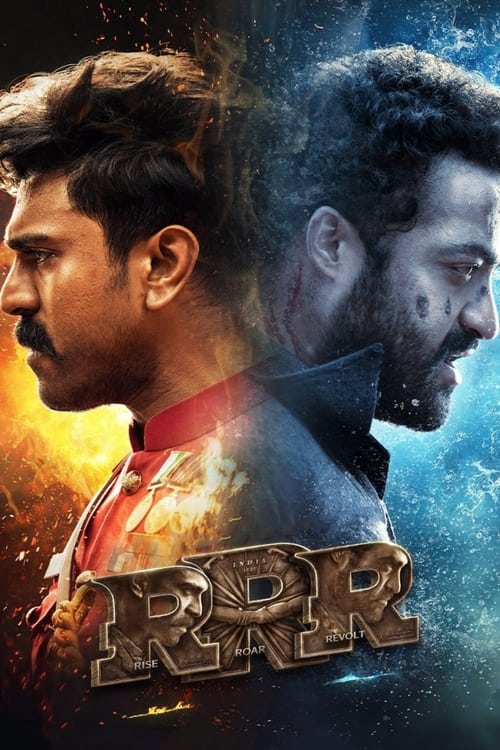
RRR
2022 · S. S. Rajamouli
For when you want a maximum-voltage crowd-pleaser — movie night with friends, the loudest speakers you own, and zero cynicism. Total comfort, delivered at total scale.
What it's about
In 1920s India under the British Raj, two strangers on secret, opposing missions — one hunting a stolen girl, one hunting rebels — become inseparable friends without knowing they're destined to collide. It's a fictional history imagining a bond between two real revolutionaries who never met, told at a scale where a rescue can involve a bridge, a fire, and most of the animal kingdom.
The experience
Three hours of pure, escalating exhilaration — sincere to its bones, operatic in its reversals, with action sequences that make you laugh out loud at their audacity and a friendship that somehow makes you cry between explosions. Exhausting in the best way.
Performances
NTR Jr. and Ram Charan play the two leads as elemental forces — water and fire — with a physical commitment and open-hearted chemistry that carries every impossible thing the film asks you to believe.
The craft
S. S. Rajamouli directs with a sincerity and scale Hollywood abandoned decades ago: musical numbers that function as duels, an interval-structured screenplay that detonates its reversals with operatic timing, and effects deployed for delight rather than realism. This is a big-screen, big-sound film if there ever was one — the dance number alone justifies the volume.
Why it matters
Its worldwide crossover was unprecedented for a Telugu production, winning the Oscar for the song 'Naatu Naatu' and introducing a global audience to Indian blockbuster cinema on its own terms.
S. S. Rajamouli's Telugu-language colossus imagines a friendship between two real anti-colonial revolutionaries — Komaram Bheem and Alluri Sitarama Raju — who never met, and builds from that counterfactual a three-hour delirium of loyalty, betrayal, and physics-optional spectacle set against the British Raj of the 1920s. Rajamouli, already the most commercially successful director in India after the Baahubali films, works in a register Hollywood abandoned decades ago: total sincerity at maximum scale, where a musical number can be a duel and an action sequence can carry the emotional weight of an aria. NTR Jr. and Ram Charan play the leads as elemental forces — water and fire, the film tells us plainly — and the interval-structured screenplay detonates its reversals with operatic timing. Its worldwide crossover was unprecedented for a Telugu production, culminating in an Academy Award for the song 'Naatu Naatu' and dance floors full of Western audiences learning the hook step. Beneath the mayhem sits a pointed rewriting of colonial history as myth — the empire, for once, cast as the monster.
Reception
A monster hit in India from day one, RRR's real arc happened in the West: a slow-burn 2022 word-of-mouth phenomenon fueled by Netflix, rapturous repertory screenings, and filmmaker endorsements, culminating in an Oscar and instant crossover-classic status.
How RRR was received, from release to now →
Influences: the films it descends from and the films it influenced
- Baahubali: The Beginning (2015) — Rajamouli and DoP K. K. Senthil Kumar built RRR's grammar of the 'elevation shot' here — the low-angle, slow-motion hero entry cut against digitally-extended landscapes at impossible scale.
- Baahubali 2: The Conclusion (2017) — The straight-faced physics-defying set piece (palm trees bent into human catapults) is the direct blueprint for RRR's shoulder-mounted-motorcycle and animals-from-a-truck action logic.
- Magadheera (2009) — Its 100-soldiers single-warrior slow-motion battle first fused ramped speed, sword choreography and CGI multiplication into the 'one hero vs. an army' beat RRR replays at the palace gate.
- Eega (2012) — Rajamouli's commitment to treating cartoon-impossible VFX (a reincarnated housefly assassin) with total dramatic sincerity licensed RRR's flying-tiger and human-projectile earnestness.
- Chatrapathi (2005) — Early Rajamouli template of the wronged strongman who erupts into mass-elevation violence on behalf of the oppressed — Bheem's protective rage descends directly from it.
- Mayabazar (1957) — The foundational Telugu mythological-spectacle film whose trick-photography 'wonder' set pieces and NTR-scale mythic staging RRR consciously channels into its interval and pre-climax tableaux.
- Sholay (1975) — Defined the Indian 'dosti' two-hero action epic — the male-friendship dyad that betrays and redeems each other, structurally mirrored in Ram and Bheem's bond.
- Mughal-e-Azam (1960) — The benchmark of opulent Indian historical melodrama — lavish period court staging and song picturization as spectacle set-piece, the register RRR revives for 'Naatu Naatu.'
- Ben-Hur (1959) — Its chariot-race model of the sustained, spatially-legible mega-set-piece as a film's structural spine is echoed in RRR's bridge-rescue and interval-block choreography.
- Spartacus (1960) — The anti-oppression uprising epic where a subjugated body becomes a symbol of collective revolt — the melodramatic scale RRR maps onto anti-colonial revolt.
- Braveheart (1995) — The template of the freedom-fighter melodrama where personal loss ignites anti-imperial rebellion, complete with martyrdom-as-climax that RRR structures its finale around.
- Gladiator (2000) — Pioneered CGI-augmented historical-epic crowds and arena scale as an emotional amplifier, the digital-spectacle-serving-melodrama approach RRR industrializes.
- 300 (2007) — Shares the speed-ramping (fast-slow-fast) combat aesthetic and hyper-sculpted male bodies as choreographic spectacle that RRR deploys in its whip-and-chain sequences.
- Apocalypto (2006) — Its sinewy, forward-driving chase choreography through hostile wilderness is a cousin to Bheem's jungle-hunt introduction and the raw kinetic-body action style.
- KGF: Chapter 2 (2022) — Part of the same pan-Indian mass-movie wave — low-angle hero-elevation, period setting and desaturated grandeur deployed to mythologize a single unstoppable man.
- Pushpa: The Rise (2021) — Telugu contemporary of RRR that stages the subaltern strongman's swagger through the same choreographed mass-elevation entries and rhythmic song-as-identity set pieces.
- Kantara (2022) — Shares RRR's move of resolving human conflict through folk-mythic/elemental transformation in the climax — the hero literally embodying a divine-elemental force.
Similar films
- Kantara (2022) — influence & lineage · same viewing thread
- Jigarthanda DoubleX (2023) — same viewing thread
- Manjummel Boys (2024) — same viewing thread
- Aavesham (2024) — same viewing thread
- Bāhubali 2: The Conclusion (2017) — shared sensibility
- Bāhubali: The Beginning (2015) — shared sensibility
- Rang De Basanti (2006) — shared sensibility
- Iruvar (1997) — shared sensibility
All the films related to RRR →
Watch it with: curated runs of related films
- First Day, First Show — A run of maximalist, movie-drunk crowd cinema best taken loud and communal — spectacle, folk myth, gangster swagger, and lads-on-a-trip mayhem that all believe in the front row.