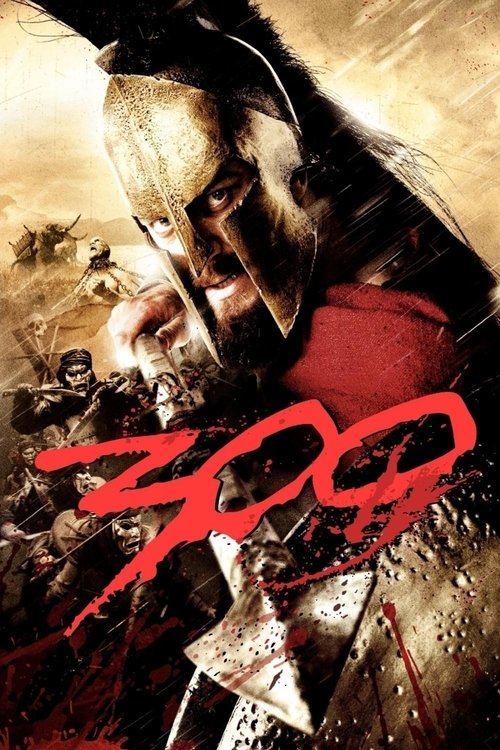
300
2007 · Zack Snyder
Less a director than a fandom phenomenon: the #ReleaseTheSnyderCut campaign's success changed studio-fan power dynamics forever, and Rebel Moon's critical drubbing versus loyalist defense is a permanent internet fault line. Naming him takes a side.
When you want to turn your brain off and your speakers up — a hyped-up night with friends, a workout-fuel movie, spectacle for its own glorious sake. Comfort food for action fans, zero homework required.
What it's about
In 480 B.C., King Leonidas of Sparta marches three hundred warriors to a narrow coastal pass to hold off the vast invading army of the Persian king Xerxes. Adapted from Frank Miller's graphic novel, it's less a history lesson than a war myth told at full volume — a doomed last stand rendered as legend, with political intrigue back in Sparta running alongside the battle.
The experience
Pure adrenaline: slow-motion spear thrusts, roaring speeches, and battles staged like moving comic-book panels, all soaked in bronze and blood-red. It's operatic, unapologetically excessive, and moves like a two-hour battle cry.
Performances
Gerard Butler's Leonidas is all jaw and thunder — a career-making turn of sheer physical commitment that launched a thousand impressions of its most famous line.
The craft
Shot almost entirely against blue screens with every backdrop painted in afterward, it recreates Frank Miller's panels frame by frame — a burned-down palette of ash, bronze, and arterial red, with speed-ramped action that snaps between slow motion and full tilt. It demands the biggest screen and loudest sound system you can find.
Why it matters
A shock blockbuster far beyond its modest budget, it defined the look of late-2000s action cinema — the speed-ramps, the digital grading, the shirtless spectacle — launched Zack Snyder's career, and seeded internet meme culture for years.
Snapshot
300 is Zack Snyder's stylized adaptation of Frank Miller and Lynn Varley's 1998 comic-book miniseries, itself a lurid reimagining of the 480 B.C. Battle of Thermopylae, in which King Leonidas and a small band of Spartans held a coastal pass against the invading army of the Persian king Xerxes. Released by Warner Bros. in March 2007, the film arrived as a near-total fusion of comics and cinema: a work shot almost entirely against blue and green screens, its environments painted in afterward, its palette burned down to bronze, ash, and arterial red. It was a commercial phenomenon far out of proportion to its modest budget, and it crystallized a particular mid-2000s aesthetic — digitally graded, slow-motion-saturated, hyper-masculine spectacle — that would echo through action filmmaking, advertising, and internet culture for a decade. It is less a war film than a graphic novel made to move, and its significance lies precisely in how completely it subordinated the photographed world to the drawn one.
Industry & production
300 was produced by Warner Bros. Pictures in partnership with Legendary Pictures, the financing entity then in the early phase of a co-production arrangement that would define much of Warner's tentpole output in the period. The project followed Snyder's 2004 Dawn of the Dead remake, which had established him commercially, and it carried comparatively low risk on paper: the source material was a finite, image-driven Frank Miller book, and the production model — virtual backlot, contained cast, no location shooting of consequence — promised a controlled budget. Principal photography took place over roughly sixty days in 2005 at Icestorm Studios in Montreal, on soundstages dressed mainly with practical foreground elements and partial sets surrounded by chroma-key backing.
The film's reported production budget of around $65 million was unusually efficient for the scale of spectacle it delivered, a direct consequence of building the world in post rather than on location. Released theatrically in March 2007, 300 became a major box-office success, grossing in the region of $450 million worldwide against that budget — figures widely reported at the time and central to the film's reputation as a model for low-overhead, high-yield digital spectacle. Its performance helped certify both Snyder as a bankable visual stylist and the broader commercial viability of R-rated, comics-derived action, and it directly enabled his next, far more ambitious adaptation, Watchmen (2009). The production also generated significant diplomatic friction: the Iranian government and many Iranian commentators condemned the film's depiction of the Persians as a grotesque, decadent, racially othered horde, a controversy that became part of the film's public life and a recurring point in its critical reception.
Technology
300 is, technologically, a landmark of the "virtual backlot" approach, in which actors perform on near-empty stages and the surrounding world is composited in digitally. The film leaned on this method almost wholesale: skies, cliffs, the sea, the Persian war machines, and much of the architecture were created as digital environments and matte work, with the live-action elements keyed in. This is the same production logic Robert Rodriguez had used on Sin City (2005) — another Frank Miller adaptation — and 300 extended and popularized it, demonstrating that an entire historical epic could be conjured without a single built landscape.
Equally important was the film's reliance on the digital intermediate (DI), the by-then-maturing process of scanning footage to a digital master for color manipulation. The DI is where 300 truly became itself: its signature crushed, bronzed, desaturated-yet-high-contrast look was achieved in the grade, pushing flesh toward burnished metal and skies toward bruised storm. The film stands as one of the most conspicuous demonstrations of color grading as authorship — proof that the "look" of a film could be substantially authored after the camera stopped. Visual-effects work was led by a roster of houses for the composites, environments, and the more fantastical Persian elements (the war elephants, the "Immortals," Xerxes' menagerie of monstrosities), all of which had to read as continuous with Miller's drawn world rather than as photorealistic creatures.
Technique
Cinematography
Larry Fong, shooting his first feature with Snyder (a collaboration that would continue across Watchmen, Sucker Punch, and Batman v Superman), lit and framed 300 as a sequence of tableaux. Because the surrounding world was virtual, the cinematography concentrated on sculpting bodies and faces — hard, raking key light to carve abdominal musculature into relief, rim light to separate figures from dark voids, and a generally low-key scheme that let the digital backgrounds bleed into shadow. Compositions are frontal, friezelike, and often symmetrical, echoing the panel logic of the comic; the camera frequently holds a heroic low angle on Leonidas and the phalanx. The much-imitated visual grammar of the battle scenes — the "speed ramp," in which a shot decelerates into crawling slow motion at the moment of a kill and then snaps back to real time — is as much a cinematographic decision as an editorial one, designed to isolate the single decisive gesture (a spear thrust, a decapitation, a shield bash) as a legible, poster-ready image.
Editing
William Hoy's cutting organizes the film around set-piece rhythm rather than narrative momentum. The battle sequences are built to alternate between sustained slow-motion "hero" beats and bursts of accelerated violence, the speed-ramping effect achieved in concert with camera and visual effects but realized in the edit's control of duration. The result is a percussive, almost musical structure of held breath and sudden release. Between battles the film cuts to a parallel court intrigue in Sparta, and the editing's job there is largely connective — sustaining tension toward the next confrontation. The framing device of Dilios's narration also shapes the cutting: the film is, diegetically, a story being told to rally troops, and the edit accordingly favors the heightened, the emblematic, and the rhetorical over the continuous.
Mise-en-scène / staging
Staging is the film's true subject. Snyder reproduces specific Miller compositions with near-reverence, treating the graphic novel as a storyboard and recreating its silhouettes, its negative space, and its iconic images — the wall of shields, the lone figure against a sky of arrows, the cloak whipping in wind. Costume and body become design elements: the Spartans stripped to leather briefs and crimson capes, the Persians swathed in gold, piercings, and theatrical excess. The art direction renders Sparta as austere stone and Persia as ornamented decadence, a visual moral binary that is inseparable from the film's politics. Props and physical scale are deliberately exaggerated — oversized executioners, towering Xerxes, a battlefield strewn with stylized carnage — so that everything in frame functions as iconography rather than verisimilitude.
Sound
The sound design pushes the same maximalism, with weighty, percussive impacts for every blow and a wide dynamic range that lets the slow-motion beats fall into near-silence before the crash of contact. Tyler Bates's score fuses orchestral and choral grandeur with heavy, distorted electric-guitar textures and driving percussion, deliberately anachronistic and closer to metal than to peplum tradition — a sound built for adrenaline rather than archaeology. The score also became a point of controversy: portions of it drew accusations of close similarity to Elliot Goldenthal's music for Titus (1999), a dispute that circulated widely at the time and that complicates any clean account of the score's originality. Bates's work nonetheless set a template for the aggressive, hybridized scoring of later action spectacle.
Performance
Performance in 300 is pitched at the register of declamation. Gerard Butler's Leonidas is the film's engine, playing the king in a mode of roared, throat-shredding conviction — the delivery of "This is Sparta!" became one of the most quoted line readings of the era — and his physical transformation (the much-discussed cast conditioning regimen) is itself part of the performance, the body as costume. Lena Headey's Queen Gorgo carries the film's only sustained interiority, anchoring the Spartan home front with a steelier, more modulated presence. Rodrigo Santoro's Xerxes is a deliberately uncanny, androgynous, god-king figure, his performance shaped as much by makeup, digital alteration, and amplified voice as by acting. David Wenham, as the narrator Dilios, supplies the film's oratorical frame, and Dominic West provides its domestic villainy as the treacherous councilman Theron. Across the ensemble the mode is heightened, mythic, and unembarrassed — naturalism would have been a category error.
Narrative & dramatic mode
The film operates in the register of legend rather than history, and it tells the audience so explicitly: the entire story is framed as a tale recounted by the surviving Spartan Dilios to inspire troops on the eve of a later battle, which licenses its exaggerations as the embroidery of oral epic. The dramatic mode is heroic tragedy of a deliberately archaic kind — a doomed last stand, known from the outset to end in annihilation, played for grandeur rather than suspense. There is little psychological complexity by design; characters embody virtues (discipline, freedom, sacrifice) or vices (treachery, tyranny, corruption). A secondary plotline in Sparta, following Gorgo's effort to win the council's support, adds political texture and gives the film a second front, but its function is to thematize betrayal and to deepen the stakes of Leonidas's stand. The structure is processional, building toward an inevitable, ennobled defeat reframed as moral victory.
Genre & cycle
300 sits at the intersection of the war film, the sword-and-sandal epic, and the comic-book movie, and it belongs squarely to the mid-2000s cycle of stylized graphic-novel adaptations that Sin City had inaugurated two years earlier. It also participates in the early-2000s revival of the historical-action epic — Gladiator (2000), Troy (2004), Alexander (2004) — but it breaks from that cycle's pursuit of monumental realism, replacing built sets and cast-of-thousands logistics with virtual artifice. In the longer genealogy of the peplum, 300 is a knowing, hyper-modern descendant of the Italian muscleman epics of the 1950s and '60s, stripped of camp and recharged with digital violence. Its fusion of these strains — and its commercial success — helped define a template for the R-rated, stylized action film as a distinct commercial category.
Authorship & method
300 is a strong instance of director-as-stylist authorship, with Snyder's method defined by fidelity to a pre-existing visual text. His central creative gesture was not invention but translation: taking Miller and Varley's panels as a near-complete blueprint and devising the cinematic means — speed-ramping, virtual environments, aggressive grading — to set them in motion. Snyder co-wrote the screenplay with Kurt Johnstad and Michael Gordon, hewing closely to the book's incidents and dialogue. The decisive collaborators are Frank Miller, whose graphic novel (with colorist Lynn Varley) supplies the film's images, structure, and ideology wholesale; cinematographer Larry Fong, who became Snyder's defining visual partner; editor William Hoy; and composer Tyler Bates. The production designer and visual-effects supervisors are, in a film built almost entirely in post, effectively co-authors of the world on screen. 300 is thus best understood as an adaptation in the strongest sense — an act of reanimation in which the directorial signature is the technique of fidelity itself.
Movement / national cinema
300 is a Hollywood studio production and does not belong to any art-cinema movement, but it can be located within an American current of comics-derived, digitally constructed spectacle that runs from Sin City through Snyder's own subsequent work and into the superhero era. If it has a "movement," it is the institutional and technological one of the virtual-backlot blockbuster — a mode of filmmaking, centered in Hollywood but executed across international VFX labor (much of the live-action work itself done in Montreal), that increasingly treated photography as raw material for digital composition. The film is a nationally American object in its politics and address even as its production was transnational in execution.
Era / period
The film is a creature of the mid-2000s, both technologically and culturally. Technologically it sits at the moment when the digital intermediate and virtual environments had matured enough to carry an entire feature, and it exploited that threshold more aggressively than almost any contemporary. Culturally, its release in 2007 placed its tale of a small, free Western people resisting a vast, despotic Eastern empire into a charged post-9/11, Iraq War-era context, and contemporary commentators read it variously as jingoist allegory, anti-Iran provocation, or empty spectacle onto which any politics could be projected. The film's reception cannot be separated from that moment; its imagery of civilizational conflict landed in a period primed to argue about exactly such terms.
Themes
The film's overt themes are freedom against tyranny, the glory of disciplined sacrifice, and the making of legend through death — Spartan martial virtue elevated to near-religious ideal. Underneath these run more contested currents. The Sparta/Persia opposition is built as a binary of West and East, order and excess, the normatively masculine and the threateningly other, and the film's visual coding of the Persians as racially and sexually deviant has been the focus of sustained critique. Bodies and their idealization form a second thematic spine: the film is preoccupied with the perfected male physique as the emblem of civic virtue, and with disability and deformity (the hunchbacked Ephialtes) as markers of exclusion and betrayal — a troubling somatic morality drawn directly from the source. The framing device foregrounds a final theme: the power of narrative itself, the way history is made into propaganda and a defeat is forged into a rallying myth, a self-awareness that the film both exhibits and enacts.
Reception, canon & influence
Critical reception was sharply divided. Many reviewers admired the film's audacity and visual command while recoiling from its violence, its thinness of character, and especially its politics; a substantial body of commentary attacked its treatment of the Persians as xenophobic, and the Iranian government's formal objections gave the controversy international weight. Detractors saw fascist aesthetics and empty bombast; defenders saw a faithful, formally bold translation of a comic that was always meant to be excessive. What was not in dispute was its impact: 300 was a major commercial success and an immediate stylistic event.
Its influences run backward to Frank Miller and Lynn Varley's graphic novel above all, and behind that to the peplum epics, to the heroic last-stand war film, and to the visual-effects lineage of Sin City; the historical kernel descends ultimately from Herodotus by way of Miller's free reinvention. Its forward legacy is large and double-edged. The speed-ramp, the bronze-and-teal grade, the abdominal hero shot, and the virtual-backlot epic all became pervasive, imitated across action cinema, trailers, video games, and advertising to the point of cliché — and parodied as readily as they were copied. "This is Sparta!" entered internet vernacular as one of the defining memes of its moment. The film established Snyder's signature and cleared the path to Watchmen, spawned a 2014 follow-up, 300: Rise of an Empire, and helped normalize R-rated, stylized comic-book spectacle as a studio staple. Its standing in any serious canon remains contested — it is more often cited as an influential aesthetic landmark and a cultural-political flashpoint than as an enduring dramatic achievement — but as a demonstration of what digital filmmaking could do to the image, and of how completely a film could become its own graphic source, 300 is genuinely consequential.
A Deleuzian reading
Watch what the camera does to a single kill.
The full Deleuzian reading of 300 →
Reception
A monster March 2007 hit that critics sniffed at as empty style — and a geopolitical flashpoint after Iran objected to its portrayal of the Persians. Now it's remembered as the moment the 2000s found its aesthetic: ground zero for speed-ramped slo-mo and the film that made Zack Snyder a name.
How 300 was received, from release to now →
Influences: the films it descends from and the films it influenced
- Sin City (2005) — Established the exact method 300 inherits — shooting actors entirely on green screen and building every environment digitally in post to reproduce Miller's panels frame-for-frame with extreme high-contrast grading.
- Sky Captain and the World of Tomorrow (2004) — Pioneered the all-virtual-backlot feature where performers act in an empty volume and the entire diegetic world — sets, sky, distance — is composited later, the production model 300 adopts wholesale.
- The Matrix (1999) — Codified the speed-ramp / variable-frame-rate action beat — decelerating a single blow to a held pose then snapping back to speed — which becomes 300's core combat rhythm.
- Gladiator (2000) — Revived the R-rated sword-and-sandal epic with a digitally-extended ancient world and muscular set-piece editing, and the declamatory outnumbered-hero address 300 channels.
- The 300 Spartans (1962) — The peplum Thermopylae film supplying the last-stand narrative kernel and heroic framing that Miller freely reinvented and Snyder then reanimated.
- Spartacus (1960) — The prestige antiquity template of massed disciplined bodies in formation and elevated declamatory dialogue that 300's rhetoric and staging descend from.
- Zulu (1964) — The heroic-last-stand war film grammar — a tiny disciplined force in a fixed defensive position repelling escalating waves — driving 300's mounting set-piece rhythm.
- Triumph of the Will (1935) — The monumental low-angle framing of the idealized body and ranked masses — the fascist-classical compositional grammar 300 deliberately mobilizes for its Spartan iconography.
- Conan the Barbarian (1982) — Body-as-spectacle sword epic foregrounding oiled musculature and primal physical heroism, the abdominal-hero fetish 300 makes its signature shot.
- The Matrix Revolutions (2003) — Inherits the speed-ramped, fully-digital battlefield and last-stand-at-the-chokepoint staging, treating the entire war film as a green-screen comic-panel composite.
- Hero (2002) — Internationalizes Hero's formula of color-graded, formally abstract combat — speed-ramped extreme slow-motion and a single tonal palette per sequence turning battle into moving graphic design.
- Star Wars: Episode III - Revenge of the Sith (2005) — Extends Lucas's virtual-set doctrine — actors on green stages composited into entirely digital landscapes — proving the all-digital 'crush' backlot could carry a mainstream live-action epic.
- Watchmen (2009) — Applies the identical panel-fidelity adaptation method — Larry Fong cinematography, signature speed-ramps, frame-for-frame translation — to Dave Gibbons's pages.
- 300: Rise of an Empire (2014) — Direct continuation replicating the bronze-and-teal digital grade, virtual-backlot environments, and speed-ramped arterial-spray combat verbatim.
- Immortals (2011) — Restages 300's stylized digital sword-and-sandal as painterly chiaroscuro tableau with the same low-key grade and slow-motion carnage.
- Sucker Punch (2011) — Pushes the speed-ramp set-piece rhythm and fully virtual-environment spectacle to pure stylized abstraction, distilling 300's craft signature.
- Spartacus: Blood and Sand (2010) — Transplants 300's speed-ramp arterial-spray combat and virtual-backlot arena wholesale to serialized television.
- Ninja Assassin (2009) — Snyder-produced, it extends the 300 combat grammar of speed-ramped hyper-stylized blood-spray staged against digitally-built environments.
- Zack Snyder's Justice League (2021) — Snyder's own template for speed-ramping (whip from slow-motion to real-time mid-blow) over a desaturated, high-contrast palette that renders every frame as a Frank Miller splash panel.
- Alice in Wonderland (2010) — Normalizes shooting an entire feature against green-screen virtual sets with high-contrast, chroma-pushed compositing, the digital-backlot aesthetic Alice inherits.
- Bāhubali 2: The Conclusion (2017) — Intra-shot speed ramping — decelerating into the kill, snapping back to real time on impact — plus crushed amber/teal grading over virtual-backlot compositing; Bāhubali 2's one-versus-many combat lifts this ramp rhythm wholesale and marries it to Peter Hein's wire choreography.
- Bāhubali: The Beginning (2015) — The in-shot speed ramp — accelerating and decelerating within one continuous take to isolate a single kill as a legible beat — plus the composited backlot and the held heroic tableau; Rajamouli applies the ramp wholesale to Peter Hein's choreography.
- The Spirit (2008) — Miller solo-directing in the same Sin City/300 all-green-screen monochrome-plus-spot-color mode, the source-author working the technique directly.
- Wanted (2008) — Comic-book action built on the same speed-ramp time manipulation — decelerating and curving bullets — extending 300's variable-frame-rate spectacle in the same year.
- Man of Steel (2013) — Establishes Snyder's maximalist mythic-spectacle grammar and his speed-ramping combat aesthetic, here largely restrained but visible in the bronze, sculptural framing of Krypton and Zod's hand-to-hand finale.
- The Lord of the Rings: The Two Towers (2002) — A stylized last-stand of outnumbered defenders at a chokepoint, built on speed-ramped impacts and graphic silhouettes — an aesthetic cousin to Helm's Deep's siege spectacle.
- RRR (2022) — Shares the speed-ramping (fast-slow-fast) combat aesthetic and hyper-sculpted male bodies as choreographic spectacle that RRR deploys in its whip-and-chain sequences.
- Batman: The Dark Knight Returns, Part 2 (2013) — Snyder's frame-accurate Frank Miller adaptation shares the identical device of reproducing the source's high-contrast silhouettes-against-sky compositions shot-for-panel.
- V for Vendetta (2006) — A same-year Frank Miller adaptation built on graphic-symmetry tableaux and ramped slow-motion as its core stylistic engine, mirroring V's symmetrical staging and slow-mo climax.
- Batman: The Dark Knight Returns, Part 1 (2012) — Frame-for-frame fidelity to a Miller/Varley book, matching splash-page tableaux and hard-boiled narrator voiceover, paralleling Oliva's panel-conscious staging and first-person narration.
Similar films
- Spartacus (1960) — influence & lineage · often watched together
- Gladiator (2000) — influence & lineage
- The Matrix (1999) — influence & lineage
- Sin City (2005) — influence & lineage
- World War Z (2013) — same viewing thread
- Napoleon (2023) — often watched together
- Masters of the Universe (2026) — often watched together
- Man of Steel (2013) — shared sensibility
All the films related to 300 →
Watch it with: curated runs of related films
- The Set-Piece Machine — A run of hard-charging, forward-driving action cinema — watch these back-to-back when you want mission-structured, physical-stakes spectacle built by people who know exactly how to escalate.