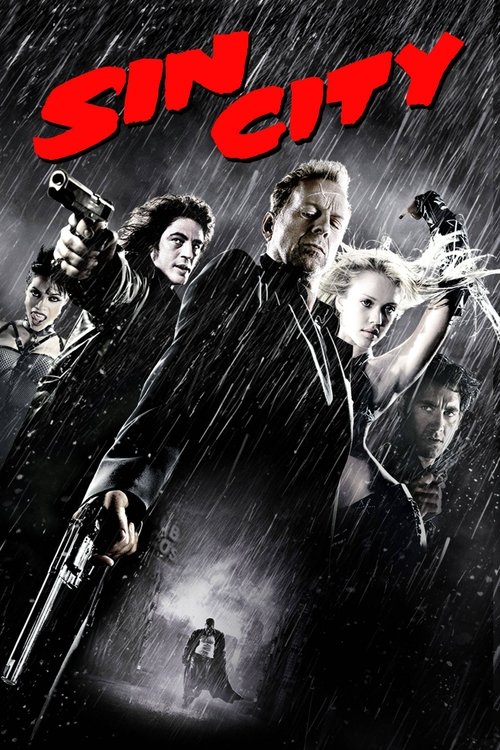
Sin City
2005 · Robert Rodriguez
For when you want style turned up to eleven — a midnight movie for a night of popcorn, attitude, and zero moral uplift. Not one for the squeamish or anyone allergic to macho voiceover.
What it's about
Three hard-boiled tales interlock in Basin City, a rotten metropolis of crooked cops and desperate avengers. A hulking bruiser hunts the killer of the one woman who was ever kind to him, a man with a new face wades into a war between the city's prostitutes and its corrupt police, and an aging cop spends his last hours protecting a girl from something monstrous.
The experience
Pulpy, brutal, and gleefully stylized — every frame looks like a comic panel come alive, with growled voiceover and violence pushed so far past realism it becomes graphic design. It's nasty fun, best taken as lurid pulp rather than taken to heart.
Performances
Mickey Rourke, buried under prosthetics as Marv, is the film's soul — he finds real wounded tenderness inside a walking slab of violence, and it marked the start of his career resurrection.
The craft
Shot almost entirely on green-screen digital sets, it transposes Frank Miller's graphic novels nearly panel-for-panel: stark black-and-white pierced by jolts of selective color — a red dress, yellow skin, white blood. It's one of the most visually faithful comic adaptations ever made and rewards the biggest, sharpest screen you can find.
Why it matters
A landmark of digital-backlot filmmaking that proved a comic's exact look could be reproduced on screen, shaping a wave of hyper-stylized graphic-novel adaptations in the decade after.
Snapshot
Sin City is a landmark of digital-era stylization: a neo-noir anthology that set out to reproduce Frank Miller's graphic novels not as loose inspiration but as something close to a frame-by-frame transposition, panel by panel, balloon by balloon. Co-directed by Robert Rodriguez and Miller himself — with a single sequence guest-directed by Quentin Tarantino — the film weaves together three of Miller's Sin City yarns, bridged by a framing prologue and epilogue, into a portmanteau portrait of Basin City, a corrupt American metropolis rendered in stark, high-contrast black and white pierced by jolts of selective color. Mickey Rourke's hulking, prosthetically transformed Marv hunts the killer of the one woman who was ever kind to him; Clive Owen's Dwight wades into a war between the city's prostitutes and its crooked police; Bruce Willis's aging cop Hartigan sacrifices himself across decades to protect a girl from a serial predator. The film's achievement is less narrative than ontological: it proved that an entire feature could be conjured almost wholly on a green-screen "digital backlot," the actors photographed in a near-empty Austin studio and dropped into environments built in the computer to match Miller's ink. Released in April 2005 and awarded a Technical Grand Prize at Cannes, Sin City became the defining demonstration of comic-book fidelity as a directorial aesthetic, and a touchstone — for better and worse — in the mid-2000s argument about what digital cinema could and should look like.
Industry & production
Sin City was produced through Rodriguez's Austin-based Troublemaker Studios and released by Dimension Films, the genre arm of the Weinsteins' Miramax operation, with which Rodriguez had a long relationship dating to his breakthrough El Mariachi and the Spy Kids franchise. The project's origin is by now a well-circulated piece of industry lore: Miller had long resisted adaptations of Sin City, having been burned by his Hollywood screenwriting experiences, and Rodriguez reportedly won him over by shooting, at his own expense, a proof-of-concept short adapting the story "The Customer Is Always Right" — the rooftop seduction-and-killing that opens and closes the finished film — using Josh Hartnett and Marley Shelton, and then showing Miller how completely the comic could be realized on screen.
The most consequential production decision was Rodriguez's insistence that Miller receive a full co-director credit, in recognition that the film was a direct translation of Miller's authored images. The Directors Guild of America, whose rules restrict shared directing credit to bona fide established teams, refused to sanction the arrangement; rather than capitulate, Rodriguez resigned from the Guild — a costly and public stand that, by his account, also cost him the chance to direct the Paramount adaptation of John Carter of Mars, which he had been developing. The episode is one of the clearest modern instances of a filmmaker treating authorship of the image as a non-negotiable matter of principle.
The film was shot fast and cheap by studio standards, almost entirely on sound stages at Troublemaker, with the cast performing against green screen. Its sprawling ensemble — Rourke, Willis, Owen, Jessica Alba, Benicio del Toro, Elijah Wood, Rosario Dawson, Brittany Murphy, Nick Stahl, Powers Boothe, Rutger Hauer, Michael Clarke Duncan, Carla Gugino, Michael Madsen, Jaime King, Devon Aoki, and others — worked in short, contained schedules made possible by the studio-bound method. A widely reported grace note of the production was Tarantino's participation: he directed the car-interior sequence in which Owen's Dwight converses with the corpse of Del Toro's Jackie Boy, reportedly for a fee of one dollar, in friendly return for Rodriguez having composed music for Kill Bill.
Technology
Sin City is, with Sky Captain and the World of Tomorrow (2004) and the Star Wars prequels before it, one of the foundational works of the "digital backlot" — the practice of photographing actors against green or blue screen and constructing the entire surrounding world in the computer. Rodriguez, an avowed early adopter of digital cinematography who had shot Once Upon a Time in Mexico on high-definition video, captured Sin City with the high-definition digital cameras then current rather than on film, and used the malleability of the digital image to push contrast, strip color, and composite environments to a degree that photochemical processes would have made impractical.
The technological argument of the film is that the comic page could become the production design. Miller's drawn panels functioned literally as storyboards and as art-direction reference; the digital environments were built to reproduce the geometry, the silhouettes, and above all the chiaroscuro of his pen-and-ink originals. Crucially, the look was not a post-production "filter" applied to ordinary footage but a method baked into the whole pipeline, from the way actors were lit on set against green screen to the grading that crushed the image into near-pure blacks and whites. This is also a film of prosthetic and makeup technology: Rourke's Marv and Stahl's "Yellow Bastard" are substantially built out of appliances, and the film's selective-color conceit — a red dress, a pair of blue eyes, the lurid yellow of a diseased villain, gouts of white or colored blood — depended on digital isolation of individual elements within an otherwise monochrome frame. The result was one of the most influential proofs that a director working largely alone, in a modest studio, could command a total visual world.
Technique
Cinematography
The cinematography — credited to Rodriguez himself, who functions as his own director of photography under the Troublemaker model — is the film's reason for being. The image is rendered in extreme high-contrast black and white that recalls not naturalistic monochrome but the brush-and-ink language of Miller's comics: faces dissolve into pools of shadow, rain and snow read as slashes of white against black, headlights and windows blow out into hard geometric shapes. Depth is flattened toward the graphic plane; compositions echo specific drawn panels in framing and silhouette. Against this monochrome ground, color is deployed as punctuation and meaning — the saturated red of a dress or of blood, the cold blue of an eye, the sickly yellow of corruption made flesh — so that hue itself becomes a dramatic event rather than a description of the world. The camera favors the low angles, looming close-ups, and theatrical staging of pulp illustration, and the lighting is frankly expressionist, owing as much to the hard shadows of 1940s film noir as to the comics that mediate them.
Editing
Rodriguez edits the film himself, as is his long practice, and the cutting serves the anthology structure: three principal stories, plus the framing material, each with its own first-person narrator whose hard-boiled voice-over drives the montage. The editing is brisk and propulsive within sequences, matched to the staccato rhythm of pulp narration, and architecturally it interlocks the separate tales so that minor characters and locations cross between them, building a sense of a single teeming city. Time runs non-linearly across the whole — Hartigan's story in particular spans years — and the film trusts its narrators to carry the audience across ellipses. The pace is keyed to violence and revelation, with the cutting often holding on a stylized tableau just long enough to register it as an image before moving on.
Mise-en-scène / staging
Because the sets are virtual, mise-en-scène here is an act of total construction: every street, bar, car, and rain-lashed rooftop is composed to match Miller's drawn world. The staging leans into noir archetype — the dive bar, the confessional, the back-alley showdown, the bordello-fortress of Old Town — and dresses its figures in the iconography of crime pulp: trench coats, fedoras, garish neon, the femme fatale's silhouette. Performers are blocked theatrically, often facing the camera in declamatory close-up, consistent with the comic-panel logic that governs the film. Costuming and makeup do heavy narrative work, from Marv's bandaged, brutalized bulk to the dominatrix-warrior styling of the Old Town women, and the selective-color scheme functions as a staging element in its own right, directing the eye and marking moral and erotic charge within the frame.
Sound
The soundtrack matches the visual register with a brooding, percussive neo-noir score composed by Rodriguez together with John Debney and Graeme Revell — another instance of the director's multi-hyphenate method, in which he claims a hand in the music as well as the camera and the cut. The sound design is heightened and pulpy, the violence rendered with exaggerated impact, and the dominant aural texture is the hard-boiled first-person narration: each protagonist speaks his story in the clipped, fatalistic idiom of crime fiction, and these voices are arguably the film's most direct conduit from Miller's printed pages to the ear.
Performance
Performance in Sin City is pitched to the comic's register — broad, iconic, declarative — and within that mode the film contains some genuinely arresting work. Mickey Rourke, buried in prosthetics as the lovelorn brute Marv, gives the film its soul: a performance of bruised tenderness and remorseless violence that played, at the time, as a reminder of how formidable an actor Rourke remained, and that fed into the larger career resurgence consummated a few years later by The Wrestler. Bruce Willis brings weathered gravity to Hartigan, the good cop whose decency is itself a kind of doom; Clive Owen supplies cool competence as Dwight; and a deep bench — Powers Boothe's serpentine senator, Benicio del Toro's flamboyant Jackie Boy, Elijah Wood's silent, bespectacled cannibal Kevin, Rosario Dawson's commanding Gail, Nick Stahl's grotesque Roark Jr. — colors the ensemble. The women, much debated, occupy the noir slots of avenging angel, virtuous victim, and warrior-courtesan; the performances honor the archetypes while the film's gender politics remain a live critical question.
Narrative & dramatic mode
The film's dramatic mode is pulp noir in its most distilled, hyperbolic form: a world of moral absolutes and operatic violence narrated in the first person by doomed men. Structurally it is a portmanteau, adapting three of Miller's books — "The Hard Goodbye" (Marv's hunt for the killer of Goldie), "The Big Fat Kill" (Dwight's defense of Old Town), and "That Yellow Bastard" (Hartigan's decades-long protection of Nancy) — framed by the "Customer Is Always Right" vignettes that open and close the picture. Each tale is a revenge or rescue narrative driven by a code of honor that the corrupt city cannot accommodate; each narrator is fatalistic, self-aware, and headed toward sacrifice. The mode is consciously archetypal rather than psychological — characters are forces and emblems more than rounded interiors — and the storytelling embraces the lurid, the grotesque, and the sentimental in equal measure, in keeping with the hard-boiled tradition it both inhabits and exaggerates.
Genre & cycle
Sin City sits at the intersection of two cycles. As neo-noir it is a self-conscious homage to the American hard-boiled tradition — Mickey Spillane, the pulp crime magazines, the chiaroscuro of classic film noir — refracted through Frank Miller's comics, which had themselves distilled and intensified that tradition. As a comic-book adaptation it belongs to the mid-2000s wave that was redefining the form, and it staked out a distinctive position within it: where the dominant superhero adaptations naturalized their source, Sin City insisted instead on absolute graphic fidelity, treating the panel as sacred. It thereby helped inaugurate a short, intense cycle of stylized, monochrome-or-desaturated comic adaptations, most directly Zack Snyder's 300 (2006), itself drawn from a Miller book and shot on the same digital-backlot principle. Within the larger history of the anthology crime film and of noir's recurrent revivals, Sin City is the moment the form fused with digital image-making.
Authorship & method
Authorship is the film's central — and contested — subject, which is precisely why the directing-credit fight matters so much. Sin City is the product of a deliberate doubling: Frank Miller as the originating author of its images and stories, and Robert Rodriguez as the filmmaker who devised the method to realize them on screen. Rodriguez's insistence on crediting Miller as co-director, to the point of leaving the DGA, frames the whole enterprise as a translation in which the question "who made this image?" has two honest answers. Around them, Rodriguez's signature one-man-band practice is everywhere: he serves as director, cinematographer, and editor, and shares the musical score, embodying the lean, vertically integrated Troublemaker model he had been building across his career. Tarantino's cameo as guest director of a single scene adds a third authorial signature and underscores the film's nature as a collaboration among friends operating outside the usual studio machinery. The cast, finally, contributes a kind of iconographic co-authorship: Rourke's Marv in particular is so fully embodied that the performance becomes inseparable from the character's place in the film's design.
Movement / national cinema
Sin City is American independent cinema in an unusual key — a genre spectacle produced largely outside Hollywood's geography, in Rodriguez's own Austin, Texas studio, on his own terms. It belongs to the broader story of digital cinema's arrival in the 2000s and to Rodriguez's particular project of demonstrating that a regional, technologically self-sufficient operation could make studio-scale pictures without the studio's apparatus. It is also a key document in the maturation of the comic-book film as a recognized form of American popular cinema in that decade. Less a movement than a method, the film's "digital backlot" approach nonetheless named an aesthetic tendency that several subsequent productions would pursue.
Era / period
The film is a precise artifact of the mid-2000s inflection point in moviemaking technology, when high-definition digital capture and computer-generated environments had advanced far enough to make an entirely virtual production world feasible, and when filmmakers were actively debating whether this was liberation or impoverishment. Sin City arrived as one of the most aggressive answers to that question, and the period's optimism about digital tools — shared by Rodriguez, George Lucas, and others — is legible in its every frame. Its source material, by contrast, reaches back to an earlier era: Miller's comics, published mostly across the 1990s, were themselves nostalgic distillations of mid-century pulp and noir, so the film carries a doubled temporality, deploying the newest production technology to resurrect the iconography of the 1940s and '50s crime story.
Themes
The film's recurring theme is the lonely persistence of a personal code in a wholly corrupt world. Each protagonist is bound by a private ethic — Marv's loyalty to the dead Goldie, Dwight's protection of Old Town, Hartigan's vow to keep Nancy safe — that the city's institutions, its police and clergy and political dynasty, exist only to betray. Sacrifice is the recurrent gesture: these are men who expect to die and do, trading their lives to honor an obligation no one else recognizes. Around this run the noir staples of revenge, redemption, and doomed love, and a fascination with bodies — beaten, transformed, prosthetically grotesque — as the ledger on which the city's violence is recorded. The film also foregrounds, and has been much criticized for, its treatment of women, who occupy the polarized noir roles of saint, victim, and weaponized seductress; whether the film interrogates or merely indulges these archetypes remains its most durable interpretive debate. Beneath all of it lies a bleak metaphysics of the city itself as an irredeemable order, in which the only available heroism is to die well.
Reception, canon & influence
Sin City was received, on its 2005 release, as a striking and divisive event. Critics broadly admired the audacity and completeness of its visual translation — many regarded the fidelity to Miller's panels as a genuine formal achievement — while a significant strand of the response found the film hollow beneath the surface, its relentless stylization and extreme violence emotionally airless, and its sexual politics troubling. It was honored at the Cannes Film Festival with a Technical Grand Prize, recognition aimed squarely at its innovations in image-making, and it performed well enough commercially to confirm the viability of its method. Within the popular canon it stands as the defining example of the "comic accuracy" school of adaptation.
Influences on the film run backward through Frank Miller's comics to the deep wells of American crime culture — Spillane and the hard-boiled pulps, the visual grammar of classic film noir — and, on the technological side, to the digital-backlot experiments of Sky Captain and the World of Tomorrow and the Star Wars prequels, as well as to Rodriguez's own prior adventures in high-definition shooting.
Its influence forward was immediate and concentrated. Most directly it cleared the path for 300 (2006), another Miller adaptation built on the same principle of total digital environment and graphic fidelity, which carried the aesthetic to blockbuster scale. It fed the wider 2000s vogue for desaturated, high-contrast comic-book stylization and reinforced the broader argument that ambitious genre cinema could be made on a virtual backlot. Within its own franchise it produced a long-delayed sequel, Sin City: A Dame to Kill For (2014), whose comparatively muted reception suggested how much of the original's power had depended on the shock of the new. For Mickey Rourke, Marv became a crucial station on the road back to leading roles. And as a test case in the authorship of the image — the dispute that cost Rodriguez his Guild membership — the film retains a particular place in debates about credit, adaptation, and what it means to direct a picture drawn first by someone else.
A Deleuzian reading
Start with the red dress.
The full Deleuzian reading of Sin City →
Reception
In 2005 it was hailed as a revolution — the comic panel brought to life, a Cannes competition title that made digital backlots look like the future. Two decades on it reads more as a time capsule of mid-2000s maximalism, its reputation dinged by imitators, a flop sequel, and Frank Miller's fading stock.
How Sin City was received, from release to now →
Influences: the films it descends from and the films it influenced
- Sky Captain and the World of Tomorrow (2004) — Established the total digital-backlot method Rodriguez adopted — actors performed entirely against blank greenscreen with every environment composited in afterward, proving a film could be 'shot' inside the computer.
- Star Wars: Episode II – Attack of the Clones (2002) — Pioneered acquiring a feature entirely on Sony HD digital cinematography feeding virtual sets, the high-def capture pipeline Rodriguez had already been experimenting with and brought to Sin City's monochrome look.
- Pleasantville (1998) — Demonstrated digital selective-color — isolating individual hues inside an otherwise desaturated frame as a controllable post effect — the exact technique behind Sin City's yellow Bastard and red dress.
- Schindler's List (1993) — Canonized the single spot of color in a high-contrast monochrome image (the red coat) as a meaning-bearing device, the grammar Sin City weaponizes for its splashes of selective color.
- Double Indemnity (1944) — Codified the doomed-narrator hardboiled voiceover delivered as a confession, the first-person past-tense narration structure each Sin City vignette imitates.
- Kiss Me Deadly (1955) — Translated Mickey Spillane's brutal pulp protagonist into noir cinema, the slab-fisted Mike-Hammer archetype that Frank Miller's Marv (and Rourke's performance) directly descends from.
- Touch of Evil (1958) — Pushed expressionist chiaroscuro to grotesque extremes — bodies and faces sculpted from hard key light and crushed blacks — the high-contrast lighting logic Sin City renders absolute.
- The Killers (1946) — Built its crime tale from interlocking flashbacks narrated after the fact, an early model for Sin City's fractured, nonlinear time scheme stitched across separate testimonies.
- Sin City (Frank Miller graphic novels) (1991) — Supplied the literal source panels — ink-blot black-and-white compositions and page layouts — that Rodriguez reproduced frame-for-frame as comic-panel blocking, the 'comic accuracy' debt itself.
- Dark City (1998) — Pushes Dark City's high-contrast, ink-black expressionist noir and comic-panel staging to a fully stylized, near-monochrome built world.
- Kill Bill: Vol. 1 (2003) — Extends the high-contrast saturated/monochrome-shift color grammar and the comic-panel presentational violence into a fully stylized, palette-coded chaptered anthology of revenge.
- Prospero's Books (1991) — Demonstrates the fully digitally-composited, painterly frame as an artistic language in its own right — the layered, surface-conscious image-making Prospero's Books first proposed via the Quantel Paintbox.
- 300 (2006) — The direct heir: another Frank Miller adaptation built on the same all-digital-environment-plus-graphic-fidelity principle, carrying Sin City's virtual-backlot method to blockbuster scale.
- The Spirit (2008) — Miller solo-directing applied Sin City's exact high-contrast monochrome, spot-color, and greenscreen-backlot toolkit to another comics property, extending the house style under its co-author's own hand.
- Speed Racer (2008) — Extended the fully-synthetic digital-backlot feature into hyper-saturated comic-panel space, treating the entire frame as an illustrated environment built in post rather than a photographed set.
- Watchmen (2009) — Carried forward the 'comic accuracy' ethos of recreating source-book panels as live-action compositions, the panel-as-storyboard fidelity Sin City made the standard for the form.
- Sin City: A Dame to Kill For (2014) — The franchise sequel reusing the identical co-direction model and digital-backlot/selective-color pipeline, a direct continuation whose muted reception isolated how much depended on the original's novelty.
- Alita: Battle Angel (2019) — Rodriguez's prior graphic-novel adaptation using an all-digital backlot and comic-panel spatial logic — constructing a physical/digital hybrid faithful to the source's visual grammar rather than naturalizing it into photorealism — is the direct methodological precursor to his approach on Alita.
- The World of Kanako (2014) — Pioneers the fully digital-composited, graphic-novel color grade — selective desaturation and blown-out artifice — that licenses Kanako's anti-realist, post-produced palette over a hardboiled noir frame.
- Zack Snyder's Justice League (2021) — Pioneers the literal comics-panel transcription — extreme high-contrast, near-monochrome silhouetting and backlight — that licenses Snyder's anti-naturalistic, ink-and-shadow superhero image.
- Atomic Blonde (2017) — Imports the panel-aware, high-contrast graphic-novel visual grammar — frames composed as comic panels with stylized color isolation — the adaptation grammar Kurt Johnstad's script and Sela's framing inherit from the source comic.
- Batman: The Dark Knight Returns, Part 2 (2013) — The literalist Frank Miller panel-to-screen method — hard-shadow monochrome and hardboiled first-person internal-monologue voiceover — that Oliva animates rather than composites.
- A Girl Walks Home Alone at Night (2014) — Comic-panel framing and blown-out monochrome chiaroscuro that treats each shot as a graphic-novel plate — Amirpour literally extended her film into a graphic novel.
- Thor: Love and Thunder (2022) — Established the monochrome-with-selective-color grammar Waititi and Idoine adopt for the Shadow Realm, where black-and-white staging isolates a single chromatic accent.
- Pulp Fiction (1994) — Modeled the interwoven portmanteau crime anthology whose chapters loop back on each other in nonlinear time — and Tarantino's guest-directed Sin City scene makes the kinship a literal collaboration.
- Desperado (1995) — Cemented Rodriguez's vertically-integrated one-man-band Troublemaker method (directing, shooting, cutting, scoring himself), the authorship practice he scaled up to realize Sin City.
- Renaissance (2006) — Pursued pure-black-and-pure-white noir with no greyscale at all via motion-capture animation, a parallel push toward the absolute high-contrast monochrome city that Sin City rendered photographically.
- Star Wars: Episode III - Revenge of the Sith (2005) — A contemporaneous all-digital, near-fully-green-screen production whose virtual sets and HD capture parallel Sith's abandonment of physical location shooting for a rendered backlot.
- Scott Pilgrim vs. the World (2010) — Pushed panel-perfect comic adaptation—recreating Miller's frames as literal shots—part of the mid-2000s wave of hyper-faithful comics-to-screen translation Wright riffs on.
- Spider-Man: Across the Spider-Verse (2023) — Reproduces a graphic novel's ink-black high-contrast panels and spot-color literally, insisting the source's drawn aesthetic survive intact on screen rather than being naturalized.
- Hundreds of Beavers (2024) — Places performers as stark black figures against high-contrast monochrome backdrops built entirely from green-screen compositing — the black-figures-on-white look Beavers mirrors in snow.
- Spider-Man (2002) — Pushes Raimi's 'compose the frame as a comic panel' impulse to literal fidelity, reproducing the source art's exact layouts — the extreme endpoint of iconic-comic staging.
- V for Vendetta (2006) — A contemporaneous panel-faithful comic adaptation whose high-contrast, near-monochrome desaturation established the mid-2000s adult graphic-novel look V shares.
- Batman: The Dark Knight Returns, Part 1 (2012) — Direct panel-to-frame translation of Frank Miller's compositions — the same 'honor the drawn image' adaptation ethic Oliva applies to comics-faithful tableaux in animation.
Similar films
- Kiss Me Deadly (1955) — influence & lineage
- Touch of Evil (1958) — influence & lineage
- Pulp Fiction (1994) — influence & lineage
- Blade (1998) — same viewing thread
- The Dark Knight (2008) — same viewing thread
- The Batman (2022) — same viewing thread
- Constantine (2005) — shared sensibility
- Deadpool (2016) — shared sensibility
All the films related to Sin City →
Watch it with: curated runs of related films
- The Superhero Movie Grows Up — Watch these as one arc — Raimi's warmth into Nolan's gravity into Logan's elegy and The Batman's rain-soaked noir — the two decades the comic-book film reached for real weight.