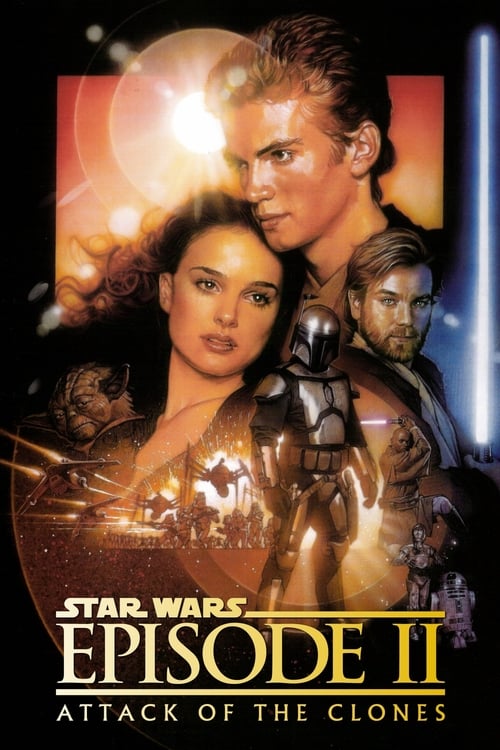
Star Wars: Episode II - Attack of the Clones
2002 · George Lucas
For a big, loud saga night when you want spaceships, lightsabers, and galaxy-spanning plot — comfort viewing for anyone invested in how the Star Wars tragedy unfolds, and essential connective tissue if you're watching the whole saga in order.
What it's about
An assassination attempt on Senator Padmé Amidala splits two Jedi down different paths: Obi-Wan Kenobi follows the trail of the would-be killers to a rain-lashed ocean world hiding a secret army, while his headstrong apprentice Anakin Skywalker is assigned to guard Padmé — and falls for her, hard, in defiance of everything the Jedi Order allows. Around them a separatist movement is pulling the Galactic Republic apart, and the investigation and the romance both feed into the opening battle of the Clone Wars.
The experience
It moves between moody detective work, swoony forbidden-love interludes, and enormous digital spectacle, building to a last act that's essentially forty minutes of escalating battle. The romance plays stilted and solemn, but the chases, duels, and sheer scale keep the pulp momentum going.
Performances
Ewan McGregor settles fully into Obi-Wan here, dry and increasingly Alec Guinness-like, and Christopher Lee brings genuine old-school menace and gravity to the separatist leader Count Dooku.
The craft
This was the first major-studio live-action feature shot entirely on high-definition digital video rather than film — a genuine turning point in how movies get made — and its worlds are built almost wholly in the computer, from a planet-wide city to a droid factory in full churn. John Williams contributes a sweeping, aching love theme, and the film is unambiguously built for the biggest screen and loudest speakers you can find.
Why it matters
Its all-digital production helped tip the entire industry away from celluloid, and the Clone Wars it ignites seeded years of Star Wars storytelling to come. It remains one of the most argued-about entries in the saga — dismissed by some, reclaimed by a generation that grew up on it.
Snapshot
Attack of the Clones is the fifth Star Wars film to reach theaters and the second chapter of George Lucas's prequel trilogy, arriving three years after The Phantom Menace (1999). It advances the saga's central tragedy—the corruption of Anakin Skywalker and the slow-motion collapse of the Galactic Republic into Empire—by braiding together a political conspiracy, a detective plot, a forbidden romance, and the opening battle of the Clone Wars that the original 1977 film had only named in passing. Its most consequential place in film history, however, is technological rather than dramatic: it is the first live-action feature by a major studio shot entirely on high-definition digital video rather than photochemical film, a distinction that made it a lightning rod in the industry's transition away from celluloid. Critically it received a decidedly mixed reception, warmer than The Phantom Menace in some quarters but still faulted for stiff dialogue and performance; commercially it was among the year's top earners. It remains a pivotal document of digital cinema's arrival and of Lucas's late-career experiment in near-total post-production authorship.
Industry & production
The film was produced by Lucasfilm and distributed by 20th Century Fox, continuing the arrangement that had governed the saga since 1977. As with the entire prequel trilogy, Lucas financed the production himself through Lucasfilm, retaining an autonomy over budget, schedule, and creative control almost unheard of for a tentpole of this scale—a position underwritten by the merchandising and home-video fortune of the earlier films. Principal photography took place primarily at Fox Studios Australia in Sydney, with location work including Italy (Lake Como's villas and Seville, Spain, standing in for Naboo and other worlds) and Tunisia (again serving as Tatooine, as it had in 1977). Second-unit and effects work was centralized at Industrial Light & Magic in California.
The production's defining industrial fact is that Lucas used it as a demonstration platform for digital acquisition. Working with Sony and Panavision, Lucasfilm shot on the Sony HDW-F900 high-definition camera system, and Lucas became an outspoken evangelist for the format, framing digital capture as cheaper, faster on set, and seamlessly integrated with the largely computer-generated environments the prequels depended upon. This stance placed him at odds with much of the cinematographic establishment and with exhibitors, most of whom still projected 35mm; only a small number of theaters were equipped for digital projection in 2002, so the vast majority of audiences saw a film-out print struck from the digital master. The episode is frequently cited as an inflection point in Hollywood's decade-long migration to digital production and projection.
Technology
More than for any dramatic reason, Attack of the Clones is studied for its technology. The Sony/Panavision HD system captured at 1920×1080 resolution in a 24-frame progressive mode engineered to mimic the cadence of film—an early articulation of what became the industry norm. The choice was ideological as much as practical: Lucas wanted an image that could be composited with digital sets without the grain, gate weave, and scanning artifacts of a photochemical intermediate, and that could be manipulated freely in the digital-intermediate color pipeline.
The film is also a landmark for computer-generated character animation. Yoda, a puppet performed by Frank Oz since 1980, appears here for the first time as a fully digital creation for his climactic lightsaber duel with Count Dooku—an audacious bid to render a beloved practical character in CGI, and a sequence often discussed in histories of digital performance. Industrial Light & Magic executed vast digital environments (the cityscape of Coruscant, the cloning facilities of Kamino, the arena and droid factories of Geonosis) with a density of synthetic imagery that pushed the studio's rendering and crowd-simulation tools. The clone-army and battle-droid sequences leaned on crowd-generation software to populate frames with thousands of agents. The result is a film in which a great many shots contain little or no photographed physical reality beyond the actors themselves.
Technique
Cinematography
David Tattersall, who had shot The Phantom Menace, returned as director of photography, now working with the HD system rather than film stock. The photography favors clean, brightly keyed digital images with deep focus, well suited to the compositing demands of shots built almost entirely in post. Certain sequences reach for a more romantic register—the golden Naboo lakeside and Como-villa scenes of Anakin and Padmé's courtship are lit and framed as classical romance—while the Geonosis and Kamino material tends toward a cooler, high-contrast palette. Because so many backgrounds were added digitally, camera moves and lighting had to be planned against virtual environments, and critics have noted a resulting flatness or weightlessness in some compositions, a common charge against the prequels' image-making.
Editing
Ben Burtt served as editor, an unusual assignment for a figure best known as the saga's sound designer. Working from the digital footage, the cutting emphasizes cross-cutting between parallel plots—Obi-Wan's investigation on Kamino and Geonosis intercut with Anakin and Padmé's romance and Anakin's return to Tatooine. The climactic act stacks multiple set pieces (the arena execution, the Jedi rescue, the clone-army arrival, the Dooku duel) into a sustained crescendo, a structure inherited from the original trilogy's habit of climaxing on simultaneous battles.
Mise-en-scène / staging
The film's staging is dominated by digital world-building. Environments range from the vertical metropolis of Coruscant to the storm-lashed platforms of Kamino and the arid arena of Geonosis, each realized primarily through visual effects. Costume and production design (Trisha Biggar's wardrobe for Padmé is especially elaborate) supply much of the tactile richness in a film otherwise composed of synthetic space. The staging of action tends toward spectacle-scale choreography—the asteroid-field chase, the arena melee, the arrival of the clone gunships—organized for maximal density of incident.
Sound
Sound is a Lucasfilm strength, and Ben Burtt's design carries the sonic identity established in 1977 forward into new hardware: lightsaber hums, blaster fire, droid vocalizations, and the roar of engines. The mix supports the film's large-scale action with the aggressive dynamic range characteristic of the saga. John Williams's score (discussed below) is integral to the soundtrack's architecture.
Performance
Performance is the film's most contested element. Hayden Christensen plays Anakin Skywalker for the first time (Jake Lloyd had played the child in 1999), tasked with portraying a gifted but volatile young man sliding toward the dark side; his and Natalie Portman's scenes as the courting Anakin and Padmé drew widespread criticism for stiffness, a fault many reviewers attributed as much to the written dialogue and to acting against greenscreen as to the performers. Ewan McGregor's Obi-Wan Kenobi, given the film's detective spine, is generally regarded as its most assured turn. Christopher Lee brings gravity as Count Dooku, and Samuel L. Jackson, Ian McDiarmid (as the scheming Palpatine), and Frank Oz (voicing Yoda) round out the ensemble.
Narrative & dramatic mode
The screenplay operates in several modes at once. Its skeleton is a political-conspiracy thriller: an assassination attempt on Senator Padmé Amidala sets Obi-Wan on an investigative trail that leads to a secret clone army and the Separatist plot fronted by Dooku. Grafted onto this is a courtly romance—Anakin, assigned to protect Padmé, falls into a forbidden love that violates the Jedi Order's strictures—and a tragic-fall narrative in which Anakin's grief and rage (culminating in his slaughter of a Tusken settlement after his mother's death) foreshadow his destiny as Darth Vader. The dramatic mode is fundamentally that of prequel tragedy: because the audience knows the endpoint, the film generates its charge from dramatic irony, staging the Republic's leaders unknowingly authorizing the war and the army that will become the instruments of their own destruction. Structurally it obeys the saga's convention of splitting its protagonists across separate quests before converging on a multi-front climax.
Genre & cycle
Attack of the Clones sits within the space-opera tradition Lucas synthesized in 1977 from Flash Gordon serials, Kurosawa, Joseph Campbell's monomyth, and Hollywood adventure. Within that framework this installment leans harder into the political-intrigue and detective registers than its predecessors, reflecting the prequel trilogy's larger project of chronicling a democracy's decay. It belongs, too, to the early-2000s cycle of effects-driven fantasy and franchise tentpoles—arriving amid the Lord of the Rings and Harry Potter launches and the first wave of modern superhero blockbusters—when digital effects made previously unfilmable worlds routine. As the middle chapter of a trilogy, it also inherits the "darkening middle" convention that The Empire Strikes Back had defined for the saga.
Authorship & method
The film is unmistakably a Lucas auteur project, exercising a degree of control few directors command. Lucas directed, devised the story, and co-wrote the screenplay with Jonathan Hales, a collaborator from The Young Indiana Jones Chronicles—Lucas having decided after The Phantom Menace to bring in a co-writer for dialogue. His method here is essentially post-production authorship: capturing performances against blue and green screens on the HD system, then building the film's worlds, staging, and much of its rhythm at ILM and in the edit. His key collaborators form a nucleus of long-standing Lucasfilm talent. David Tattersall (cinematography) and Trisha Biggar (costumes) carried over from Episode I. Ben Burtt—the sound designer who had shaped the saga's aural world since 1977—took on the editor's chair. John Williams, composer of every numbered saga film, returned to score. Rick McCallum produced. The concentration of authority in Lucas and a tight circle of returning specialists is itself a defining feature of the prequels' production culture, and a frequent subject of critical commentary about the absence of the pushback that shaped the original trilogy.
John Williams's contribution deserves particular note: his score introduces "Across the Stars," the love theme for Anakin and Padmé, a lush and tragic melody that ranks among his most prominent original-composition additions to the saga's musical vocabulary, alongside his reprise and development of established leitmotifs.
Movement / national cinema
The film belongs to American studio filmmaking, but its production geography is transnational: shot largely in Australia with location work in Italy, Spain, and Tunisia, and post-produced in California. It is best understood not within a national-cinema "movement" but as a leading instance of the digital-cinema turn—an industrial shift, championed here by Lucas, from photochemical to electronic image-making. In that sense its most meaningful affiliation is with the small vanguard of early-2000s digital productions rather than with any geographic school.
Era / period
Released in May 2002, the film is a product of the early-2000s blockbuster moment, when franchise world-building and effects-heavy fantasy reasserted their commercial dominance and when the technological groundwork for the industry's digital transition was being laid. It arrived after the September 11, 2001 attacks, and commentators have often read its story—of a manufactured crisis exploited to grant emergency powers and raise an army, hastening a republic's turn toward autocracy—as resonant with the era's anxieties about security and executive power, though the prequels' political architecture had been conceived earlier and Lucas's stated influences run toward the historical rise of past authoritarian regimes.
Themes
The dossier's thematic core is the fragility of democracy: the film dramatizes how a republic can be maneuvered, through fear and procedural manipulation, into ceding power and militarizing—Palpatine's acquisition of emergency authority and the raising of the clone army as the machinery of the Republic's own undoing. Intertwined is the theme of attachment and its dangers, central to the Jedi ethos: Anakin's love for Padmé and his devotion to his mother, forbidden or unmastered, become the emotional fault lines of his coming fall, and his massacre of the Tuscans marks the film's darkest exploration of grief curdling into wrath. Fate and foreknowledge suffuse the whole, as prophecy and audience hindsight frame Anakin's choices as steps toward a doom already written. Questions of identity and manufacture—the clones bred for war, the droid armies—shadow the film's meditation on individuality and servitude.
Reception, canon & influence
Critical reception was mixed. Reviewers generally judged Attack of the Clones an improvement on The Phantom Menace in its action and stakes, while continuing to fault its romantic dialogue and central performances and, for some, the weightless quality of its heavily digital imagery. Commercially it was one of 2002's highest-grossing releases worldwide, confirming the franchise's commercial durability even amid critical reservation; precise figures should be checked against box-office records rather than asserted here.
The influences on the film run backward through Lucas's established sources—the Flash Gordon serials, Kurosawa, the classical adventure serial, and the mythic structures of the original trilogy—now inflected by a political-thriller sensibility and historical models of republican collapse. Its forward legacy is twofold. Dramatically, it is a load-bearing chapter of the Skywalker saga, seeding the Clone Wars that later expanded across acclaimed animated television (notably the Clone Wars series) and cementing prequel-era characters, worlds, and iconography that a younger generation of fans came to embrace, even as the prequels' initial reputation was contested. Technologically, its true influence is outsized: as the first major-studio feature shot entirely on high-definition digital video, it is repeatedly cited as a catalyst in cinema's transition from film to digital acquisition and projection, and its all-digital Yoda stands as a milestone in the CGI rendering of established characters. Its reputation, like that of the prequels generally, has undergone substantial reassessment in the decades since release—a trajectory that is itself part of the film's cultural afterlife.
A Deleuzian reading
Obi-Wan stands on a storm-lashed platform on Kamino and is shown the army.
The full Deleuzian reading of Star Wars: Episode II - Attack of the Clones →
Reception
Savaged in 2002 for its wooden romance and green-screen sheen — widely ranked as the saga's low point — it's since been carried into a strange second life by the prequel-meme renaissance, where a generation that grew up on it defends it with total sincerity.
How Star Wars: Episode II - Attack of the Clones was received, from release to now →
How to watch Star Wars: Episode II - Attack of the Clones: what to notice on a first viewing
- Watch the clone ranks stretch to the frame's edges on Kamino. ILM's crowd-generation software multiplies a handful of models into thousands of identical soldiers, packed into deep-focus frames. The image copies the story: manufactured life multiplied from one template, with no original anywhere.
- Follow how the film cuts between Obi-Wan's investigation and Anakin's romance. Editor Ben Burtt keeps interrupting the detective trail with scenes of courtship on Naboo, then cutting back to Kamino. Two plots run in parallel, and each cut trades one mood for the other.
- Notice the golden light on Naboo against Kamino's cool tones. Tattersall lights the Naboo courtship scenes like classical romance, then shifts to a harder, high-contrast palette for Kamino and Geonosis. The color scheme marks emotional register: gold for forbidden love, cold blue-grey for conspiracy and war.
- Listen for the lightsaber hum and the new love theme. Ben Burtt reuses sound cues minted in 1977 while John Williams introduces one new melody, Across the Stars, into the same musical vocabulary. Familiar sounds carry meaning by habit; the new theme signals this doomed romance without a word of dialogue.
Influences: the films it descends from and the films it influenced
- Star Wars (1977) — Establishes Ben Burtt's synthesized-from-real-world sound-effects vocabulary and John Williams's leitmotif system, both of which Clones directly extends with Burtt now cutting picture and Williams adding 'Across the Stars.'
- The Empire Strikes Back (1980) — Codifies the darkening middle-chapter template—a downbeat ending, romance foregrounded, the hero's defeat—that Clones deliberately reprises as the tragic hinge of the prequel arc.
- Flash Gordon: Space Soldiers (1936) — Supplies the serial grammar of hard wipe transitions and cliffhanger cross-cutting between simultaneous perils that Lucas revives in the intercut Geonosis rescue climax.
- Star Wars: Episode I - The Phantom Menace (1999) — Pioneers the prequels' greenscreen post-production authorship pipeline and carries over Tattersall's cinematography and Biggar's costuming, which Clones then pushes fully into HD digital acquisition.
- Jurassic Park (1993) — Proves ILM's photorealistic CG creatures can share the frame with live actors under naturalistic light, the rendering lineage that culminates in the all-digital Yoda.
- Terminator 2: Judgment Day (1991) — Introduces a fully CG-rendered character (the T-1000) that acts and performs rather than merely appears, the precedent for treating digital Yoda as a performing lead.
- Toy Story (1995) — Demonstrates entirely computer-rendered characters sustaining a feature's emotional load, validating the leap to a wholly synthetic Yoda over the earlier puppet.
- Vidocq (2001) — One of the first features shot entirely on 24p HD digital video, the immediate technological forerunner to Clones' studio-scale adoption of the Sony/Panavision HDW-F900 system.
- Star Wars: Episode III - Revenge of the Sith (2005) — Completes the identical all-HD, greenscreen-and-ILM pipeline while paying off Clones' seeded political conspiracy and attachment-driven fall into Anakin's full tragedy.
- Sky Captain and the World of Tomorrow (2004) — Photographs its entire cast against blank greenscreen with every environment built digitally in post, taking Clones' compositing-first method to its logical extreme.
- Sin City (2005) — Shoots actors on an empty HD greenscreen 'digital backlot' with all sets rendered later, an approach Rodriguez explicitly built from the Lucas HD workflow.
- 300 (2006) — Combines total greenscreen virtual environments with crowd-simulation software to multiply its armies, extending Clones' Geonosis clone-army digital-crowd staging.
- Once Upon a Time in Mexico (2003) — Rodriguez's first feature shot on the Sony HDW-F900, adopting the exact HD-digital acquisition rig Clones legitimized after consulting Lucas's setup.
- Collateral (2004) — Exploits HD digital sensors' low-light latitude for night exteriors, advancing the studio-feature digital-acquisition turn that Clones had just made commercially respectable.
- Avatar (2009) — Carries post-production authorship to virtual production, building performance-captured characters and wholly digital worlds in the edit—the endpoint of the fully-digital-pipeline blockbuster Clones inaugurated.
- Star Wars: The Clone Wars (2008) — Serializes the multi-front, parallel-cross-cut battle staging Clones introduced, expanding its seeded Clone Wars conflict and prequel iconography into sustained animation.
- The Lord of the Rings: The Two Towers (2002) — Deploys Weta's Massive agent-based crowd simulation for its battle armies in the same year Clones renders the Clone Wars' massed forces, a parallel breakthrough in autonomous digital crowds—while Gollum mirrors Yoda as a CG performing character.
Similar films
- Star Wars: Episode I - The Phantom Menace (1999) — influence & lineage · same viewing thread
- Star Wars (1977) — influence & lineage · same viewing thread
- The Empire Strikes Back (1980) — influence & lineage · same viewing thread
- Terminator 2: Judgment Day (1991) — influence & lineage · same viewing thread
- Star Wars: Episode III - Revenge of the Sith (2005) — influence & lineage
- Jurassic Park (1993) — influence & lineage
- The Lord of the Rings: The Two Towers (2002) — influence & lineage
- Rogue One: A Star Wars Story (2016) — same viewing thread
All the films related to Star Wars: Episode II - Attack of the Clones →
Watch it with: curated runs of related films
- The Blockbuster Sci-Fi Canon — A run of the effects-driven epics that taught modern audiences what a movie could feel like — from the desert planets of Star Wars to the rain of Blade Runner and the sands of Arrakis.