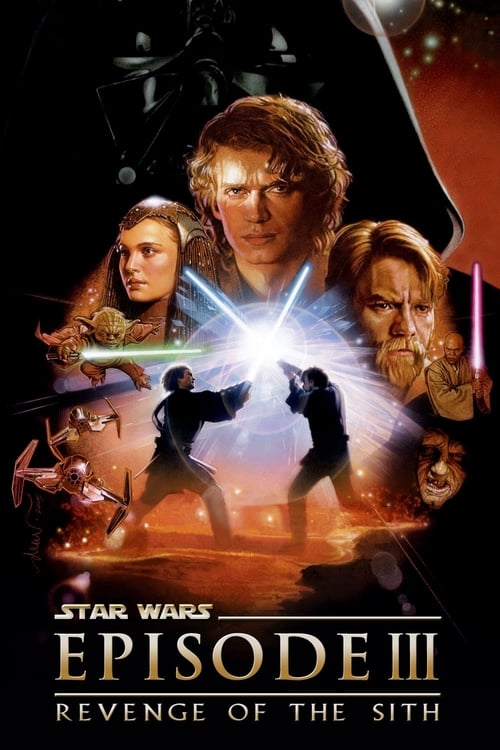
Star Wars: Episode III - Revenge of the Sith
2005 · George Lucas
For when you want blockbuster spectacle with the weight of a tragedy — a big-screen, turn-the-lights-off event watch, especially if you grew up with these films and want the one where it all comes crashing down.
What it's about
The Republic is crumbling, a shadowy Sith plot a thousand years in the making is coming to fruition, and Jedi hero Anakin Skywalker — gifted, loved, and afraid of loss — is being pulled toward a choice between the people he serves and the man who flatters his fears. It's the fall of a democracy and the making of cinema's most famous villain, told as the tragedy everyone knows is coming.
The experience
Operatic and heavy with doom — because you know where it ends, every scene plays like a countdown, and the spectacle keeps escalating toward a volcanic final act. It's the darkest of its saga, more tragedy than adventure.
Performances
Ian McDiarmid's silken, insinuating Palpatine is one of the great portraits of seductive evil in the blockbuster era — he makes the fall of a republic feel like a private temptation.
The craft
Lucas shot the film entirely on digital video when that was still a provocation, building a handmade digital world no studio committee would have approved, and structured the story as pure tragedy since the audience already knows the ending. It's maximalist filmmaking that rewards the biggest screen and loudest speakers you can find.
Why it matters
Dismissed by many critics in 2005, it has been decisively reappraised by the generation that grew up inside it, its story of a democracy applauded into dictatorship only gaining resonance — and it stands as a monument to Lucas's stubborn digital futurism.
The prequel trilogy's grim capstone, and the film where George Lucas's grand design finally locks into place: a Republic dismantled from within, a democracy applauded into dictatorship, and a gifted young man remade into the most famous villain in movies. Because the ending is known from the start, Lucas could structure the film as pure tragedy — closer to opera than to adventure serial — with Ian McDiarmid's silken Palpatine giving one of the great performances of seductive evil in the blockbuster era. Shot entirely on digital video when that was still a provocation, it stands as a monument to Lucas's stubborn futurism, a handmade digital world no studio committee would have approved. Dismissed by many critics in 2005, it has been decisively reappraised by the generation that grew up inside it, its political anxieties looking less cartoonish with each passing year. The opening shot alone — a single unbroken dive through a full-scale space battle, following two fighters across a burning sky — announces the confidence of a filmmaker spending decades of accumulated capital all at once.
A Deleuzian reading
The film begins by falling.
The full Deleuzian reading of Star Wars: Episode III - Revenge of the Sith →
Reception
In 2005 it landed as "the good prequel" — the best-reviewed of the three, but still shadowed by prequel-era fatigue. Two decades on, the generation that grew up with it has driven a full-blown reappraisal, capped by a hugely successful 20th-anniversary theatrical re-release in 2025.
How Star Wars: Episode III - Revenge of the Sith was received, from release to now →
Influences: the films it descends from and the films it influenced
- The Hidden Fortress (1958) — Lucas lifts Kurosawa's graphic screen-wipes and axial, low-angle 'peasant's-eye' staging of grand events, the transition grammar that structures the prequel's scene changes and battlefield geometry.
- Metropolis (1927) — The vertically-layered, matte-built megacity of endless traffic lanes is the direct compositional template for Coruscant's 'handmade digital world' of stacked skylanes and cathedral-scaled Senate interiors.
- Triumph of the Will (1935) — Palpatine's Senate coronation borrows Riefenstahl's low-angle demagogue framing and massed-ovation blocking, giving 'so this is how liberty dies' its rally-podium visual rhetoric.
- Richard III (1955) — McDiarmid's relish — the conspiratorial seduction and theatrical self-delight of a villain courting his listener — descends from Olivier's direct-address Shakespearean villainy transplanted into the opera-box manipulation of Anakin.
- 2001: A Space Odyssey (1968) — Kubrick's demand for photoreal, weightless space hardware established the motion-control/optical-composite discipline that ILM inherited and then converted wholesale to CG for Sith's battles.
- Jurassic Park (1993) — ILM's breakthrough here — seamlessly integrating rendered CG creatures into live plates — is the technical parent of Sith's fully digital characters (General Grievous) sharing frames with actors.
- Star Wars: Episode II - Attack of the Clones (2002) — The first major studio feature captured entirely on 24p Sony CineAlta HD; Sith is the direct continuation of that all-digital-video acquisition and green-screen 'digital backlot' pipeline.
- 300 (2006) — Extends Lucas's virtual-set doctrine — actors on green stages composited into entirely digital landscapes — proving the all-digital 'crush' backlot could carry a mainstream live-action epic.
- Avatar (2009) — Cameron scales Lucas's fully-synthetic-world pipeline to performance-captured digital characters and environments, the endpoint of the all-CG production ambition Sith piloted.
- Rogue One: A Star Wars Story (2016) — Directly inherits the prequels' digital-backlot Star Wars and pushes the CG-character integration further into photoreal digital resurrection of actors, extending Grievous-era synthesis.
- Gravity (2013) — Its bravura opening — a long, unbroken virtual-camera plunge through orbital space — is the maturation of Sith's 'unbroken opening dive,' with the camera freed by full CG environments.
- Joker (2019) — A 'villain-origin predetermined tragedy' built on the same dramatic engine as Anakin's fall — a sympathetic figure marched, step by inevitable step, toward the monster the audience already knows he becomes.
- Transformers One (2024) — The reference case for the prequel-tragedy: staging two brothers-in-arms curdling into archenemies under total audience foreknowledge, wringing dramatic irony from an ending the fanbase already owns.
- Sky Captain and the World of Tomorrow (2004) — Shot with actors on bare blue-screen stages and every environment built in the computer — the same 'handmade digital world' method Lucas industrialized, arriving in the same digital-cinema moment.
- Sin City (2005) — A contemporaneous all-digital, near-fully-green-screen production whose virtual sets and HD capture parallel Sith's abandonment of physical location shooting for a rendered backlot.
- Children of Men (2006) — Cuarón's digitally-stitched 'invisible cut' long takes are the art-cinema cousin of Sith's unbroken opening dive, using digital compositing to fake a single continuous camera through a battle.
- The Godfather Part II (1974) — Shares the craft of the tragic-descent structure — a protagonist's principled soul corroded scene by scene into tyranny — the 'democracy into dictatorship' arc mapped onto a single character's damnation.
Similar films
- Star Wars: Episode II - Attack of the Clones (2002) — influence & lineage
- Rogue One: A Star Wars Story (2016) — influence & lineage
- Avatar (2009) — influence & lineage · same viewing thread
- Return of the Jedi (1983) — same viewing thread
- The Lord of the Rings: The Return of the King (2003) — same viewing thread
- Indiana Jones and the Last Crusade (1989) — same viewing thread
- Harry Potter and the Deathly Hallows: Part 2 (2011) — same viewing thread
- The Odyssey (2026) — same viewing thread
All the films related to Star Wars: Episode III - Revenge of the Sith →
Watch it with: curated runs of related films
- Studio-Sized Mythmaking — A run of blockbuster quest epics — fellowships forged, dark lords faced, and long roads home — that rhyme on scale, world-building, and the pull of a saga you can lose a weekend inside.